In the battle of a thousand locks, how can traditional lock enterprises break through?
"A good smart lock is the beginning of enhancing happiness." "I really like the door locks with 3D vein and intelligent dynamic features. They are much more convenient than many mechanical locks of previous brands."
On Internet platforms such as Xiaohongshu, there is no shortage of netizens enthusiastically recommending how good smart door locks are.
With the rapid development of intelligent technology, the quality of modern home life has been continuously improving. The value and market volume of smart door locks are also increasing day by day.
Meanwhile, competitors such as home appliance and Internet giants have entered the market one after another. Traditional lock enterprises are facing a situation of having wolves in front and tigers behind.
So, how should traditional lock enterprises break through?
01 Entry into the Market
Making locks is no longer just the business of traditional lock - making enterprises.
Many new players have flocked into the seemingly niche smart door lock market.
Among them, there are some traditional home appliance brands -
In 2018, Midea launched its smart door lock brand "Midea Meiju".
In 2020, TCL launched smart door lock products with finger vein recognition unlocking technology.
In 2021, Skyworth released fully automatic smart door lock products.
In 2022, Haier released smart door lock products integrating functions such as 3D face unlocking, ultra - wide - angle cat - eye visibility, and whole - house smart linkage.
In addition, Internet and technology companies have also entered the smart door lock field. Xiaomi, Baidu, and Huawei have all launched their own smart door lock products.
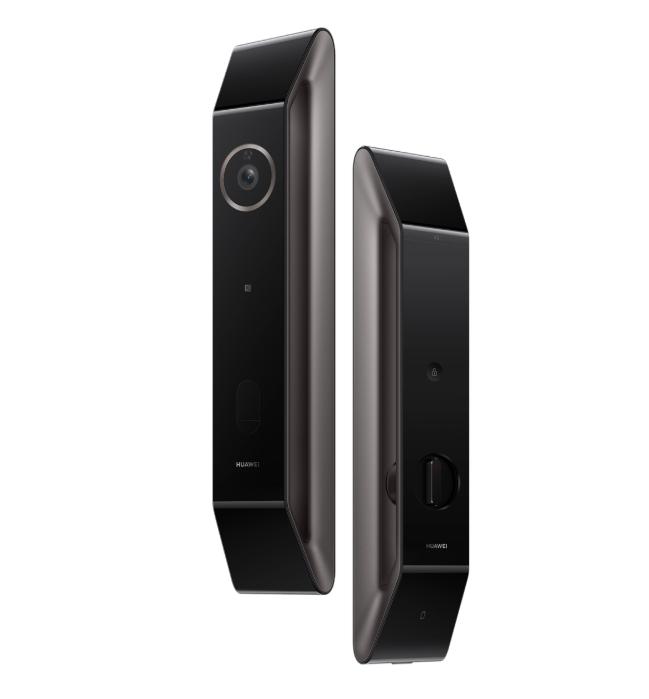
Huawei Smart Door Lock Plus Starry Black
New - force brands such as Loock and Gogolock have also launched some distinctive products. For example, the Palm Lock V5 Max released by Loock in 2023 is trying to get a share of the market.
Indeed, within just a few years, the number of smart door lock brands has doubled. According to the data statistics of LOTU Technology, as of 2023, there were more than 3,000 enterprises engaged in the smart door lock industry in China. 48% of the brands on online e - commerce platforms were new brands, with the number reaching 239.
Why do these new players flock into the smart door lock market?
The potential market prospect is the primary reason.
With the increasing demand of consumers for home security and convenience, the smart door lock market will witness explosive growth.
The analysis data of CIC Industry Research Institute shows that the full - channel retail volume of household smart door locks in China reached 18.7 million sets in 2023, and it is expected to reach 20.5 million sets in 2024. There is even more room for imagination in the future.
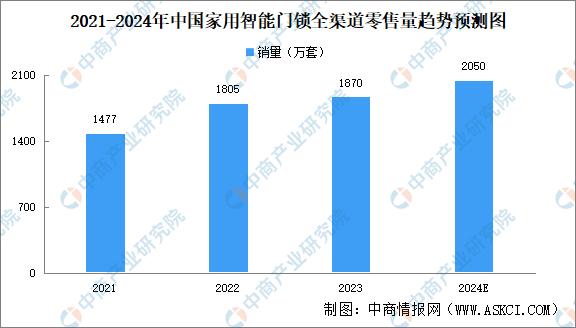
Sales trend of household smart door locks in China. Data source: CIC Industry Research Institute
For Internet giants and home appliance enterprises, door locks are not just a product, but a key part of building an ecological system.
Taking Xiaomi as an example, Xiaomi has built its own intelligent ecosystem for vehicles, people, and homes. As one of the entrances to smart homes, smart door locks have extremely high strategic value and are truly a must - fight place for all.
From the perspective of the industry competition pattern, there is no absolute leading brand in the smart door lock industry yet, which gives new players new opportunities.
The entry of giants has brought a new competition pattern to the smart door lock industry.
Relying on their strong brand influence, consumer base, technological R & D strength, as well as perfect channels and service systems, they have brought great pressure to traditional door lock enterprises.
This has also led to increasingly fierce competition in the smart door lock industry, which has gradually entered a white - hot stage.
02 Fierce Competition
In fact, new players have made traditional lock industries feel "a bit of a chill".
For many established lock enterprises, their understanding of door locks formed over the past decades is based on historical experience, craftsmanship level, manufacturing materials, mold technology, or simply safety and firmness.
This is also their traditional moat advantage.
After new players entered the market, they adopted new strategies.
Internet, home appliance, and technology companies, relying on their strong strength and innovation advantages, continuously apply new technologies to smart door lock products.
From the initial password and fingerprint unlocking to the current 3D face and finger vein recognition unlocking, for a while, the technological iteration of the entire industry has accelerated, the evolution pattern and competition have become more radical, and the air is filled with the smell of gunpowder everywhere.
Huawei's smart door lock is equipped with HarmonyOS Connect, which can support the distributed visual cat - eye function; Xiaomi's smart door lock supports remote management via the Mi Home App and smart home linkage functions; Ezviz's smart door lock supports functions such as face recognition and video intercom.
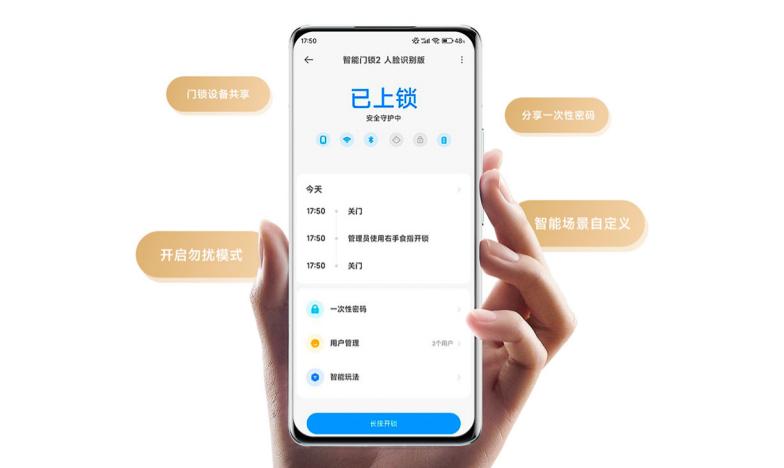
Xiaomi's smart door lock supports remote management via the Mi Home App
Naturally, the market is optimistic about this. Taking the application of biometric technology as an example, data from Aowei Cloud shows that in the first half of 2024, the shipment volume of fingerprint recognition modules reached 11 million sets, and the shipment volume of face recognition modules reached 4 million sets, indicating their popularity among consumers.
The iteration of new technologies has also led to continuous innovation of products.
Relevant news statistics show that the number of new models released by new smart door lock brands each year is more than three times that of traditional door locks. This pace is something that traditional door lock enterprises have never encountered in the past few decades.
The market share that traditional door lock brands have always held is constantly being "eroded". According to the data from Zhiyan Consulting, as of 2023, cross - border brands and emerging brands in smart door locks have accounted for 24% and 15% respectively, showing a trend of continuous increase and potentially exceeding the scale of traditional brands.
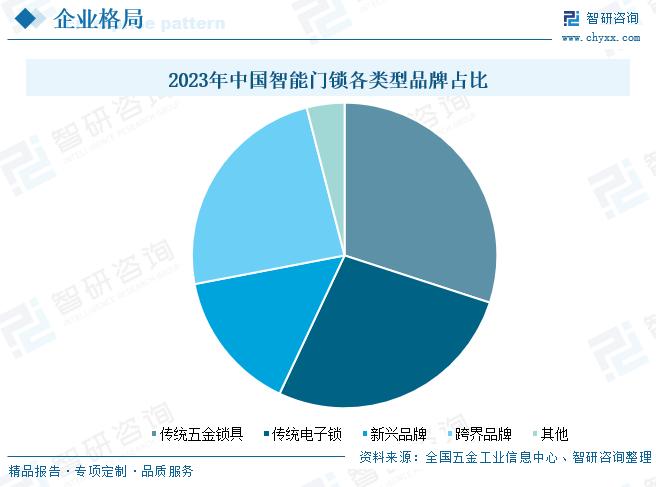
Data source: Zhiyan Consulting
In the long run, traditional door lock enterprises are at great risk of losing more market share.
The pressure brought by new players is not limited to this. Price is also one of their trump cards.
Relevant research data from CIC Industry Research Institute shows that in February 2023, the average price of smart door locks dropped to 1,003 yuan, reaching the lowest point in the past two years. It is expected that the average price will further drop to 995 yuan per set this year.
Price involution and the decline of the average price have become an established fact.
For traditional enterprises, even if they currently still hold the relevant dominant market share, once a price war breaks out, trading price for volume and involution competition are inevitable results.
Most traditional door lock enterprises are heavy - asset companies with factories and equipment. A price war will inevitably lead to continuous pressure on their operations.
03 Way Out
Facing the aggressive new players, traditional lock enterprises have only two choices: either wait for their market share to be continuously eroded by new - force brands until they disappear, or take up the "sword" to break through.
Actually, traditional lock enterprises also have their own advantages.
In comparison, Internet, technology, and home appliance companies are quite good at building smart home ecosystems, brand awareness, and user data analysis. Traditional lock enterprises have advantages in brand history, production and manufacturing experience and craftsmanship, product quality, and after - sales service systems.
Therefore, traditional lock enterprises should give full play to their professional advantages to win consumers' trust.
Product quality is the cornerstone of an enterprise's survival.
Wang Yuebin, the chairman of Wangli Security, one of the top ten famous lock brands in China, once said:
Even if there is only a one - in - ten - thousand product quality problem, it means 100% dissatisfaction for consumers.
However, traditional craftsmanship is limited by manual operation and outdated equipment, making it difficult to meet the increasing personalized needs of the market and the efficient delivery of large - scale orders.
At the same time, the lack of a precise traceability mechanism in complex processes leads to inconsistent quality control standards, making it difficult to guarantee product quality.
Wangli Security invested 1.3 billion yuan to build the world's largest intelligent manufacturing base for door locks and smart homes, exploring a path to effectively combine traditional industrial manufacturing brands with intelligence, ensuring safe production, improving product quality, shortening the production cycle, and reducing production costs.

Wangli Security's intelligent manufacturing base for door locks and smart homes
Desman, a representative of professional lock enterprises founded in 2009, has focused on experience services in the face of the "thousand - lock war".
An iResearch report shows that consumers need timely and considerate installation and repair services, with the attention to both exceeding 60%.
Desman has built an efficient self - built service system covering pre - sales consultation, in - sales installation guidance, and after - sales repair, ensuring that users can get timely and professional help at every stage of use. It aims to build a moat different from that of technology giants and new - force brands.
The established lock brand Kaadas chose to take the initiative. It actively launched fully automatic smart door locks to meet people's demand for intelligent technology and actively cooperated with Internet enterprises to keep up with the fast - paced changes in the smart door lock market.
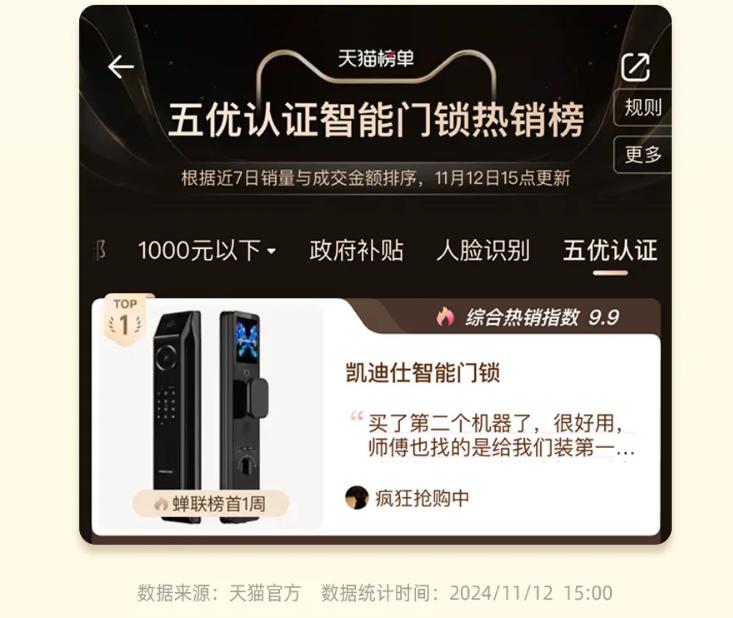
Kaadas smart locks topped the hot - selling list on Tmall's Double Eleven in 2024
Traditional door lock enterprises are well aware that the Chinese market is large in scale, has multiple levels, and diverse needs, providing a broad living space.
Facing the continuous attacks of opponents, only by finding their own ecological niche can they have a place in the future.
This article is from the WeChat official account "Zhengjieju" (ID: zhengjieclub). The author is Zhengjieju. It is published by 36Kr with authorization.