"ChatGPT said I was wasting my life, but it's wrong," the clear-headed counterattack from the former product head of WhatsApp

In a complex era, simplicity and execution are the real powers.

At WhatsApp, one of the most execution - oriented companies in Silicon Valley, the product team's creed is "Make the product serve everyone."
Ami Vora once served as the Head of Product at WhatsApp, leading the messaging experience and growth strategies, and building the core product experience that connects billions of users worldwide from scratch.
After that, she joined Meta, responsible for the integration strategies of social and business products. Later, she became the Chief Product Officer of Fair (a US mobility technology company), leading the team to reshape the user experience of car subscription services and the data - driven decision - making system.
She believes that "Everyone is more exhausted than we think," "Simplicity itself is competitiveness," and in a rapidly changing era, strategy alone cannot win; execution can.
In this conversation hosted by product writer Peter Yang, Ami shared her real experiences at WhatsApp, her thoughts on the boundaries between human emotions and AI feedback, and how she redefines the role of a "product manager" in the AI wave. The following is the podcast content, organized and published by "Future Human Laboratory" —

● Screenshot of the podcast. Peter Yang is on the left, and Ami Vora is on the right.

"You're wasting your life."
Peter: Ami, you're very influential in both the writing and product circles. We know you often use AI tools. Can you share how AI helps you save time or brings you some "happiness"?
Ami: I like that you mentioned the word "happiness." We're always pressured to figure everything out, which leaves little room for fun.
It's quite interesting to use AI for some random little creations with my kids. For example, my daughter loves drawing. She'll say, "I want a half - mermaid, half - unicorn." I'll use a generative tool to draw it for her. And I specifically make sure the characters in these images are all female, like female firefighters, female entomologists, etc. It has become a relaxed and fun interaction.
Also, I'm actually a highly introverted person and always a bit nervous when meeting new friends. AI has helped me with this. Before a meeting, I'll ask it to check the other person's information, interests, commonalities, etc. This way, I'll be more at ease when we meet. Although it doesn't change the essence of my conversations with people, it calms my mind.
Peter: A while ago, I posted a prompt online to use ChatGPT for an unkind but honest "self - assessment." You tried it too, right?
Ami: Yes, I thought it would only tell me things I already knew. But it completely broke through my "safe zone."
The prompt was: "You're my investor, advisor, and boss. Please give me the most direct feedback." Its response, in summary, was: "You're wasting your life."
Actually, I was on vacation at that time, writing articles, traveling, and learning to make pizza. I was very relaxed. But the AI seemed to be shouting at me: "This is a great time to start a business, but you're wasting your time!" — In a way, it was right.
Later, I talked about this with a friend who doesn't work in the tech industry. She said: "Just step away from the computer and go for a walk. Remember that you're a human being." This brought me back to reality and made me realize that AI feedback may be "true," but it can also be imbalanced.
Not long ago, I tried the same prompt again, and it still said I was wasting my time. But this time, I didn't feel hurt; instead, I found it interesting — because I really had a great summer, spending time with my family, learning new things, and relaxing. Isn't that a "high - quality life"?

"What they want is a sense of relief."
Peter: You wrote an article about "simplicity as a competitive advantage," which I really like. Many teams can't help but make their products more and more complex. How do you get everyone to adhere to "simplicity"? Do you have any tips?
Ami: For me, everything always starts with "Who are we doing this for?" and "What's the purpose of doing it?" A basic assumption I have about the world is that everyone is more tired than we think. Everyone is exhausted, and everyone is trying to make things work. People don't want to learn something new; what they want is a "sense of relief" — a haven where "everything just works," and they don't have to do extra work. Always putting the user at the center has always been helpful to me.
At WhatsApp, we always adhered to the concept: Make the product suitable for anyone on the planet. If a product can be easily used by anyone, it will work better for everyone. At that time, many people were pursuing "more powerful features" and "fancier technology," but we thought that even tech elites actually wanted reliability and smoothness rather than complexity.
Strategically, I often ask: If we don't implement a certain feature for now, how serious will the consequences be? Can we set priorities? For example, invest 80% of our energy in the most core features and use the remaining 20% for exploration. Simplification is not being lazy; it's about clarity.
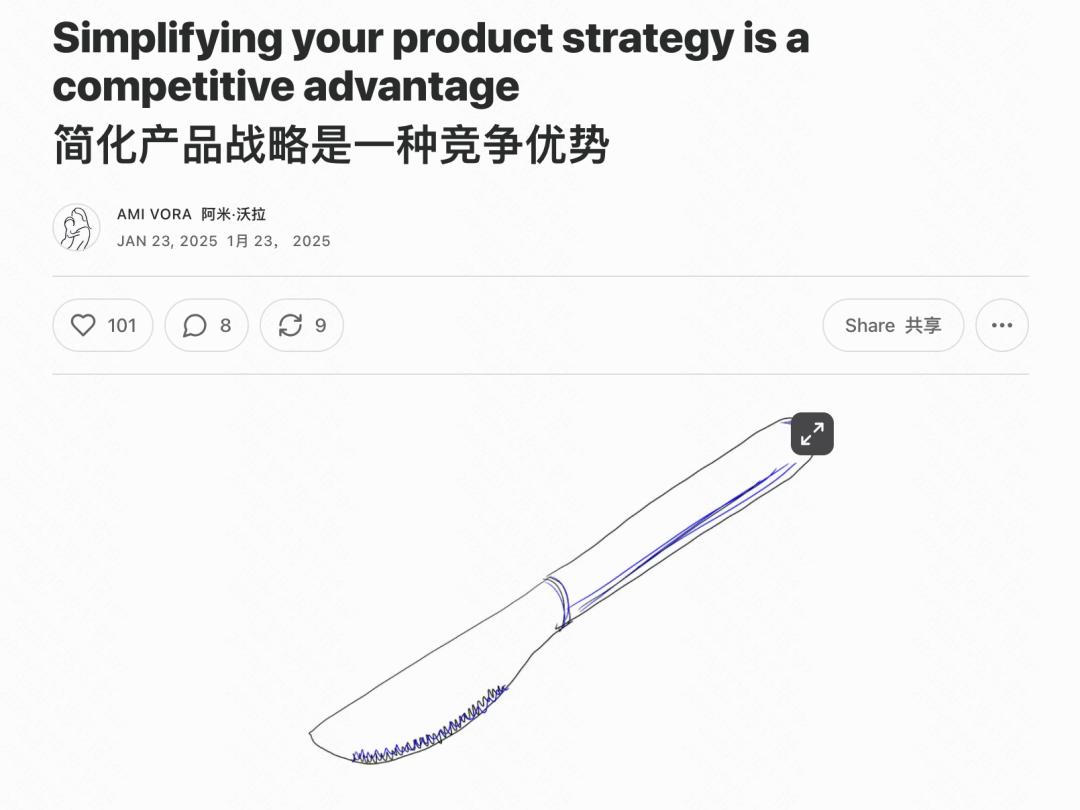
● Ami's article
Peter: When you're reviewing product documents or designs, what kind of "evaluation criteria" do you have in mind?
Ami: It's very simple: "Can I understand who this is for and what it helps them achieve?" It may sound like nonsense, but if you ask ten team members, you may get ten different answers. I think "clarity" is the prerequisite for "simplicity," and "clarity" is like the building block.
Take WhatsApp as an example. Simplicity is the right direction. But in tools like Facebook Ads, users actually want powerful configuration capabilities rather than over - simplification.
So the key is not to blindly pursue "simplicity," but to clearly understand who the users are, what they want, and why we're doing this.

Strategy gives you direction; execution gives you feedback.
Peter: Let's talk about the interaction design of AI. I've always thought that one of the important reasons why ChatGPT and these chat - type AI products became popular so quickly is that they make people feel like they're just "chatting." It's like having a conversation with another person, and this form naturally reduces the learning cost.
However, many people think that the current AI chat interfaces are still in the early stage. In the future, there will definitely be better interaction methods, more natural and efficient, surpassing text - based chatting. What do you think? Do you think the "chat" interaction form will be replaced?
Ami: To be honest, I also find it hard to believe that five years from now, the most advanced AI interaction will still be "typing in a text box to chat." It will definitely still exist, but I don't think it will be the mainstream. However, I also think that the chat interface made AI popular because it's wrapped in a shell that everyone is familiar with. Even if you can never predict what answer it will give, at least you know "how to ask."
This interaction mode is very predictable. The interaction method is predictable, but the content of the result is unpredictable — this tension makes it both safe and magical. We've seen improvements in wearables, voice assistants, and headphones. I guess the next - stage interaction will be closer to "naturally conversing with the world." Future AI interaction should be a "naturally occurring" experience, not a "designed interface."
Peter: You also wrote an article about execution, mentioning "Execution eats strategy for breakfast." Can you explain it in detail?
Ami: The biggest lesson I learned at Meta is that even if the strategy is perfect but the execution is poor, you'll still lose, and the worst part is that you won't even know why you lost. On the contrary, an average strategy combined with excellent execution allows you to learn, iterate, and correct every day.
Strategy gives you direction; execution gives you feedback. If you only want to think the strategy through "perfectly" all at once, you may spend years thinking to find the completely right strategy and then only have one chance to implement it. But if you value execution, you'll get a chance to test and learn every day. For example, release a product every day, learn from it, make improvements based on feedback, and then release the next product, continue learning and improving. This makes it easier to build products because you don't have the pressure to pursue perfection.
I like the concept of "Minimum Viable Strategy." Just make the direction clear — who the target customers are, why we can win, and what the risks are. Don't fantasize about second - order effects three years from now. The world is changing too fast.
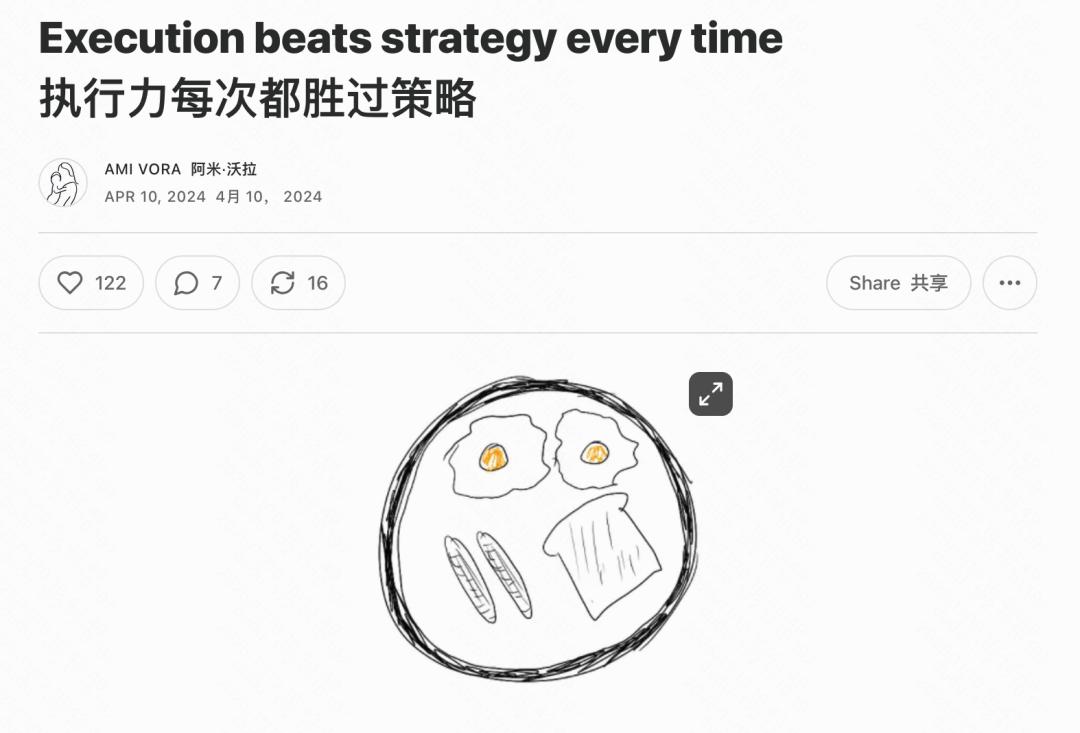
● Ami's article
Peter: Many companies spend one or two months creating annual or quarterly plans, but then no one reads those documents. You said that "The best strategy is one that can change the team's daily behavior." How do you simplify the planning process or ensure that the plan can truly impact daily work?
Ami: Sometimes, it's like an instinctive reaction. I'll first ask, "What change is this plan expected to bring? If we spend six weeks on this, will the world be different?"
If the answer is "No real change," it means we shouldn't waste those six weeks. Sometimes, simply making the planning cycle lighter can liberate the team. I prefer "trigger - based planning" — we'll have a meeting when the environment or assumptions actually change, rather than having a meeting just for the sake of a "quarterly meeting."

Generalist product people will be in demand again.
Peter: Many PMs complain that they have to wait a long time for leadership approval, and project progress is too slow. Do you have any effective methods?
Ami: I hope this situation happens less and less. We can start from two aspects:
First, agree in advance on "what doesn't need approval." For example, changes that affect less than x% of users can be launched by the team independently and monitored.
Second, encourage leaders to set up "office hours" instead of "review meetings."
Shorten the decision - making cycle to 24 hours instead of four weeks. I'm actually allergic to "over - document writing." When I see a PM spending a month writing a five - page proposal while the product hasn't moved forward at all, I think, "How much better it would be to use that time to write code?" Users only care about the product in their hands, so everything must revolve around getting the product to people faster and better.
Peter: You also wrote an article about "how to protect your deep - work time." Can you share your methods?
Ami: Instead of rejecting meeting invitations one by one, I first clarify: What are the two most important things I need to accomplish this week? Then I block out all the time for them. Other requests that don't support these two goals will be postponed.
Also, it's important to tell the other person "why I can't meet." For example, "I'm focused on route planning this week. Can we talk next month?" This way, they won't feel ignored. I list my key tasks every Monday and reserve time for them on my calendar. Otherwise, your time will be automatically filled by