Lei Jun lost nearly 700,000 followers in a month, and Xiaomi's market value has evaporated by more than HK$550 billion from its peak.
Recently, the first-in-the-nation lawsuit regarding a Xiaomi car purchase dispute over "collecting the balance before vehicle delivery" has reached a first-instance verdict.
According to reports from multiple media outlets, in this case, Xiaomi's Haikou company unilaterally arranged for the vehicle to come off the production line in December 2024 and required the consumer to pay the balance within 7 days after receiving the payment notice. Due to the inability to inspect the vehicle and personal capital turnover issues, the consumer did not pay the balance. Subsequently, Xiaomi cancelled the order and confiscated the 5,000-yuan deposit, leading to a dispute between the two parties.
After the trial, the Meilan District People's Court of Haikou City held that the relevant standard terms of Xiaomi cars in this case were "unfair and unreasonable" and should be deemed invalid. Moreover, the company violated the principle of good faith. Therefore, it was ruled that Xiaomi's Haikou company must return double the car purchase deposit, totaling 10,000 yuan.
The above case is not the first judicial dispute involving Xiaomi cars this month. On November 24, a court hearing for cross - examination was held in a case accusing Xiaomi cars of false advertising regarding the "perforated hood".
In the evidence submitted temporarily by Xiaomi previously, its legal team stated that Lei Jun had repeatedly expressed that "it is not recommended to buy", and the relevant statements about wheel hub heat dissipation on Weibo had been deleted. They claimed that "it should not be regarded as misleading consumers" and "it was not an intentional false advertisement". Some media interpreted this as Xiaomi's legal department "stabbing Lei Jun in the back".
Notably, Lei Jun has encountered a "reputation crisis". According to Huitun Data, Lei Jun lost 699,000 followers in the past month.
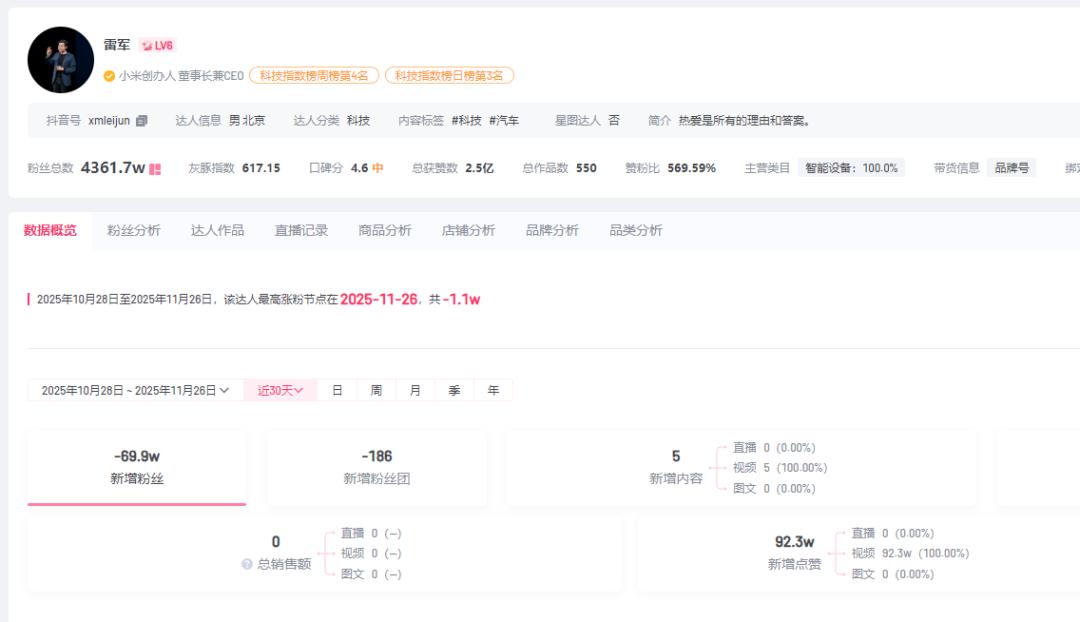
Meanwhile, Xiaomi's market value has declined. Its latest market value has shrunk by more than HK$550 billion compared to the annual high.
Xiaomi Cars Ordered to Pay Double Deposit for Collecting Payment Before Vehicle Inspection
Leida Finance learned that recently, the Meilan District People's Court of Haikou City pronounced a verdict in a case where Xiaomi cars "demanded the balance before vehicle delivery". The court ruled that the relevant Xiaomi company must return double the car purchase deposit, totaling 10,000 yuan, to the involved consumer.
It is reported that this case can be traced back to July 2024. At that time, Ms. Li (a pseudonym) test - drove a 318,900 - yuan Xia Guang Zi SU7 Max in Haikou and paid a 5,000 - yuan deposit through the Xiaomi car APP.
In October of the same year, due to capital turnover issues, after negotiating with Xiaomi's customer service, Ms. Li reached an agreement: she could postpone taking delivery of the car, and the order would be reserved for her for 360 days (counted from the date of deposit payment). Ms. Li could apply for production scheduling at any time during this period.
However, more than a month later, Xiaomi's Haikou company unilaterally required Ms. Li to pay the entire balance of 313,900 yuan within 7 days. Since she could not raise the full amount of funds in the short term and had not inspected the vehicle, Ms. Li did not pay the balance. Subsequently, Xiaomi cancelled the order and did not refund the aforementioned 5,000 - yuan deposit.
After the trial, the Meilan District People's Court of Haikou City held that Xiaomi's Haikou company, based on the standard terms, required consumers to pay the balance within 7 days after receiving the payment notice without inspecting or taking delivery of the vehicle. If the payment was overdue, the order would be cancelled and the deposit would not be refunded. This act essentially increased the consumer's payment obligation and, at the same time, restricted the consumer's main right to inspect the vehicle quality, which was a situation where the standard terms should be deemed invalid.
The court also pointed out that Xiaomi cars' official had clearly replied to netizens that "it supports paying the balance after vehicle inspection", and this official reply constituted an important basis for the consumer's trust when concluding the contract.
In this case, Xiaomi's Haikou company insisted that the plaintiff pay within a limited time before production scheduling; otherwise, the order would be cancelled and the deposit would be confiscated. Its actions were inconsistent with the publicity and violated the principle of good faith, substantially depriving the plaintiff, as a consumer, of the right to inspect the vehicle and increasing the payment obligation. Therefore, the relevant standard terms in the "Xiaomi Car Purchase Agreement" were "unfair and unreasonable" and should be deemed invalid.
In addition, the court held that after reaching an agreement with Ms. Li on the postponed production scheduling of the vehicle, Xiaomi's Haikou company, without Ms. Li's notice for production scheduling, actively arranged for the production of the vehicle she ordered to come off the production line and, at the same time, required her to pay the entire car purchase balance at once, which violated the supplementary agreement reached between the two parties and constituted a breach of contract.
Finally, the court ruled that Xiaomi's Haikou company must return double the car purchase deposit, totaling 10,000 yuan, to Ms. Li within 10 days from the date of the verdict's entry into force; Xiaomi Jingming Technology Co., Ltd., the parent company of Xiaomi's Haikou company, shall bear joint and several liability for the above - mentioned debt.
Hearing of the "Perforated Hood" Case: Did Xiaomi's Legal Department "Stab Lei Jun in the Back"?
Notably, the aforementioned case is not the only judicial dispute involving Xiaomi cars this month. On November 20 this year, a hearing for cross - examination was held in the Qinhuai District People's Court of Nanjing City in a case accusing Xiaomi SU7 Ultra of false advertising regarding the "perforated hood".
This case originated from a publicity controversy in May this year. Xiaomi cars once claimed that the carbon - fiber double - duct front hood with an optional installation price of 42,000 yuan fully replicated the design of the prototype vehicle.
However, after purchasing the car, some consumers found that the actual function of the carbon - fiber perforated hood they had optionally installed did not match the publicity. They questioned Xiaomi cars' false advertising and filed a lawsuit.
According to Hongxing News, this case was originally scheduled to be heard on November 10, but Xiaomi temporarily submitted 84 pages and 14 groups of new evidence, resulting in the case being postponed to November 20 for a hearing for cross - examination.
According to Xiaomi's civil defense statement, its legal team stated that compared with the ordinary mass - produced version, the perforated hood version cancelled the front trunk, which was in line with the fact stated in Lei Jun's Weibo that "the internal structure has been changed". Moreover, according to the "Aerodynamic Wind Tunnel Test Report", the opening of the engine hood of Xiaomi SU7 Ultra could reduce the lift coefficients Clf and Clr of the front and rear axles by 0.002 respectively and increase the drag coefficient Cd by 0.001. Therefore, it had the functions of airflow export and auxiliary front - cabin heat dissipation, and it was not false advertising.
At the same time, since the mass - produced version of Xiaomi SU7 Ultra had wheel - hub heat - dissipation ducts on both sides of the bumper, the wheel - hub heat - dissipation function did exist regardless of whether the hood was perforated.
However, some rights - protecting car owners did not agree. They pointed out that the change in the Cd value brought about by a real duct should be at the 0.x level, and Xiaomi had obtained the above - mentioned "Aerodynamic Wind Tunnel Test Report" on May 16 but had never shown it to them.
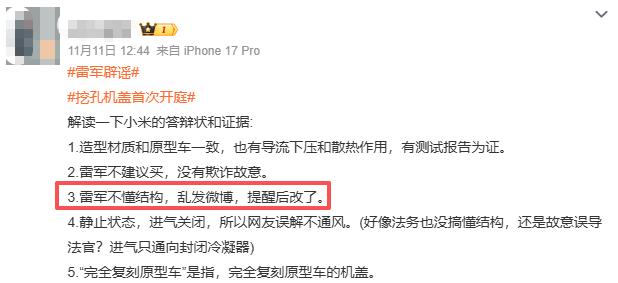
During the court hearing, Xiaomi also pointed out that Lei Jun had repeatedly said at the press conference and live - broadcast that "it is not recommended to buy" the perforated hood version, and after being corrected by engineers, he had deleted the statement on Weibo that "the double ducts directly lead to the wheel hub and support wheel - hub heat dissipation" 8 hours later. Therefore, the content "did not deviate significantly from the facts and was corrected in time, and it was not an intentional false advertisement", and "it should not be regarded as misleading consumers".
Some netizens said that the above - mentioned argument of Xiaomi's legal department could be interpreted as "Lei Jun doesn't understand cars, posted randomly on Weibo, and corrected after being reminded".
In addition, Xiaomi's legal team mentioned that the optional installation price of the perforated hood was only 42,000 yuan, which was not a decisive factor for consumers to buy the car, and the publicity content such as "perforated hood" and "suitable for both street and track" was not written into the contract, so there was no breach of contract.
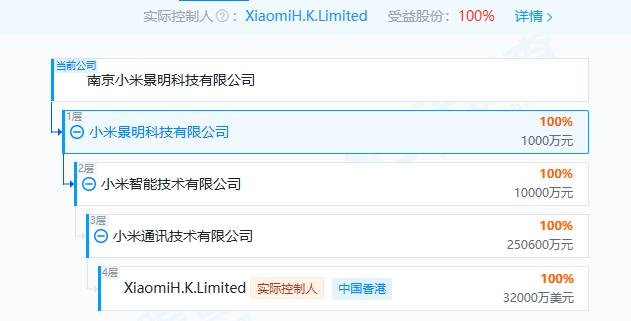
At the same time, Xiaomi argued that the second - party in this car purchase agreement was Nanjing Xiaomi Jingming Technology Co., Ltd., which was an independent legal entity from Xiaomi Jingming Technology Co., Ltd. and Xiaomi Automobile Technology Co., Ltd., and it did not bear joint and several liability.
According to Tianyancha information, Nanjing Xiaomi Jingming Technology Co., Ltd. is a wholly - owned subsidiary of Xiaomi Jingming Technology Co., Ltd., both of which were established in 2023. After equity penetration, the actual controller of both is Xiaomi H.K. Limited.
It is worth mentioning that on September 10, 2024, during an on - site inspection of Nanjing Xiaomi Jingming Technology Co., Ltd. located at No. 276, Daming Road, Qinhuai District, Nanjing City, Jiangsu Province, by the Qinhuai District Fire and Rescue Brigade of Nanjing City, it was found that the exhibition hall had been put into use without the permission of the fire and rescue agency, which violated Article 15 of the "Fire Protection Law of the People's Republic of China". Nanjing Xiaomi Jingming Technology Co., Ltd. was ordered to stop using the 4S store at No. 276, Daming Road, Qinhuai District, Nanjing City, Jiangsu Province, and was fined 30,000 yuan.
Xiaomi Automobile Technology Co., Ltd. was established in 2021. It is a member of the Xiaomi Group, located in Beijing. It is an enterprise mainly engaged in the automobile manufacturing industry, and its legal representative and actual controller is Lei Jun.
Xiaomi's Q3 Revenue Declined Quarter - on - Quarter, and Market Value Shrunk by HK$555.954 Billion from the Peak
Although Xiaomi has been involved in controversies recently, the company's financial report is quite impressive.
On the evening of November 18, Xiaomi Group released its Q3 2025 performance report. The company's total revenue in that quarter was 113.121 billion yuan, a year - on - year increase of 22.3%; the adjusted net profit was 11.31 billion yuan, a year - on - year increase of 80.9%.
Among them, the revenue from intelligent electric vehicles and AI innovation business reached 29.01 billion yuan, a year - on - year increase of 199.16%, becoming the fastest - growing segment.
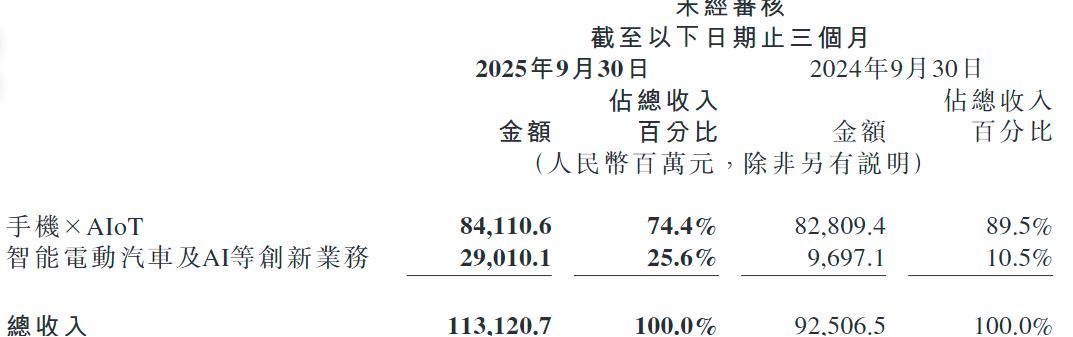
The above - mentioned Q3 report pointed out that in the third quarter of this year, Xiaomi delivered more than 100,000 new cars, a year - on - year increase of 173.43%, and achieved revenue of 28.3 billion yuan, with a year - on - year growth rate of 197.89%.
Notably, in the third quarter of this year, Xiaomi's intelligent electric vehicle and AI innovation business segment achieved its first profit, with an operating income of 700 million yuan this quarter.
However, there are also hidden concerns behind the impressive performance. The financial report shows that in the third quarter of this year, Xiaomi's revenue decreased by 2.4% compared with the second quarter, and the gross profit decreased by 0.6% quarter - on - quarter.
Some market analysts believe that the quarter - on - quarter decline in revenue in the second quarter means that Xiaomi's growth momentum has weakened, which is not conducive to maintaining a high valuation.
Leida Finance noticed that since the release of Xiaomi's Q3 report on the evening of the 18th, the company's stock price has continued to fall, once falling below HK$40 per share.
On November 24, Xiaomi's founder, Lei Jun, stepped in to "save the situation". Through Team Guide Limited, which he wholly owns, he purchased a total of 2.6 million Class B common shares of Xiaomi. According to the company's announcement, Lei Jun's average transaction price this time was HK$38.58 per share, and the total amount of the share - increase was more than HK$100 million.
After the share - increase, Lei Jun held a total of 6.057 billion shares of Xiaomi, accounting for 23.26% of the total number of issued shares. Xiaomi's board of directors believes that this move demonstrates Lei Jun's full confidence in the company's long - term development prospects and growth potential.
As of the close on November 26, Xiaomi's stock price was HK$40.1 per share, a decline of 0.595%. Compared with the annual high of HK$61.45 per share, the market value has shrunk by HK$555.954 billion.
This article is from the WeChat official account "Leida Finance", author: Zhou Hui, editor: Shen Hai. It is published by 36Kr with authorization.