Cathie Wood makes a significant statement: AI is not a bubble at all. The biggest wealth opportunity in the next decade has just begun.
By 2030, the number of global AI users is likely to explode to between 4 billion and 5 billion, meaning the user base will expand fivefold.
Currently, the annual revenue of AI foundation model companies is approximately $30 billion. It is estimated that in the next few years and throughout the decade, the potential monetization scale will reach about $1.5 trillion.
The shortage of chips has led to a supply - demand imbalance in AI infrastructure. The power shortage also means that the expansion of data centers and AI systems is physically restricted. This real shortage is yet another clear evidence that the current situation is not a hype cycle.
Wood predicts that the real GDP growth in the United States will accelerate to an unprecedented and sustainable level of around 5% in the next 5 to 10 years.
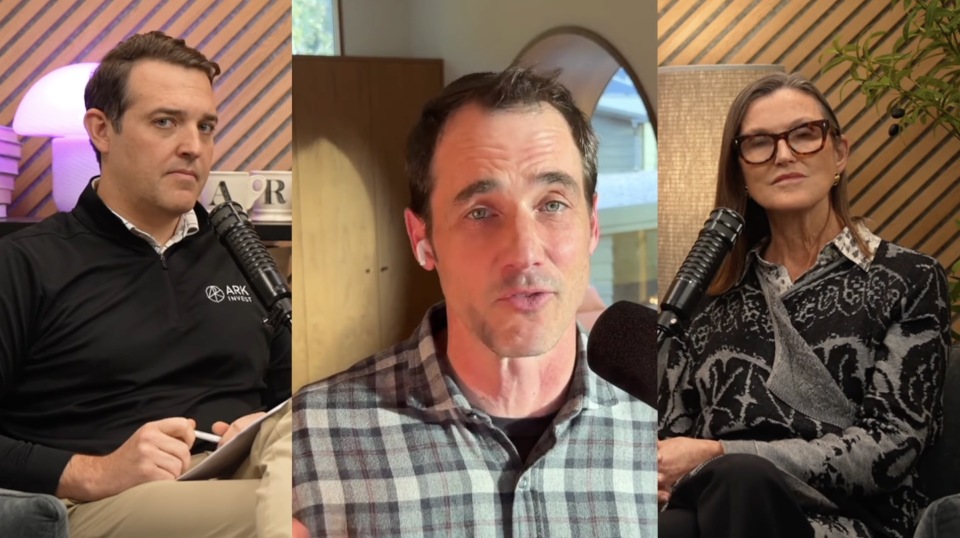
On November 25th local time, ARK Invest, known for its "disruptive innovation" investment philosophy, held the latest episode of its in - depth internal interview program "Fund Focus".
This interview was hosted by Tom Staudt, the President and Chief Operating Officer of ARK. The core guests of the dialogue were Cathie Wood, the soul figure, CEO and Chief Investment Officer of ARK, and Brett Winton, the Chief Futurist and a staunch defender of its investment logic.
Since 2023, the technological wave centered around generative artificial intelligence (Generative AI) has swept across the global capital market at an astonishing speed, leading to a soaring market value of giants such as NVIDIA and OpenAI. Along with this, there has been vigilance and skepticism about this boom in the market: the "AI bubble theory" is rife. Investors are generally anxious: Is the current frenzy the dawn of a technological revolution or a repeat of the dot - com bubble? Against the backdrop of many companies' valuations reaching new highs but profits yet to be realized, determining the nature of the current market has become the key to future asset allocation.
In this 40 - minute in - depth dialogue, the three guests focused on the investment logic in the AI era and thoroughly deconstructed two core questions: Is AI really a bubble? How should investors allocate assets in the face of unprecedented macro - level changes?
Wood and Winton put forward a subversive core view: The current AI wave is not a bubble but an early stage of the greatest technological revolution in human history, more similar to the early days of the Internet in 1995. They used detailed data and historical analogies to prove that the current market is in a situation of supply falling short of demand. The huge growth in AI delivery capacity (expected to be 50 times) will generate a monetization potential of over $1.5 trillion, which is sufficient to support the existing valuations.
They firmly believe that AI is the "catalyst" for accelerating the other four major innovation platforms (robotics, energy storage, blockchain, and multi - omics sequencing), and it will push the global real GDP growth to an unprecedented level of 7% to 8%. This transformation will not only affect stocks but also bring disruptive risks to traditional asset classes such as fixed income and private credit.
The following is a condensed version of this interview:
01. The End of the AI Bubble Theory: Disruptive Growth in Demand and Supply
Host: Today, we will address a core question that concerns global investors the most: Is the current AI - centered tech wave a new bubble or a real technological revolution? Joining me in this program are our CEO and Chief Investment Officer Wood, and Chief Futurist Winton. First, I'd like to directly pose this most controversial question: Are we currently in an AI bubble?
Winton: This is a crucial consideration and a question in everyone's mind. Psychologically speaking, when everyone in the market is questioning the existence of a bubble, it's actually very difficult for a bubble to form. Because a real bubble is often accompanied by blind, unreserved optimism and consensus.
Wood: This widespread concern, that so many people are worried we're in a hype cycle like the dot - com and telecom bubble back then, actually makes me feel at ease. This is profoundly different from historical bubble periods.
Winton: If we analyze from the basic economic principle of supply and demand, my short answer is: We're not in a bubble because we haven't reached a situation of oversupply. A bubble forms when there's no real demand for the products in the market, or when the supply far exceeds the actual application capacity. Right now, we're facing a huge demand gap.
We've observed that currently, there are about 1 billion global AI chatbot users. This number is only slightly more than 15% of the total number of global smartphone users. This is still a relatively early stage of penetration. Our prediction shows that by 2030, this number is likely to explode to between 4 billion and 5 billion, meaning the user base will expand fivefold.
Host: A five - fold increase in users is already very impressive, but how do you link this growth to economic value?
Winton: It's not just about the increase in the number of users. We expect that in the next few years, the functionality of AI underlying tools for knowledge workers using them will be more than ten times more powerful than it is now. So, multiplying the five - fold increase in the number of users by the ten - fold increase in the value of the tools means that the delivery capacity to users will increase by about 50 times.
Currently, the annual revenue of AI foundation model companies is approximately $30 billion. If we multiply this $30 billion by the 50 - fold potential growth in capacity, we can see that in the next few years and throughout the decade, the potential monetization scale will reach about $1.5 trillion. This potential market scale and demand growth are more than enough to support the infrastructure and valuations we're currently investing in to support these AI tools.
People call the current stage an "AI bubble" simply because they've never seen such large growth figures. But the fact is, the figures are large precisely because the productivity opportunities are even greater.
Wood: I'd like to add from a historical perspective. During the dot - com bubble, companies got high valuations based on the assumption that "in the next decade, so much attention might be directed towards this new Internet service". Investors were just chasing a dream, and the technology wasn't mature at that time. Cloud computing didn't really emerge until 2006; the first major breakthrough in AI, deep learning, didn't appear until 2012; and the second major breakthrough, the Transformer architecture, didn't come out until 2017. These technologies are the foundation for the current explosion of AI.
At that time, the cost of technology was also prohibitive. I once mentioned an example: Sequencing a complete human genome at that time cost $2.7 billion and required 13 years of computing power. Undoubtedly, we need cloud computing, AI, and more data analysis capabilities to solve this problem. However, fast - forwarding to today, the technology is ready. The seeds sown in the twenty years after the dot - com and telecom bubble have been incubating for 25 to 30 years. They are now starting to thrive.
Winton: As we've analogized, the current stage is more like the mid - 1995 of the Internet. At that time, Internet users accounted for about 15% of global PC users, similar to the current penetration rate of AI chatbot users. In early 1995, companies like Cisco and Intel saw their stock prices soar 10 to 20 times before the bubble burst. Even after the bubble finally burst, their stable prices were still three to four times higher than the post - crash lows. This clearly shows that the real and lasting value created by revolutionary technologies is huge.
02. Valuation, Profit Timeline, and the Challenges of Corporate Transformation
Host: Your arguments convincingly rule out the possibility of a "bubble", but we must face the next question: To what extent do the current high valuations reflect or even exceed the expected growth potential? Many companies, especially cutting - edge AI companies, have extremely high valuations but have not yet achieved profitability in many cases. How can investors find a balance between "reasonable pricing" and a "bubble"?
Wood: This question is crucial and relates to ARK's core investment discipline. One of ARK's firm investment principles is: We assume that for any stock in an exciting and disruptive field, no matter how high the premium its current valuation has relative to the market, this premium will fade or be significantly compressed within the next five years.
This means that our analysts and the entire investment team must be convinced that the revenue growth and profit margin expansion these companies can achieve will be sufficient to offset the negative impact of valuation compression. We incorporate this growth into our models. When evaluating a stock, we must base it on a minimum threshold, that is, an assumption of at least a 15% compound annual growth rate (CAGR).
Host: You mentioned the application of Wright's Law (which describes the relationship between production efficiency and cumulative output). How do you use this law to predict the speed of cost reduction and scale expansion?
Wood: We use Wright's Law very aggressively. Different from Moore's Law (based on time), Wright's Law (based on experience) can more accurately predict how fast costs will decline as cumulative production increases. This prediction allows us to more accurately understand the sharp decline in computing costs, robot manufacturing costs, and gene sequencing costs. This method helps us predict that even for companies with high valuations, their market scale and efficiency improvements can absorb the existing premiums. We've even seen that the execution ability of some companies - such as Palantir, whose revenue growth in the US commercial sector reached 123% - exceeded our predictions based on aggressive assumptions.
Host: Regarding corporate applications, Alex Karp, the CEO of Palantir, put forward a sharp view: The market overestimates the "over - engineering" of large language models (LLM) in simple, low - value tasks but underestimates the value of truly business - transformative cases. How should we combine the declining cost curve with his view?
Wood: I understand Alex's point. This actually touches on the biggest challenge in the corporate application of AI: Corporate transformation takes time. For a large company to see the real transformation brought about by AI, it has to do arduous work: collect all data from scattered corners within the organization; clean and integrate the data; and plan work processes with unprecedented detail to disrupt its existing organizational structure. It takes time for the effects to show. So, when he talks about real, comprehensive corporate transformation, he may be emphasizing that it's a tough job. But once the transformation is successful, the effects will be shocking.
Winton: Our data also shows that in terms of API usage and request volume, enterprises are not looking for cheap models to complete daily tasks but tend to look for models that can handle more complex work processes. This shows that enterprises have realized that the "over - engineering" of low - value tasks is not cost - effective. What they're pursuing are complex models that can access a wider range of data sets and make tactical and strategic decisions, which is where the real value lies.
Host: Recently, we've heard slightly different profit visions from two AI giants, OpenAI and Anthropic. Sam Altman, the CEO of OpenAI, said that they will enter a deeper cash - burning period in the next few years and then become very profitable almost overnight. Anthropic, on the other hand, said that they will turn profitable more quickly. As investors, how do you interpret this difference?
Wood: This shows that they're targeting two slightly different markets. OpenAI has clearly been attracting a lot of attention in the consumer field. They have as many as 800 million weekly active users and have achieved huge scale expansion. They're starting with a $20 - per - month subscription and will eventually have an advertising model and broader commercial leverage. It's a longer - term development process but with great leverage.
Anthropic, on the other hand, is more focused on the B2B (business - to - business) field, especially on developing its programming capabilities and applications in the scientific field. For example, Anthropic's cooperation with 10X Genomics (a single - cell sequencing company in our investment portfolio) shows that they're approaching from a scientific perspective and are committed to solving very large real - world problems. They understand that healthcare may be the most profound application of AI.
Winton: I'd like to emphasize that both of these companies are top holdings in our Venture Fund. Their strategic divergence is interesting. OpenAI's strategy is to invest in R & D to create the next model and promise large - scale computing investment to bring about another three - fold increase in productivity. Anthropic is more focused on a faster path to profitability.
But even for OpenAI, according to our understanding and public reports, the gross profit margin of its product offerings is actually very healthy, similar to that of software companies. The reason why the outside world thinks "this is obviously a bubble" is partly because it's reported that OpenAI may conduct an initial public offering (IPO) at a valuation of $1 trillion. But if they can achieve an annualized revenue of $100 billion in 2027, then a $1 trillion valuation corresponds to a price - to - sales ratio of about 10 times. This is not even high. Compared with many publicly traded software companies, this is a very healthy and even slightly undervalued IPO price estimate.
03. Market Discernment, Chip Shortage, and Room for Small Businesses
Host: Since last year, we've seen that almost all CEOs, even those of non - tech companies, have added the word "AI" to their earnings reports in the hope of a rising stock price. When a CEO can simply say in the earnings report that "we're applying AI to everything we do", does this indicate a bubble?
Wood: This is a good question. Our research shows that the market is quite discerning and not blindly chasing. We've seen this in the SaaS (software - as - a - service) field. For companies like Salesforce, their revenue growth has not accelerated and remains in the low - double - digit percentage range. Although they've added AI to all their products, the market isn't buying it.
Winton: The underlying reason is that the software - as - a - service part or the application part of the technology stack is losing market share to the platform - as - a - service part. Companies like Palantir, which cleverly place their software on top of any enterprise's legacy software, are replacing the roles played by all those SaaS companies. When revenue growth can't keep up with AI investment, the market will abandon these stocks. This is vastly different from the madness in the late 1990s - when there was more than one IPO on average every trading day and stocks could quadruple or quintuple on their first day of listing.
Wood: I'd also like to mention large - tech companies such as Meta, Amazon, Alphabet, and Microsoft. They all have huge "cash fortresses" with high liquidity. They've all said that they're increasing capital expenditure, and shareholders are also closely watching where the cash is going. If revenue growth can't keep up with the investment, they'll also be punished. But encouragingly, in most cases, their growth rates have accelerated and they've been rewarded by the market.
Winton: This large - scale AI construction has also led to serious shortage problems. Elon Musk once said in a meeting that in this new era, there are two areas with large - scale shortages: chips and electricity. The shortage of chips has led to a supply - demand imbalance in AI infrastructure. The power shortage also means that the expansion of data centers and AI systems is physically restricted. This real shortage is yet another clear evidence that the current situation is not a hype cycle.
Host: Since the entry threshold is so high and requires huge computing investment, is there still a possibility for small AI startups to compete? Or is this just a game among large - tech companies?
Wood: I'd like to answer this question from the perspective of "aqua - hire" (acquiring a company for its talent rather than its product). Mark Zuckerberg, the CEO of Meta, is now well - known for this practice. For example, it's reported that he poached the CEO of Scale