NIO hits the trending list by releasing a financial report, and it's still 3.5 billion yuan away from profitability.
Releasing financial reports can even make it onto the hot search list...
Other than NIO, there's really no one else.
You know, November 26th was an auspicious day for the Q3 fiscal season. On this day, Alibaba released its financial report, Pony.ai released its financial report, and Sueteng released its financial report...
But the only one that made it onto the hot search list was NIO.

Moreover, there's absolutely no exaggeration in this hot search. After all, a financial report that doesn't even mention the key performance indicator of "net profit" in an official official account tweet really doesn't need any artificial boosting.
Yes, NIO is still in the red. It had a net loss of 3.48 billion yuan in Q3, but the loss has significantly narrowed by over 30%.
Meanwhile, the company's comprehensive gross profit margin reached 13.9%, hitting a three - year high, and it achieved positive operating cash flow and free cash flow.
This time, NIO not only expressed confidence in making a profit in the fourth quarter of this year but also set its new business goal further, aiming for an annual profit next year.
After the release of the financial report, NIO's stock price dipped slightly in pre - market trading. But from the end of the earnings call to the market close, it rose slightly by 0.34%, with a daily increase of 2.11%.
Although NIO hasn't turned a profit yet, its trends and efforts have indeed been noticed.
Based on the Q3 level, in a simple and straightforward way of thinking, NIO is only "3.5 billion yuan" away from making a profit - it's just a matter of stepping on the accelerator.
How far has NIO come in its pursuit of profitability?
Overall, NIO's performance in the third quarter showed a good upward trend, which could be predicted from the vehicle delivery data before the release of the financial report:
In the third quarter of this year, NIO delivered 87,071 vehicles, a year - on - year increase of 40.8% and a quarter - on - quarter increase of 20.8%.
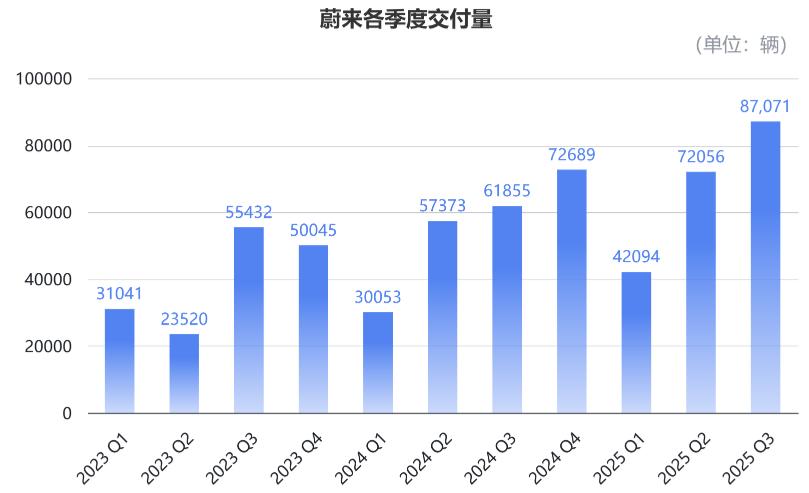
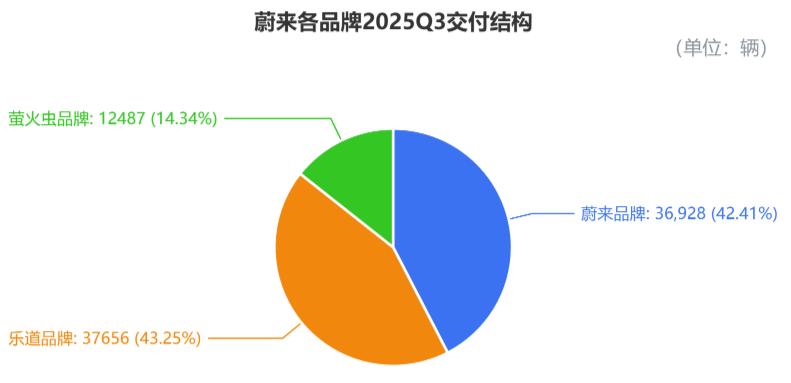
Among them, the sales volume of the NIO main brand in the third quarter was 36,928 units. During the same period, LeDao surpassed the NIO brand, reaching 37,656 units, and Firefly delivered 12,487 units in Q3.
Starting from August, NIO's monthly deliveries exceeded 30,000 units. In September, it sold 34,749 vehicles, setting a new monthly delivery record. As of the end of the third quarter, NIO had delivered a cumulative total of 873,000 vehicles.
The continuous growth in vehicle deliveries has boosted NIO's core financial indicators:
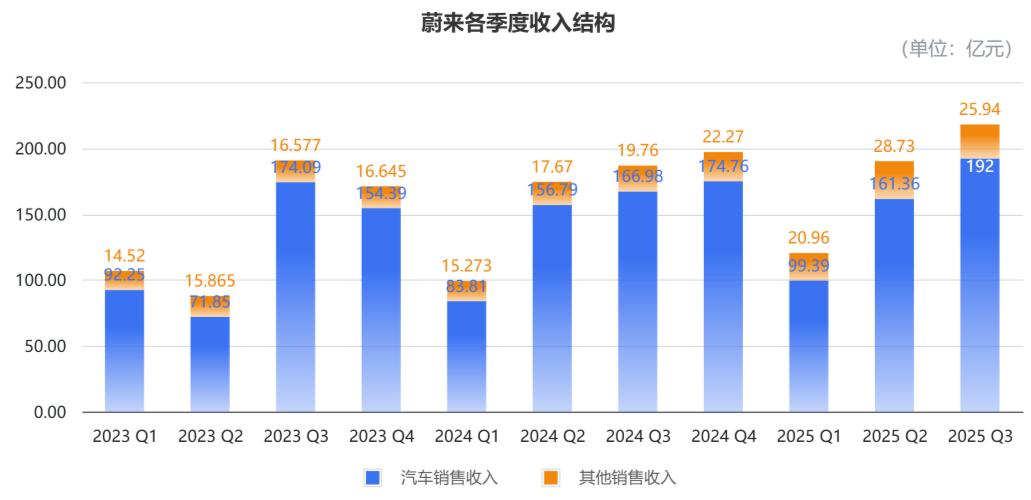
NIO's total operating revenue in the third quarter was 21.79 billion yuan, a year - on - year increase of 16.7% and a quarter - on - quarter increase of 14.7%.
Among them, the company's automobile sales revenue in Q3 was 19.2 billion yuan, accounting for 88.1% of the total revenue, a year - on - year increase of 15% and a quarter - on - quarter increase of 19%.
Calculated, NIO's average price per vehicle in Q3 was approximately 220,200 yuan, a year - on - year decline of 18.3% and a quarter - on - quarter decline of 1.5%.
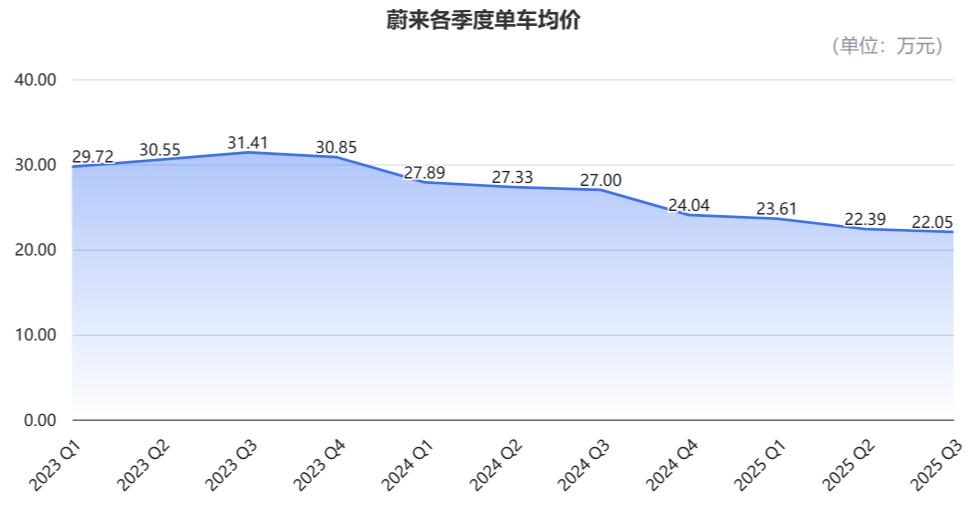
The decline in the average price per vehicle is largely due to the change in the vehicle model structure. After the delivery of LeDao L90, its sales volume grew rapidly, and the LeDao brand with a relatively lower price range began to dominate the sales volume.
However, this decline didn't pull down NIO's gross profit level. On the contrary, NIO's gross profit increased significantly this quarter. Even CEO Li Bin revealed that it "exceeded internal expectations":
In the third quarter, the company's comprehensive gross profit was 3.025 billion yuan, a year - on - year increase of 50.7%. During the same period, the company's comprehensive gross profit margin reached 13.9%, hitting a three - year high, up 3.2 percentage points from the same period last year.
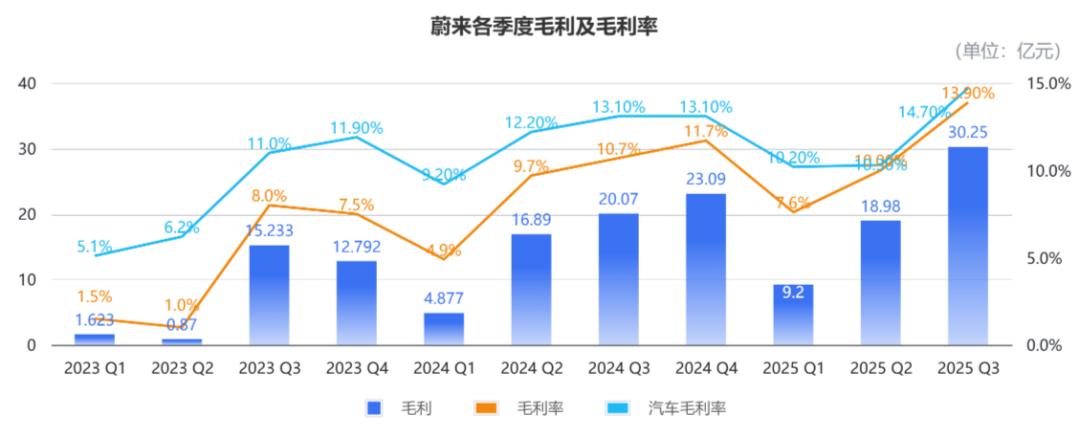
From a financial perspective, the increase in the gross profit margin comes from two aspects. On the one hand, from the core automobile business, the automobile gross profit margin reached 14.7%, up 1.6 percentage points year - on - year and 4.4 percentage points quarter - on - quarter. On the other hand, from other businesses, the relevant gross profit margin also reached 7.8%, higher than market expectations.
From a business perspective, the increase in the gross profit margin is also composed of two factors. One is cost reduction in the supply chain brought about by the increase in sales volume, and the other is that the LeDao L90, which has been a best - seller this year, has a higher gross profit level than the L60.
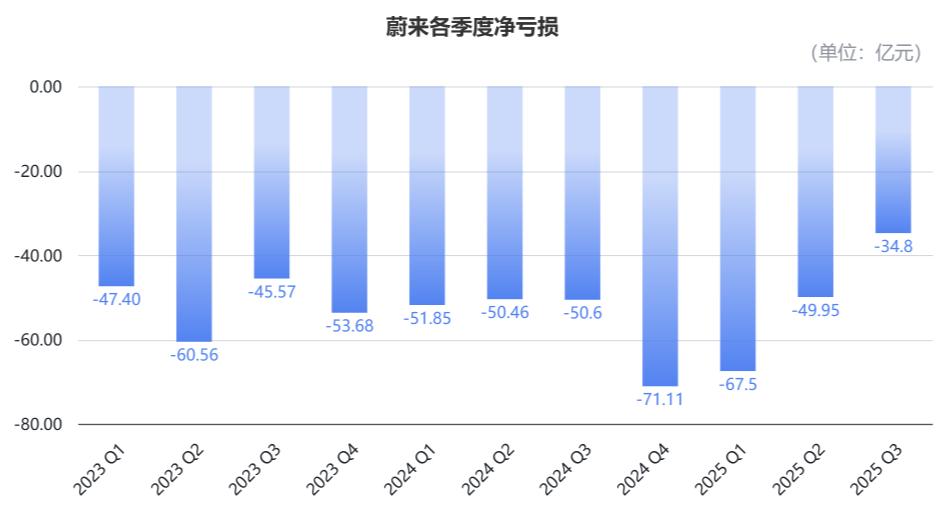
In terms of the loss, which is of the greatest concern to the outside world, NIO had a net loss of 3.48 billion yuan in Q3, narrowing by 31.2% compared with the same period last year and 30.3% quarter - on - quarter.
Excluding the impact of equity incentive expenses, the adjusted net loss in Q3 was 2.735 billion yuan, a year - on - year decrease of 38.0% and a quarter - on - quarter decrease of 33.7%.
In terms of cash, NIO achieved positive operating cash flow and free cash flow in Q3.
As of the end of the third quarter, the company's cash and cash equivalents, restricted cash, short - term investments, and long - term time deposits totaled 36.7 billion yuan.
For the upcoming and most crucial fourth quarter, NIO has provided guidance:
It is expected that vehicle deliveries in Q4 will be 120,000 - 125,000 units, a year - on - year increase of 65.1% - 72.0%, setting a quarterly record high.
It is expected that the revenue in Q4 will be between 32.758 billion and 34.039 billion yuan, a year - on - year increase of 66.3% - 72.8%.
Based on NIO's delivery of 40,397 vehicles in October, in the last two months of this year, NIO needs to deliver an average of 40,000 - 42,000 units per month, which is a downward adjustment compared with the planned average of 50,000 units per month in the previous quarter.

In response, the outside world has added a bit more concern about the company's possibility of making a profit.
However, Li Bin reiterated that NIO is still confident of making a profit in Q4. Moreover, the company's next business goal is set further, aiming for an annual profit next year.
During the earnings call, NIO CEO Li Bin dissected the source of the confidence in making a profit in detail for the outside world.
How far is NIO from profitability?
Let's take a look at Li Bin's "profit formula" again: Profit = Sales volume × Gross profit margin - Expenses.
So according to the formula, NIO's confidence also comes from the progress in these three aspects:
First is sales volume, which is the most easily perceived by the outside world in a timely manner. It's obvious that NIO's sales volume started to soar in the third quarter. Among them, the new ES8 and LeDao L90 made the most prominent contributions to the Q3 sales volume.
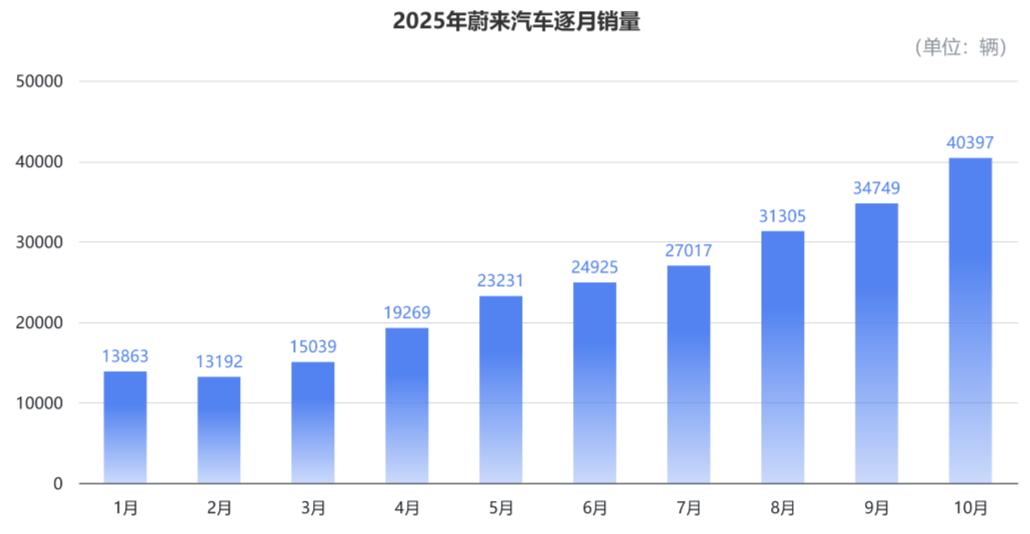
The reason why NIO lowered the monthly average sales volume guidance for the fourth quarter is actually due to the phase - out of the new energy vehicle purchase tax exemption, which has caused fluctuations in the entire automotive industry. NIO expects that the "end - of - year surge effect" (i.e., seasonality) in the industry in Q4 won't be as obvious as in previous years.
However, Li Bin believes that the impact of this policy phase - out on the industry won't be too significant. After all, to date, the dependence of intelligent electric vehicles on policy support has been much less than in the past, and the market and consumers' psychology have basically digested the new policy.
He believes that the impact of this phase - out on NIO will be relatively smaller than on other automakers because over 80% of NIO's car owners choose to buy the car and lease the battery, and the battery price isn't included in the purchase tax.
Moreover, the phase - out mainly affects the LeDao models with relatively lower prices. For high - gross - profit models like the new ES8, the order demand remains strong, and there are still many backlogged orders.

NIO also predicts that in the first quarter of next year, which is the traditional off - season in the automotive industry, the seasonal impact will also be correspondingly weakened. Not only will Q1 next year "not be an off - season", but NIO is more optimistic about the following quarters.
Li Bin revealed that NIO plans to launch three large - sized vehicles next year, including the LeDao L80, and won't adjust its vehicle launch plan according to policy changes, maintaining the rhythm of launching two models in the first half of the year and one in Q3.
Coupled with the new ES8 and LeDao L90, which will still be in the hot - selling period next year, with five large - sized vehicles on sale simultaneously, NIO is confident that it can achieve a monthly sales volume of 50,000 units next year.
Next, the second key to profitability is gross profit. From NIO's gross profit margin in the third quarter, we can indeed see an improvement in the company's profitability.
It is expected that by the fourth quarter of this year, the company's gross profit margin for the whole vehicle can reach around 18%, and the non - vehicle business can also maintain the growth momentum of Q3, with an overall more obvious jump in the gross profit margin.

According to CFO Qu Yu, many of NIO's models maintain a high gross profit level. The gross profit margin of the new ES8 is 20%, and the gross profit margins of the "5566" models and LeDao L90 are between 15% - 20%.
With the growth of sales volume driving continuous cost reduction in the supply chain and continuous optimization of cost control, NIO's comprehensive gross profit margin may reach over 20% in 2026.
The last item related to profitability is expenses, which are divided into R & D expenses and sales, general, and administrative expenses. NIO is comprehensively improving efficiency through the CBU mechanism.