In the battle of a hundred smart glasses, can Rokid withstand the pressure?
"Underestimating this year's market demand was the biggest mistake I made this year."
Zhu Mingming, the founder of the smart glasses brand Rokid, recently made such an exclamation. Rokid originally thought it could sell 100,000 to 150,000 units of its products in 2025. However, the 200,000 orders it has received so far this year have made Zhu Mingming both happy and troubled.
Looking at the entire smart glasses industry, it is undoubtedly in a period of product explosion.
According to IDC data, in the first half of 2025, the global smart glasses market shipped 4.065 million units, a year - on - year increase of 64.2%. Data from Tmall's Double 11 on October 30 showed that the turnover of smart glasses skyrocketed 25 times year - on - year, making it one of the fastest - growing categories in the 3C digital industry. Among them, Rokid's turnover increased by more than 7 times, and Thunderbird's increased by more than 80% year - on - year. The semi - annual report on smart glasses released by JD.com on August 26 also showed that in the first half of 2025, the sales volume of smart glasses increased by more than 10 times year - on - year, and the number of settled brands tripled.
All in all, the emergence of dozens of new products in the market this year has made the competition in the entire smart glasses market unprecedentedly fierce.
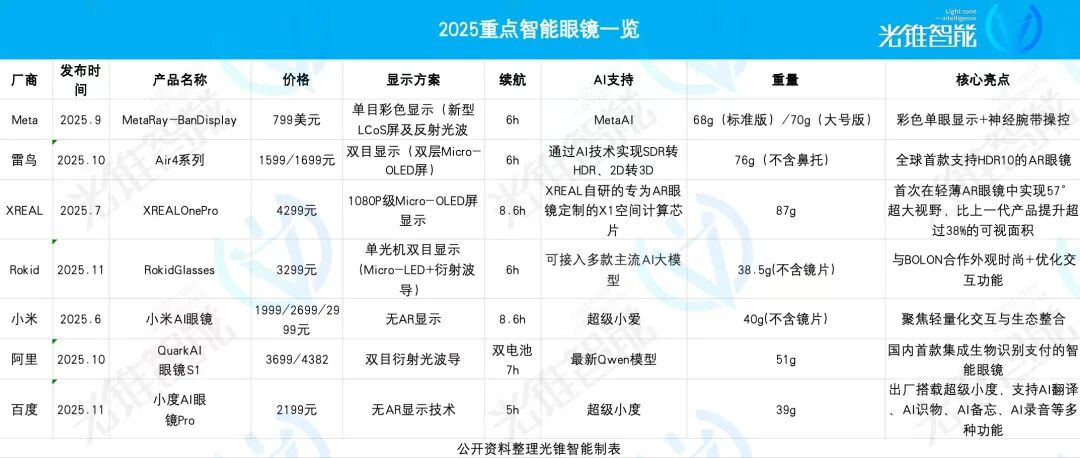
Looking at the newly released products, manufacturers with their own display technology are more inclined to launch AR products, while those with stronger software technology tend to further refine the smart functions of the glasses.
Although each product has its own highlights, smart glasses products also show certain similarities. AI assistants, AI object recognition, music listening, and photo - taking are all highly homogenized functions.
At the hardware level, the differences between smart glasses of the same type are not significant. At the AI ability level, large technology companies can also achieve good smart functions for glasses by relying on their own models and application entry capabilities.
"I respect big companies, but only if they go all in. Rokid is still the company with the highest unit investment density in this field in the industry. We won't run out of resources in the short term, so there's no need to worry."
Although Zhu Mingming said that he is not afraid of the competition from technology giants, being in a highly competitive market, not standing out is also a risk.
In the "battle of a hundred glasses", can Rokid withstand the pressure?
A Year of Delivery: Rokid Focuses More on the Consumer - Grade Track
2025 is a year when both the sales volume and the number of products of smart glasses have exploded.
After the entry of large technology companies such as Xiaomi, Alibaba, and Baidu, according to incomplete statistics from Guangzhui Intelligence, at least dozens of new smart glasses have been released this year. On average, a new smart glasses product is launched every week.
In the intensive product release rhythm of the market, Rokid, an established domestic smart glasses manufacturer, has not made significant changes in its response. Its main products are still the Rokid Glasses (ER product) released last year and the Rokid AR Lite set (AR product, including the glasses Max and the host Station).
From the overall rhythm, this year is the year when Rokid delivers the products released in 2024 and starts large - scale delivery. Among them, Rokid Glasses is the current focus of Rokid's products.
After the product was released in 2024, Rokid began to deliver (to pre - order users) Rokid Glasses on June 24 this year. At that time, Rokid had received 250,000 global pre - order orders. On September 1, Rokid Glasses were launched on all channels, and the sales volume exceeded 40,000 units in the first 5 days. During the just - passed Double 11, Zhu Mingming said that the sales of Rokid Glasses reached 50 million yuan. Calculated at the latest price of 3,299 yuan, it is equivalent to selling about 15,000 units. In total, Rokid Glasses has obtained at least 55,000 more orders after its official launch.
Under the pressure of the rapidly increasing orders, Rokid is currently in a state of severe production capacity shortage. In a recent interview, Zhu Mingming said that he seriously underestimated the market demand. "We initially planned a production capacity of 100,000 - 150,000 units, but it was far from enough. Many orders had to be postponed to next year." Since this year's Double 11, Rokid has required the supply chain to adjust to three - shift production. It is expected that the industry will have a production capacity of one million units after December. "We will try our best to only sell in - stock products and not sell futures."
In other words, under the pressure of production capacity, it is unlikely that Rokid will launch new products this year. Moreover, Rokid's product focus has also significantly shifted to Rokid Glasses. The biggest change in the company's strategy is that Rokid's customer group has shifted from the original "semi - To B and semi - To C" to the pure consumer - grade entertainment track.
In 2024, in order to cooperate with the Rokid AR Lite and the concept of spatial computing, in addition to demonstrating the display effect, Rokid also showed a lot of cooperation with industry applications. For example, when referring to the scenarios of museum and scenic spot guidance, Zhu Mingming said, "For example, in our projects implemented in more than 200 museums and scenic spots, all were handed over to our partners."
In the press conference in 2025, for the Rokid Glasses jointly launched by Rokid and BOLON in November this year, more refined polishing was done on the functions for the C - end consumer scenarios. For example, it cooperates with Gaode to provide navigation functions; cooperates with Alipay for voiceprint payment; cooperates with JD Technology to launch the "look and search for the same - style shopping" function; and cooperates with QQ Music to launch a music experience exclusive to smart glasses.
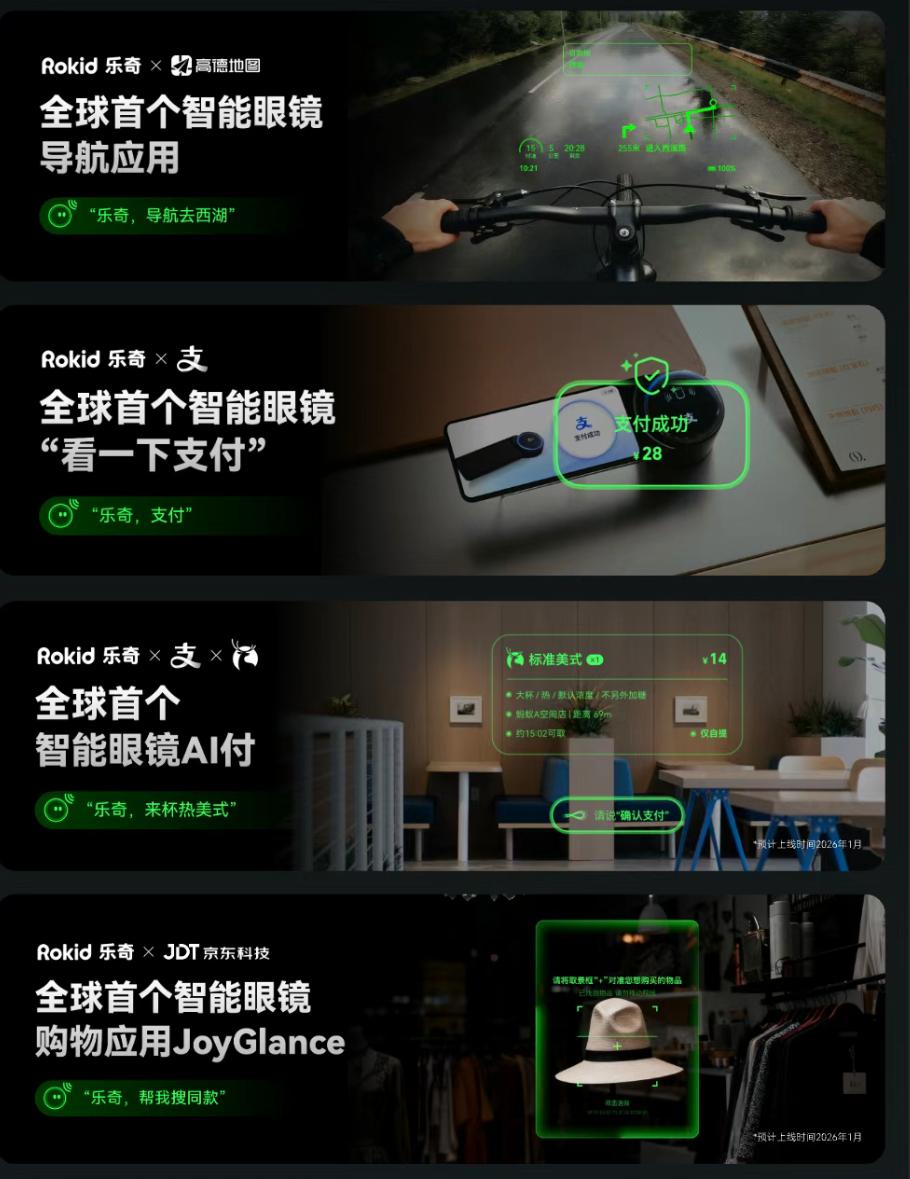
The rich consumer - grade application ecosystem of Rokid Glasses cannot be separated from Rokid's self - developed Rokid YodaOS system (the system has two versions, targeting AR Lite and Glasses respectively).
Different from other smart glasses manufacturers that simply modify the Android system, the most important goal of Rokid for the smart glasses system is openness. Especially after Rokid released the Rokid Glasses SDK in September this year, by opening interfaces such as AI, interaction, and sensors, Rokid Glasses has unparalleled playability in the smart glasses industry. For example, some users have "installed" a vocabulary - learning software in the glasses, and some have ported NES games into it. Such openness is almost unique among smart glasses manufacturers.
"Big companies have their own burdens."
But as Zhu Mingming said, the open system ecosystem of Rokid smart glasses is actually an advantage of a "small company".
For domestic large - scale models in the market, such as Tongyi Qianwen, DeepSeek, Doubao, Zhipu Qingyan, and Nami Search, Rokid has already connected to all of them. It can be said that it has all kinds of AI large - scale models. Rokid also doesn't need to worry about the APP ecosystem carried by smart glasses. Similar to Alipay and QQ Music, these are the best applications in the segmented fields of the Chinese market. Now, in terms of the developer ecosystem, Rokid has gathered nearly 30,000 developers and nearly 5,000 enterprises. Compared with April last year, the number of Rokid developers has grown tenfold.
With the support of the developer ecosystem, Rokid is trying to transfer more functions that were originally only accessible through mobile phone interaction to smart glasses. As a startup, this year is the twelfth year since Rokid was founded. After experiencing a period of being in the cold and surviving a difficult start - up period, it has finally welcomed the spring of the industry.
"In three to five years, mobile phones will still exist, but glasses will be the main device. Mobile phones will serve as terminals for communication, computing, and storage, while more interaction will occur on glasses." Zhu Mingming said.
Regarding the market expectations for the next few years, Zhu Mingming gave specific figures: Rokid aims to sell 1 million units next year, 2 - 3 million units the year after, and exceed 10 million units three years from now. "Either we will achieve this goal, or other brands will. But the trend is irreversible."
However, considering the current market performance of smart glasses, such a goal may still be a bit high.
Rokid at a Crossroads
Although Rokid has been very successful in 2025, it is still far from the time to "relax".
In the "battle of a hundred glasses" in 2025, so many products were launched in a short period because everyone saw the success of Meta Ray - Ban.
"If we consider the approximately 2.6 billion myopic people globally and the annual sales volume of about 1 billion pairs of sunglasses, the basic user scale is huge, and it is expected to be developed into a major category of smart hardware in the future." Many securities firms have calculated the market based on this logic and maintain a rather optimistic expectation.
Judging from the sales performance, the sales volume of smart glasses has indeed skyrocketed. According to IDC data, in the first half of 2025, the global smart glasses market shipped 4.065 million units, a year - on - year increase of 64.2%. IDC predicts that the global smart glasses market shipments will exceed 40 million units by 2029. Based on 2024 as the base value, the CAGR5 will reach a terrifying 55.6%.
Although the industry is growing rapidly, Rokid, which claims to sell 10 million units in three years, does not have a large market share. According to Counterpoint statistics, Rokid's market share in the global AR glasses market is not high and is almost on par with the "Other" category. (Counterpoint's statistical scope includes both AR and optical waveguide glasses as AR, and Meta's products without display are not included.)
Moreover, Rokid is currently facing "sniping" from other players. For example, INMO GO3, released by Yingmu this year, set a record of over 20,000 pre - orders on all channels in the first 3 days of its launch. The Quark AI glasses, scheduled to be released on November 27, have already received more than 6,000 pre - orders before their release.
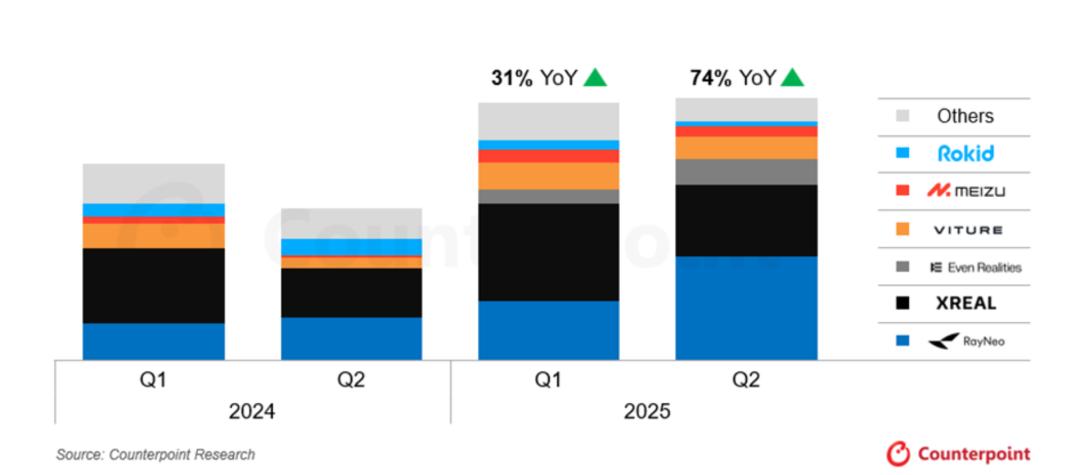
The difficulty for Rokid to achieve its sales goals comes partly from the entire smart glasses industry.
According to IDC statistics, the majority of the actual sales volume of smart glasses does not come from the ER and AR products promoted by well - known brand manufacturers, but from the "not - so - smart" products from Huaqiangbei.
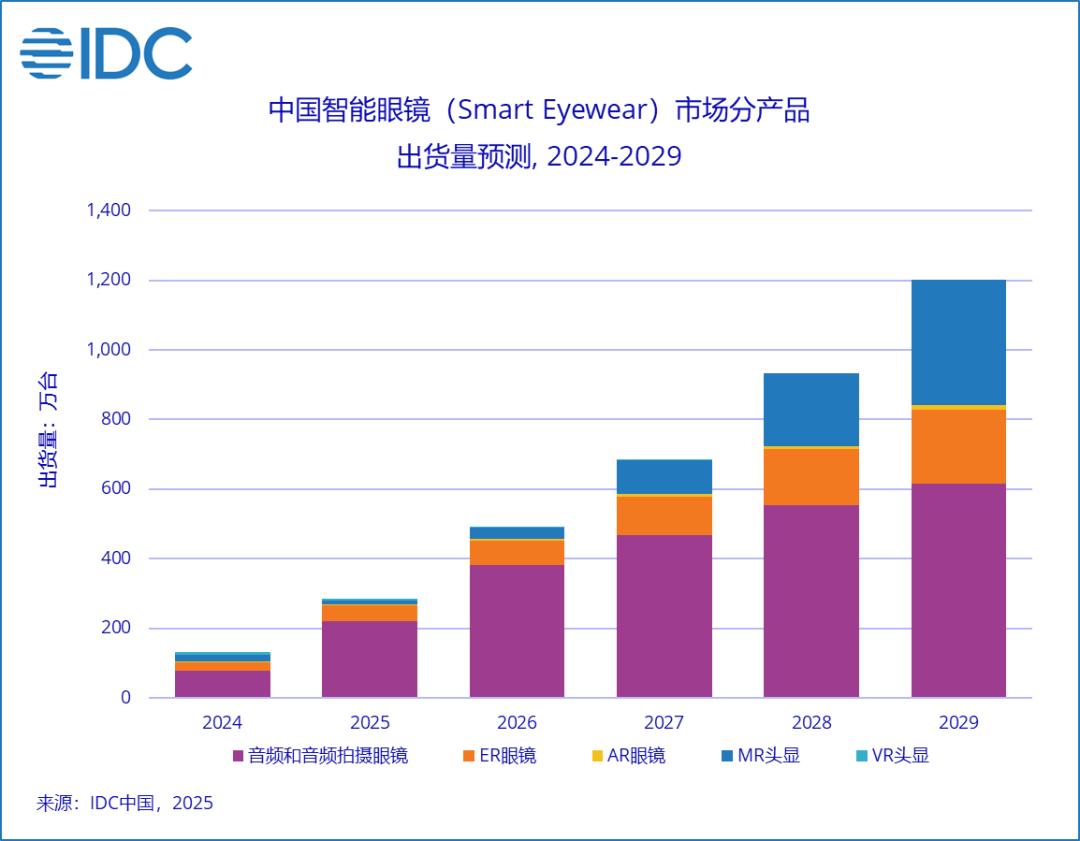
The reason for this phenomenon may be related to the imperfect construction of the sales channels in the smart glasses industry.
In its report in the first half of 2025, IDC mentioned that "in the second quarter of 2025, in the shipment channels of the smart glasses market, the proportion of shipments through retail channels (third - party channels) increased by 4.0% year - on - year, and the proportion of shipments through direct - sales stores (official online stores) increased by 4.4% year - on - year."
This data performance is actually a bit counter - intuitive. In the context of smart glasses manufacturers strengthening cooperation with third - parties, why did the proportion of shipments through retail channels only increase by 4.0%?
Since 2024, smart glasses manufacturers have started to learn a lot from the cooperation experience of Meta and Ray - Ban and have chosen to strengthen cooperation with physical glasses channel providers to promote their products into more offline stores. Correspondingly, in addition to jointly launching new products with BOLON (under Essilor), Rokid has also entered the stores of chain channel providers such as Boshi Optical and other cooperation projects that support customized lenses in offline glasses stores in the past year.
Regarding the specific results of the cooperation, Rokid once revealed that "Rokid already has 1,007 offline franchise stores, and the income brought by Rokid accounts for more than 50% in nearly 40 of them." Obviously, Rokid's cooperation with third - parties is still not strong enough.
In addition, another reason for Rokid's sales difficulties is homogenization.
From the perspective of software ecosystem adaptation, the software functions of most current smart glasses basically rely on cooperation with APP manufacturers. The AR navigation, voiceprint payment, and music - playing functions that Rokid Glasses currently features are not actually scarce. Because large technology companies can, after cooperating with Rokid, transfer these functions to their own or other cooperative products.
Moreover, these software functions implemented through cooperation with Rokid are actually a bit "under - polished". For example, in Rokid's voiceprint payment function, users need to call out the AI by voice, scan the code, and confirm the payment by voice in three steps. This operation is not only complicated, but also making sounds in public is a "social - death moment" for introverted people.
In other words, if Rokid doesn't want its products to be homogenized, it needs to significantly lead the industry in technology.
But this is actually quite difficult. After all, the barriers to self - developing the software and hardware of smart glasses are extremely high. Meta can become the "leader" in smart glasses because it truly has the ability of a full - stack AI large - scale model. Thunderbird can maintain its leading position in the market share of AR glasses because TCL behind it has a globally leading Micro LED production line. The "autonomy" of the smart glasses system that Rokid has can ultimately show very little differentiation.
Standing at the crossroads of the industry's sales explosion, Rokid, which has set a goal of selling 10 million units in three years, seems to have no other choice. Before truly solving its own and the smart glasses' problems, it may be difficult for Rokid to reach its "iPhone moment".
Conclusion
Whenever I study a new smart terminal and think about the upper limit of this product, I often think of the embarrassment that Jobs once faced.
In the summer of 2004, Jobs hoped to integrate the iPod and the music store into Motorola's mobile phones to expand Apple's advantage in the music copyright field. Ed Zander, the then - CEO of Motorola, showed great interest in this cooperation and also said a sentence that made Jobs think deeply for a long time -
"When you're leaving your house, you make sure you have three things. Your keys, your wallet and your cell phone. Your iPod isn't on that list."
Rokid still has a long way to go before it becomes a "must - have" item when going out.
This article