Annual revenue exceeds $30 million: Former Huawei employees tap into the AI wave in the Middle East | Insight Global
Author | Ou Xue
Editor | Yuan Silai
Editor's note: When going global becomes the core strategy of a Chinese company, how to conquer the global market has become an extremely professional topic. In the evolution of globalization, many Chinese brands have stood at the forefront. In view of this, Yingke has launched the "Insight Global" column to explore the cutting - edge directions and opportunities for Chinese brands to go global from the perspective of brand growth and change, providing thinking and inspiration for global players and the industry.
This is the 52nd issue of our column - with "deep localization + mid - platform AI capabilities" as the core advantages, Neuxnet has successfully positioned itself in the digital wave in the Middle East. The company focuses on three core industries: finance, infrastructure, and culture and tourism. Through its self - developed EAIP enterprise - level AI platform, it provides customers with full - stack solutions from intelligent agent applications to business process reengineering. Its AI intelligent agents have replaced more than 50% of manual operations in actual scenarios, and it is expected that its revenue will exceed $30 million in 2025.
While the "battle of hundreds of models" in the domestic AI field is in full swing, a Chinese - background technology company has quietly opened up a new situation in the Middle East.
Many Chinese entrepreneurs have more or less heard of Saudi Arabia's "Vision 2030" and the "Smart Dubai" initiative. When it comes to enthusiasm for new technologies, Middle Eastern governments are no less enthusiastic than any major power.
The digital infrastructure wave that once occurred in China is now repeating itself in the Middle East.
Taking Riyadh in Saudi Arabia as an example, local banks are gradually adopting AI systems to replace traditional manual credit card review positions. At the same time, insurance companies are also introducing AI agents to take over the vehicle insurance survey process that is suspended daily due to religious ceremonies, in order to improve operational efficiency.
This will be a growth opportunity worth $400 billion over the next decade.
In 2015, serial entrepreneur Zhang Lei founded the software company Neuxnet, initially focusing on the C - end business. In 2021, it shifted to the B - end. With its enterprise - level AI solutions, Neuxnet has deeply participated in the digitalization process of countries such as Saudi Arabia, Qatar, and the United Arab Emirates. Currently, its annual revenue is nearly $30 million. Among them, the AI business accounts for more than 50% of the company's revenue, and it is expected to increase to two - thirds next year.
Although the Middle East market is vast, the competitive landscape is complex. It is a market with full competition among global enterprises. After exploration, Neuxnet has found its own differentiators. It does not aim to be a low - cost alternative to Indian companies, nor does it focus on the standardized product output of European and American enterprises. Instead, it provides high - value AI services to customers through deep localization and configurable mid - platform capabilities.
Currently, Neuxnet has deeply penetrated into three core fields: finance, infrastructure, and culture and tourism. Its EAIP enterprise - level AI capabilities platform has become the fastest - growing business line, and it is expected to account for two - thirds of the company's revenue next year.
"What the Middle East really lacks is not technology, but companies that understand both technology and scenarios," Zhang Lei told Yingke.
Neuxnet's practice in the Middle East provides new ideas for Chinese technology companies going global: when different countries are chasing AI, providing deep localization capabilities may be more competitive than the parameters themselves.

Positioning in the Middle East
Most founders of enterprises that can take root in the Middle East have many years of local work experience and extensive connections.
Although Neuxnet's headquarters is in Singapore, it has a deep Middle East background.
Zhang Lei was involved in overseas communication infrastructure construction at Huawei in his early years and later became a core member of Baidu's wireless business.
After founding Dianxin Mobile in 2010, Zhang Lei began to focus on internationalization in 2012. He built two tool matrix systems successively, with users covering North America, South America, Southeast Asia, the Middle East, and North Africa. In 2017, he initially began to deeply penetrate into the Middle East and Central Asia markets and completed tool - based products with tens of millions of daily active users. In addition, starting in 2019, he cooperated with a royal enterprise in the UAE and completed several major national - level projects, laying a solid foundation for the subsequent large - scale expansion of business in the Middle East.
Even so, Neuxnet went through twists and turns before finally targeting B - end customers in the Middle East market.
At the beginning, like many entrepreneurs, Zhang Lei entered the C - end market, which seemed easier to grow. However, soon, the company's ToC communication products were successively banned in the Middle East, North Africa, and were massively removed from the Indian market.
He realized that the global market environment had undergone fundamental changes. "Shifting from ToC to ToB is essentially an inevitable choice to deal with systematic risks," Zhang Lei recalled.
He also analyzed the situations of several major markets and found that the United States has high barriers, South America is volatile, Europe has thin profits, and Southeast Asia has weak payment systems. Only the Middle East, especially countries such as Saudi Arabia, the UAE, and Qatar, is sending out optimistic signals and is a "high - value market."
Recognizing the trend is just the first step. The real test is how to survive in the Middle East.
In the Middle East market, Neuxnet quickly encountered three types of competitors: Americans master top - notch technologies, Europeans have penetrated into all industries, and Indians undertake workflow development at extremely low costs. Chinese companies have no chance of winning if they compete on cost or communication.
Neunext quickly demonstrated the flexibility typical of Chinese enterprises. It does not engage in the "workflow customization" that Indians are good at, but focuses on communication and AI applications with high technical thresholds. It does not produce standardized products like Europeans and Americans but responds quickly to customer needs with a "mid - platform + customization" approach. It is even willing to share part of its intellectual property and code to build trust, lower the usage threshold, and has built a complete FDE cooperation model.
This approach of pre - placed engineers + technical mid - platform quickly paid off. Especially at the AI model level, with the rise of open - source models such as DeepSeek and Qianwen, Chinese teams are gradually on par with European and American teams in terms of models, and even outperform them in the application side - thanks to their ability to be closer to customers and iterate more flexibly.
Currently, Neuxnet's core business focuses on two major areas: one is the communication technology direction, mainly manifested in the construction and operation of super apps; the other is the EAIP (Enterprise AI Platform) enterprise - level AI capabilities platform, which provides enterprises with products and technologies such as model selection, multi - model architecture, computing power coordination, enterprise knowledge platform, and enterprise intelligent agents, and can reduce the manual intervention rate in business processes by more than 50%.
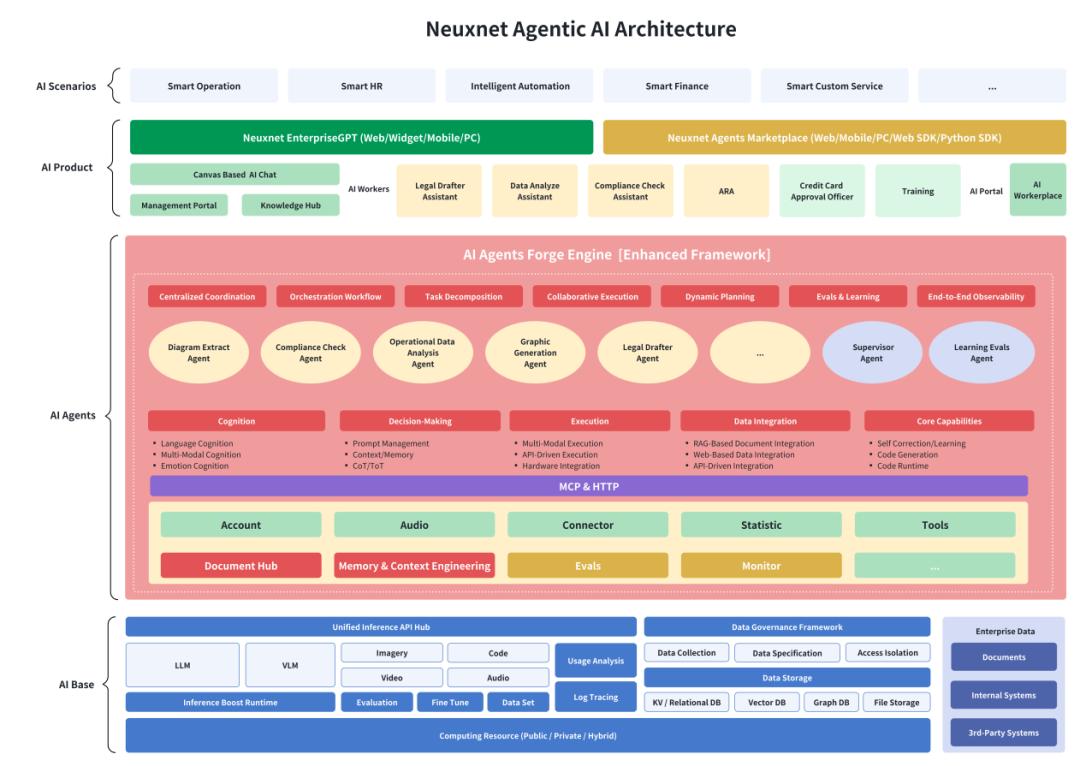
Neuxnet Agentic Architecture (Source/Enterprise)
Neuxnet's products have been deeply applied in core fields such as infrastructure, culture and tourism, and finance in the Middle East and have a place on the list of large B - end customers.
In addition, in addition to the main battlefield in the Middle East, Neuxnet's business has also gradually expanded to multiple countries and regions such as Central Asia, Southeast Asia, Japan, and Singapore, and it has three R & D centers and five branches globally (in Saudi Arabia, the UAE, Qatar, Hong Kong, and Japan).

Betting Big on AI
In global competition, Neuxnet has fully demonstrated the AI capabilities of Chinese companies. Next, the company will also shift its focus entirely to AI.
Neuxnet's EAIP enterprise - level AI capabilities platform has a clear structure, covering three product sequences: EnterpriseLLM builds a multi - model architecture to solve model selection and data governance problems; EnterpriseGPT provides enterprise - level efficiency tools, including intelligent search, knowledge base, and various enterprise digital tools; EnterpriseAgent is directly embedded in business processes, replacing traditional manual links, and has become the fastest - growing business segment.
Among them, in the field of EnterpriseAgent, Neuxnet has divided its implementation into three categories: general - purpose agents (such as market analysis and data analysis), workflow agents (deeply involved in business processes), and functional agents (such as HR and finance).
Zhang Lei said that the most effective type currently is the workflow agent. For example, Neuxnet has successfully deployed an AI solution in the credit card review process of the largest retail bank in the Middle East, increasing the recognition accuracy from 30% to 80% and the automation rate from 20% to more than 50%. At the same time, Neuxnet is also helping a large local insurance company handle thousands of daily vehicle insurance claims. By using AI video judgment to replace traditional manual surveys, it is expected to significantly reduce the manual workload rate from 70% to below 20%.
Neuxnet's agent solution has initially taken the shape of an AI digital employee and will be widely applied in areas where inefficient human labor can be replaced in the future.
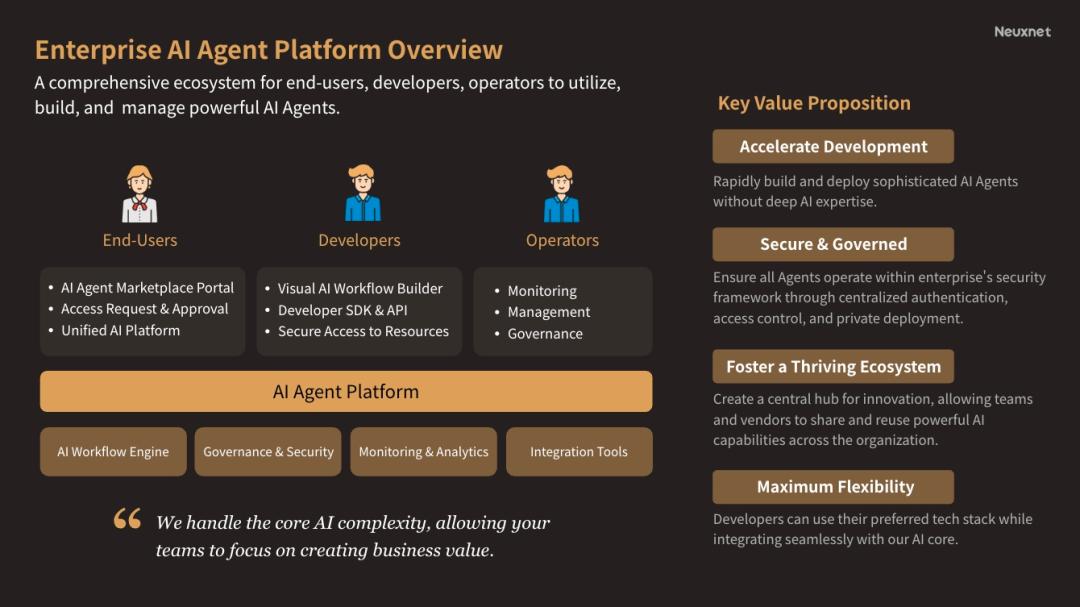
Neuxnet Enterprise AI Agent Platform Overview (Source/Enterprise)
Although Neuxnet has achieved good results in the Middle East market, it still remains cautious.
In terms of the market, Neuxnet only deeply deploys in the three industries of finance, infrastructure, and culture and tourism in the Middle East, only retains finance and infrastructure in Southeast Asia, and focuses on the energy field in Europe.
This is a typical "nail" strategy. In fact, the key to the success of enterprise - level AI lies in the depth rather than the breadth of industry knowledge. By deeply cultivating specific vertical fields, the company can continuously accumulate industry - specific process, data, and compliance knowledge, thus building a competitive barrier that is difficult to replicate.
In addition, Neuxnet has a clear focus: it only engages in AI application - layer business and gradually shuts down non - AI business to promote the AI transformation of all products.
This positioning allows it to avoid the "arms race" with technology giants in the field of basic large models and instead concentrate all its energy on its most proficient area - transforming cutting - edge AI technologies into standardized solutions to solve industry pain points.
In a market environment where the AI concept is over - hyped, this restraint is valuable. It means that the company is not blindly chasing short - term hotspots but has a pursuit of industry professionalism and long - term technology development.
The core challenge for AI technology to move from the laboratory to large - scale commercial use has now reached the crucial stage of engineering implementation. Zhang Lei believes that the next decade will be a period of great development for AI, and there are a large number of engineering problems to be solved at each stage.
At the same time, the implementation of AI technology varies globally. The vast development space means huge opportunities. For a global AI company like Neuxnet, there will be a vast expanse ahead.