With clinical breakthroughs and favorable policies, is the commercialization of domestic brain-computer interfaces about to begin?
In 2025, it is unanimously recognized by the industry as the first year of brain-computer interface in China.
This is not groundless. First, in terms of policy, in March this year, the National Healthcare Security Administration issued the "Guide for the Establishment of Medical Service Price Items for Nervous System Diseases (Trial)", marking the first time that brain-computer interface has been included in the medical insurance, and the commercial closed-loop has been initially formed; In July, seven departments including the Ministry of Industry and Information Technology and the National Development and Reform Commission jointly issued the "Implementation Opinions on Promoting the Innovative Development of the Brain-Computer Interface Industry", officially elevating the brain-computer interface industry to the national strategic level; Then in November, the 14th Five-Year Plan included the brain-computer interface in the "Six Future Industries", indicating that efforts should be made to promote it as a new economic growth point.
Second, in terms of capital, according to incomplete statistics from the Arterial Orange Database, as of November 20, 2025, there have been 28 financing rounds in the field of brain-computer interface in China this year, with a total financing amount exceeding 5 billion yuan. Among them, there was a Series B financing of 350 million yuan completed by Jieti Medical in February this year, setting a new record for the highest single-round financing in the domestic brain-computer interface field.
Finally, at the crucial clinical end, 2025 has seen fruitful results everywhere. In March, Jieti Medical successfully completed the first domestic long-term implantation prospective (FIM) clinical trial of an invasive brain-computer interface system in the human body at Huashan Hospital Affiliated to Fudan University; In September, the team led by Professor Duan Feng from Nankai University successfully completed the world's first interventional brain-computer interface-assisted motor function repair trial for the affected limb of a human body, helping a hemiplegic patient restore the motor function of the affected limb; Also in September, Mingshi Brain-Computer completed the world's first IIT experiment on visual reconstruction of "complex graphics + multiple colors", successfully achieving a leap from simple light spots to complex graphics and even color perception in visual reconstruction; In November, Zhonghua Brain-Computer and Union Hospital Affiliated to Tongji Medical College of Huazhong University of Science and Technology jointly completed the first clinical implantation surgery of a domestically developed brain-computer interface chip, and successfully collected neural signals from the sensorimotor area of the patient's brain.
Obviously, for the brain-computer interface field, 2025 is definitely a year of historical significance. Many industry insiders have also deeply felt this. Liu Bing, the founder of Mingshi Brain-Computer, said, "Many things have really happened in the industry this year. In fact, it has also pushed the brain-computer interface field to a critical turning point - it is gradually transitioning from the initial stage of focusing on the exploration of cutting-edge technologies to a new stage of demonstrating clinical value."
So, how should this be specifically understood?
After five years of talking about brain-computer interface, where has it been implemented now?
In January 2020, Zhejiang University and the Department of Neurosurgery of the Second Affiliated Hospital of Zhejiang University School of Medicine jointly completed the first domestic clinical translation research of an implanted brain-computer interface, enabling a patient with complete quadriplegia to use "thoughts" to control an external robotic arm and manipulator to perform actions such as shaking hands, picking up drinks, eating fried dough sticks, and playing mahjong, achieving three-dimensional motion control. This is regarded as the beginning of the development of the domestic brain-computer interface industry, and many people have thus gained a more practical concept of brain-computer interface.
In the following years, brain-computer interface has rapidly fermented in China and has long occupied the hot topics. Related reports mainly focused on the innovation of technologies and materials, bold assumptions about future clinical application scenarios, and the financing dynamics of the capital market. However, as time passed, the industry focus gradually extended towards clinical translation. As a result, a key question has become increasingly prominent at present, that is, where exactly are the application scenarios of brain-computer interface? And what is the current progress? The answer may lie in a series of breakthrough clinical studies this year.
It is reported that brain-computer interfaces are divided into three types: invasive, non-invasive, and semi-invasive, depending on the implantation position and method of the electrodes and the cerebral cortex. Currently, the non-invasive type is the most widely used in clinical scenarios, accounting for 86% of the market, because it only needs to attach the electrodes to the scalp, so it has the characteristics of high safety and low cost. Currently, it is mainly used in scenarios such as training of attention and cognitive ability, closed-loop regulation of sleep and emotions, and closed-loop neural rehabilitation, motion assistance, or voice output using eye tracking, electroencephalogram, electromyogram, and rehabilitation aids.
According to the current market feedback, the application of brain-computer interface in these scenarios has been relatively mature. Take the world's first mass-produced intuitive control intelligent bionic hand launched by Qiangnao Technology as an example. After wearing it, users can control the prosthetic limb through the brain to perform fine actions such as grasping, pinching, and rotating, achieving an operation experience close to that of natural limbs. According to the enterprise, the quarterly sales volume of the intelligent bionic hand in 2024 has exceeded four to five times the total annual sales volume in 2023, and it is in a stage of rapid market expansion.
Another representative non-invasive product is various intelligent electroencephalogram bracelets. Take BrainLink under Hongzhili Technology as an example. It collects electroencephalogram signals through the forehead electrodes and combines multi-modal data such as electromyogram and heart rate variability to achieve functions such as attention training, meditation assistance, and emotion regulation. Therefore, it is widely used in consumer-grade scenarios such as education, psychological intervention, and daily health management. In 2024, the sales volume of BrainLink exceeded 100,000 units, ranking among the top three in the domestic non-invasive brain-computer interface consumer-grade market.
Compared with the non-invasive type, the market share of invasive and semi-invasive brain-computer interfaces is only 14%, but the clinical scenarios they target have extremely rigid demands, including restoring the motor ability of patients with high paraplegia, enabling aphasics to spell at high speed with "thoughts", reconstructing the visual function of the blind, and exploring neuromodulation therapies for mental diseases such as depression and obsessive-compulsive disorder. Once any of these scenarios is realized, it will open up a new medical industry track.
Taking the invasive brain-computer interface as an example, because the electrodes need to be directly implanted into the cerebral cortex, the signal quality is extremely high, but at the same time, it also brings greater safety issues, making clinical research always face extremely severe technical challenges. However, from this year's perspective, these seemingly impossible clinical scenarios are gradually becoming a reality.
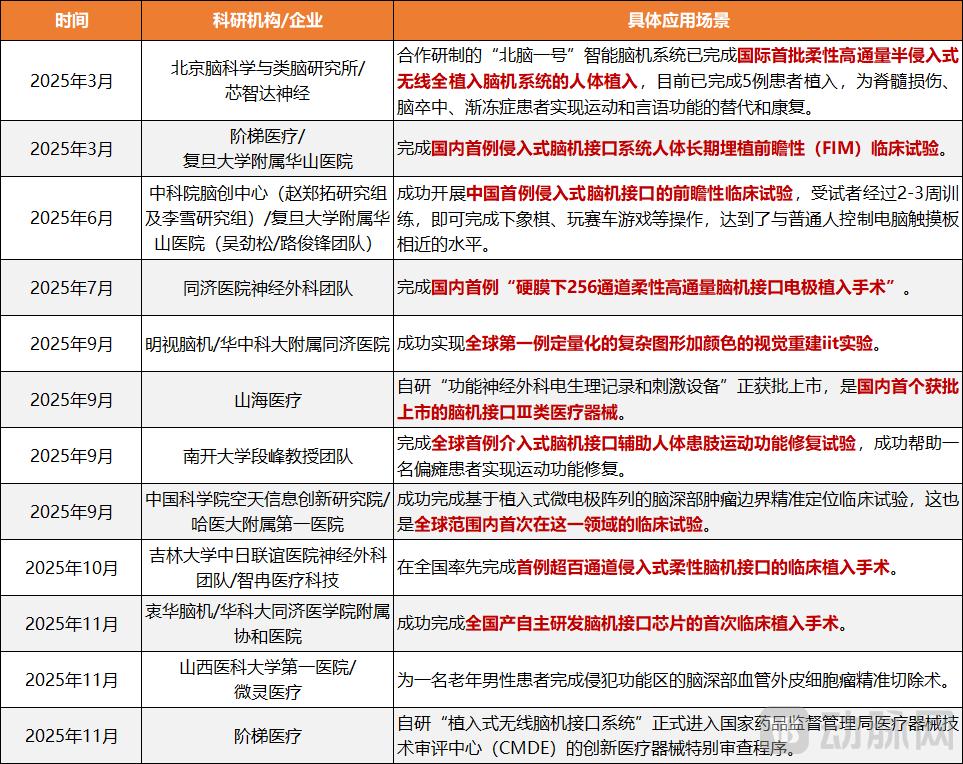
Figure 1. Breakthrough clinical research in the domestic brain-computer interface field in 2025
For example, in terms of restoring the motor ability of patients with high paraplegia, in June 2025, the team led by Professor Duan Feng from Nankai University completed the world's first interventional brain-computer interface-assisted motor function repair trial for the affected limb of a human body. Through the combination of interventional brain-computer interface technology and functional electrical stimulation technology, they successfully helped a hemiplegic patient restore the motor function of the affected limb. It is reported that after the implantation surgery, the patient's left upper limb has been able to perform daily actions such as free grasping and taking medicine, and the overall motor function has been greatly improved.
In addition, in terms of restoring language ability, at the beginning of 2025, Brain Tiger Technology, the Department of Neurosurgery of Huashan Hospital Affiliated to Fudan University, and the Tianqiao Institute for Brain Science jointly carried out a clinical trial research on high-precision real-time motion decoding and language decoding - a patient with brain injury conceived the sentence "Happy New Year 2025" in his mind, and through computer decoding, finally sent a command to the robotic arm to make a heart-shaped gesture. It is worth mentioning that compared with English, which only has 26 letters, Chinese has 418 syllables and 4 tones, so the decoding difficulty is higher, and a neural encoding and decoding mechanism and information processing means more in line with the characteristics of Chinese are needed.
Finally, in terms of the alleviation and treatment of mental diseases, in November 2025, the team led by Sun Bomin from Ruijin Hospital published the data of the first batch of domestic prospective clinical trials of invasive brain-computer interface treatment for refractory depression in a sub - journal of Nature: In the open - label stage, half of the patients (13/26) had significantly improved symptoms of depression and anxiety, and 9 patients even reached a remission state where the symptoms basically disappeared.
In this regard, Liu Bing, the founder of Mingshi Brain-Computer, summarized, "At present, the clinical scenarios of invasive brain-computer interfaces are mainly in two directions. One direction is neuromodulation, such as the treatment of epilepsy or Parkinson's disease; the other direction is the reconstruction of nervous system functions, including movement, vision, language, etc. The non - invasive type, because of its characteristics such as safety and convenient operation, currently mainly focuses on consumer - grade auxiliary interaction scenarios such as emotion monitoring, attention training, health indicator evaluation, and simple command recognition."
Unable to achieve large - scale monetization in the short term, how to survive first?
On November 11, 2025, the "Implantable Wireless Brain - Computer Interface System" independently developed by Jieti Medical officially entered the special review process for innovative medical devices of the Center for Medical Device Evaluation (CMDE) of the National Medical Products Administration, becoming the first invasive brain - computer interface product in China to enter this "green channel", marking a key step in the industrialization process of China's brain - computer interface from clinical verification to market access.
Although this is gratifying, it must also be recognized that it will take at least 3 - 5 years for the brain - computer interface field to truly achieve large - scale monetization. Therefore, a very sharp topic is now in front of all brain - computer interface enterprises: How to survive first without a stable commercialization model and a mature profit model?
For this reason, Arterial Network summarized the following three feasible paths through case studies and interviews with senior industry insiders:
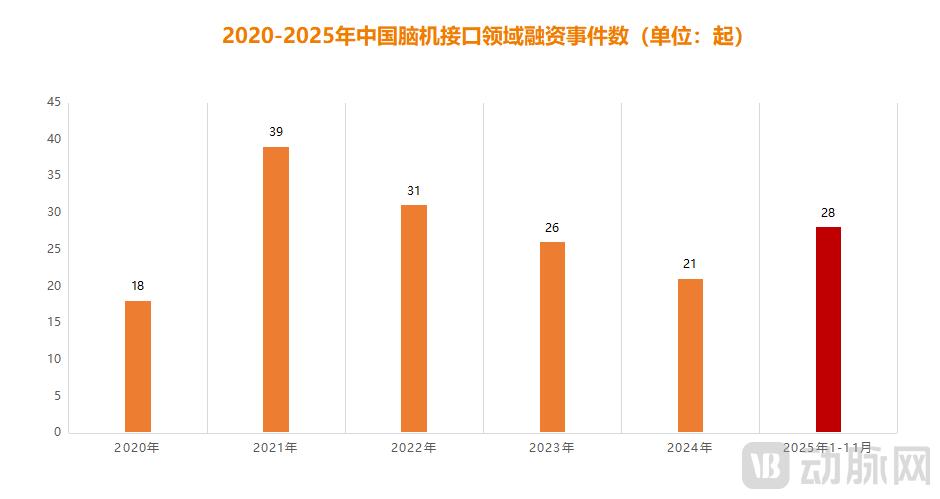
Figure 2. Number of financing events in the Chinese brain - computer interface field from 2020 to 2025 (Data source: Arterial Orange Database)
The first point is to seize the source of investment and financing. According to incomplete statistics from the Arterial Orange Database, there have been more than a hundred financing rounds in the domestic brain - computer interface field in the past five years, and these funds have become an important support for many enterprises to survive to date. Looking to the future, financing will still be the main or even the only "blood transfusion" channel for many brain - computer interface enterprises. Therefore, to survive, enterprises must have the core ability to continuously raise funds in the capital market.
As the industry continues to develop, the investment and financing logic of brain - computer interface has changed significantly. In this regard, Jiang Donghui, a partner at Delian Capital, said, "In the past few years, the technological development path of the domestic brain - computer interface field was not clear, and most of the investments were made by focusing on upstream advantageous technologies. In the past one or two years, with the increasing maturity of domestic brain - computer interface engineering and the deepening understanding of clinical applications, when investors choose investment targets, in addition to considering the technological advancement, maturity, and the feasibility of solutions to meet actual clinical needs of enterprises, they also need to pay attention to whether the core team has the depth and breadth of scientific insight, the ability to organize cross - disciplinary resources, and the desire for commercialization. In short, both the 'business' and the 'people' need to match, and more emphasis is placed on market certainty."
Extending along this logic, it actually requires brain - computer interface enterprises to have a clear commercial path at present, which happens to be the second path to "survive first". In this regard, Liu Bing, the founder of Mingshi Brain - Computer, said, "We should not always try to do big and comprehensive things, nor should we always be obsessed with obtaining the first license in a certain field. More importantly, we should first find a certain track. This track should first have a rigid demand in clinical practice, second, its payment logic should be very clear, and finally, it should be easy to develop, at least the current technology can cover and achieve this segmented direction."
The last path is to "lay eggs along the way" and continuously achieve self - sufficiency. For this reason, Jiang Donghui, a partner at Delian Capital, proposed a short, medium, and long - term strategic layout. "The country has made a large investment in brain science research in recent years. Many innovative products of brain - computer interface companies can be applied and commercialized in scientific research scenarios without obtaining registration certificates. Therefore, the scientific research market is a short - term product; in the medium term, some upgrades of existing clinical products can be made, such as flexible SEEG electrodes, intraoperative monitoring products, and innovative R & D combined with existing neuromodulation products; in the long term, it is the R & D of BCI products, finding application scenarios with great clinical demand, conducting clinical trials, obtaining registration certificates, and commercializing them."
Overall, the key for brain - computer interface enterprises to survive at present is to find more market certainty, including having the ability to continuously raise funds, focusing on a potential track, and establishing a feasible commercialization path.
A rapidly growing market and problems to be solved urgently
According to data from Precedence Research, the global brain - computer interface market size was approximately $2.62 billion in 2024, and it is expected to reach $12.4 billion by 2034, with a compound annual growth rate of 17.4% from 2025 to 2034. Focusing on the Chinese market, data predicts that the market size of China's brain - computer interface will exceed 6 billion yuan by