Back to the Factory: The Management Legends Born in the Manufacturing Industry
The academic community should return to the factory floor. Instead of merely abstractly defining what "management with Chinese characteristics" is, it should summarize the organizational wisdom and institutional creativity of Chinese enterprises in dealing with complex realities through factory practices.
The Factory - The Origin of Management Science
The factory, once regarded as the "furnace of iron and fire," has not only shaped the industrial foundation of human civilization but also given birth to the cornerstone of modern management theory. From the roaring steam in the steel - rolling workshop to the whispering algorithms in the cleanroom, the factory has always played a pivotal role as a hub connecting technological progress and organizational evolution. It is the origin of management science and the cradle of management ideas.
At the end of the 19th century, scientific management germinated in the steel mills of Pennsylvania. In the early 20th century, the assembly - line revolution exploded in the automobile factories of Detroit. In the mid - 20th century, the human relations theory had a profound impact at the Hawthorne Works in Chicago. Later, Toyota's production system shocked the world with its lean philosophy, establishing a new paradigm that combines high efficiency and high flexibility. Even today, with AI algorithms, digital twins, and industrial robots pouring into the production workshops, the factory remains the "testing ground" and "evolution field" for various management ideas and technologies. This historical context reveals an important fact: Management theory has never been a castle in the air. It is a systematic response and institutionalized reflection of an organization when facing specific problems. Confronted with real - world challenges such as complex labor, scarce resources, and difficult coordination, factories have gradually spawned a series of management innovations, ranging from efficiency optimization to human - centered motivation, and from process design to strategic scheduling, through continuous exploration.
Entering the 21st century, with the deep integration of technologies such as big data, artificial intelligence, and edge computing into the manufacturing system, the factory has evolved from a mere physical "production unit" to a composite platform for digital control, organizational collaboration, and knowledge renewal. This has enabled "factory management" to transcend the scope of traditional "workshop management" and become the most cutting - edge field for observing the evolution of organizational forms, understanding the logic of human - machine collaboration, and testing the effectiveness of management mechanisms. This understanding is particularly crucial for the management of contemporary Chinese enterprises. From the labor - force dividend of the "world's factory" to the technological leap of a "manufacturing powerhouse," China's manufacturing industry is undergoing a profound transformation and upgrading. Digitalization, greening, and intelligentization have become the keywords for high - quality development. Enterprises' management also urgently needs to shift from experience - driven to mechanism - driven, and from tool imitation to theoretical innovation. Therefore, understanding the management theories born in factories is not only about tracing the origin of knowledge but also about illuminating the path for future practices.
Only by returning to the perspective of the factory and the soil of practice can management gain real vitality. Reactivating the fundamental relationship of "factory - management - innovation" is an important cornerstone for promoting Chinese management theory to the world.
The First Factory Revolution: The Era of Scientific Management and Standardization with Efficiency as the Top Priority
1. Taylor and Scientific Management: Quantifying Human Labor with Scientific Methods
At the end of the 19th century, workers in American steel mills relied on experience for operations, resulting in low production efficiency and serious waste. Frederick Taylor conducted numerous experiments at the Bethlehem Steel Company in Pennsylvania. He applied time and motion studies to systematically measure, disassemble, and optimize each worker's operation, thereby significantly improving efficiency. He put forward four principles of scientific management:
(1) Replace the empirical method with scientific methods;
(2) Select, train, and match workers scientifically;
(3) Managers should cooperate with workers rather than confront them;
(4) Replace individual judgment with a scientific system.
These principles form the cornerstone of scientific management. Although scientific management has been criticized as "mechanizing human nature," its role in promoting productivity is unprecedented, and it has laid the foundation for modern production management.
2. Fordism and the Assembly - Line Revolution: The Logical Closed - Loop of Mass Production
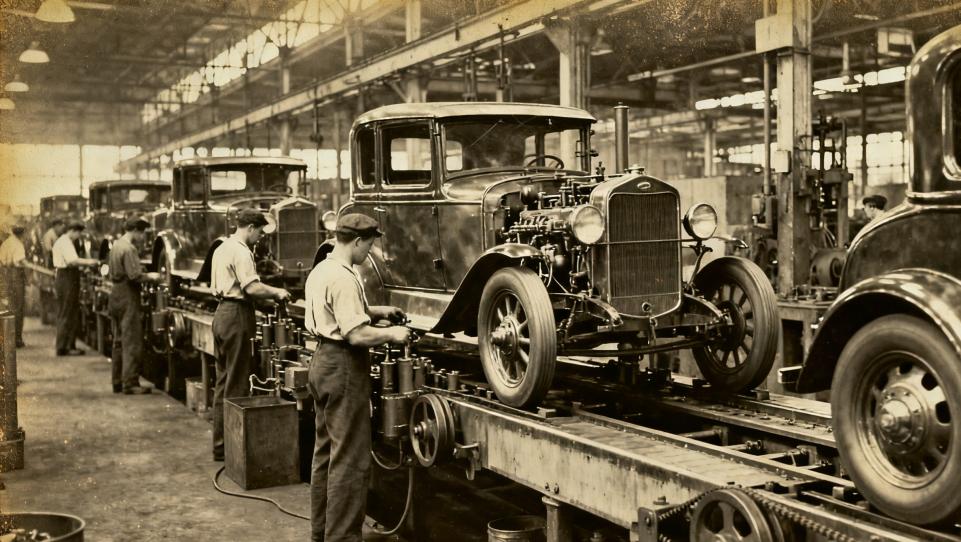
In the early 20th century, Henry Ford introduced the assembly - line production technology at the Highland Park Plant in Detroit, which greatly changed the operating logic of the manufacturing industry. Through a moving conveyor belt, products were transferred from one workstation to the next, and each worker was only responsible for a simple action. This highly - specialized division of labor and standardized rhythm process reduced the chassis assembly time of the Model T from 12 hours to 1.5 hours, significantly reducing unit costs and doubling production. Fordism is not only a technological system but also a social system. In 1914, Ford announced that it would raise the daily wage of workers to $5, much higher than the industry average. This not only reduced employee turnover but also enabled workers to afford the cars they produced. Thus, an industrial - capitalist closed - loop of "high wages - high efficiency - high consumption" was established, inaugurating the golden age of "mass production - mass consumption." The essence of Fordism includes:
(1) High - level standardization: Complete unification of parts and process flows;
(2) Single - product strategy: Concentrate resources to achieve economies of scale;
(3) Simplification of worker skills: Reduce training costs and facilitate rapid replication;
(4) Welfare management driven by capital: Use material incentives to replace worker protests.
Subsequently, this production logic quickly spread globally and had a profound impact on the planned economy of the Soviet Union, state - owned factories in China, and "late - developing industrialized countries" in East Asia. In China, the production models of state - owned factories from the 1950s to the 1970s were greatly inspired by it and later became the primary reference for "learning management from the West" in the early days of reform and opening - up.
3. Foxconn - The "Modern Heritage Heir" of Taylor and Ford
Among many Chinese manufacturing enterprises, Foxconn is the most thorough representative in inheriting Taylorism and Fordism. As the world's largest electronics contract manufacturer, Foxconn has built super - factories with hundreds of thousands of employees in Shenzhen, Zhengzhou, Chengdu, etc., responsible for assembling core products for brands such as Apple, Dell, and HP. In Foxconn's assembly lines, standardization, rhythmization, and division of labor have reached the extreme: Workers receive strict training, their operating actions are disassembled by stopwatches, and the rhythm between processes is uniformly controlled by takt time; the management system is highly verticalized, and each line supervisor is fully responsible for output, quality, and efficiency. This efficiency - driven machine has made Foxconn a symbol of "Made in China," but it has also been accompanied by extremely high labor intensity, psychological pressure, and a sense of alienation from humanity. Around 2010, Foxconn encountered an ethical crisis due to the "employee suicide incidents." Since then, Foxconn has launched a "transformation plan," adding employee - care mechanisms and "collaborative culture" training, attempting to transition management from "rigid control" to "flexible collaboration." This evolution process highlights an important reflection: The extreme of efficiency may not necessarily be the extreme of management; the success of standardization may also bring about the suppression of humanity.
The Second Factory Revolution: The Rise of Attention to Humanity and Organizational Culture
In the first half of the 20th century, with the acceleration of the industrialization process, the traditional management paradigm centered on "efficiency first" gradually exposed its limitations. Although the assembly line, standardization, and strict division of labor brought a leap in productivity, they also turned workers into "quantified tools," triggering widespread alienation, apathy, and resistance. Against this backdrop, the second factory management revolution quietly took place. "People" shifted from being the objects of management to the core variables of the organization, and management began to move from "technological control" to "cultural guidance" and "psychological mobilization."
1. The Hawthorne Experiments and the Human Relations School: From Efficiency to Care
From 1924 to 1932, Professor Elton Mayo of Harvard University conducted a series of productivity experiments at the Hawthorne Works of the Western Electric Company in Chicago. Initially, the experiments aimed to verify the impact of lighting conditions on production. However, the findings were unexpected: Regardless of how the lighting changed, the workers' production generally increased. The reason was that the workers felt respected and a sense of belonging because they were being noticed, which generated positive emotions and work motivation. In the subsequent "interview program," the research team delved into the workers' social relationships, psychological feelings, and group interactions, further revealing that the key variables affecting work performance were not the physical environment or salary incentives, but a sense of belonging, emotional connection, and interpersonal trust. Thus, the human relations school, which was of epoch - making significance in the history of management, was born. Its core ideas include: Workers are "social beings" with thoughts and emotions; informal groups and organizational atmosphere play an important role in work motivation; managers' emotional support, communication style, and relationship quality significantly affect employee performance.
The rise of this perspective initiated a shift from "control - based management" to "incentive - based management," giving birth to multiple management sub - fields such as organizational behavior, employee participation, team motivation, and corporate culture. The factory is no longer just a physical labor place but has become a cultural space for psychological construction, meaning identification, and organizational socialization.
2. Japanese Experience and "Soft Management": From Total Quality Management to Lean Production
In response to the Western focus on humanity, Japanese enterprises developed a unique "soft management system" under the post - war conditions of resource scarcity. This is not only a set of technical methods but also an organizational philosophy and cultural path.
Manufacturing enterprises represented by Toyota developed a new - type factory management system represented by lean production. Its core components include just - in - time (JIT), which emphasizes production on demand and minimizes inventory; the kanban system, which uses visual management to regulate the material flow and production rhythm; and continuous improvement (kaizen), which encourages employees to continuously propose minor improvements at their posts, forming a culture of "full - staff innovation and process embedding." Different from the Western "post - control" approach, lean production focuses on in - process prevention and source quality, embedding quality responsibility into each process and constructing a decentralized, highly - responsible, and participation - oriented work mechanism.
In addition, an important source of Japanese management thought is total quality management (TQM) introduced by American experts such as W. Edwards Deming and Joseph M. Juran. Deming's "PDCA cycle" (Plan - Do - Check - Act) emphasizes whole - process management (controlling quality throughout the process), full - staff participation (from senior management to front - line employees should participate in quality improvement), and data - driven and statistical analysis (such as control charts and process capability indices). This management system that combines rational tools and cultural power enabled the Japanese manufacturing industry to rise rapidly in the 1970s and 1980s, establishing global competitive advantages in the fields of automobiles, electronics, and machinery. It, in turn, influenced European and American enterprises, triggering a global "lean production wave" in manufacturing.
3. Sany Heavy Industry's Chinese - Style Lean Production
As a leading enterprise in China's construction machinery industry, Sany Heavy Industry's evolution path of factory management is also representative. In the early days, its production system faced problems such as a wide variety of product categories, customized orders, and inventory backlogs, resulting in increased costs and decreased efficiency. Since 2008, Sany has introduced a lean production system and promoted organizational improvement in the following ways: Building "lighthouse factories" and establishing automated intelligent production lines in Changsha and other places; Implementing "pull - type" production, replacing the traditional ERP push mechanism with the kanban system; Promoting a "team improvement culture," where each work unit sets improvement goals and encourages employees to participate in process design and standard updates. At the same time, Sany also attaches great importance to the construction of organizational culture and employee value identification. It has put forward the corporate mission of "Quality Changes the World" and strengthened team training, management transparency, and cross - level communication mechanisms, forming a collaborative model of "strong technology + soft culture." Today, Sany has successfully entered the era of Industry 4.0. Its management logic of "data - driven, process re - engineering, and employee participation" is the best annotation for the in - depth integration of lean production and total quality management in the Chinese context.
The Third Factory Revolution: Mathematics and Models, the "Arsenal of Rational Thinking" in the Factory
The first factory revolution relied on "action decomposition" and "process standardization." The second factory revolution introduced "understanding of humanity" and "cultural incentives." The third factory revolution stems from a deeper rational force - data modeling and system optimization. This is not only a tool and technology but also represents a modern management thinking mode based on data and guided by logic. Factory management has gradually shifted from "decision - making based on experience" to "decision - making based on models." This transformation has profoundly changed management functions such as planning, production, logistics, maintenance, and quality, and has also given rise to a large number of classic theories and optimization methods, constructing the "rational brain" of the factory.
1. Operations Research and Industrial Optimization: From the War to the Workshop
During World War II, the Allied forces of the United States and the United Kingdom developed a new method system integrating mathematical logic, probability models, and simulation deduction to optimize troop deployment, material supply, and radar layout. This system, collectively known as operations research, was originally designed for war but quickly transformed into a tool for peaceful industries after the war and became an indispensable "advisory system" for factory management.
In 1947, George Dantzig proposed linear programming. This method has been widely applied in factory scenarios such as capacity allocation, production scheduling, and transportation optimization. Queuing theory, which originated from Agner Krarup Erlang's telephone network modeling, is used for equipment maintenance, man - machine workstation scheduling, and service window arrangement.
The inventory model solves the key problem of "how much to order and when to order." It is particularly suitable for designing the quantity and cycle of material replenishment in the JIT system, ensuring the continuity of supply while controlling inventory holding costs. In the face of non - linear problems, heuristic methods such as simulated annealing, genetic algorithms, and dynamic programming are widely used in complex workshop scheduling, multi - constraint project scheduling, and path optimization in flexible manufacturing systems.
These methods together form the "mathematical arsenal" on the eve of the factory's digital transformation and have promoted the independent development of management sub - fields such as operations management and production system engineering.
2. From Tools to Theories: How Models Feed Back into Management Thinking
With the in - depth application of models, enterprises are no longer just using them to solve problems but are also using them to reconstruct their own logic and systems.
In 1984, Eliyahu Goldratt proposed the theory of constraints in his book The Goal. He pointed out that in any production system, there is always a key constraint point that determines the overall output. The key to management is not to optimize all aspects but to identify the bottleneck, concentrate resources to break through the bottleneck, and manage other aspects synchronously to avoid system imbalance caused by "local optimization." This theory breaks the myth of "comprehensive improvement" and emphasizes "systems thinking" and "priority of local control." It has had a profound impact on concepts such as lean production, agile manufacturing, and supply - chain collaboration.
As a management method driven by data analysis for process improvement, Six Sigma integrates statistical tools such as control charts, regression analysis, and analysis of variance, aiming to control process fluctuations within a very small range and achieve the ultimate quality goal of "only 3.4 defects per million pieces." Different from total quality management and lean production, the biggest feature of Six Sigma is that it clearly defines financial returns (projects must be measurable); it trains professional improvement talents through the "Black Belt system"; it advocates using "DMAIC" (Define - Measure - Analyze - Improve - Control) as the main process line. This kind of systematic method has gradually evolved from a technical methodology to an enterprise strategic tool and has been widely adopted by many manufacturing enterprises.
3. Huawei: A Sample of the "Logic - Constructed Factory"
In the first decade of the 21st century, to cope with the complexity of the supply chain under global expansion, Huawei introduced the SAP ERP system and the APS (Advanced Planning and Scheduling) system. Through linear programming and predictive modeling, it precisely matches "market - order - resource - delivery." Ren Zhengfei once proposed that the