Exclusive First Test of Intel's New Processor: Not at Full Power, but IPC Is Really Not Low
Preface: Intel's New Processor Appears Before Official Release
Not long ago, we from 3eLife went to the United States to attend the "2025 Intel Tech Tour" and brought you the latest information on Intel's 18A process, advanced packaging technology, and a series of products including the next-generation mobile processor architecture, Panther Lake.
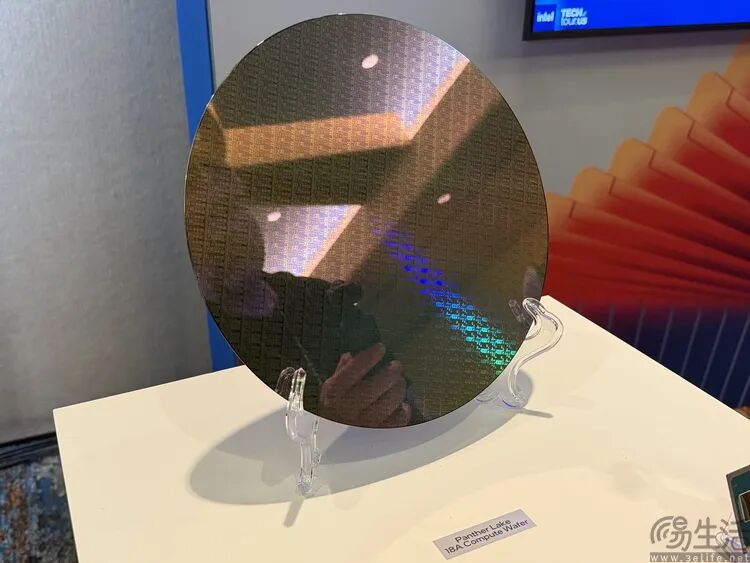
At that time, we had a close look at and even touched the Panther Lake-H processor. However, we were unable to conduct actual tests on it then. So, the information we could share with you was limited to the official architecture details and "performance comparisons" that did not involve specific benchmark scores.
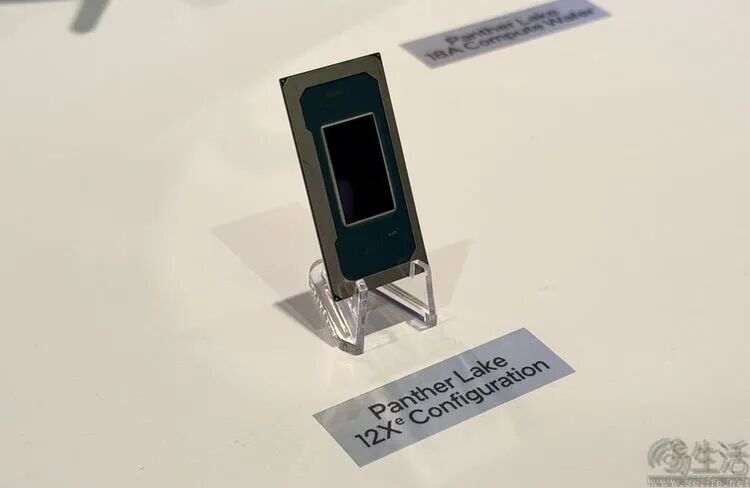
However, things have changed in recent days. Simply put, a source has leaked the engineering samples of Intel's new processors. Through relevant channels, we from 3eLife have obtained more detailed product information than what is currently available on the Internet. This includes not only specific technical specifications but also what might be the world's only benchmark scores at present.
Appearance: In the "Full-Blooded" Large Chip, the CPU and GPU Specifications Seem Off
Let's get straight to the point. The following picture was publicly shared on a social platform by the leaker, Yuuki_AnS. It is said to be a photo of Intel's Reference Validation Platform (RVP).
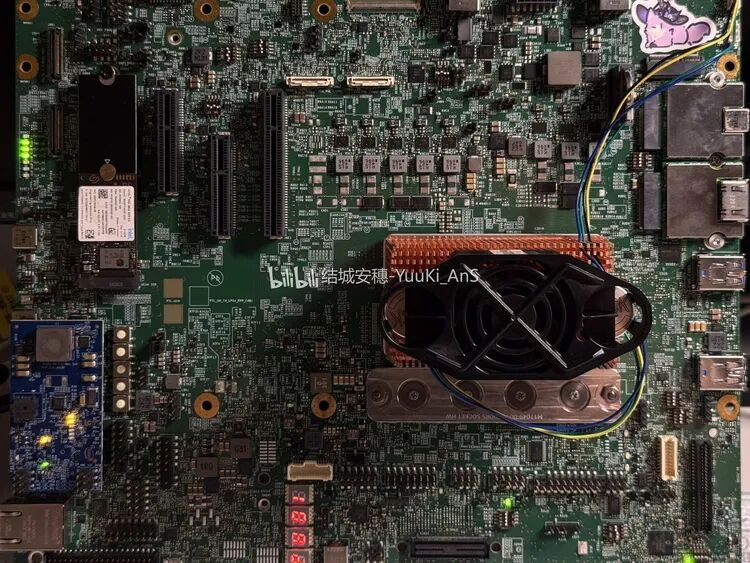
The RVP picture publicly shared on the social platform
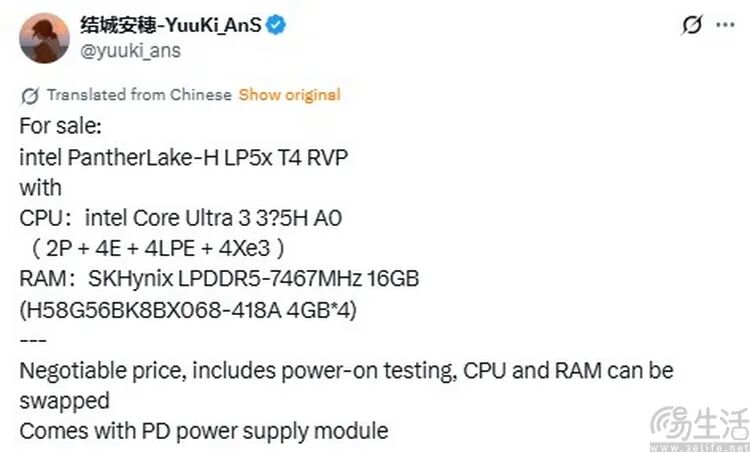
At the same time, Yuuki_AnS also revealed some specific technologies of this platform. It is said that the CPU installed on this platform might be a mobile processor from the Core Ultra 3 series, with a 10-core configuration of 2P + 4E + 4LPE. The test platform comes with a removable 16GB LPDDR5X-7467 memory module. Both the CPU and the memory are fixed with test-specific fixtures. So, although it uses BGA packaging, it can actually be freely removed and replaced. Also, this test platform is powered by an external PD power module, which seems to indicate that it is relatively close to the final product stage and has been positioned as a "mobile version."
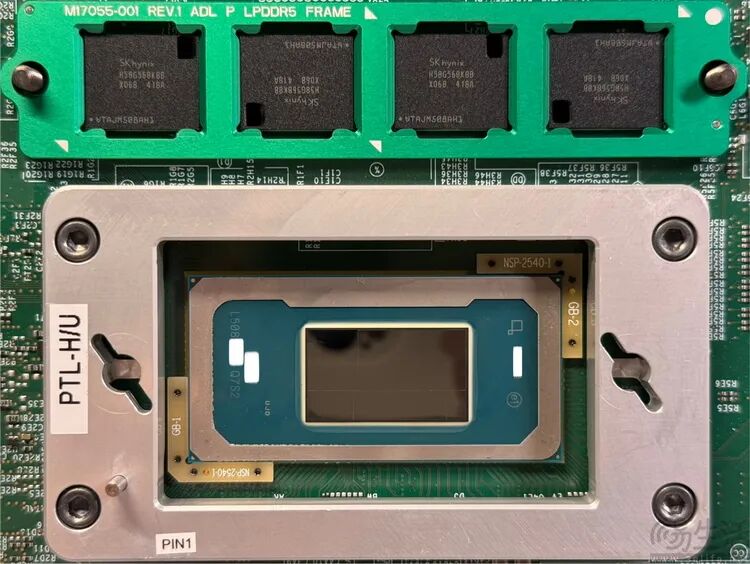
Through relevant channels, we have obtained some information about this platform that might be the world's first exposure.
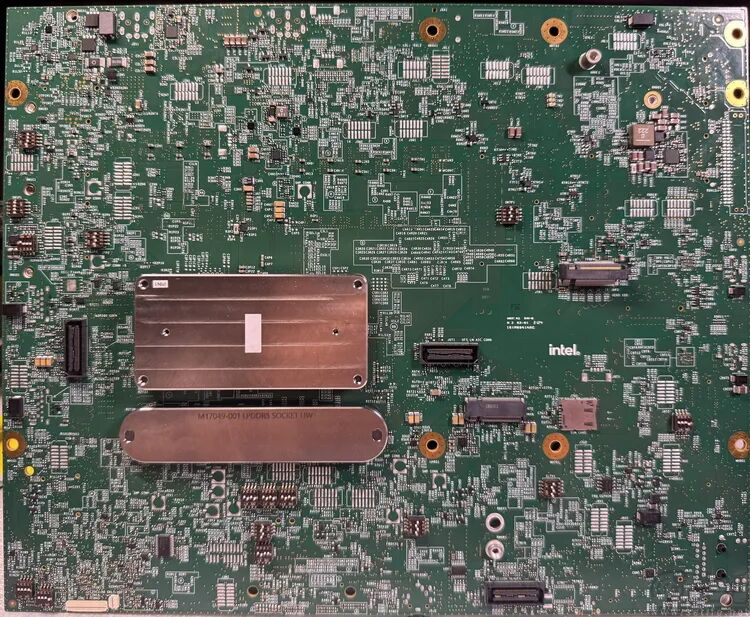
First of all, according to the information we've gathered, the currently exposed Panther Lake development platforms are not limited to the one in Yuuki_AnS's hands. They have also started to circulate among PC enthusiasts and semiconductor R & D companies.
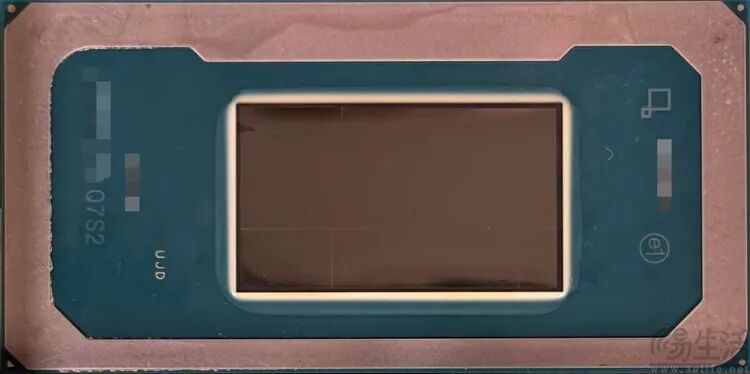
Let's take a look at the "true face" of Panther Lake. If you've read our analysis of the "2025 Intel Tech Tour: The Debut of the 18A Process and the Explosion of New Architectures," you should notice something strange now.
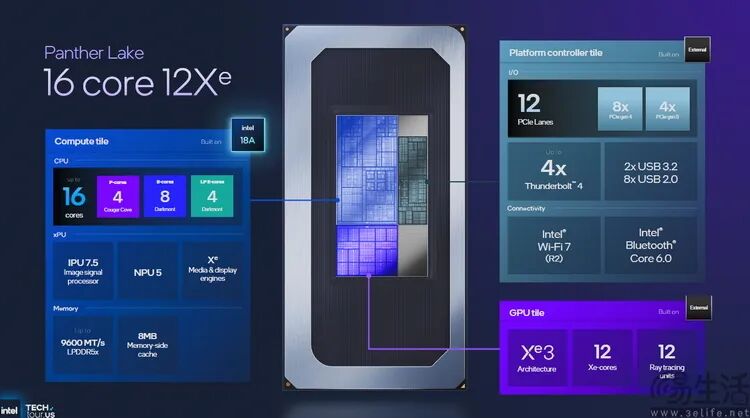
Yes, judging from the chip form of this "Core Ultra 3," it completely matches the core size and appearance characteristics of the "full-blooded + large integrated graphics" 4 + 8 + 4 + 12Xe version previously announced by Intel.
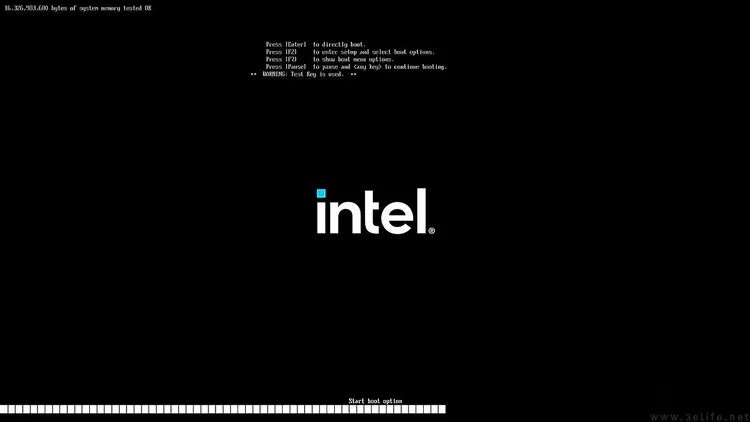
The boot screen of this RVP
There are two possibilities. One is that this is actually a flagship processor above the "Ultra 7" level, but it has been "disguised" as an entry-level model with only 2 P-cores and 4 groups of Xe integrated graphics through the BIOS or microcode for testing purposes. The other possibility is that there is indeed a version in Intel's "Ultra 3" series that is derived from a "large integrated graphics" chip with some parts disabled.
Technical Analysis: Ultra-Low Voltage or Standard Voltage? Confusing Product Information
Next, let's take a look at some information that can be seen in the BIOS after the system is booted up.
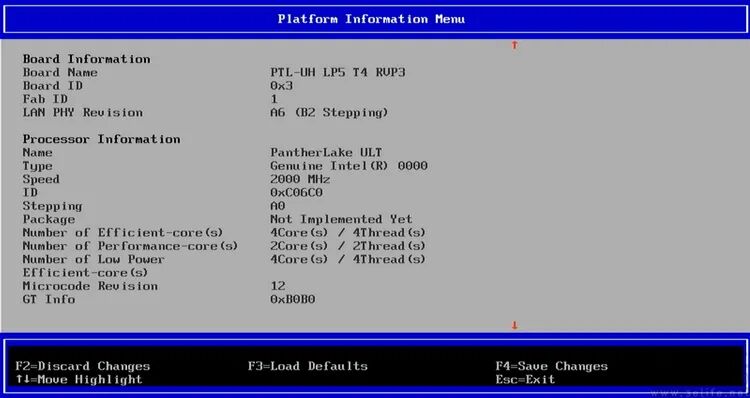
As we can see, it is indeed an RVP (Reference Validation Platform). However, the interesting thing is that the CPU type is shown as "Panther Lake ULT," which means it is an ultra-low voltage processor. In other words, the model of this processor might be "Core Ultra 3XXU" instead of "3XXH," which represents the standard voltage mobile platform.
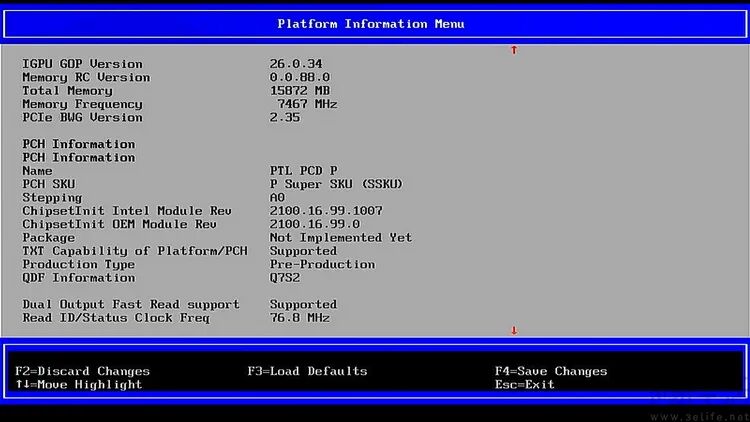
We can see that the internal model of this CPU is "Q7S2"
This is not surprising because in the previous Arrow Lake and Meteor Lake generations, the ultra-low voltage models already used the same packaging and interface design as the "standard voltage mobile models." This also seems to explain why this mobile version of Panther Lake, which looks "large" and "expensive," only has two P-cores. In the past, those ultra-low voltage mobile processors with a typical TDP of 15W also only had two P-cores.
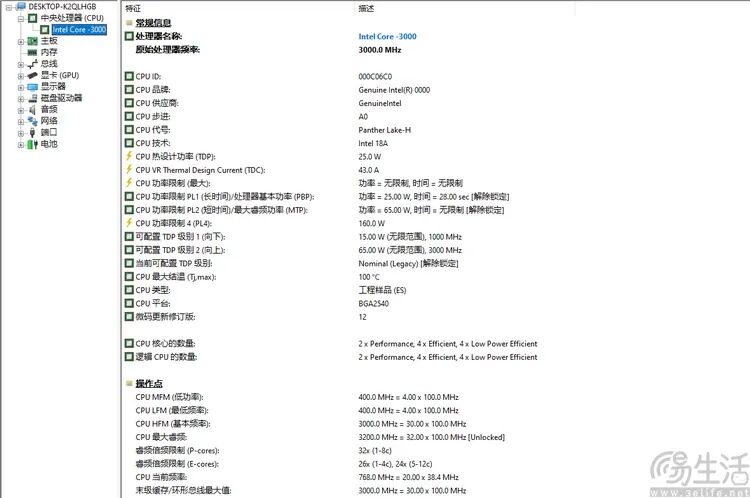
However, to our surprise, in AIDA64, this ES version of the CPU is recognized as a standard voltage "Panther Lake-H" with a TDP range of 25W - 65W. So, does this mean that either the BIOS display information or the software recognition information is incorrect?
Is it possible that both are correct?
If we look back at Intel's previous generation of mobile CPU product lines, we will find that in the Arrow Lake-U series, the CPU P-core architecture is not the same as that of the Arrow Lake-H (LionCove). Instead, it is an improved version of the RedwoodCove, which is the same as that of the Meteor Lake.
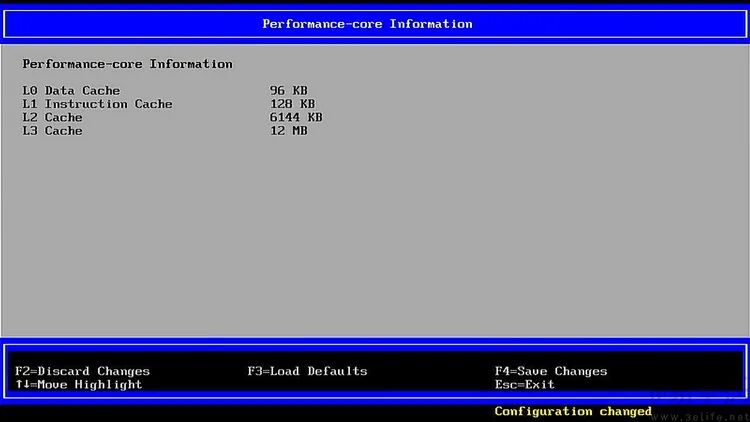
The P-core cache information of Q7S2
In other words, the reason why this engineering version of Panther Lake-ULT is "misrecognized" by the recognition software at least shows that Intel has unified the architecture of the "Core Ultra 300U" series with that of the "Core Ultra 300H" standard voltage version. This not only indicates that the new CougarCove large cores might have made significant progress in energy efficiency compared to the previous generation and can be integrated into a 15W CPU but also shows Intel's determination to "unify" the process and architecture in the next-generation product line.
Benchmark Test: Severely Limited by Memory Configuration, but the Large Cores Outperform the Previous Desktop Version
Finally, we come to the actual benchmark test section that you might be most looking forward to.
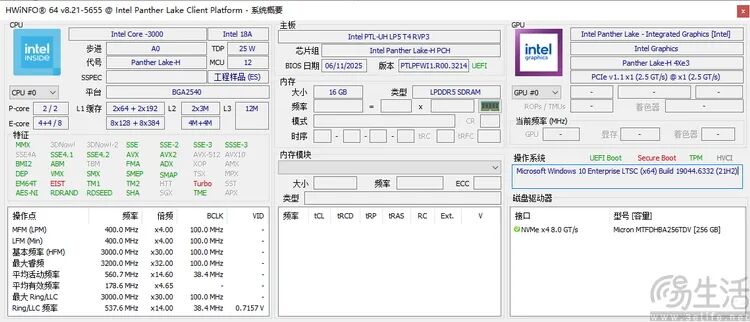
It should be noted that, on the one hand, this Panther Lake-ULT processor is still in the early ES stage. The default frequency of its P-cores is only 3GHz, and the maximum turbo frequency is only 3.2GHz. So, it's basically impossible to expect it to have excellent CPU and memory subsystem test results.
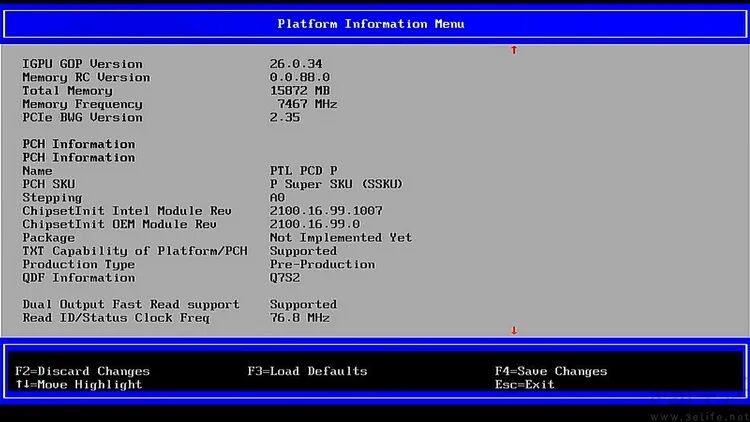
On the other hand, we didn't obtain the integrated graphics driver for this processor, so we don't have the benchmark scores for its integrated graphics. This benchmark test analysis is limited to the CPU part.
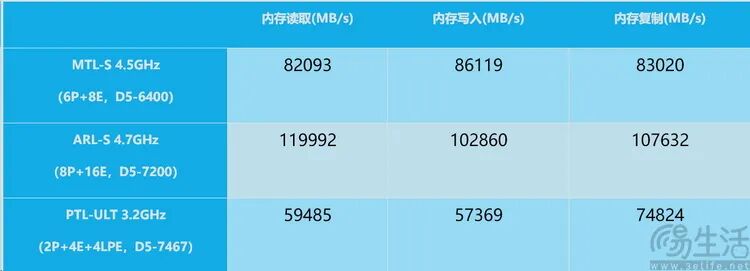
First, we compared the memory performance of this Panther Lake-ULV platform with that of two other Intel CPUs we have at 3eLife. They are also early ES versions, but with much higher frequencies. So, we can see that even if it is paired with high-frequency LPDDR5X memory at 7467MHz, if the CPU itself doesn't have enough computing power, it still can't drive the memory throughput.
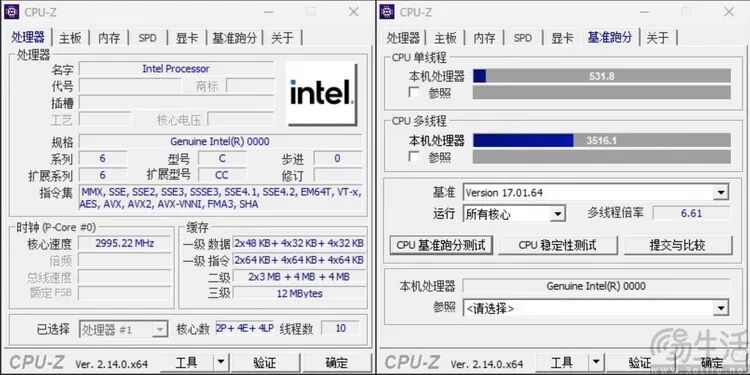
Secondly, from the CPU-Z benchmark scores, the single-core performance of this Panther Lake-ULT is not very high, basically only equivalent to that of the 10th-generation Core processors. But this is mainly because its frequency is too low.
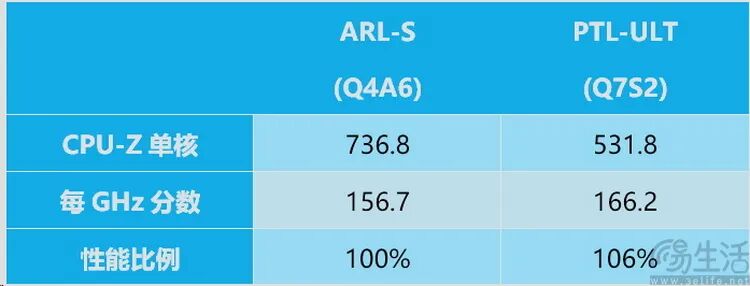
When we quantitatively compared the single-core benchmark scores of this Panther Lake-ULT processor with those of the previous Arrow Lake-S processor, we found that although the former has greater power consumption limitations and the paired memory has a much higher latency, the new Cougar Cove large cores still showed about 6% higher P-core performance at the same frequency on the low-voltage laptop platform than Intel's latest desktop processors.
According to the information previously announced by Intel, Panther Lake can actually be paired with high-frequency LPDDR5X memory at 9600MHz. So, it's possible that the current memory configuration (LPDDR5X-7467) of this RVP has imposed a significant bottleneck on the CPU performance.
