Going head-to-head with BYD, Volkswagen and other automakers launch a counterattack in the new energy vehicle market.
From January to October 2025, in the new energy vehicle market, the market share of Chinese brands further increased to 91%, expanding by 2.7 percentage points compared with the same period in 2024. Other brand camps were squeezed to varying degrees.
In recent years, some mainstream overseas brands have withdrawn from the Chinese market due to heavy burdens. However, the leading brands that have been deeply involved in the Chinese market for many years are naturally reluctant to leave. Relying on the advantages of joint - ventures, some brands have actively carried out "reverse new joint - ventures", seeking cooperation and support from Chinese companies in core new energy fields such as three - electric systems, intelligent cockpits, and intelligent driving. Even so, it is not easy for them to re - enter the market and grab a share from BYD, Hongmeng Smart Mobility, Xiaomi, etc.
The historical stock of users is being depleted, and over 60% of mainstream overseas users are turning to other camps
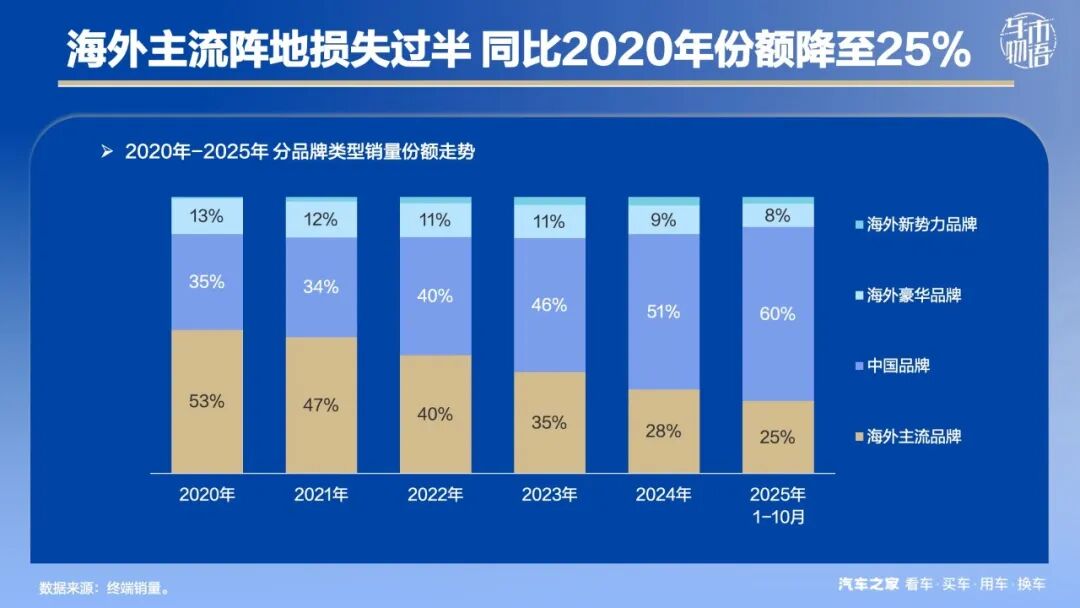
According to terminal sales data, since 2020, the market share of mainstream overseas brands has been declining year by year. By January - October 2025, their market share was only 25%, more than half of the market lost compared with 53% in 2020.
With the price war raging, under the "crazy discounts" of luxury brands, mainstream overseas brands have been hit hard. However, the rise of Chinese brands has dealt an even greater blow to their market share. Caught between the two, mainstream overseas brands have nowhere to hide.
In the stock market, competition is fierce. To grab more market share, it is particularly important to focus on existing users. Thanks to their brand and technological advantages in the fuel - powered era, mainstream overseas brands have accumulated a large user base, but this base has been rapidly disintegrating in recent years.
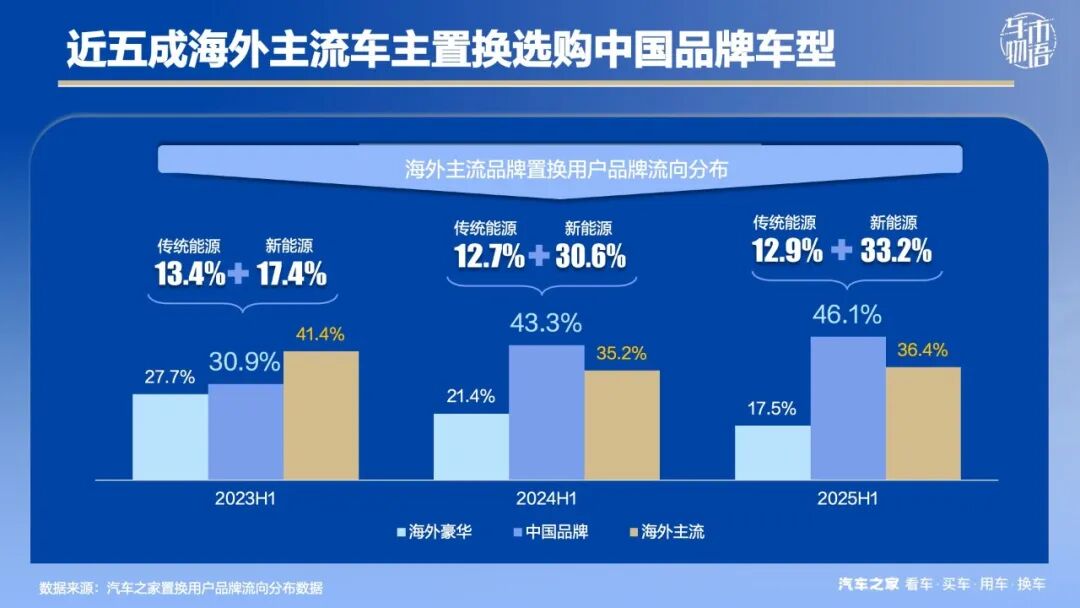
According to the replacement user data from Autohome, the proportion of users of overseas brands replacing within the same brand camp has been rapidly declining, from 27.7% in the first half of 2023 to 17.5% in the first half of 2025, a decline of 10.2 percentage points in two years. Among them, the main destination of the lost users is the new energy camp of Chinese brands.
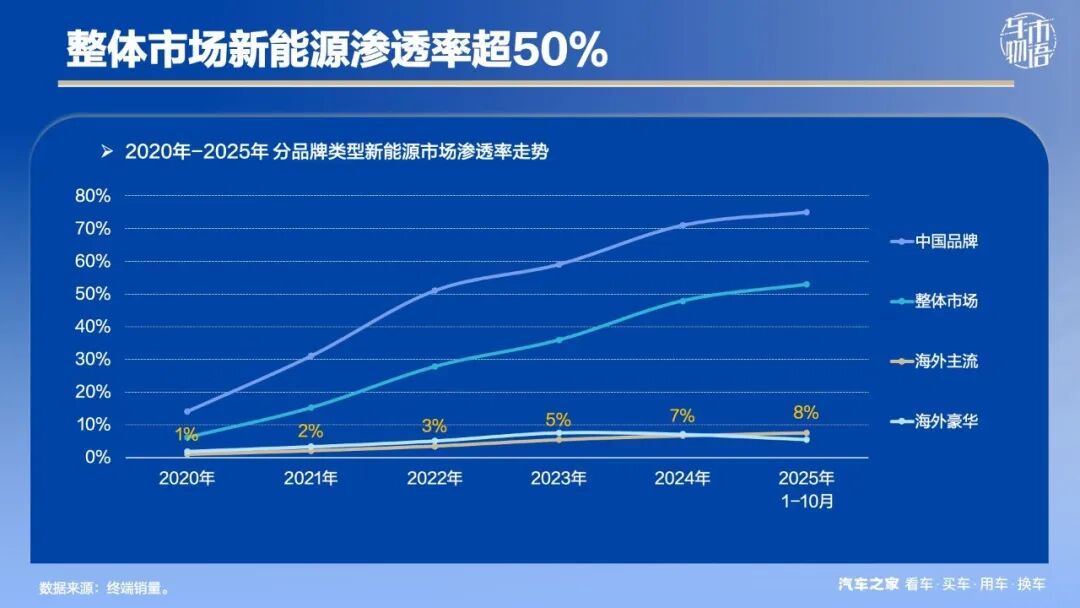
Thanks to policy support and continuous improvement in product technology, the Chinese new energy vehicle market has developed rapidly. By 2025, the overall new energy penetration rate in the market has exceeded 50%. Among them, Chinese brands are far ahead, with a penetration rate close to 80%, while mainstream overseas brands have still not exceeded 10%.
The small number of products and insufficient product strength are the main reasons for their weak competitiveness. However, it is worth noting that, different from the continuous decline in the overall market, the new energy market penetration rate of mainstream overseas brands has been continuously rising. By 2025, it has exceeded that of overseas luxury brands, getting rid of the last - place position.
Increase the proportion of new new - energy vehicle launches, targeting the economy - class market below 200,000 yuan
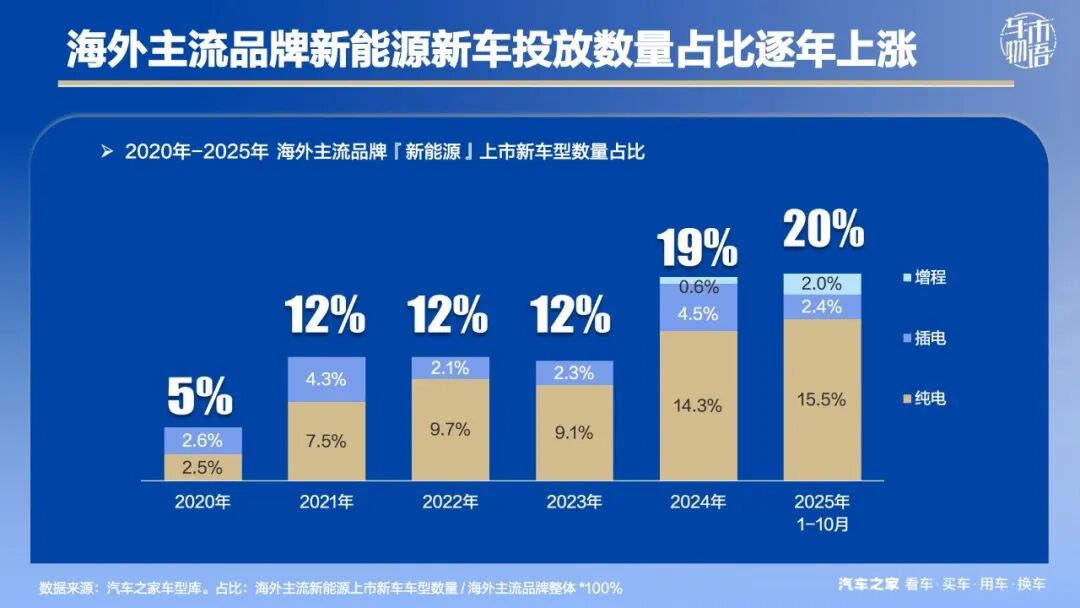
Mainstream overseas brands will certainly not give up the new energy vehicle market. In terms of new product launches, they suddenly increased their efforts starting from 2024. From 2021 to 2023, the proportion of new new - energy vehicles remained at 12%. In 2024, it soared to 19%, and from January to October 2025, it further increased to 20%.
Among them, the proportion of new pure - electric vehicle models increased the most, from 2.5% in 2020 to 15.5%. The launch of plug - in hybrid vehicles decreased compared with 2024, while the proportion of extended - range models increased.
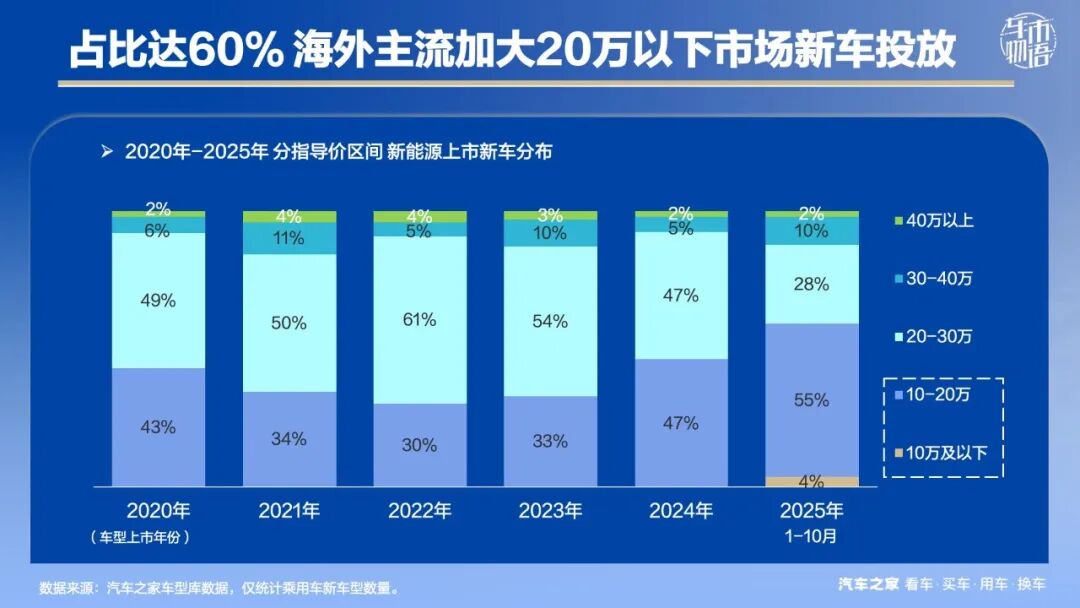
Looking at the price - guide intervals, mainstream overseas brands have mainly increased the launch of new vehicles in the economy - class market below 200,000 yuan. By January - October 2025, the proportion of new new - energy vehicle models with a guide price below 200,000 yuan increased to 60%. In addition, they have also opened up a lower - priced niche market, launching new models priced at 100,000 yuan or less, accounting for 4%. This is no different from declaring an all - out war on Chinese brands.
Starting from assisted driving, the standard - equipment rate of urban NOA for new vehicles priced between 100,000 and 200,000 yuan is much higher than that of Chinese brands
Nowadays, it is completely impossible to win against Chinese brands with old - fashioned methods. Mainstream leading overseas brands are no longer complacent and self - satisfied. Instead, they have joined hands with Chinese enterprises for support. Some have even entrusted Chinese teams to fully develop new products. How effective are these efforts? Sales figures tell the whole story.
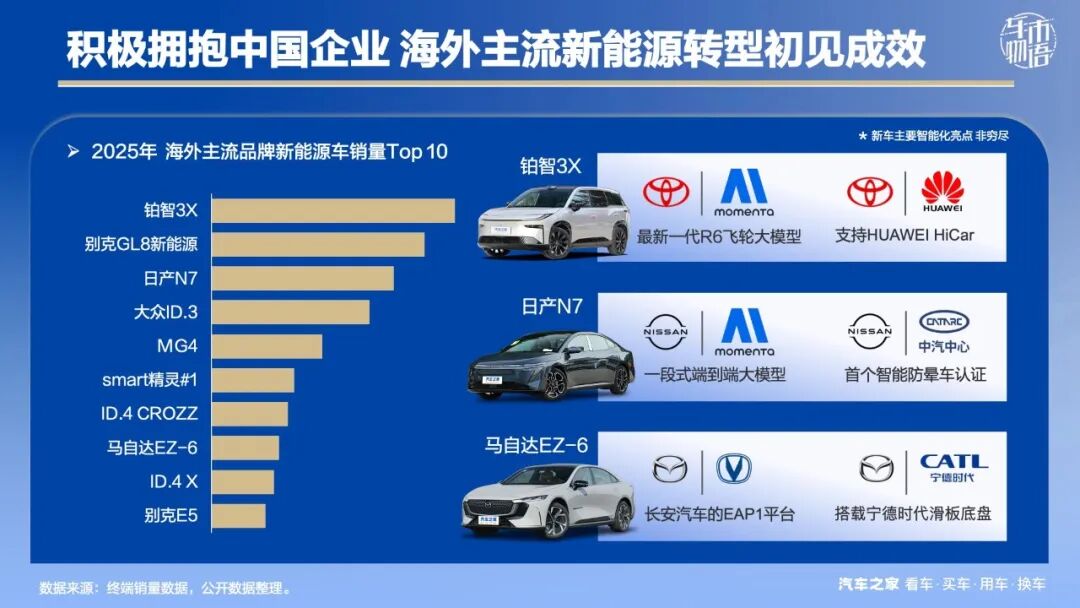
The GAC Toyota bZ3X was newly launched in March 2025. It joined hands with Momenta, adopted an integrated end - to - end large - model, and supports Huawei HiCar. The new car received over 10,000 orders within one hour of its launch and ranked first in the cumulative sales of the mainstream overseas new - energy vehicle market from January to October 2025.
Similarly, the Nissan N7, the first model under Nissan's Tianyan architecture, received over 10,000 firm orders 18 days after its launch and ranked third in cumulative sales in 2025. At the end of October, the Nissan N7 received its second major OTA update, adding two major functions: urban memory pilot assisted driving and memory parking assistance, as well as optimizing more than 20 intelligent cockpit functions. It has started accepting pre - orders and firm orders, carried out OTA updates, and held user conferences. Nowadays, mainstream overseas new - energy vehicles are becoming more and more like "new - force vehicles".
To grab market share, mainstream overseas brands have really gone all out. In addition to transforming to new marketing methods, lowering prices, and making up for technological shortcomings, they have also made great efforts in terms of configuration.
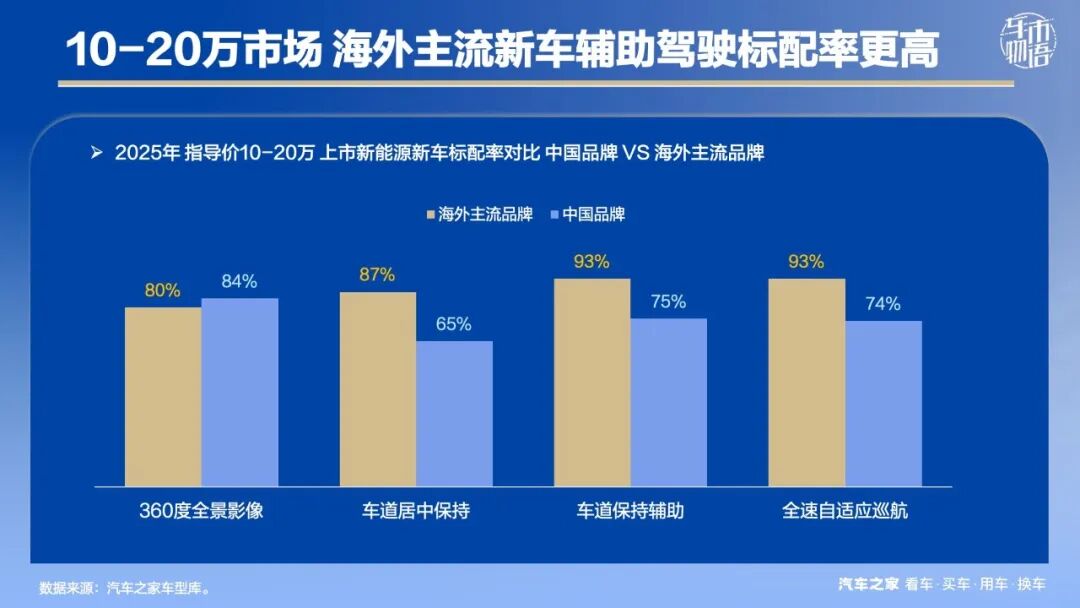
Comparing the market segment of vehicles priced between 100,000 and 200,000 yuan, which has the largest proportion and the highest growth rate of new vehicle launches, the standard - equipment rate of mainstream overseas new - energy vehicles is no longer a weak point.
In terms of basic assisted - driving configurations, the standard - equipment rates of lane - keeping assist and full - speed adaptive cruise have both reached 93%, almost becoming standard features, far higher than those of new Chinese brand vehicles in the same price range. The standard - equipment rate of lane - centering assist has also reached 87%, significantly higher than the 65% of Chinese brands. Although the 360 - degree panoramic image is slightly inferior, its standard - equipment rate has also reached 80%.
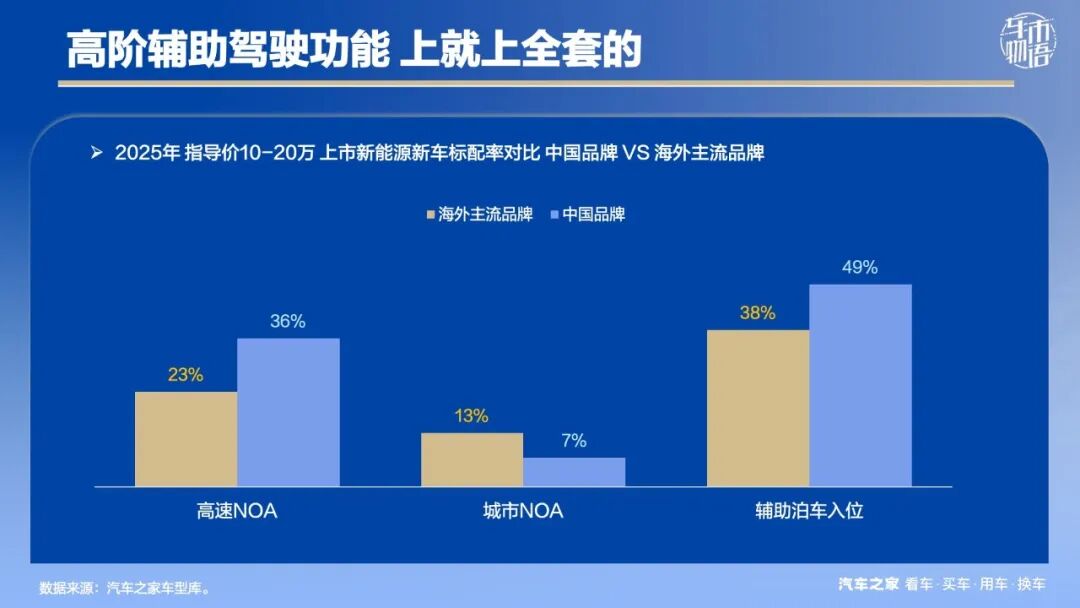
In terms of high - level assisted driving, Chinese brands have a higher standard - equipment rate in highway NOA and assisted parking. Among them, the standard - equipment rate of assisted parking for new Chinese brand vehicles has approached 50%. However, in terms of urban NOA, the standard - equipment rate of mainstream overseas new vehicles has reached 13%, while that of Chinese brands is only 7%. Compared with Chinese brands that mainly focus on providing highway NOA functions, mainstream overseas brands often offer a full set of functions.
In addition, to regain user trust, GAC Toyota has even promised to take full responsibility for intelligent parking accidents and electric vehicle spontaneous combustion, eliminating many concerns for users and reassuring those who are hesitant about intelligent driving. To regain their market positions, many mainstream overseas brands have exhausted all their efforts and are fighting a desperate battle.
More mainstream overseas brands are actively embracing Chinese enterprises and achieving rapid growth in the new - energy vehicle market through "new joint - ventures". Among them, Volkswagen has established a joint - venture company "Core Journey" with Horizon, developing an L2++ - level intelligent driving system based on Horizon's Journey 6P chip. After all, whether it's competing on configuration or suppliers, there will eventually be a ceiling. At that time, how to break through? It still depends on differential advantages. Only by having exclusive and advanced technological barriers can one gain the right to speak in the market.
The 2025 Guangzhou Auto Show is about to open. Heavy - weight new vehicles from mainstream overseas brands, such as the Buick Electra E5 with "seamless" urban NOA, the Ford Bronco Sport that can meet various outdoor driving scenarios, and the bZ7 equipped with Huawei's Hongmeng cockpit, will all make their appearances. In 2026, with the addition of more new mainstream overseas brand vehicles, the competition in the new - energy vehicle market will become even more intense. However, the Chinese market is only so big. When some are happy, others are bound to be sad.
This article is from the WeChat official account "Autostinger" (ID: autostinger), author: Sun Ying. It is published by 36Kr with permission.