After the bubble in the robotics industry bursts, who will become the new giant?
In the past few years, robots have been repeatedly incorporated into the narrative system of "technology hardware" and even "AI computing power extension". As representatives of new - quality productivity, they have become the common focus of numerous policies, funds, and technological discourses. However, a more important judgment is gradually emerging - what robots truly bring is not just the automation dividend of industrial upgrading, but a fundamental variable in the "reconstruction of the labor force system". If we still understand the robot industry from the perspective of the "hard - technology track", we are already one step behind.
Perhaps we have paid too much attention to "whether it is human - like" and "whether there are breakthroughs in chips", while ignoring a more fundamental question: robots are becoming a "new - type labor force asset" that can be defined, measured, and configured. They are no longer just hardware but a new species that can participate in cost accounting, organizational management, and capability iteration like human resources. Once we adopt this "labor force asset" understanding framework, our perception of the entire industry will undergo a fundamental change.
It is not just a race for "future tools", but a reconstruction of the "employable" capital model; not just an exploration of the boundaries of "automation extension", but an active adjustment of the "supply - demand structure"; and not just a rotation of hotspots in the "new trend", but a starting point for re - evaluating the "enterprise operation structure".
From this perspective, the robot enterprises worthy of attention and long - term holding are no longer those with "advanced technology" or "received orders", but those that truly possess the ability to define, standardize, and deploy at the organizational level of the "new labor force model".
In other words, we are entering an era where "enterprises do not use robots to reduce costs, but use robots to build a new labor force organization". Starting from this new paradigm, the value anchor points, valuation logics, and competitive barriers of the entire industry will also be rewritten.

What kind of industry does the robot belong to?
In industry observation, we tend to classify robots as a subclass of "high - end manufacturing" or "intelligent equipment". Especially after the rise of humanoid robots, the narrative of "AI + hardware" has almost become an industry consensus. However, this classification method comes more from the technical path rather than the essence of the industry.
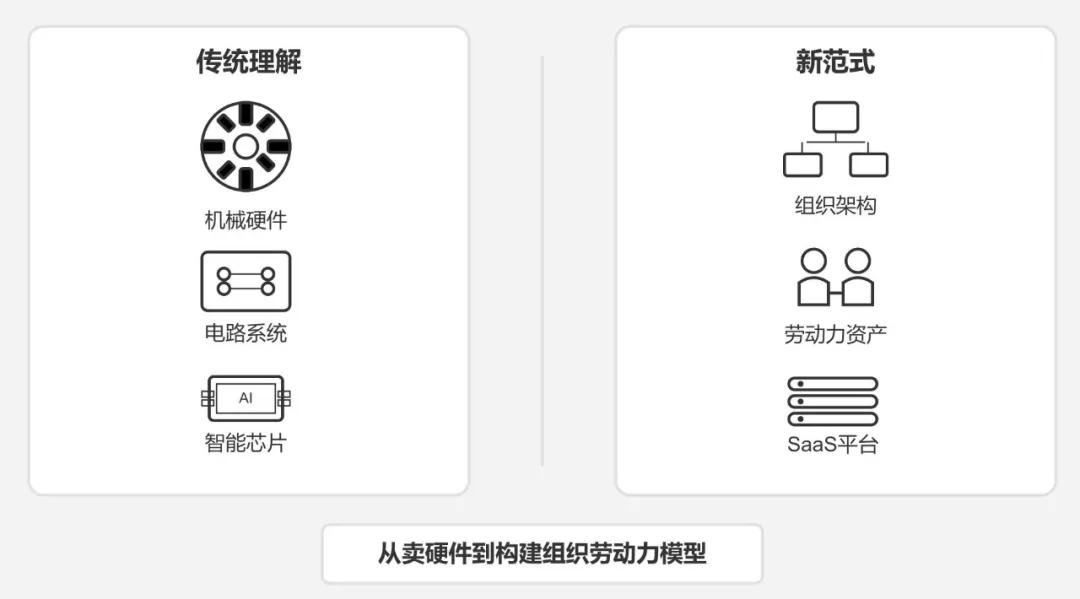
If we look at it from another angle, what robots truly provide is not a certain "product", but a substitution of "labor force capabilities". They are purchased, configured, and invoked by enterprises in the form of software - hardware systems. The ultimate goal is not to improve production efficiency, but to complement and even reshape the labor force structure of the organization. This means that robots are more like "assets" rather than commodities - even a "capitalized form" of a new - type labor force.
From the manufacturing category to the organizational paradigm: it is not just equipment, but a labor force unit
Traditional industrial robots entered factories as "precision machinery" to replace repetitive labor positions such as handling, welding, and assembly. However, today's humanoid robots and service robots have long left the manufacturing workshop and entered various service scenarios with "intensive human - to - human interaction" such as warehousing and logistics, shopping malls and retail, education and medical care, and government service windows.
This is not a simple expansion of scenarios, but a horizontal penetration of the robot industry from the "downstream of the manufacturing industry" to the "labor force service system". We can see that more and more robots are included in the "operating costs" item, priced by "working hours", configured by "positions", and even flexibly deployed according to "work content". These changes mean that robots are no longer just manufacturing equipment, but are being systematically managed as "organizational labor force assets".
This is not a "hardware upgrade", but a shift in the "supply - demand structure"
From a macro perspective, the robot industry is highly anticipated not only because it represents the technological frontier, but also because it undertakes the task of alleviating the structural shortage of the labor force. According to data from the National Bureau of Statistics, the proportion of the working - age population aged 16 - 59 in China has decreased from 74.4% in 2012 to 61.3% in 2023. At the same time, the demand of the manufacturing and service industries for the standardization, stability, and low marginal cost of the labor force is constantly increasing.
In this context, robots are not a patch - type choice to "replace human labor", but a systematic solution to "rebuild the employment logic". They give enterprises the opportunity for the first time to turn the variable of "human" into a constant of "machine" and organize the production factor of "labor force" with algorithms and standards. What is truly changed behind this is not efficiency, but the underlying unit of the entire resource allocation system.
The value logic of the robot industry: it is not about comparing "performance", but about comparing "organizational embedding ability"
If we evaluate robots based on "equipment performance", we are likely to fall into a linear competition of "parameter advantages and disadvantages" such as chips, joints, and motors. However, the robot enterprises truly worthy of long - term attention are often not the ones with the strongest parameters, but the ones that can best integrate into the customer's organizational system and standardize the output of "human - like labor force".
In this sense, the future competitiveness of robot enterprises does not lie in the intelligence level of a single robot, but in whether they have the ability to output a "systematic labor force solution". This includes task modeling, workflow embedding, device networking, and remote scheduling capabilities, as well as the underlying algorithm iteration and data feedback mechanism.
What exactly is a robot?
©Kr Rui Research Institute

What is the moat?
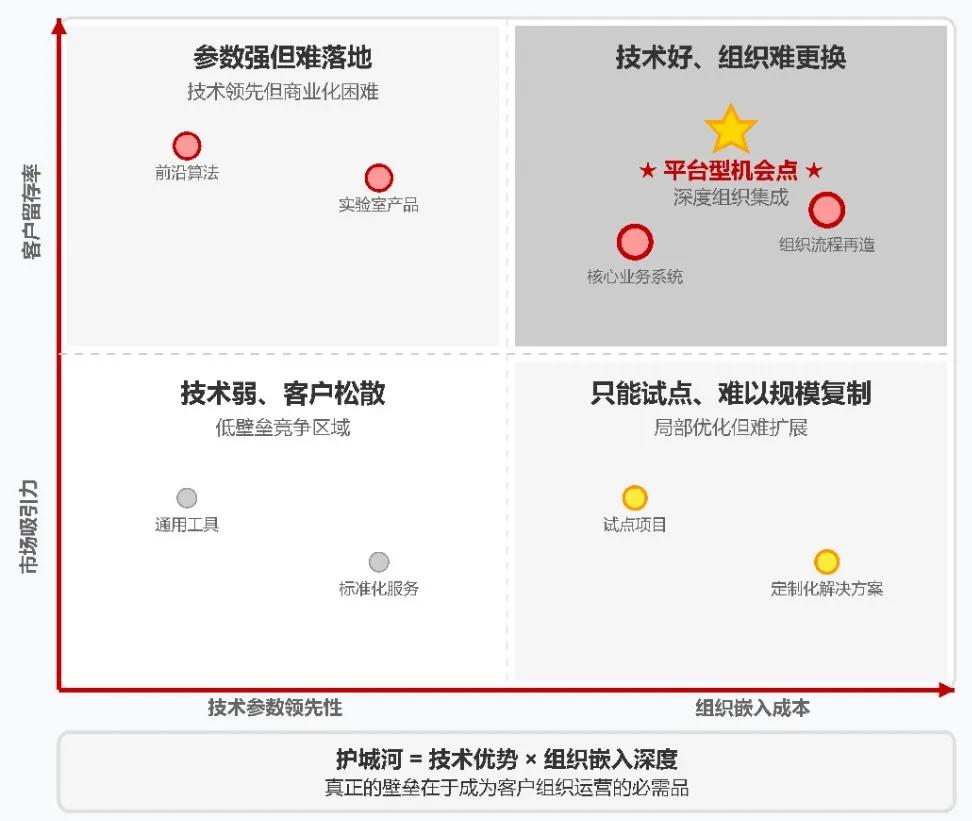
When we try to evaluate the long - term value of a robot company, we often fall into the obsession with "technological leadership", such as self - developed controllers, motor accuracy, algorithm models, and overall machine integration levels. However, if we re - examine this industry from the perspective of the "new - type labor force asset", we will find that what truly determines how far a robot enterprise can go is not its current technical parameters, but whether it can build an asset model of "sustainable delivery of organizational capabilities".
"Technological leadership" is just an admission ticket, and the long - term moat is the "organizational embedding cost"
For customers, technological leadership can bring "trial attractiveness"; but whether it can be truly deployed on a large scale and deeply embedded in the workflow is the key to whether they are willing to cooperate in the long term. Therefore, the real competitive moat is not the performance of the robot itself, but how difficult it is to deploy the robot as a "position - type asset".
Those enterprises that build "industry - level solutions" through standardized interfaces, industry preset models, and full - link service capabilities have created "organizational path dependence". This is the core reason why enterprises such as Ubtech and Unitree Robotics have continuously expanded their delivery volume after gradually entering the B - end customer system.
The "asset model" is better than the "product model": Is the robot sold once or continuously monetized?
In the past decade, most Chinese hard - technology enterprises have followed the path of "to B, selling products, and competing on parameters". However, for the robot industry, this path often leads to an early appearance of a ceiling. In contrast, enterprises with real long - term value - releasing capabilities often have the ability of a "SaaS - like asset model":
- Not selling a single robot, but selling the available working hours of a "position unit";
- Not just completing a one - time deployment, but embedding in the customer's organization and participating in task scheduling and process optimization;
- Not realizing value through the ex - factory price, but achieving long - term value precipitation through the compound logic of "availability + serviceability + platform management".
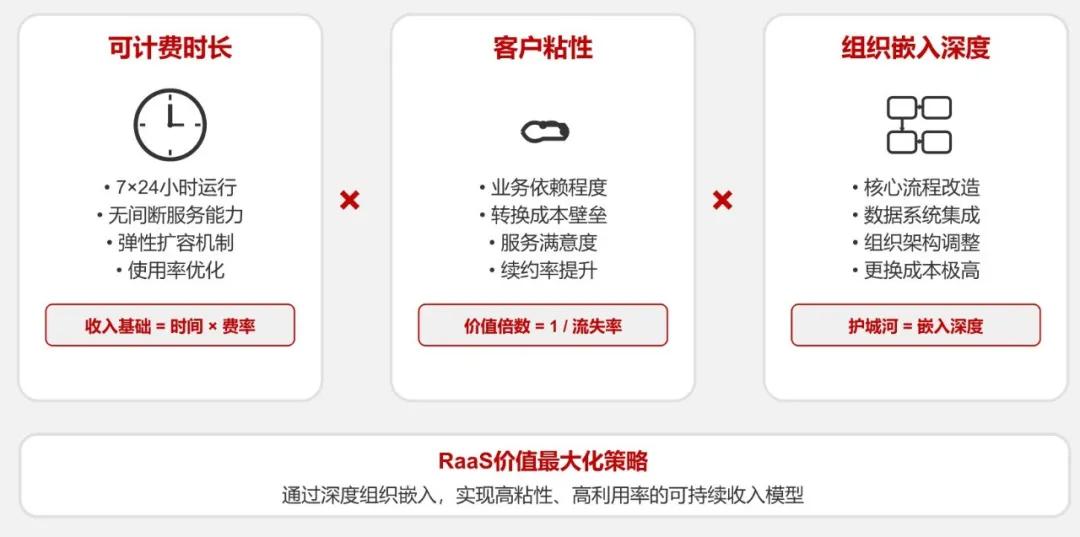
In this model, the essence of a robot enterprise's assets is more like a "labor force output platform", and its essential value lies in the compound ability of "billable working hours of a single robot × customer stickiness × organizational embedding depth".
Where is the real moat?
©Kr Rui Research Institute
Why can some companies grow fast but not scale up?
Currently, we can see that some robot enterprises have achieved topic breakthroughs or capital pursuit in a short period of time, but they start to face a "growth bottleneck" after the Series B or C financing. The fundamental problem is often that they are overly dependent on project - type orders and lack a delivery system for large - scale asset deployment.
In essence, these companies still stay in the traditional engineering service logic of "customization + integration" and fail to transform robot products into "labor force assets", making it difficult to form organizational - level substitution capabilities and platform - type delivery capabilities. In contrast, companies like Fourier and Boston Dynamics, which truly have the hope of building a "general platform asset model", have completely different valuation logics: their moat is not technology, but the system stickiness that makes them "indispensable in the customer's organization".

How to identify truly worthy robot enterprises?
When the attention of capital, industry, and the government is simultaneously focused on the "humanoid robot" track, the industry is prone to fall into a kind of blind pursuit similar to the "GPT - like" phenomenon. Especially those enterprises that seem to have "explosive points, valuations, and concepts" are more likely to be labeled by the market.
However, if we return to the fundamentals - starting from the enterprise's organizational capabilities, business models, and product asset attributes, we will find that truly worthy enterprises often form a penetrating compound advantage in these three dimensions.
Is there one thing it does extremely well?
It is not about being the first in product function points, but about having clear and continuous leadership in a core ability related to "delivery efficiency". For example:
- Unitree Robotics: It focuses on the optimization of legged robot whole - machine and low - cost deployment. Its strength lies not in single - point innovation, but in "engineering - based cost control and whole - machine consistency";
- Fourier Intelligence: Its core lies in the "ability to embed in the rehabilitation scenario". Through the integration of algorithms and usage processes, it has built extremely strong scenario adaptation capabilities;
- Keenon Robotics: Although it mainly produces delivery robots, its real "one" ability is the stability of the indoor movement path of its "algorithm + scheduling system".
Therefore, "whether there is one extremely strong aspect" is not about showing off technology, but about whether it has an irreplaceable efficiency advantage in key delivery links.
Can it expand from a single point to cover more scenarios?
Many robot enterprises start from a single application scenario but end up being overly dependent on it. Once this ability cannot be scaled up and migrated, it means that the model lacks a basis for business compound interest.
Those enterprises with the "ability migration path" can often make structural arrangements in the following three directions:
- Scenario migration: From hospitals to nursing homes, from industrial factories to commercial service areas;
- Role migration: From a collaborative assistant to an independent executor, and from an executor to a platform scheduling center;
- Model migration: From single - machine deployment to system integration, and then to an asset operation platform of "Robot as a Service" (RaaS).
Fourier Intelligence is a typical example: It started with lower - limb rehabilitation in the early stage and later developed the capabilities of wearable intelligent assistive devices, training and evaluation platforms, and even an ecological - level rehabilitation center. This migration logic is not just about telling stories, but the result of the coordinated evolution of the organizational structure, product architecture, and business model.
Does it have the organizational ability and resource acquisition path to scale up?
The ceiling of many enterprises is not a product problem, but an "organization and resource" problem. Do they have a team capable of continuous delivery? Do they have the endorsement of government/industry resources? Do they have large - scale B - end customers as a guarantee for stable shipments?
This depends on whether the enterprise has the following aspects:
- Stable industrial cooperation channels: Such as the HarmonyOS ecosystem, Huawei Ascend platform, and NVIDIA Jetson system;
- Clear policy/geographical support paths: Such as the "Robot Ecosystem Area" in Shenzhen and the "Haidian Embodied Intelligence Test Field" in Beijing;
- Brand and trust assets: Such as whether it undertakes national - level demonstration projects and whether there are repurchase cases from medium - and large - sized B - end customers.
The value composition formula of RaaS
©Kr Rui Research Institute

What kind of asset does the robot industry belong to?
When many people study robots, they overly focus on product forms and functional indicators: Is it anthropomorphic? Does it look like a human? Is it flexible? Is it smart?
However, these questions often only belong to the surface definition of the technical paradigm, not the core that investment judgments should truly focus on. If we examine it from the more essential perspective of the "new - type labor force asset", we will find that the robot industry is more like an "organizational infrastructure - type asset", and its value is far higher than that of a single - point product.