The situation in Brazil is too complicated.
When it comes to expanding into the Latin American market, Brazil is often regarded as the second choice after Mexico. Thanks to the close political and diplomatic exchanges between China and Brazil in recent years, Brazil has gained significantly more attention on Chinese Internet platforms.
Within Brazil, Chinese brands have a strong presence. "Large - scale advertisements of BYD can be seen everywhere at the airport and along the roads in São Paulo. Every time I go out on work assignments wearing my work ID, young people would come up to me enthusiastically and tell me that they often shop on SHEIN," said Marco, a newly - arrived SHEIN business development manager in Brazil.
Compared with the newly - arrived Marco, Fang Ke has lived in Brazil for many years and established "Anjun Logistics", the largest local logistics company. As his understanding of Brazil deepened, he began to notice the emerging contradictions behind the booming trend of Chinese companies going global. In 2024, China's exports to Brazil reached a new high, but the market share of Chinese cross - border e - commerce platforms in Brazil declined. While Chinese car manufacturers are building local factories, most expatriate employees choose to return to China after their assignments end, and few stay in Brazil.
As a vast and untapped market, the "soil conditions" and "climatic environment" of the Brazilian market are not suitable for all Chinese enterprises. Sun Xinyue, the CEO of Jingwei Consulting, who has lived in Latin America for a long time and helps Chinese enterprises invest, introduce resources and operate locally, summarized that Chinese enterprises in Brazil present a polarized pattern where successful branding of leading enterprises coexists with the dilemmas of numerous small and medium - sized enterprises. "Compared with Mexico, I'm not as optimistic about Brazil. The Brazilian market is very open and welcomes Chinese investment, but the market environment is not friendly to small businesses, and the entry threshold is extremely high."
Even if a business opportunity is found, enterprises need a long time to understand and adapt to the complex market rules in Brazil. Different from the underlying logic of investing in Mexico, which often aims at the US market, the investment value of Brazil lies in its vast market of 200 million people. Compared with the close economic and trade relations between the US and Mexico, Brazil is more geographically and culturally isolated from its neighboring countries.
It can be said that the importance of long - termism has been repeatedly proven by Chinese enterprises in Brazil. "In doing business in Brazil, being hasty means being slow, and being slow means being fast. Enterprises must understand this before taking action," said Fang Ke.
This article attempts to help Chinese enterprises interested in expanding into the Brazilian market better understand and grasp the future of going global to Brazil by answering several key questions about the Brazilian market:
Which industries are suitable for investment in Brazil?
Is cross - border e - commerce still a profitable business in Brazil?
What are the most challenging localization problems for enterprises expanding physically into Brazil?
1. Emerging industries are the focus, while traditional industries have high barriers
"When I first came to São Paulo a few years ago, there were only three Chinese restaurants in the southern district. Now, there are dozens, and several streets are like Chinatowns," said Marco. According to media statistics, more than 40 Chinese enterprises have settled in the southern district of São Paulo. In the EZ Towers, an office building with the highest rent, the offices of Huawei, Hisense, and Great Wall Motors are all located on the same floor.
From a macro - data perspective, the official website of the Ministry of Commerce shows that in 2024, China's exports to Brazil reached a new high of $72.08 billion (approximately 513.779 billion yuan), a year - on - year increase of 22%. "Now, the bilateral trade volume between China and Brazil in two days is equivalent to that of a whole year 30 years ago," said Lau, the vice - president of the IEST Group in Brazil.
In addition to physical trade, Brazil is also one of China's major investment destinations in emerging markets. In 2024, China's investment in Brazil exceeded $4.8 billion (approximately 34.2 billion yuan), more than doubling year - on - year (a 113% increase).
Initially, what attracted Chinese enterprises to invest in Brazil were mainly its rich energy resources and the growing consumer market. During the first decade of the 21st century, the main investors in Brazil were energy enterprises such as the State Grid and Sinopec, and manufacturing enterprises such as Gree and Huawei. After 2010, seeing the opportunity between the rapid growth of the Brazilian automobile market and the high import tariffs on cars, Chinese car manufacturers such as Chery and Geely began to invest in building factories in Brazil one after another. In 2011, Brazil became China's largest automobile export destination.
Subsequently, infrastructure in new energy, the digital economy, and logistics have gradually become key areas of investment and cooperation for China in Brazil. The Brazilian Trade and Investment Promotion Agency disclosed in May this year that China will invest a total of 27 billion reais (approximately 35 billion yuan) in Brazil in the next few years, covering areas such as clean - energy vehicles, key minerals, and transportation services.
The new - energy vehicle industry is the most typical example. In recent years, the demand for new cars in Brazil has been continuously expanding. It is the largest automobile market in Latin America and the sixth - largest in the world. Data from the National Association of Motor Vehicle Manufacturers of Brazil (ANFAVEA) shows that in 2024, new - car sales increased by 14.1% year - on - year to 2.635 million vehicles. Although fuel - powered cars are still the mainstream, the Brazilian government is vigorously promoting the transformation to new - energy vehicles, introducing policies such as exempting imported electric vehicles from tariffs and halving the tariffs on plug - in hybrid vehicles.
Seeing the market opportunity, Chinese car manufacturers have accelerated their expansion into the Brazilian market. According to CCTV News, based on data from Brazilian government departments and industry associations, in the first four months of 2024, the sales volume of Chinese electric vehicles in Brazil reached 48,000, accounting for 36.2% of the total imported electric vehicles in Brazil. Among them, BYD, Great Wall Motors, and Chery all ranked among the top five in the sales of new - energy vehicles in the Brazilian market.
To reduce the transportation and other costs of direct exports, Chinese car manufacturers have also increased their investment in local factories. As early as 2014, Chery's first overseas factory rolled out its first complete vehicle in Jacarei, São Paulo. In 2021, Great Wall Motors acquired a Mercedes - Benz factory in São Paulo to produce new - energy passenger cars. In July 2025, BYD announced the official operation of its first pure - electric vehicle production base in Camacari, Bahia.
At the factory opening ceremony in October, Luiz Inácio Lula da Silva, the President of Brazil, who used to be an automotive metalworker, also attended in person.
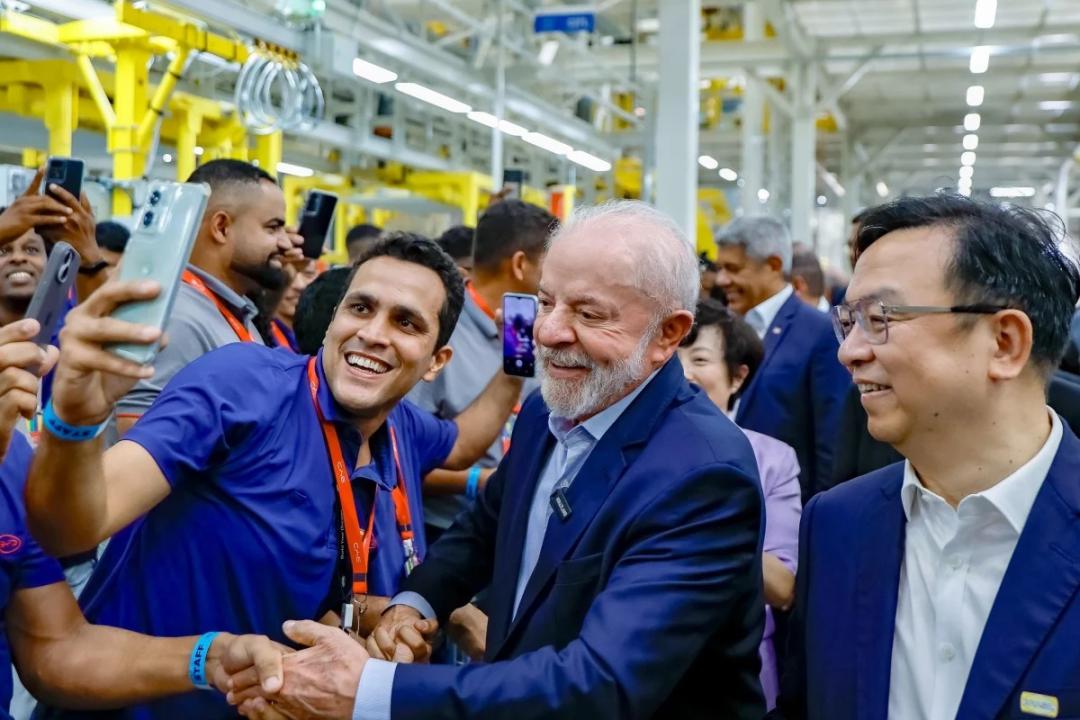
Luiz Inácio Lula da Silva attends the factory opening ceremony
"The establishment of car factories in Brazil has driven the development of the industrial chain, and enterprises in parts, glass, tires, etc. have followed. In the past two years, many companies in the automobile industrial chain have contacted us to inquire about doing business and setting up companies in Brazil," Lau introduced. For example, BYD has established multiple industrial - chain factories in Brazil, including those for electric buses, iron batteries, solar energy, and lithium iron phosphate batteries.
Lau suggested that newly - entered enterprises in Brazil can also focus on the technical route of using ethanol as fuel to find opportunities for differentiated competition. Currently, 90% of cars in Brazil are equipped with engines that can run on both gasoline and ethanol. Under the limitation that charging piles are difficult to popularize quickly, BYD is also considering developing hybrid cars that can use ethanol.
Photovoltaic is another key investment area in clean energy. 80% of Brazil's territory is in the tropical region, with an average annual sunshine duration 1.2 times that of China. It has abundant sunlight resources, and the government has introduced multiple policies to support the development of the photovoltaic industry since 2012. In December 2023, CGN's first green - field photovoltaic project in Brazil officially started in Russas, Ceará. Half a year later, a photovoltaic power station invested and built by SPIC Brazil also went into operation in the same state, with an installed capacity equivalent to the annual electricity consumption of more than 350,000 local households.
In addition, Lau added that areas such as the Internet of Things, industrial drones, medical devices, and biotechnology are also worthy of attention and investment for Chinese enterprises. "More and more Brazilian business delegations are visiting China to contact Chinese emerging technology companies and bring back new technologies and products that are not yet available in Brazil."
If the domestic market demand in Brazil is the pulling force attracting Chinese investment, then the cooperation plans between governments at the international relations level are the continuous driving force behind it. After communicating with several Brazilian scholars, Sun Xinyue believes that this year, Brazil is facing the challenges of both sluggish growth and inflationary pressure, and is also affected by the US "reciprocal tariff" policy. Therefore, it hopes to expand exports to China and attract Chinese investment to avoid being restricted by Western countries and to improve its technology and energy autonomy.
According to a previous report by Xinhua News Agency, during the visit of Chinese national leaders to Brazil in November 2024, the two countries signed a cooperation memorandum between Yuanxin Satellite, a Chinese low - orbit satellite company, and TELEBRAS, a Brazilian state - owned telecommunications company. Yuanxin Satellite will officially provide commercial satellite communication services in Brazil in 2026, which means it will replace Elon Musk's "Starlink" as the satellite communication service provider in Brazil.
Compared with the open attitude towards Chinese investment in new energy and emerging technology fields, Sun Xinyue also reminded that traditional industries in Brazil, such as agriculture, steel, and banking and finance, which are monopolized by families and consortia, are not willing to let Chinese companies "share the pie." For example, in 2009, a Chinese enterprise planned to buy land in Brazil to grow agricultural products such as soybeans but was opposed by the Brazilian government.
2. Under the complex tax system, small enterprises succeed in cross - border e - commerce but are also trapped by it
Although large enterprises have established a foothold in Brazil, it is actually very difficult for most small and medium - sized enterprises to enter the Brazilian market on their own, and the tax system is the biggest obstacle.
The Brazilian tax system can be described in one word: complex. There are more than 50 types of taxes. They are divided into three levels according to administrative jurisdiction: federal taxes, state - government taxes, and municipal - government taxes. Each level includes multiple types of taxes, which form different tax combinations with taxes at other levels. Therefore, Brazil is also jokingly called the "country of ten thousand taxes."
The "Doing Business 2020" report released by the World Bank shows that in the analysis of the "ease of doing business" in 190 countries around the world, Brazil ranks only 124th. In the 2025 Global Business Complexity Index (TMF), the complexity of Brazil's business environment ranks 6th among 79 jurisdictions around the world.
Lau said, "When consulting for Chinese companies, we often encounter the problem that they don't understand why the tax team in Brazil needs more people than the tax team at the Chinese headquarters. I always have to explain to them that due to the large number and complexity of taxes in Brazil, more people are really needed to handle them."
The complex tax system not only leads to a long - drawn - out business registration process but also keeps the overall tax cost high. Sun Xinyue estimated that, including various taxes, the current comprehensive tax rate for Brazilian enterprises may reach over 40%. "If the gross profit of an enterprise is not high enough, the profit will easily be eaten up by the tax cost."
The Brazilian government is also trying to solve these problems. For example, in December 2023, it promulgated a tax - reform bill to simplify tax types and reduce tax rates, including merging the existing five indirect taxes into a two - level value - added tax. However, the new tax - collection plan will not be implemented until 2026, with a transition period of seven years. For foreign companies, the transition period itself is also a new challenge. Enterprises need to understand the current tax system and constantly make adjustments according to future changes.
Sun Xinyue is relatively pessimistic about the prospects of tax reform: "The problems in the tax system are deeply rooted, and it's difficult to see real improvement immediately. Brazil spends one of the longest hours in the world on tax calculations. Now, with the co - existence of the new and old taxes, enterprises actually need to file two sets of taxes, which will increase personnel costs and may also lengthen the cash - flow cycle."
Although the business environment is not very "friendly," business still has to be done. Since 2023, the "Four Rising Stars of Going Global" have launched a new round of competition in Brazil, providing a "shortcut" for small enterprises to "hitch a ride" and expand overseas.
In April 2023, SHEIN chose Brazil as the first stop for its transformation into an e - commerce platform. In the same month, AliExpress announced at its annual merchant summit that it would make Brazil a key market. In December, Amazon officially opened its Brazilian site to Chinese sellers. Half a year later, Temu also officially launched in Brazil.
Eva is the sales manager of a storage factory in Shenzhen. The high demand for digital hardware in the Brazilian market has led many Brazilian customers to find her through cross - border platforms such as Amazon and AliExpress. "When I first started doing business on AliExpress in 2018, it took at least a month for packages to reach Brazil, and there were often problems of lost packages at customs, resulting in very high losses. In the past two years, the platform has launched a hosting service. We only provide the ex - factory price, and the platform takes care of customs clearance and logistics distribution. The delivery time has also been halved."
In addition to lost packages, the customs - clearance process at Brazilian customs is very cumbersome, usually taking about seven days, which prolongs the overall logistics time. Merchants may fail to clear customs smoothly due to incomplete product information, lack of tax numbers, missing certificates, or exceeding the personal purchase limit.
The hosting model, first proposed by Temu and quickly emulated by platforms such as AliExpress and SHEIN, takes care of the "dirty and tiring" tasks in tax, logistics, and payment, greatly reducing the entry threshold for merchants to enter the Brazilian market and preventing the risks brought by merchants' non - compliant shipping methods.
Eva suggested, "When doing business in the Brazilian market, customs clearance and order fulfillment are the most headache - inducing issues. Merchants with insufficient experience should make the most of the platform's mature model to accumulate experience first. Hastily setting up a local team will lead to many pitfalls."
The logistics capabilities provided by the platform have, to a certain extent, solved the problem of returns that Chinese merchants often encountered in the past. Eva introduced that the cost of returning goods from Brazil to China is too high, so they can only choose to give the goods to users. "Gradually, many users deliberately return goods to take advantage. Now, we can choose to return the goods to the platform's local warehouse for secondary sales, reducing some losses."
On the other hand, the platforms that small and medium - sized merchants highly depend on will constantly engage in price wars to maintain their competitiveness and attract more traffic, squeezing the profit margins of merchants.
In August 2023, the Brazilian government abolished the tax - exemption policy for small packages worth less than $50, which was a heavy blow to Chinese merchants. In 2024, Brazil announced an additional 20% import tariff on direct - mail small packages. Coupled with the previous 17% standard turnover tax (ICMS) in each state, the tax cost has further increased.
After the abolition of tax exemption, the number of direct - mail small packages from China to Brazil decreased by nearly 30%. "Brands like Anker have the ability to set higher prices to absorb the tariff cost, but small merchants can't do that," Fang Ke said. Currently, the customers of Anjun Logistics are mainly cross - border e - commerce platforms, local e - commerce brand enterprises, and large Chinese enterprises expanding overseas. "Many small and medium - sized merchants who come to us ask if there are any 'gray' ways to avoid taxes, and we won't accept such non - compliant requests."
Although some merchants use the method of "first - leg sea freight + overseas - warehouse stocking" to reduce tariff costs, this also brings new problems. Eva gave an example: "We usually stock goods in Brazil according to a 60 - day sales cycle, and the inventory volume is large. The biggest fear is that the platform's promotion efforts are insufficient, resulting in slow - moving goods, which will cause losses."