Tesla Abandons Chinese Auto Parts: Which Companies Should Be Worried?
The economy is the foundation of politics, and politics is the sword and shield of the economy. Major initiatives of multinational enterprises are often an extension of international politics.
This industrial adjustment triggered by politics has now led American car manufacturers to "exclude" Chinese auto parts and attempt to break away from the Chinese supply chain. First, it was General Motors, and then Tesla.
Actually, different from the assumptions of many onlookers, whether it's General Motors, its joint - ventures in China such as SAIC - GM and SAIC - GM - Wuling, or Tesla, the so - called "abandoning Chinese auto parts" only applies to new cars produced in American factories.
Did you know? Many "foreign cars" in overseas markets use Chinese auto parts.
According to customs data compiled by the China Association of Automobile Manufacturers, from January to September 2025, the cumulative export value of auto parts reached 71.83 billion US dollars, a year - on - year increase of 4.5%. This is also the reason why the US targeted Chinese auto parts first during the China - US trade war in 2018.
Taking 2024 as an example, despite the trade frictions with China, the US still imported 17.15 billion US dollars (about 124.5 billion RMB) worth of Chinese auto parts, accounting for 15.6% of China's total auto parts exports. Among them, Tesla accounted for 11% of China's auto parts exports to the US.
The domestic businesses of General Motors and Tesla are not directly affected.
According to C Dimension, General Motors' global headquarters recently stated that it "has confidence in the Chinese market". Naturally, it won't ask SAIC - GM and SAIC - GM - Wuling to abandon the local supply chain and look for suppliers from afar. And it's no news that North American factories are reducing their dependence on the Chinese supply chain.
As for Tesla, it has replaced some Chinese - made auto parts with those from some first - and second - tier suppliers and plans to replace all other auto parts with products made outside China in the next one or two years.
So, which companies will be anxious in this round of supply - chain war?
01
Tesla in the US: A Review of Chinese Auto Parts
Currently, the common information circulating in China is about the suppliers of domestic Tesla cars. There is relatively less information about Chinese auto parts used in Tesla's US factories.
C Dimension has compiled the information based on existing sources and intelligence from suppliers. The general situation is as follows. If there are any errors or omissions, readers are welcome to supplement and correct.
First is the core three - electric system and related components. This is the area where the Chinese supply chain is most involved and has the highest value.
The first category is battery - related auto parts.
Regarding battery cells: Although Tesla's Gigafactory in Nevada produces battery cells in cooperation with Panasonic, its Shanghai Gigafactory is one of the largest purchasers of battery cells in the world. It mainly purchases lithium - iron - phosphate and ternary lithium battery cells from CATL and LG New Energy (Chinese factories. Although the Nanjing factory is a joint - venture with Geely, factories in Huizhou and other places also produce batteries).
It is said that some battery cells produced in China will be shipped to the US for models such as the standard - range Model 3.
Battery pack components include:
· The PCB printed circuit boards of the battery management system (BMS), many of which are produced by Chinese PCB factories;
· Thermal management system components: such as cooling pipes and heat sinks;
· Battery pack structural parts: such as battery pack shells, brackets, and covers, mainly provided by Chinese precision metal processing enterprises.
Motors and drive units include:
· Magnets in permanent - magnet synchronous motors. Tesla has publicly admitted that the motors of all its models rely on rare - earth magnets produced in China. Although it is also trying to develop technologies to reduce this dependence. Its motors use neodymium - iron - boron permanent magnets, and China is the world's major producer and supplier of rare earths and permanent magnets. It not only ranks first in production and reserves but also has a monopolistic advantage in smelting and processing;
· Motor parts: such as stator and rotor laminations, some of which are provided by Chinese suppliers;
· Power modules in IGBT inverters. Although the core chips may come from companies such as Infineon, the packaging and some components of the modules may be completed in China.
The second category is chassis and body structural parts. Chinese manufacturing has obvious cost and scale advantages in this type of products.
· Aluminum alloy die - castings: With Tesla's introduction of large - scale integrated die - casting technology, some die - casting molds and trial - production parts may come from Chinese suppliers;
· Suspension system parts: such as steering knuckles and control arms, many of which are provided by Chinese first - tier auto parts suppliers (such as Tuopu Group and Xusheng Group);
· Body stamping parts, such as steel/aluminum sheet stamping parts for doors and side panels;
· Glass: Fuyao Glass is the largest automotive glass manufacturer in China and a global supplier for Tesla, providing window glass for its US factories;
· Wheels: Wheels of some models are provided by Chinese manufacturers.
The third category is interior and exterior decorations and electronic systems. This is the most complex part in terms of categories, and the penetration rate of the Chinese supply chain is very high, including:
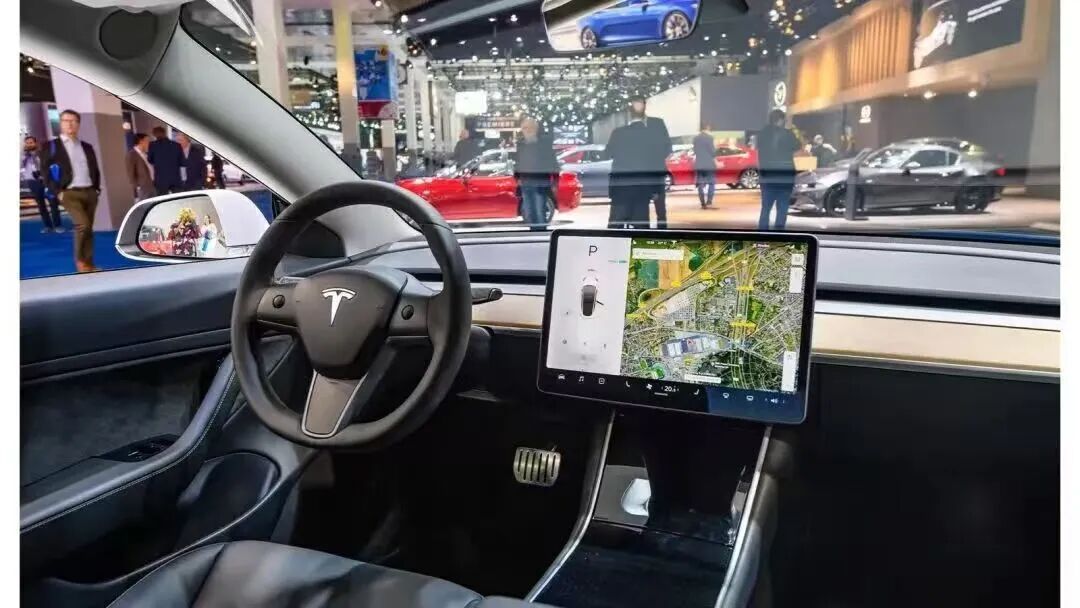
· Central control screens and displays: The entire touch - screen module, including the liquid - crystal panel, touch panel, and cover glass, is likely to come from Chinese technology companies (such as BOE and Lens Technology);
· This also involves the PCB boards mentioned above. Almost all electronic control units (ECUs) require PCBs;
· Electronic control units (ECUs), which are modules responsible for controlling windows, air - conditioners, lights, etc., many of which are produced by Chinese joint - venture or local auto parts enterprises;
· Interior parts: such as instrument panels, steering wheels, seat fabrics, seat belts, and airbags;
· Air - conditioning systems: Components such as air - conditioning boxes, blowers, and evaporators;
· Lighting systems: Tail lights, interior lights, etc.
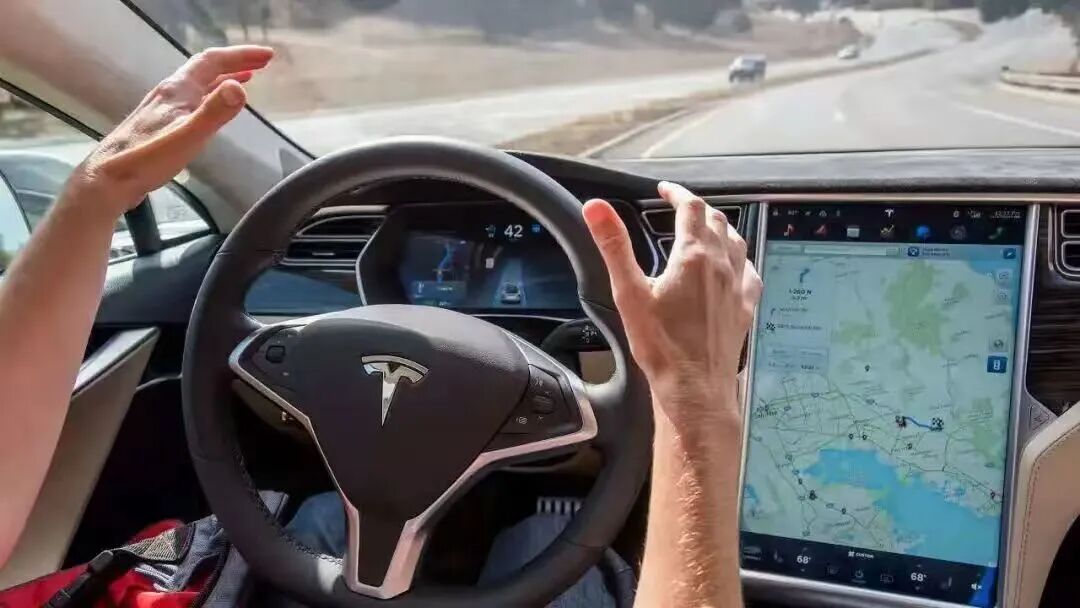
In addition, there are semiconductors and chips. Although high - end computing chips (such as FSD chips) are manufactured by Samsung/TSMC, the packaging and testing of a large number of mature - process chips (used for body control, power management, etc.) and power semiconductors are completed in China. Many globally well - known semiconductor companies (such as Texas Instruments, STMicroelectronics, and Infineon) have large - scale packaging and testing factories in China, and their products will directly or indirectly enter Tesla's supply chain.
02
Who is Really Anxious?
First, let's analyze Tesla's US factories' dependence on various Chinese - made auto parts and the degree of their substitutability.
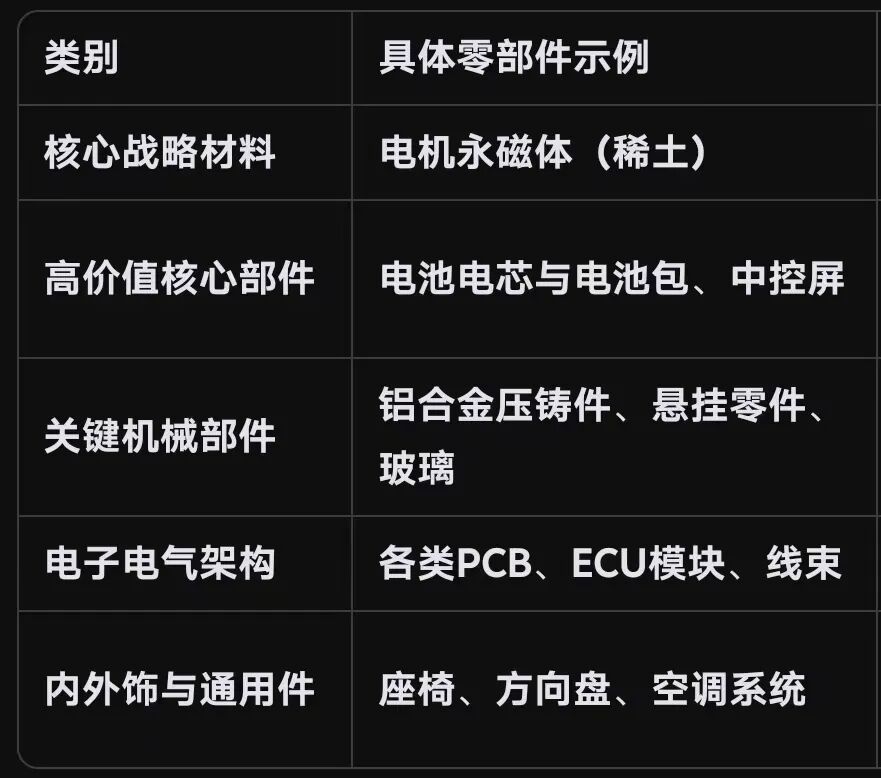
Core strategic materials: Permanent magnets for motors (rare earths). The dependence on this type is extremely high and almost irreplaceable.
High - value core components: Battery cells, battery packs, and central control screens. The dependence on this type is high, and China leads in terms of technology and production capacity.
Key mechanical components: Aluminum alloy die - castings, suspension parts, and glass. The dependence on this type ranges from medium to high, with obvious cost and quality advantages.
Electrical and electronic architectures: Various PCBs, ECU modules, and wiring harnesses. The dependence on this type is high, with a mature supply chain and high integration.
Interior and exterior decorations and general parts: Seats, steering wheels, and air - conditioning systems. The dependence on this type is medium, with a wide variety of categories and a reliance on China's manufacturing ecosystem.
Generally speaking, Tesla's US factories have an all - around dependence on Chinese auto parts, covering both high - value - added core components and low - cost basic parts.
This dependence has multiple reasons. China has a complete supply - chain ecosystem: In the Yangtze River Delta and the Pearl River Delta, you can find suppliers for almost all auto parts; there is a cost advantage, as large - scale production brings unparalleled cost competitiveness; in terms of manufacturing technology and speed, Chinese suppliers in fields such as batteries and electronics are globally leading in technology and response speed.
In recent years, affected by geopolitics and supply - chain security, Tesla has been promoting the diversification and localization of its supply chain (for example, establishing a battery supply chain in North America). However, it is very difficult to completely break away from the dependence on Chinese auto parts, especially strategic resources such as rare - earth magnets and batteries, in the short term.
Conversely, Chinese suppliers can "work around the situation" by establishing production capacity in the US.
Take Sanhua Intelligent Control, a very important first - tier supplier for Tesla, as an example.
Sanhua provides core components for Tesla's automotive thermal management system, responsible for the cooling and heating of batteries, motors, and cockpits, including:
· Electronic expansion valves: This is the "core control switch" of the thermal management system, used to precisely control the flow of refrigerants, which is crucial for energy efficiency and thermal management accuracy.
· Cooling plates: Directly responsible for the cooling and heating of battery packs to ensure that the batteries operate in the optimal temperature range.
· Other thermal management components such as thermal expansion valves, electronic water pumps, and oil coolers.
Sanhua Intelligent Control supplies Tesla's non - Chinese markets mainly in two ways. One is direct export from Chinese factories, such as Model 3 and Model Y exported from Tesla's Shanghai Gigafactory to Europe (and to the US in the early days). The other is local supporting supply for vehicles produced in Tesla's Fremont factory in the US and the Gigafactory in Austin, Texas (such as Model S, Model X, and Model Y). These factories also need thermal management system components.
To further reduce costs and improve supply - chain resilience, Sanhua Intelligent Control is building a factory in Mexico. This will enable it to supply Tesla's North American factories more conveniently, forming a "near - shore supply chain".
Conversely, in addition to Chinese local suppliers, suppliers such as Infineon that have factories in China may also export their products to Tesla's US factories and will also be "affected" in the process.
Ultimately, more anxious than the suppliers is still Tesla itself. When there are gaps in the supply - chain replacement process and costs rise, it will directly affect Tesla's performance. Of course, more anxious than Tesla is probably the real instigator behind the scenes.
This article is from the WeChat official account "C Dimension". Author: Shi Jie, Editor: Wang Yue. Republished by 36Kr with permission.