Tony Hong, former head of DJI's lidar business, starts a new venture. He says he wants to reshape the dignity of travel with technology | Exclusive interview by 36Kr
Author | Zhang Ziyi
Editor | Yuan Silai
It was in 2023 when Tony Hong left Southern University of Science and Technology to start his own business.
It was a trough in the venture capital industry. The global investment in startups dropped by 38% compared to 2022, and both investors and entrepreneurs were on the sidelines.
However, a new spark was ignited. ChatGPT had emerged, and artificial intelligence showed an unprecedented evolution speed. Even in the academic circle, Tony Hong could still sense the rapid warming of the environment.
He was an assistant professor at Southern University of Science and Technology at that time, leading a rather stable and decent life. When persuading his family to support his decision to start a business, he told his wife, "I'll definitely regret it if I don't do this."
If we look back at Tony Hong's experience, his choice won't come as a surprise. After obtaining his doctorate from the University of California, Berkeley, he had the budding idea of starting a business during his post - doctoral research. So he chose to leave the academic circle and joined Honeywell to research sensors. In 2016, Tony Hong returned to China and joined DJI, leading the team to develop lidar from scratch. In 2019, he joined Southern University of Science and Technology and returned to the academic world.
Although he only spent three years at DJI, this experience left a deep impression on him. Tony Hong found that everyone has the opportunity to create a great product. Even if it can't change the world, it may still solve some problems and drive progress.
So when he saw the unprecedented energy burst out by AI, Tony Hong naturally thought: What should technology bring to people? What role should he play? Is it possible for robots to benefit humanity more practically?
He could no longer tolerate being just a bystander of history. In 2023, Tony Hong found his former colleagues at DJI and founded Ruochuang Technology, launching the travel brand Strutt. "Strut" in English means "to walk with one's head held high and confidently."
From 2023 to the present in 2025, Strutt has been researching and developing a product - the intelligent personal travel vehicle ev¹.
Strutt's ev¹ is a rather unconventional product. It doesn't look like a traditional wheelchair product. After all, it has a highly technological appearance and the solid feeling of a car seat. People sitting on it seem to do nothing but move forward smoothly.
Yingke exclusively learned that Strutt recently completed its Pre - A round of financing, receiving tens of millions of dollars in cumulative funding from multiple globally renowned investment institutions, including Matter Venture Partners and Vertex Ventures. And on November 13th, Strutt ev¹ was officially launched in San Francisco, USA.
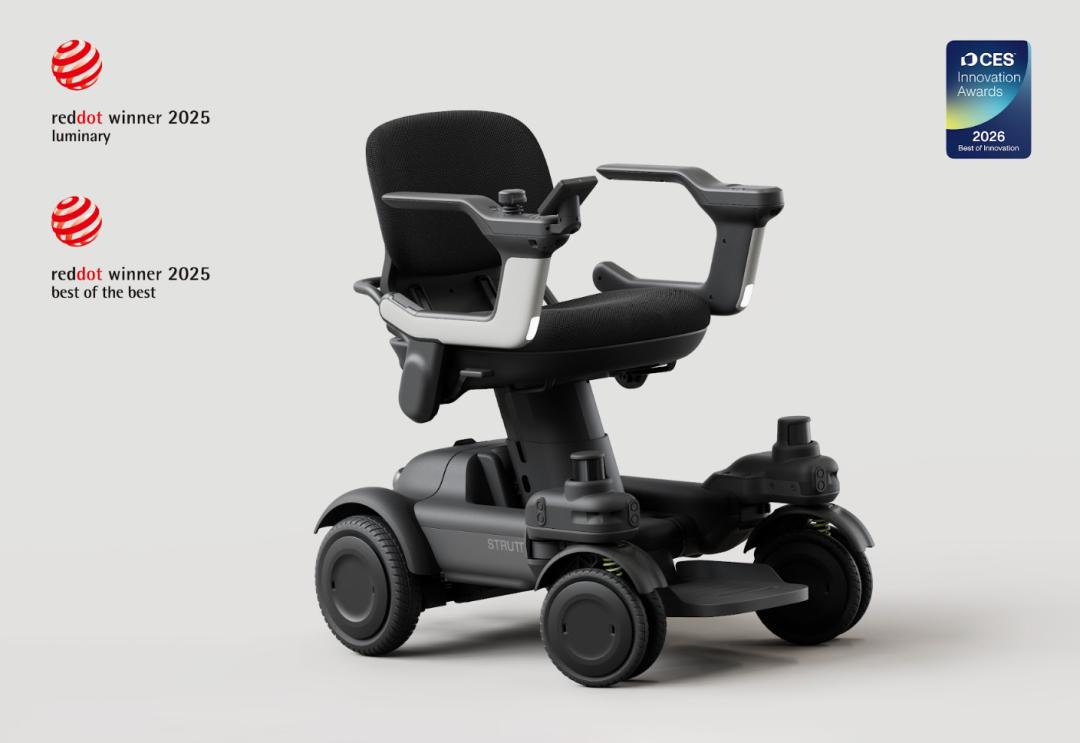
(Image source/Enterprise)
Currently, few entrepreneurs are involved in the electric wheelchair field. It's not as trendy as Ebikes, not as cool as hoverboards or scooters, and not as lightweight as electric two - wheelers. Electric wheelchairs have a rather fixed user profile - people with limited mobility, who may be the disabled or the elderly.
It seems that doing business targeting them isn't that appealing. However, it's a real and urgent need. A report from the World Health Organization shows that as of 2020, 3.3 out of every 1000 people in the United States use wheelchairs each year. In the United States, the increasing number of elderly people in need of mobility solutions has led to a strong demand for wheelchairs.
If we expand to the global scale, according to a United Nations report, over one billion people have some form of disability, not including the elderly with limited mobility due to illness. Tony Hong hopes that robot technology can enable these neglected people to gain full freedom, independence, and dignity.
Of course, in Tony Hong's view, the ev¹ product isn't just an electric wheelchair. It has a grander ambition - to serve both people with limited mobility and all individuals with travel needs. It may even serve as a robot for family companionship in the future.
We had a two - hour in - depth conversation with Tony Hong, discussing Strutt, the market, and how technological changes can contribute to the future of humanity.
01 "We're going to do something big."
Yingke: You've worked in enterprises and also in universities. What kind of foundation does such experience lay for your entrepreneurship?
Tony Hong: After graduating with my doctorate, I didn't really want to pursue an academic career. I hoped to do something more practical, something that could combine technology with humanity and the dream of changing the world.
Yingke: The financing environment was not good in 2023. Why did you decide to start a business at that time?
Tony Hong: By that time, opportunities in all aspects were almost ripe. I had figured out what I should do, and the industrial chain infrastructure was also in place. I saw some cutting - edge research and could see great opportunities and potential. From past experience, implementation is crucial, so I decided to start my own business.
Yingke: How long did you think about resigning to start a business?
Tony Hong: I didn't spend much time convincing myself. I spent some time convincing my wife and family, telling them that I had to do this, or I'd regret it.
Yingke: I noticed that your father is an engineer and your mother is a nurse. Did you get any experience from your family in developing this product?
Tony Hong: My parents have had a profound and subtle influence on me. My father is an engineer who can make something properly and let others use it. My mother is a nurse. She is very careful and willing to take care of others. When I was a child, being in the hospital with my mother, I could see that many people were in great need of help.
My background and academic journey tend to be more technology - oriented. I've always been thinking about how technology can benefit humanity and be transformed into products that help people in daily life. This society should be inclusive. No matter what their physical condition is or what their job is, they should have full freedom, independence, and dignity. I hope that robot technology can resonate with these elements.
Yingke: Will your experience in developing products at DJI influence the product development of your generation?
Tony Hong: Definitely. DJI's extreme pursuit of products has deeply influenced us. When developing the assisted driving system, there were sudden stops and starts at the beginning because the safety redundancy was set very high. We once set the car model like the common "box" in autonomous driving, but the vehicle couldn't move because the box was too large. So finally, we refined the vehicle body model into a 3D model exactly the same as the car, enabling precise obstacle avoidance in a narrow three - dimensional space. If it were an ordinary team, they might have given up long ago, but we thought we must refine this thing.
Yingke: After leaving DJI, what do you think is the most useful experience from DJI?
Tony Hong: The most precious experience was actually meeting a group of excellent young people who were full of ideals and very smart. For a completely innovative thing, no one knew how to do it. But precisely because there was no experience, the first - principles thinking was very important. Everyone dared to try, verify quickly, and iterate rapidly, and finally, we could reach the world - class level.
The best thing about DJI is that it gives engineers a lot of freedom without too many rules and regulations, providing us with a lot of space to explore. And it has the determination to provide sufficient resources for actual productization and production. It's hard to get such growth elsewhere, and I'm grateful to DJI.
Yingke: You started your business in 2023. Have you been researching and developing this product for the past two or three years?
Tony Hong: We've been researching and developing this product for two years. The first year was for researching platform technology, and the second year was for refining the product. But I want to emphasize that we started user research from day one. Since we don't have a long - term need for it ourselves, we need to have a very deep sense of empathy. Most of my time, besides management, is spent with users, experiencing our product with them to find out what's wrong and needs optimization. Although we haven't officially started selling, the end - users who have experienced our product highly recognize it.
02 "What we're going to do is far more than just an electric wheelchair."
Yingke: At present, whether it's the silver - haired economy or products targeting the disabled, there don't seem to be many technological products specifically developed for them. I'm curious about when you realized that this was what you wanted to do and that you could do it well?
Tony Hong: Many people have explored the silver - haired economy, the transformation of elderly care products, and the needs of the disabled, but few have truly combined them with productized technology. There are two thresholds here: one is technology product fit, and the other is product market fit.
Can technology ultimately be turned into a product? Can the product meet market demand? Both are very difficult. What kind of product can connect them?
Currently, there are few enterprises truly focusing on products in the silver - haired economy. I believe that clearly defining the product is more important than defining the user group or the technology stack. The product is the bridge between people and technology.
Yingke: So how do you achieve this fit?
Tony Hong: Our feeling is that the demand definitely exists. Imagine that the global aging rate is high, there are fewer and fewer young people, and fewer young people are willing to do nursing work. The social crisis is real, and the crisis also means strong demand. But the core problem is how to pinpoint that demand. It must be a specialized product that meets the needs and has future scalability.
When we were choosing a product, we had an idea: how to meet the needs of many people and achieve the best combination of technology and the market. We first focused on travel because travel is very important to everyone. Once a person's physical function deteriorates or they can't go out, their quality of life will significantly decline.
There are various needs in the travel field. We found some core pain points: how to better drive personal travel devices is very important. Personal travel devices need to be used in various indoor and outdoor places with complex and changeable environments, so a high degree of intelligence is required to provide a sense of ease and safety while driving. This is the core reason why we think intelligence can bring significant value to this scenario.
Yingke: You must have investigated many products before. In your opinion, what pain points of such products haven't been solved?
Tony Hong: Electric wheelchairs themselves don't meet the needs of many people. Many people don't need a wheelchair. They may just have difficulty walking or want to visit an exhibition. In this case, they obviously don't need a wheelchair, especially considering that in the general social definition, wheelchairs are more for the disabled. We don't want this to be the case. We hope our product can provide enough dignity and freedom.
The most painful point is that it's very difficult to control a wheelchair precisely with a joystick, which may lead to collisions, accidental roll - overs, or an inability to pass through narrow spaces.
The difficulties lie in several aspects: one is direction control. The joystick is very small and sensitive. Different from a car's steering wheel, a slight movement of the joystick will greatly increase the turning radius of the wheelchair, so it's very challenging for the elderly to control the direction precisely. The other is speed control. The joystick has a short stroke and high force. It's either at zero or fully pushed, and it's difficult to control it at an appropriate speed.

(Image source/Enterprise)
Yingke: The ev¹ is equipped with lidar, which is usually used in drones or cars. How did you come up with the idea of using it on a wheelchair?
Tony Hong: Our thinking didn't start from lidar itself. How can we create a better robot product? Especially in the current situation of an aging population and a low birth rate, how can we have a better product to meet the needs of more people? We started from this point.
Robot technology has developed significantly today, and I believe it will continue to develop further in the next decade. Technologies such as large - language models, embodied intelligence, and multi - sensor fusion are gradually maturing. It's foreseeable that robot technology will enter a golden age. For me, what's more attractive is how we can use this technology to benefit more people.
During the product development process, we found that the ev¹ is far more than just an electric wheelchair. Whether from the aspects of design, technology, target user group, or user experience, it has far exceeded the scope of an electric wheelchair. We prefer to define it as a personal travel device. Today, drones and intelligent assisted - driving systems are highly intelligent, but the personal mobile travel devices we see are not in a very good state. Electric wheelchairs are one of them, but they are a device invented in the last century.
If a travel product can help more people and intelligence plays an important role in it, then it can definitely help solve some problems arising from the aging society.
03 Returning control to the user
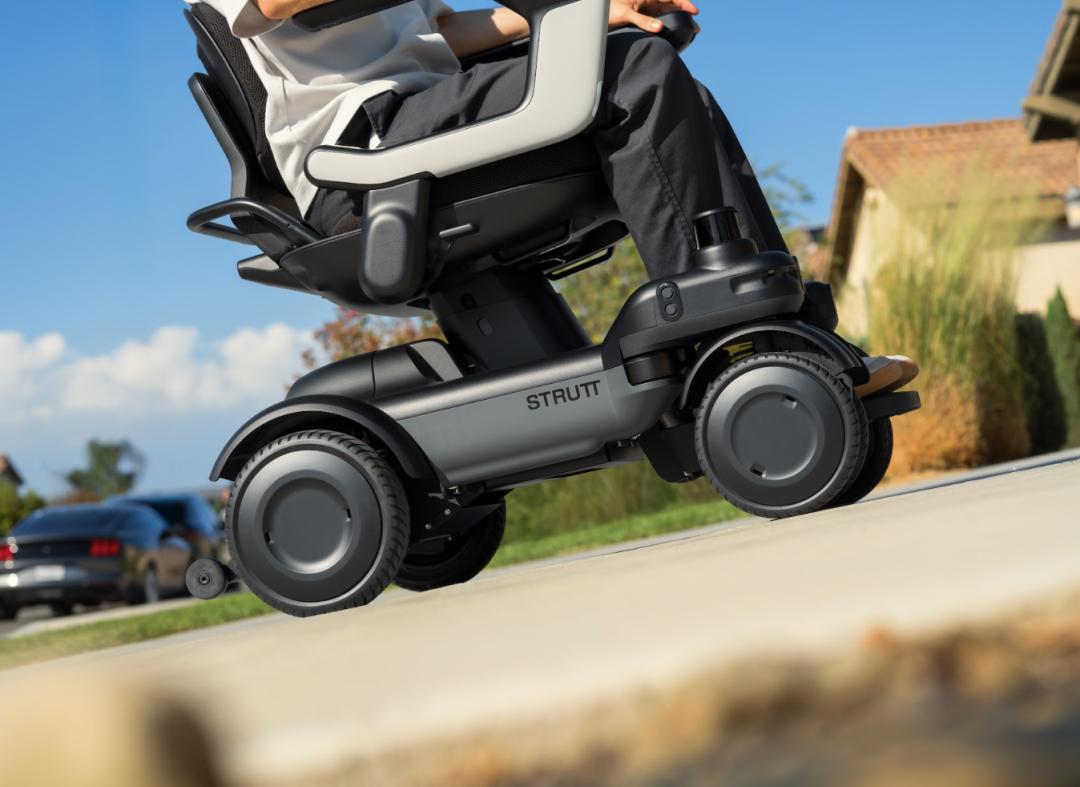
(Image source/Enterprise)
Yingke: I noticed that an important design of the ev¹ is the assisted - driving system (Co - pilot). Why did you choose this human - machine co - driving mode?
Tony Hong: We interviewed many users, and a considerable number of elderly users attach great importance to control rights. They believe that retaining control is the most important function of the assisted - driving system.
Moreover, from the perspective of functional safety, we don't want it to be in a completely autonomous - driving state where the user can't intervene. We hope it's in a co - driving state similar to L2.9, jointly controlled by the system and the user.
Our Co - pilot currently has two functions: one is stopping in front of an obstacle. It can help the user stop in front of an obstacle, and the user still controls the direction in this mode. The second function is small - angle deflection. When the steering instruction given by the user is insufficient to avoid an obstacle, the system can help fine - tune the direction, providing enough joystick movement for the user to avoid the obstacle. At this time, we help fine - tune not only the speed but also the direction.
This function is usually used when the user is exploring a new area. They hope to have a certain degree of control, just like "I can go wherever I want with my own legs." So the Co - pilot is very important because it helps the user drive more safely.
Yingke: What are the difficulties of the Co - pilot?
Tony Hong: It's the underlying technology stack (the entire set of technical solutions). To achieve a good Co - pilot, a very complete intelligent assisted - driving system is needed. Because the system needs to know exactly how much to adjust and how to avoid obstacles nearby, such as passing people or pets. So