After posting several articles in succession, Lei Jun got angry for a moment, but it was just a momentary outburst of anger.
Many people on the Internet take things out of context, distort facts, and smear others.
On November 16th, Lei Jun posted several Weibo posts in a row, with rather intense words.
“I've rarely seen Lei Jun express emotions in his Weibo posts,” said a colleague from ifanr.
Lei Jun mentioned something he said in an interview in April last year - “For a car, good looks come first.” However, this statement has often been maliciously misinterpreted by people with ulterior motives as “Xiaomi cars don't prioritize safety.”
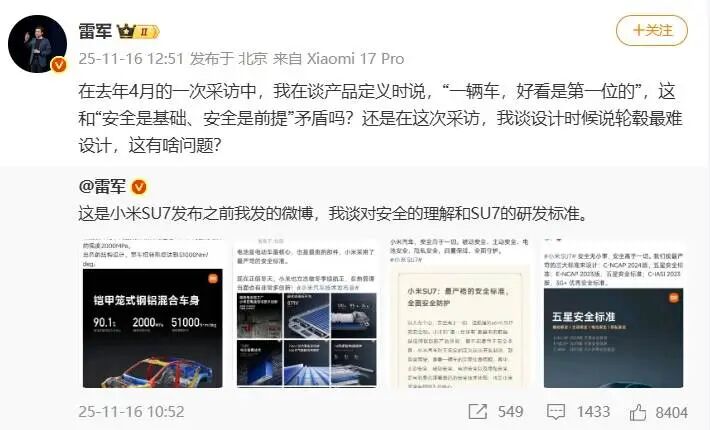
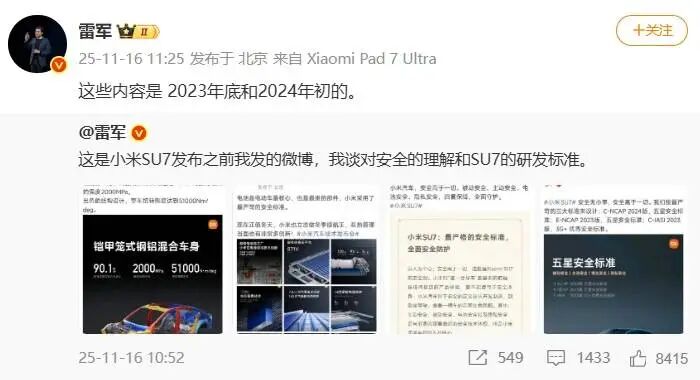
Lei Jun countered by asking whether this statement contradicted his previous statement that “safety is the foundation and prerequisite.” To support his point, he also attached several screenshots of his old Weibo posts where he talked about technical standards such as the body strength and battery safety of the Xiaomi SU7 before its release.
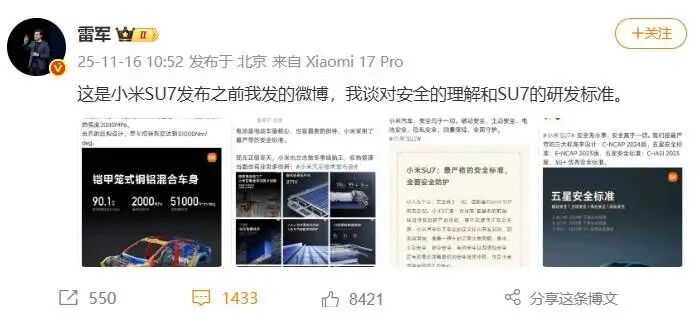
In his interactions with netizens, he also clearly expressed his attitude, believing that “many people on the Internet take things out of context, distort facts, and smear others,” deliberately pitting “good looks” against “safety,” two elements that are not in conflict.
This way of guiding product doubts towards public opinion has almost become a consistent approach for Lei Jun when facing controversies.
After the serious accident of the Xiaomi SU7 in Chengdu, Lei Jun's first public appearance was at the World Intelligent Connected Vehicles Conference on November 6th. Instead of directly addressing the specific questions about product safety on stage, he shifted the topic to the industry level, calling on everyone to rationally view the growth of new car - making forces and emphasizing the need to “jointly resist 'paid trolls and negative public relations'.”
On the same day, Lei Jun reposted a comparison and evaluation video of the Xiaomi YU7 and the Tesla Model Y. When a netizen questioned in the comment section that “(Xiaomi) only dares to compare with the Model Y,” Lei Jun replied in the tone of “Which product do you suggest we compare with?”

It's true that everyone has a temper. From Lei Jun's perspective, his design concept has been taken out of context by “paid trolls,” and his competitive products are ridiculed when compared with mainstream competitors.
This sense of frustration is understandable. However, when this emotion starts to dominate public responses, a serious discussion about product and safety concepts will inevitably turn into a public opinion stand - off between support and smear.

The Ineffective 'Digital Circle PR Strategy'
Many people say that Xiaomi has brought a lot of PR methods from the digital circle to the automotive circle in the past two years. However, this PR strategy is somewhat out of place in the automotive industry.
The reason is that users have very different psychological expectations for these two industries. Mobile phones are fast - moving consumer electronics. Most of the problems users encounter are overheating, freezing, and crashing, and the tolerance is relatively high. At worst, users can just make do or buy a new one. But in the automotive field, users may face problems such as loss of control, fire, and inability to escape after a collision. There is no such thing as “making do.”
This difference in the trust threshold has been clearly reflected in the market reaction.

After the relevant accident fermented, Lei Jun's personal social media account lost more than 300,000 followers in half a month, and the live - streaming room of Xiaomi cars was once flooded with a large number of negative comments.
It's undeniable that paid trolls exist, but it's hard to simply attribute this large - scale public opinion to “paid trolls.”
The reason why users are so sensitive to the discussion of “good looks or safety” is not only because of the online hype but also because of several real and shocking accidents. Several serious accidents from Tongling to Chengdu have a disturbing common point: after a serious collision, the car doors seemed unable to open, causing great difficulties for rescue.
The public's questions are specific. They need a detailed technical explanation of the car doors and a review of the accident, but what they got was an accusation of negative public relations.
In fact, the trust of many users in Xiaomi has been gradually eroded in daily marketing. The air duct on the front hood of the SU7 Ultra is just a decorative design, and the “168 million driving modes” are just combinations of a few core parameters... Such practices inevitably make people think of some of Xiaomi's operations in other fields. For example, when promoting laptops, it was said that they were “thinner than a one - yuan coin,” but actually, it was compared with the height of a coin standing upright; when promoting mobile phones as the “king of backlight photography,” it was noted in the bottom - right corner that “it is the product design goal.”
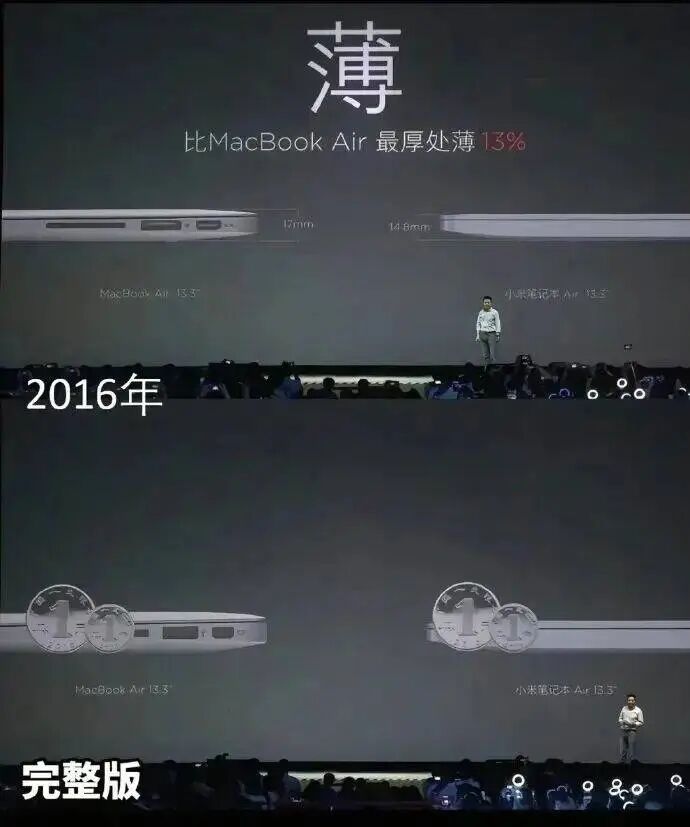
This practice of highlighting eye - catching numbers in promotion and then limiting them with inconspicuous annotations may be ignored in the consumer electronics field. But in the automotive field, it is easily understood by users as being sneaky. When a brand is used to playing with words, the public will naturally doubt whether it will cut corners on safety.
This long - accumulated sense of distrust is perhaps what Xiaomi really needs to be vigilant about behind this emotional Weibo response.
Beyond Anger, More Responsibility is Needed
The public's anxiety and questions will not disappear because of Lei Jun's explanation. If this anger can be directed to the real problems that need to be solved, it should first focus on the car door issue that the public is most concerned about.
Rather than being taught what taking things out of context means, the public needs a detailed explanation. For example, how can the hidden door handles of the Xiaomi SU7/YU7 be guaranteed to open in extreme situations such as collision, power failure, or even falling into water? Why did this mechanism fail in the accidents that have occurred? Is it a design flaw, a quality control problem, or a limitation under specific conditions? More importantly, will Xiaomi provide improvement plans for existing car owners?
An honest announcement can rebuild trust far better than ten Weibo posts.

In addition to this, Xiaomi should take this opportunity to play a leading role in safety.
The draft for comments of the “Technical Conditions for Safety of Motor Vehicle Operation” issued by the Ministry of Public Security, which has recently sparked widespread discussion across the network, clearly requires that “after each start of a passenger car, it should be in the default state where the acceleration time from 0 - 100 km/h is no less than 5 seconds.” This regulation points exactly to the safety hazards brought by high - performance electric vehicles at present.
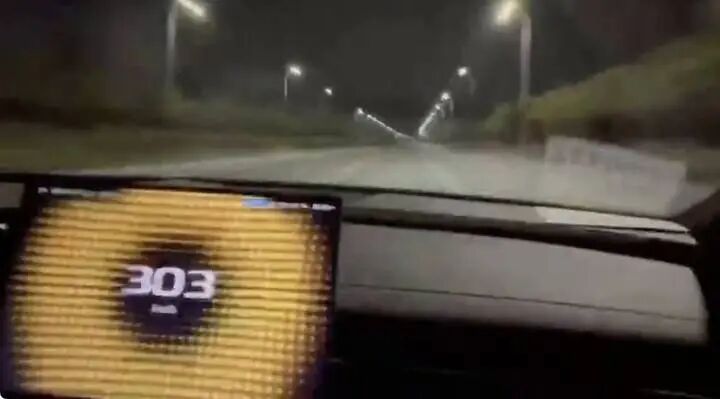
Instead of repeatedly emphasizing “safety is the foundation” on Weibo, Lei Jun should prove it with actions by publicly supporting and advocating for this national standard draft. This is the embodiment of “safety comes first” and a crucial step for Xiaomi cars to establish a safety label.
After solving the problems of car doors and acceleration, there is a more fundamental problem: cars are getting faster, but drivers' skills are not keeping up.
Xiaomi must have also realized this problem. The “elite driving training” it launched for car owners at an affordable price is a good attempt. However, this is ultimately an action that depends on the personal interests of car owners, with limited coverage and far from enough to solve the problem. Moreover, the popularization of high - performance electric vehicles is an industry - wide phenomenon, not just limited to Xiaomi.
Our current C1 driver's license allows drivers to drive both the 90 - horsepower Wuling Hongguang and the 1548 - horsepower Xiaomi SU7 Ultra legally. A driver who has only learned “reversing into a parking space” and “starting on a slope” in driving school simply cannot handle the G - force generated by 2 - second acceleration, let alone emergency avoidance at high speeds.
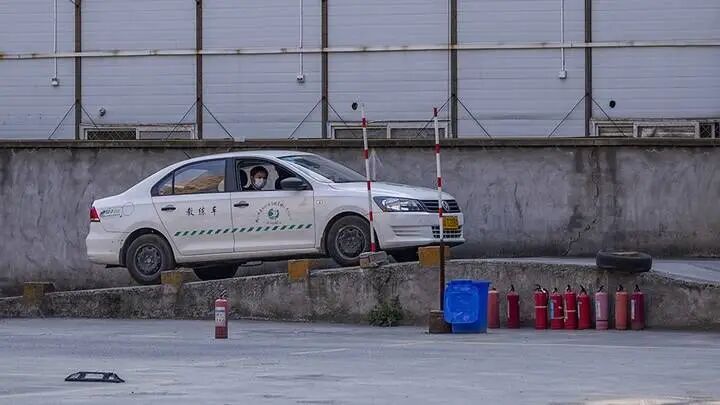
As the biggest beneficiary and promoter of this “performance democratization” wave, Xiaomi has an inescapable responsibility. Lei Jun, as an industry leader and public figure, is most qualified and capable of standing up, using his social influence to actively call for and promote the establishment of a driver's license grading system.
This is the responsibility of “putting all one's reputation on the line,” which can fundamentally help the whole society safely enjoy the performance dividends brought by the technological explosion.

Lei Jun's anger is real, but the target of his anger deviates from the public's concerns. He is angry about being misunderstood, but what really threatens his “last entrepreneurship” is not all due to paid trolls.
Lei Jun got angry, but it shouldn't just end with that.
This article is from the WeChat official account “Dong Che Hui”. Author: Li Hua. Republished by 36Kr with permission.