Tencent has poured cold water on AI once again.
Author | Zhang Fan, Huang Yida
Editor | Huang Yida
On November 13th, Tencent released its third - quarter earnings report, and the performance was typically "Tencent - style".
The financial report shows that Tencent achieved revenues of 192.869 billion yuan in Q3 2025, a year - on - year increase of 15%, slightly exceeding market expectations. The positive growth of the three core businesses - gaming, advertising, and financial technology & enterprise services to varying degrees was the main support for Tencent's steady revenue growth this quarter.
In terms of business, the core highlight of the gaming business was that the overseas gaming revenue skyrocketed by 43% year - on - year this quarter; the growth of advertising business revenue benefited from both the increase in advertising loading rate and the growth of advertisers' investment, and AI was also an important internal driving force for revenue growth; the growth of financial technology & enterprise services revenue, on the one hand, reflected the economic recovery driving the rebound of financial technology - related demand, and the growth of enterprise services revenue was mainly driven by the cloud business.
In terms of profit, Tencent continued its previous strong growth level. The gross profit in the same period reached 108.8 billion yuan, a year - on - year increase of 22%; the Non - IFRS operating profit in the same period was 72.6 billion yuan, a year - on - year increase of 18%. It is worth noting that the year - on - year growth rates of gross profit and operating profit have led the year - on - year revenue growth for twelve consecutive quarters.

Chart: Summary of Tencent Holdings' financial report; Source: Company financial report, 36Kr
In addition to core financial data such as revenue, gross profit, and operating profit, Tencent's capital expenditure is also a focus of market attention. The company's capital expenditure in the quarter was 12.98 billion yuan, a year - on - year decrease of 24% and a quarter - on - quarter decrease of more than 32%. At the subsequent earnings conference call, Tencent's senior management said that the full - year capital expenditure in 2025 is expected to be lower than the previous guidance range but still higher than that in 2024.
01 Lowering of Capital Expenditure Guidance
At its 2024 annual earnings conference, when responding to the capital expenditure growth rate in 2025, Tencent gave a vague figure: "low teens". The Chinese meaning of "low teens" is about 10 - 13% of the full - year revenue in 2025.
Considering that Tencent's revenue in 2024 was 660 billion yuan and adding the part of performance growth, the market generally expected Tencent's capital expenditure in 2025 to be around 90 billion yuan, only about a 17% increase compared to the 76.8 billion yuan of capital expenditure in 2024. Obviously, the "low teens" expectation at the beginning of 2025 could not meet the market's appetite.
With the release of Tencent's third - quarter earnings report, it was clear that the capital expenditure guidance would be further lowered, only indicating that it would be higher than that in 2024.
Tencent's capital expenditure was low in the second - quarter earnings report this year, mainly due to the "chip shortage" caused by factors such as overseas export controls. Tencent's announcement in the third - quarter earnings report to further lower capital expenditure was also affected by the "chip shortage" to a certain extent. Meanwhile, Tencent President Liu Chiping explained the chip supply issue, saying that the company currently has sufficient GPU reserves to meet internal use.
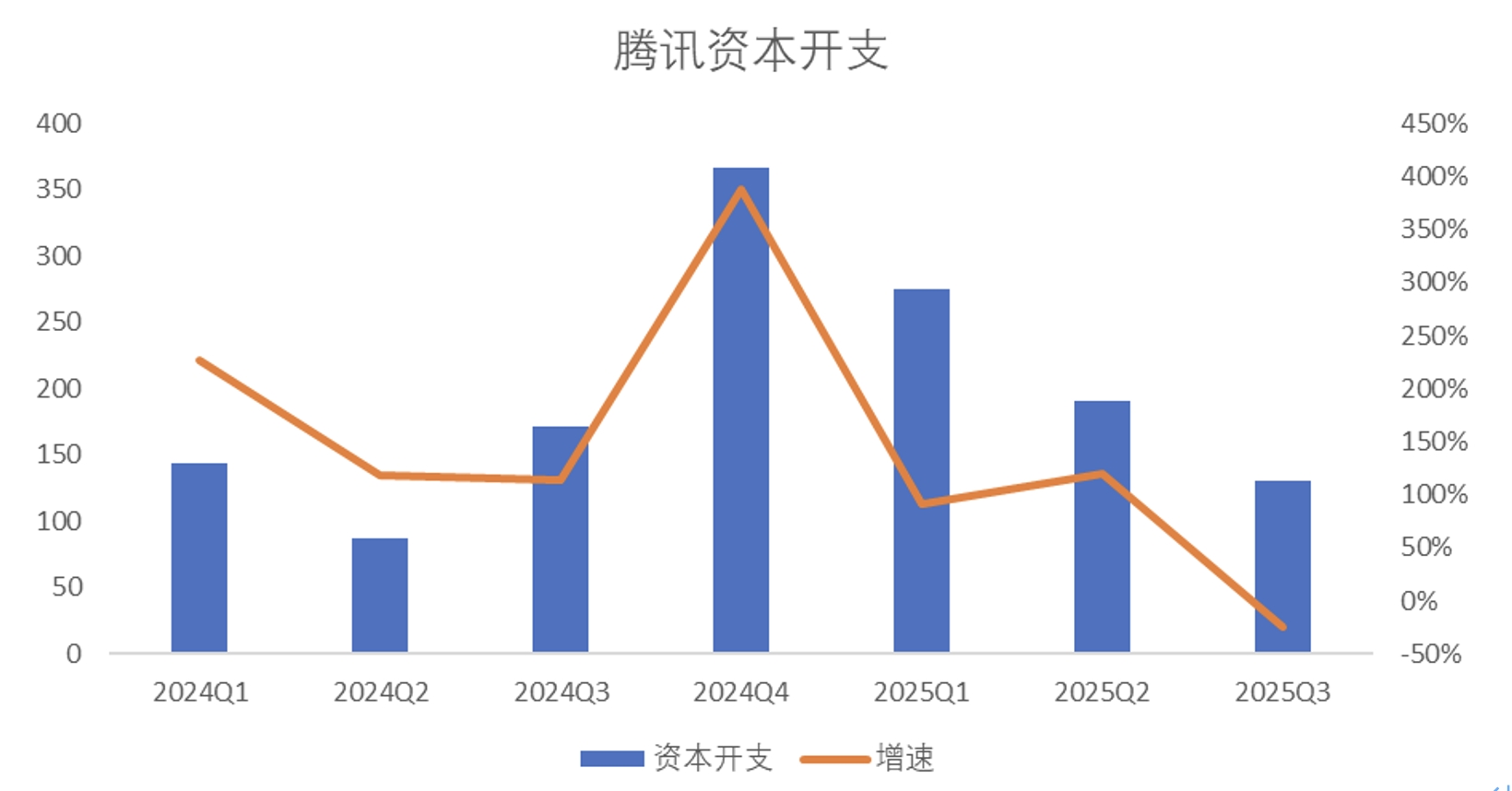
Chart: Tencent's capital expenditure level in recent years; Source: Company financial report, 36Kr
02 Why Is Tencent More Low - Key?
In the current round of domestic AI infrastructure construction, Tencent has been relatively low - key, which is significantly different from the fierce competition among overseas companies such as Google, Amazon, and Microsoft. This phenomenon is essentially determined by the competitive landscape of the cloud market. The intense competition among multiple overseas giants in the cloud market is more intense than that in the domestic market.
In the global cloud market in Q2 2025, Amazon accounted for 32%, Microsoft 22%, and Google 11%, with growth rates of 17.5%, 39%, and 31.7% respectively. Microsoft and Google, with relatively lower market shares, are catching up. Correspondingly, Alibaba Cloud in China is dominant. According to Omdia data, in the first half of 2025, Alibaba Cloud's market share was 35.8%, far ahead of Volcengine Cloud in second place with 14.8% and Huawei Cloud in third place with 13.1%.
Alibaba's core e - commerce business is facing challenges from multiple aspects. Currently, the domestic e - commerce market is a landscape full of giants. There is Pinduoduo taking the low - price route, JD.com taking the high - quality service route, and Douyin aiming for e - commerce. Alibaba's share in the Chinese e - commerce market was once close to 85% in 2015, but under the multi - pronged attack, it had dropped to less than 40% by 2024.
Therefore, under pressure on its e - commerce base and with the approaching end of the traffic dividend, Alibaba, leveraging its advantages in the cloud business, is willing to open up a new battlefield in the AI field, and the corresponding investment is relatively more aggressive.
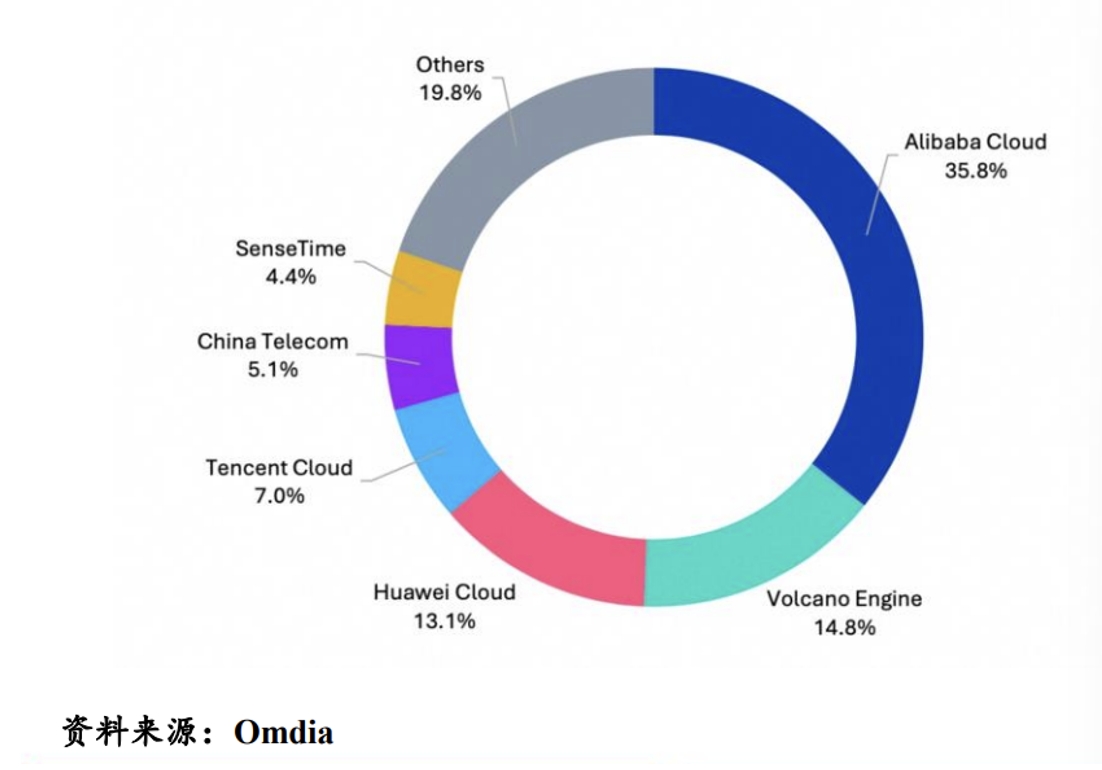
Chart: Competitive landscape of the domestic cloud market in H1 2025; Source: Omdia, 36Kr
In fact, extrapolating Alibaba's situation to Tencent is more like a "wishful thinking" of the capital market in the AI boom. Compared with Alibaba, Tencent is more cautious in AI infrastructure investment mainly because the business models of the two are significantly different, and their core businesses are at different development stages. Therefore, their AI investment logics are not highly comparable.
Currently, Tencent's three core businesses still maintain strong growth potential, with stable performance growth and strong certainty and sustainability; AI is continuously penetrating all aspects of the core business and has been deeply integrated with the product line, becoming one of the underlying technological supports for business revenue growth.
The underlying logic for Tencent to maintain relatively restrained investment in AI infrastructure: on the one hand, it is to consider the potential risks brought by the uncertainty of AI technology direction. At the same time, based on its own business model, Tencent's current AI strategy is to achieve stronger model performance with lower deployment and inference costs and gain benefits for the core business; on the other hand, Meta, another Internet social media giant, is currently trapped in the "black hole" of high - cost AI infrastructure investment, which also provides a lesson for Tencent.
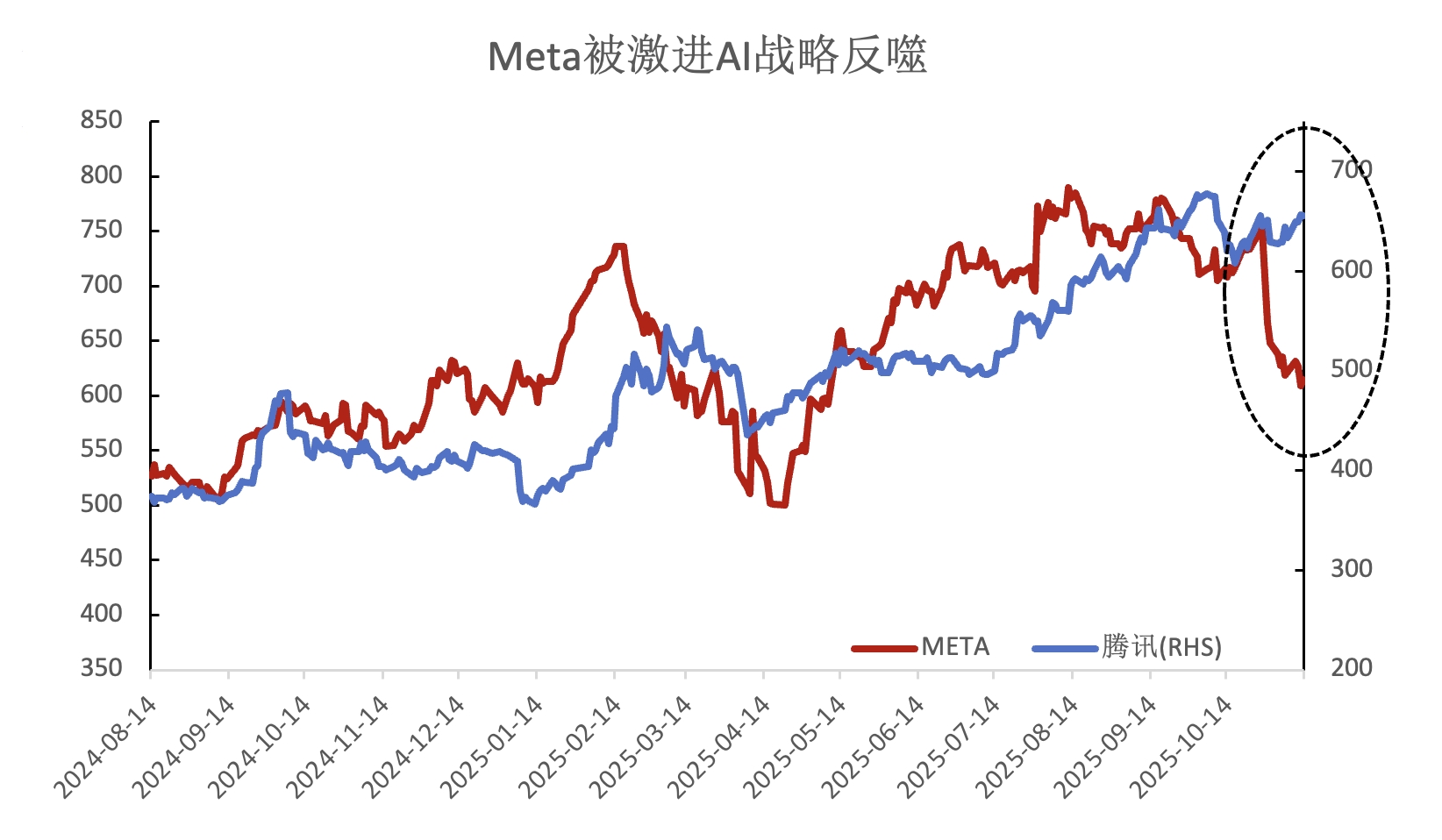
Chart: Stock price trends of Tencent and META; Source: Wind, 36Kr
*Disclaimer:
The content of this article only represents the author's views.
The market is risky, and investment should be made with caution. Under no circumstances do the information or opinions expressed in this article constitute investment advice to anyone. Before making an investment decision, if necessary, investors must consult professionals and make decisions carefully. We have no intention to provide underwriting services or any services that require specific qualifications or licenses for the trading parties.