Once pushed to the brink of collapse by Steve Jobs, Apple's 8th engineer created a tool that allowed the boss to design on his own. Remarkably, the prototype of the Mac calculator was finalized within ten minutes and has been in use for nearly 20 years.
A true story about the early Apple team designing the Mac calculator: When Steve Jobs thought the design was too ugly, the engineer had to teach the boss to do it himself.
In February 1982, Chris Espinosa, the 8th employee of Apple (only 21 years old at that time), encountered a problem that resonated with many people - his boss, Steve Jobs, loved to "give instructions" too much.
At that time, Chris was designing a calculator program for the Macintosh (the epoch - making computer released in 1984). He submitted multiple versions, but none of them passed. Jobs kept finding faults: the buttons were too big, the colors were wrong, the layout was not good - looking... He made revisions again and again.
Finally, Chris couldn't stand it anymore. So he came up with a smart idea - he simply created a "Steve Jobs DIY Calculator Kit" and let Jobs drag and drop to design the calculator in the way he wanted at will.
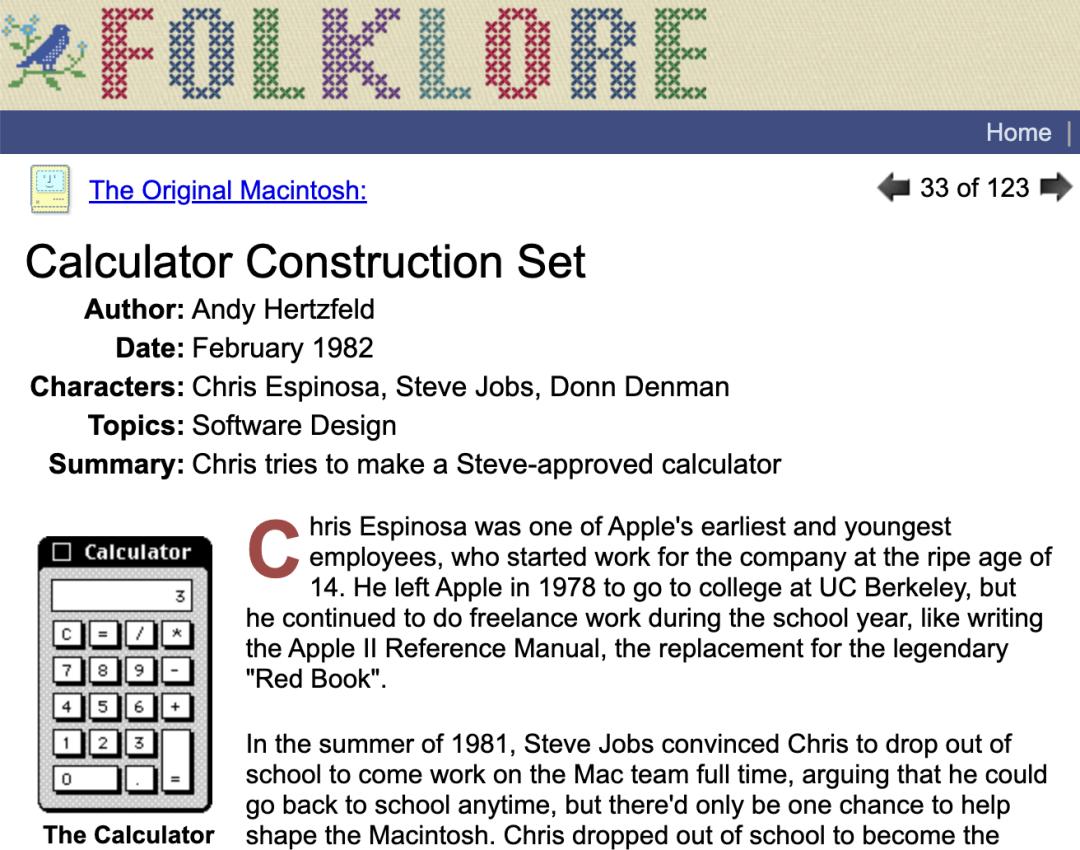
This story was later recorded by another Apple engineer, Andy Hertzfeld, on his website Folklore.org (https://www.folklore.org/Calculator_Construction_Set.html) and was also disclosed by foreign media Arstechnica, allowing the public to learn about some interesting stories of this technology giant in the dimensions of software design and R & D.
Advised to drop out of school and became Apple's 8th employee
Chris Espinosa was one of the earliest and youngest employees of Apple - he joined Apple at the age of 14.
It was the mid - 1970s. Apple was just a small company starting in a garage.
Later, he left Apple to go to college and studied at the University of California, Berkeley. However, he didn't completely cut off contact and still did some part - time work for Apple, such as writing official technical documents like the "Apple II Reference Manual".
In the summer of 1981, Jobs found him again and persuaded him to drop out of school and return to Apple. Jobs' reason was very "Jobs - like" - "You can go to college later, but participating in the birth of the Mac is a once - in - a - lifetime opportunity."
So, Chris took his advice, decided to drop out of school, and officially joined the Macintosh team as the "document in - charge person".
It's worth mentioning that Chris is still working at Apple today and is the employee with the longest service in the company.

Getting frustrated with revisions, better let Jobs do it himself
Back then, when the small Apple team was rushing to make progress and hoped to introduce third - party developers as soon as possible so that they could get started with the Mac's development tools, they were in urgent need of technical documents. The most core part of the Mac system was QuickDraw, which was responsible for graphic drawing, equivalent to the underlying engine of today's graphical interface.
Chris decided to start writing the QuickDraw documentation. To better understand it, he planned to write a small program by himself for practice.
At that time, there was a popular idea in their team called "desk ornaments" (later renamed "desk accessories"), which meant some small tools built into the system, such as clocks, notepads, calculators, etc.
Chris was very interested in this idea, so he decided to make a calculator drawn with QuickDraw.
After a few days of hard work, he made a version that he thought was quite good. But the real test was to show it to Jobs - Jobs was the recognized "aesthetic standard" in the team, and any design had to pass his approval.
So everyone gathered around the computer, waiting for Jobs' evaluation. After Jobs finished looking at it, he was silent for a while and said, "Well, it's a start, but overall - it's terrible. The background is too dark, the lines are too thick, and the buttons are too big."
Chris had to say, "Okay, then I'll keep revising it until you're satisfied."
In the next few days, Chris revised the design version every day according to Jobs' feedback and showed it to him the next day. As a result, new problems were always found. This back - and - forth process almost became the nightmare of a "one - man committee" review - the only "reviewer" was Jobs, and he was never satisfied.
Finally, Chris had a brilliant idea.
The next afternoon, instead of presenting a new version of the calculator, he presented a brand - new "toolkit", which he named the "Steve Jobs DIY Calculator Kit".
This program allowed others to modify various interface details through a drop - down menu, such as line thickness, button size, background pattern... Everything could be selected by oneself.
Then Chris pushed the computer in front of Jobs and let him try it himself.
Jobs immediately started adjusting the parameters when he saw it. After playing for about ten minutes, he finally came up with a design that he was satisfied with.
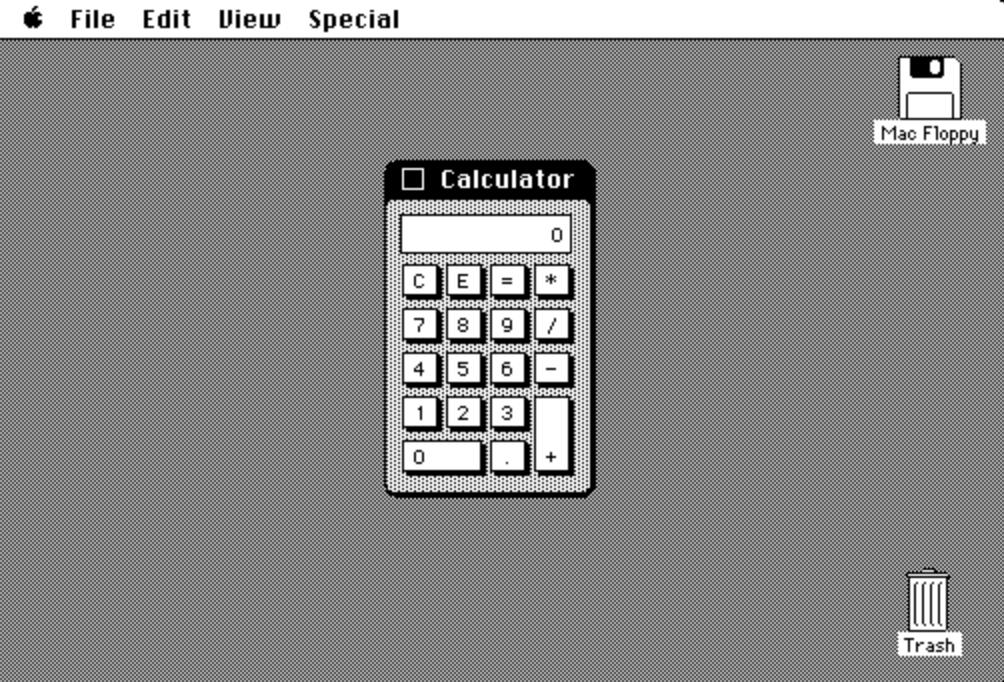
As a result, this plan was immediately adopted. Facts have proved that as long as Jobs could "control it with his hands" instead of "describe it verbally", he could quickly find the ideal design.
A few months later, engineer Andy Hertzfeld officially implemented the calculator interface based on the parameters set by Jobs in those ten minutes, and another engineer, Donn Denman, was responsible for implementing the mathematical calculation part.
Just like that, the calculator built into the Macintosh was born - it was released with the first Mac in 1984 and was used in the Mac OS system for 17 years (from Mac OS 1 to OS 9) until Apple launched Mac OS X in 2001 and it was replaced by a new design.
Why did this method work in Apple?
Chris' "DIY Calculator Kit" was actually the prototype of many software design tools later - it was one of the earliest cases of "visual, parametric design".

It was 1982. Most computer screens could only display black - and - white text at that time. The idea of allowing users to directly adjust parameters and control the appearance through a graphical interface was simply ahead of its time.
A few years later, Apple's own HyperCard system officially developed this concept into a complete "visual application framework".
This "primitive calculator design tool" also inadvertently revealed a management characteristic of Jobs: he actually knew exactly what he wanted, but might not be able to accurately "say it out".
When Chris changed "verbal communication" to "direct operation", this communication barrier was completely bypassed.
Facts have proved that this idea was very effective. Later, after Jobs returned to Apple in the 1990s, he also continued this habit - he never liked to read PowerPoint presentations or a bunch of parameter tables. Instead, he wanted to experience the product himself and use his own feelings to judge whether the design was qualified.
And that short ten - minute "calculator design" unexpectedly became a classic. This interface almost remained unchanged for nearly 20 years with the Mac system and was not eliminated after countless system updates. What was originally just a "stopgap measure to solve a problem" finally became one of the simplest and most durable designs of the Macintosh.
Conclusion
This interesting story also reflects the working atmosphere at Apple back then: there was both the genius' persistence and the engineers' creative resistance. Nowadays, many software designs are the result of team discussions and meeting decisions. Stories like "one person makes a decision and another person responds cleverly" are becoming rarer and rarer.
In response to this, a netizen sighed: "The ability to know what you want or to be able to judge whether something is right at a glance is completely different from the ability to clearly express your thoughts to others (or even to yourself)."
Another developer commented - "Based on my own experience, many bosses nowadays always demand: 'It must be simple and easy to use... and it must support about 342 different options. There are also 5 special cases that will make these 342 options ten times more. It should have been completed yesterday. Why isn't it done yet? Oh, by the way, we need to make some more changes.' At least Jobs knew exactly what he wanted, while most people have no idea what they want and are not willing to pay attention to details, nor do they have the patience."
Source:
https://www.folklore.org/Calculator_Construction_Set.html
https://arstechnica.com/gadgets/2025/11/the-mac-calculators-original-design-came-from-letting-steve-jobs-play-with-sliders-for-ten-minutes/
This article is from the WeChat official account "CSDN", author: Su Mi, published by 36Kr with authorization.