Sales increased by 0.6% in the first 10 months. Fuel-powered vehicles are launching an "intelligent counterattack." Industry insiders: Fuel-powered vehicles will popularize mid- to high-level intelligent driving at a geometric rate next year.
“The Sagitar L currently on display in the store is the brand - new generation model that was just launched in September this year. Compared with the previous model, this car has seen many upgrades in terms of intelligence. In particular, the interior looks more technologically advanced. There are significantly more customers coming to see the car and take test - drives than before. There are still certain discounts at the retail level, and this car is selling even better.” On November 11, a salesperson at a FAW - Volkswagen dealership in Beijing told a reporter from National Business Daily.
The above - mentioned salesperson believes that the 15 - inch touch - controlled intelligent 2K floating screen on the central console of the new - generation Sagitar L is quite eye - catching. It is also equipped with the IQ.Pilot enhanced driving assistance system, which can provide L2 - level assisted driving functions at speeds of up to 120 km/h. These intelligent selling points make this car quite attractive to consumers.
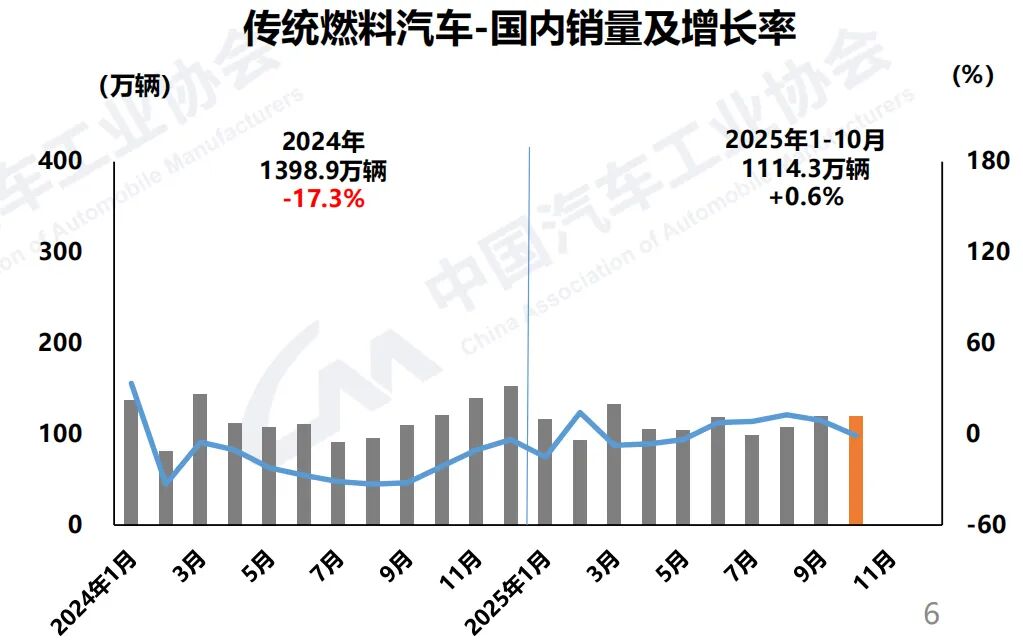
Contrary to the changes at the retail level, against the backdrop of continuous intelligent upgrades of fuel - powered vehicles by automakers, the domestic fuel - powered vehicle market is recovering. The latest data released by the China Association of Automobile Manufacturers (hereinafter referred to as CAAM) on November 11 shows that from January to October 2025, the domestic sales of traditional fuel vehicles reached 11.143 million units, a year - on - year increase of 0.6%.
Picture source: CAAM
“The recovery of fuel - powered vehicle sales is a relatively obvious change in the current automotive market. Although the growth rate in the first 10 months is not high, it has reversed the situation of a significant decline in fuel - powered vehicle sales last year.” Chen Shihua, the deputy secretary - general of CAAM, said, “However, according to the data monitored by the association, the current price cuts of fuel - powered vehicles at the retail level are still relatively high.”
Fuel - powered vehicle sales are recovering, and 'equal intelligence for fuel and electric vehicles' has become a consensus
“From an industrial perspective, the global automotive market is shifting from the 'competition of power forms' to the 'competition of intelligent experiences'. Intelligence should not be divided by the labels of 'fuel' and 'electric'. Intelligent assisted driving has gradually become consumers' basic expectation for new cars. In the future, fuel - powered vehicles and electric vehicles will develop in parallel on the intelligent track, jointly promoting the automotive industry to evolve in a more intelligent and diversified direction.” Wu Yongqiao, the president of Bosch Intelligent Driving and Control in China, told reporters. Chinese automakers are accelerating their expansion overseas, and intelligence has become the core competitiveness. Bosch's global regulatory compliance capabilities and intelligent assisted driving technologies will also help fuel - powered vehicles form differentiated advantages in nearly 80% of the global market.
Picture source: Provided by the enterprise
CAAM data shows that in October this year, the monthly new - car sales of new energy vehicles exceeded 50% of the total new - car sales for the first time, reaching 51.6%. On the one hand, this shows the strong growth momentum of new energy vehicles. On the other hand, it also indicates that fuel - powered vehicles still account for half of the automotive market. During the same period, the domestic sales of traditional fuel vehicles were approximately 1.197 million units, a month - on - month increase of 0.4%.
Against this background, “simultaneous development of fuel and electric vehicles” is the common choice of many automakers. In the wave of intelligence, the intelligent upgrade of fuel - powered vehicles has also become a consensus. “In March this year, with the launch of the Tanyue L, we launched a three - step intelligent upgrade strategy for fuel - powered vehicles - to achieve L2 - level assisted driving technology, gradually transition to technologies related to high - speed NOA, and in the third step, achieve key technological breakthroughs for end - to - end and urban driving.” Zhao Jianmin, the person in charge of market operations for the Volkswagen brand at FAW - Volkswagen Sales Co., Ltd., said in an interview with reporters.
“This year, we have achieved the second - step intelligence - high - speed NOA capabilities - on fuel - powered vehicles such as the Tanyue L, Teramont, and Sagitar L. This actually breaks the inherent perception that 'fuel - powered vehicles cannot achieve intelligence'. People may think that fuel - powered vehicles have a more distant relationship with intelligence, and electric vehicles are naturally more compatible with intelligence. Currently, this view does not hold.” Zhao Jianmin believes.
Taking the new - generation Sagitar as an example, official data shows that in the first month after its launch, the sales volume of the Sagitar family was approximately 33,200 units, a month - on - month increase of 86%, accounting for 50.6% of the A+ - class fuel - powered sedan market.
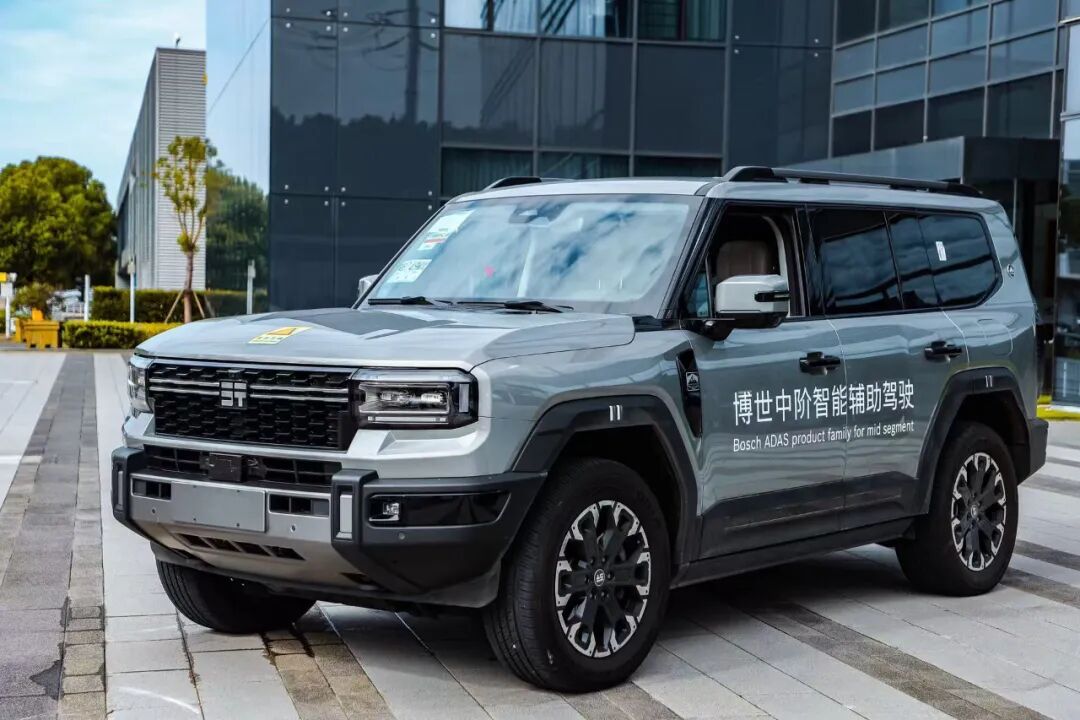
At the industrial chain level, suppliers are actively cooperating with the intelligent upgrade of fuel - powered vehicles. “Bosch always believes that intelligence is the ultimate direction of the automotive industry and should not be limited by the power form. With the core goal of 'equal intelligence for fuel and electric vehicles', we have launched a mid - level intelligent assisted driving solution, aiming to break the perception that 'intelligence = electric' and enable fuel - powered vehicle users to have the same intelligent experience as new energy vehicle users.” Wu Yongqiao said.
It is understood that Bosch's mid - level intelligent assisted driving system can be adapted to fuel - powered vehicle models. As of October this year, this solution has been mass - produced and delivered to multiple automakers such as Jetour, Dongfeng, and BAIC. In the first quarter of 2026, Bosch's first overseas mid - level intelligent driving project will also be officially mass - produced.
When talking about the considerations behind this, Wu Yongqiao said straightforwardly that one of the important reasons is to meet the diverse needs of the global market and follow the industrial trend. “Fuel - powered vehicles are still the backbone of the global automotive market, accounting for nearly 80% of the global share and about 50% of the Chinese market. We predict that in 2026, fuel - powered vehicles will popularize mid - and high - level intelligent driving at a geometric rate. Intelligence will be upgraded from a value - added function to a core configuration. This is an inevitable result of industrial upgrading and a positive response to the global users' travel needs. Currently, Bosch's mid - level solution has achieved mass delivery, which proves the feasibility of the intelligent implementation of fuel - powered vehicles.” Wu Yongqiao told reporters.
New energy vehicle exports exceeded 2 million units for the first time in the first 10 months
Although fuel - powered vehicles are recovering, new energy vehicles are still the main engine driving the growth of the automotive market and the main driving force for automobile exports at present.
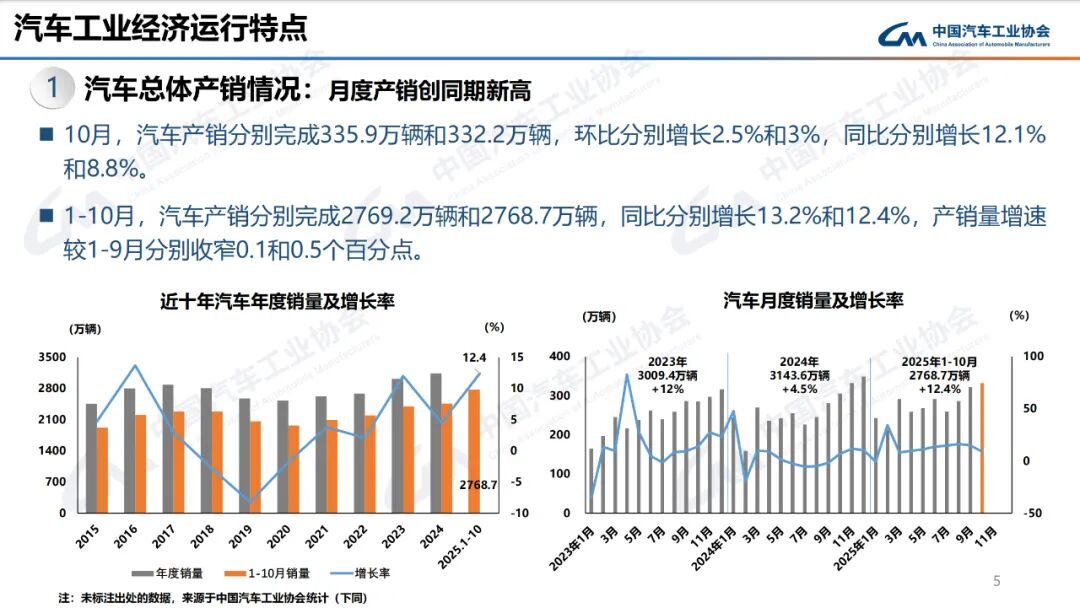
According to CAAM data, in October 2025, China's automobile production and sales reached 3.359 million and 3.322 million units respectively, a month - on - month increase of 2.5% and 3% respectively, and a year - on - year increase of 12.1% and 8.8% respectively. From January to October, China's cumulative automobile production and sales reached 27.692 million and 27.687 million units respectively, a year - on - year increase of 13.2% and 12.4% respectively.
Picture source: CAAM
From January to October this year, China's production and sales of new energy vehicles reached 13.015 million and 12.943 million units respectively, a year - on - year increase of 33.1% and 32.7% respectively. Among the main types of new energy vehicles, compared with the same period last year, the production and sales of fuel - cell vehicles decreased significantly, with a decline of 32.6%. The sales of pure - electric vehicles and plug - in hybrid vehicles both increased, reaching 8.33 million and 4.61 million units respectively, with growth rates of 42.9% and 17.8% respectively.
“In October, automakers seized the window period of policy change at the end of the year, and production and supply maintained a relatively fast pace. Enterprises continued to launch new products intensively, and the comprehensive governance work of the industry advanced steadily. The automotive market continued its good development trend, and monthly production and sales reached new highs for the same period.” Chen Shihua said. Since the beginning of this year, new energy vehicles have continued to achieve relatively high growth. On the one hand, the domestic policy of subsidizing the replacement of old cars with new ones has continued to take effect, with large - scale and wide - ranging benefits, promoting the relatively high growth of the new energy vehicle market. On the other hand, the purchase tax of new energy vehicles will be adjusted from full exemption to half - exemption next year, which has prompted some consumers to buy cars in advance, and the market has witnessed a new round of consumption peak.
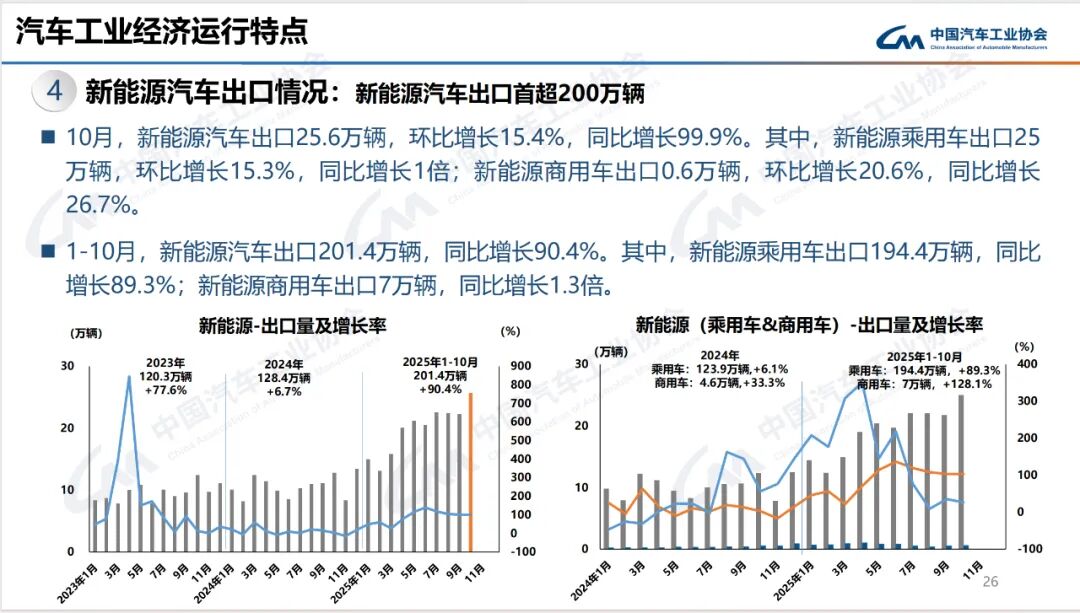
In terms of exports, from January to October this year, China's new energy vehicle exports exceeded 2 million units for the first time, reaching 2.014 million units, a year - on - year increase of 90.4%, becoming the main driving force for the growth of China's automobile exports. During the same period, China exported 5.616 million automobiles, a year - on - year increase of 15.7%. In October, China exported 666,000 automobiles, a month - on - month increase of 2.1% and a year - on - year increase of 22.9%, remaining above 600,000 units for three consecutive months.
Picture source: CAAM
Specifically, among the top ten enterprises in terms of vehicle exports in October this year, seven enterprises achieved positive export growth. Among them, Chery's export volume reached 126,000 units, a year - on - year increase of 13%, accounting for 19% of the total export volume. Compared with the same period last year, BYD's export growth rate was the most significant, with an export volume of approximately 84,000 units, a year - on - year increase of 1.8 times.
It is worth mentioning that in October this year, Chinese - brand passenger cars maintained a high market share. A total of 2.148 million units were sold that month, a month - on - month increase of 7% and a year - on - year increase of 11.2%, accounting for 72.5% of the total passenger - car sales volume. The market share increased by 2.4 percentage points compared with the same period last year. In terms of commercial vehicles, production and sales in October reached 364,000 and 361,000 units respectively, a year - on - year increase of 25.4% and 21% respectively. From January to October, the cumulative production and sales of commercial vehicles reached 3.456 million and 3.479 million units respectively, a year - on - year increase of 10.9% and 9% respectively, showing a continuous improvement trend.
CAAM said that in the first 10 months of this year, the driving effect of the “two new” policies was obvious, and the domestic automotive market performed better than expected. In 2025, China's automobile sales are expected to exceed 34 million units.
“Next year is the first year of the 15th Five - Year Plan, and promoting consumption will still be one of the key tasks. Since the second half of last year, the policy of replacing old cars with new ones has had a significant driving effect, and it is not yet clear whether the policy will be continued. Considering that the purchase tax of new energy vehicles will be halved next year, to reduce market fluctuations, it is recommended to continue to optimize and implement relevant policies next year and issue the implementation details as soon as possible to stabilize market expectations and help the industry operate smoothly.” Chen Shihua said.
This article is from the WeChat official account “NBD Auto”. Author: Pei Jianru. Republished by 36Kr with permission.