On the Eve of Large-Scale Commercialization of L3: How Will Autonomous Driving Reconstruct the Trillion-Dollar Service Market?
Imagine what changes would occur in people's car - using lives when cars can automatically find parking spaces, charge themselves, make appointments for car washing and maintenance, and plan everything for the owners on the way?
As the large - scale commercialization of L3 - level autonomous driving approaches, a new trillion - level service ecosystem driven by "thinking" cars is accelerating towards us.
At the First Autonomous Driving Travel Ecosystem Forum held on November 7th, industry experts unanimously agreed that from 2025 to 2027, autonomous driving technology will enter a critical period for large - scale commercialization. A new industrial ecosystem integrating manufacturing, digital technology, and services is accelerating its formation.
Zhang Yongwei, the chairman of the China Auto Hundred Association, said at the forum that the service ecosystem is becoming the "third pole" of the industry after automobile manufacturing, digital, and AI technologies. The automobile service industry is expected to reach a market scale of over 8 trillion by 2028, becoming the second automotive industry.
"Intelligence will be an important development direction for the automobile service industry. We should use digital and AI technologies, rely on autonomous driving enterprises to drive ecological aggregation, establish pilot demonstrations, and create national and international service providers to promote the coordinated development of automobile intelligence and service intelligence," Zhang Yongwei said.
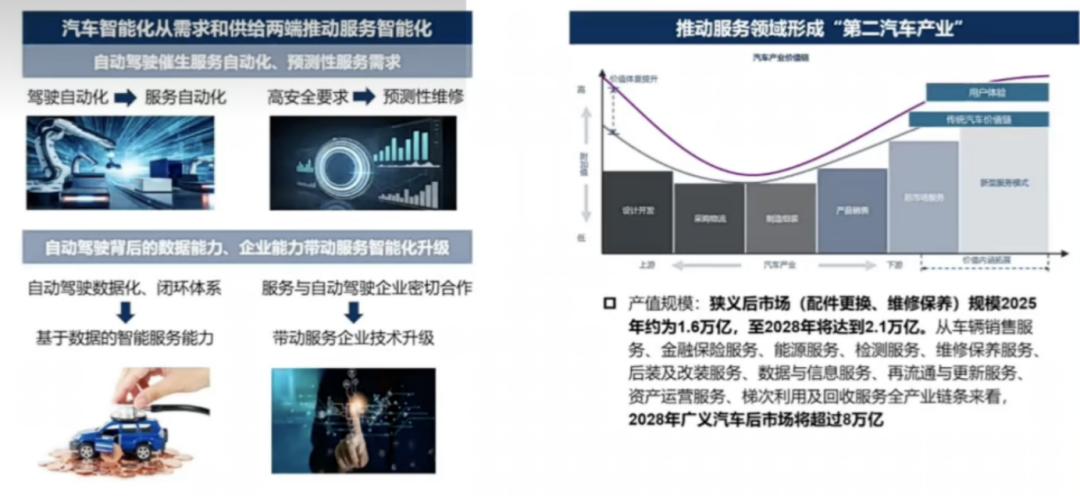
(The automobile service field will become the second automotive industry. Source: China Auto Hundred Association)
The report "Autonomous Driving Travel Ecosystem 2025" (hereinafter referred to as the "White Paper") released during the forum systematically sorted out for the first time the application value of autonomous driving in areas such as parking, charging, the aftermarket, and insurance, and comprehensively looked forward to how autonomous driving technology will reshape the future travel and service ecosystem.
Build a New Paradigm for the Autonomous Driving Travel Ecosystem
The White Paper points out that China is in a critical stage of breaking through from L2 - level assisted driving to L3 - level conditional autonomous driving. It is expected that high - speed L3 will be commercially available on a large scale in 2026, marking the official arrival of the autonomous driving era.
"The world is accelerating the commercialization of the autonomous driving industry. After achieving large - scale commercialization of high - speed L3 in 2026, it is expected to achieve large - scale commercialization of urban L4 in 2027 and commercialize unmanned trunk logistics in 2028," said Li Wenguang, the president of the intelligent driving product line of Yinwang. The implementation of autonomous driving will reshape the travel ecosystem and bring new industrial space.
Based on this trend, Yinwang launched the "Qiankun" intelligent driving open platform. By providing standardized kits for charging, parking, car washing, insurance, etc., it empowers ecological partners to create value for users together. This platform aims to promote cross - industry integration and upgrading and build a complete autonomous driving service ecosystem.
As the "first stop" for the implementation of autonomous driving, parking lots are undergoing profound changes.
Sun Longxi, the president of Ketuo Co., Ltd., pointed out that as the starting and ending points of autonomous driving travel, parking lots are ideal scenarios for the implementation of autonomous driving because of their enclosed space, clear rules, and mature technology and market demand.
He proposed to reconstruct the parking lot from the "perspective of the car" and achieve a smooth experience of "one - key valet parking" and separation of people and vehicles by setting up functional areas such as drop - off areas and waiting areas.
At the same time, the parking lot system will shift to serving the vehicle infotainment system, realizing automatic payment, intelligent scheduling, and sharing of urban - level parking space resources. With the network of more than 4,000 parking lots managed by Ketuo across the country, it can not only improve the utilization efficiency of parking spaces by more than 30% but also achieve urban - level parking scheduling, allowing hospital vehicles to automatically park in idle parking spaces in surrounding communities.
"As autonomous driving continues to iterate and enter the fast lane, we believe that the parking experience will get better and better. With autonomous driving, a parking lot with 200 spaces can become one with 250 or 300 spaces. At the same time, each parking experience will be very good. It's always more comfortable than parking, reversing, and finding a parking space by oneself. This is the temperature and depth that technology should have," Sun Longxi emphasized.
The upgrade of the charging ecosystem is also crucial. The White Paper points out that for the charging ecosystem, autonomous driving vehicles will change from passive to active, being able to independently plan routes and go to idle charging stations to complete "seamless charging." This not only greatly improves the user experience but also can achieve "peak shaving and valley filling" through intelligent scheduling, enhancing the stability of the power grid and the benefits of operators.
Li Hongqing, the CEO of Wanbang Digital Energy, emphasized that with the arrival of the autonomous driving era, the charging process must make a leap from "manual operation" to "fully automatic," which is the key to ensuring the long - term continuous operation of autonomous driving vehicles.
Ideal automatic charging should be built on the basis of the ecological collaboration of "vehicle - charging pile - power grid - cloud," realizing the whole - process unmanned operation of automatic vehicle parking, identity recognition, opening of the charging port, automatic plug - in, charging, seamless settlement, and automatic departure.
To achieve this goal, Wanbang Digital Energy proposed a path for the smooth upgrade of existing charging facilities to avoid repeated construction and focused on two major technical routes: one is the chassis charging system, suitable for household and public high - power charging scenarios, which can achieve efficient conductive charging through positioning and save space to the greatest extent; the other is the side - mounted robotic arm charging system, which is compatible with various existing charging interfaces and only takes 40 seconds from startup to completion of docking, greatly improving charging efficiency.
It is reported that the project has been adapted to more than 60 models and has been applied in scenarios such as the BMW brand charging station in Beijing. This collaborative solution is promoting a qualitative leap in the charging experience from "plug - and - charge" to "park - and - charge."
The After - service Market Embraces "Autonomous Driving" Comprehensively
Autonomous driving is reshaping the traditional automobile aftermarket.
The White Paper points out that vehicles can independently make appointments and go to service outlets during off - peak hours to complete processes such as car washing and maintenance, freeing car owners from the time - consuming and laborious maintenance process. The service model is also shifting from "passive repair" to "active early warning" and "personalized management."
Hu Xiaodong, the co - founder of Tuhu Car Care, pointed out that there is a significant pain point of time consumption in current automobile services. Taking car washing as an example, users need to spend an average of 50 - 70 minutes, more than 60% of which is waiting and travel time.
For this reason, Tuhu is cooperating with Huawei to explore a new model of "seamless car care": after the car owner places an order through the App, the vehicle can automatically go to the Tuhu store to complete the service and return without the participation of the car owner, realizing true "valet car washing." This marks a key step in the evolution of automobile services from standardization and digitalization to intelligence.
As the role of cars changes from a means of transportation to an intelligent terminal, the relevant supporting ecosystem is also evolving. The insurance system is undergoing a profound reconstruction. The White Paper shows that the insurance industry will build a new risk model based on the full - life - cycle data generated by the autonomous driving system, shifting from evaluating "driver behavior" to evaluating "the reliability of machine algorithms," thus giving rise to new insurance types specifically serving L3 and L4 - level autonomous driving.
Ni Hong, the deputy general manager of the Personal Non - Vehicle Insurance Department of PICC, said that the role of insurance is transforming from a risk bearer to an innovation escort.
Ni Hong believes that autonomous driving technology will reshape the travel ecosystem in four aspects: the subject of insurance liability will expand from drivers to automobile enterprises and software and hardware suppliers; road traffic safety accidents are expected to be reduced by 94%, and commuting time will be shortened by 15% - 30%; energy utilization efficiency will be improved by 18% - 25%, and carbon emissions will be significantly reduced; while traditional driving positions are being transformed, new industries such as autonomous driving algorithms and automatic charging will emerge.
For the development of autonomous driving, PICC has launched exclusive insurance for assisted driving covering five major scenarios, including innovative clauses such as assisted parking, replacement car service, and public opinion protection.
Looking forward to the future, Ni Hong said that the insurance system will show three evolutions: the subject of liability will shift from drivers to multiple subjects of "drivers + automobile enterprises + suppliers"; the focus of protection will expand from operational risks to system risks; the pricing basis will be upgraded from historical data to real - time driving and system performance dynamic data.
To address the pain point of plugging and unplugging the charging gun after automatic charging, Du Shangbiao, the vice - president of Flash Express, presented a solution of "human - centered service." Relying on the "one - to - one urgent delivery" model of its 3 million rider network, Flash Express can respond in an average of 1 minute and provide on - site service in 10 minutes, effectively solving the "last mile" problem of the fully automatic charging ecosystem.
The White Paper emphasizes that autonomous driving brings about a profound ecological revolution. In the future, cars will evolve into "intelligent mobile spaces" that integrate energy, information, commerce, and services. With the in - depth advancement of technological breakthroughs and ecological collaboration, a safer, more efficient, and more convenient era of intelligent travel is accelerating towards us.
This article is from the WeChat official account "Financial Automobile". Author: Financial Automobile. Republished by 36Kr with authorization.