Why are big players flocking to the auto industry: "barbarians" or "water carriers"?
At 8:00 this morning, the Aion UT Super, highly anticipated by Liu Qiangdong, ranked first on JD.com's list of the hottest new products during the Double Eleven promotion.
This new energy vehicle model, hailed as the "People's Good Car", has a purchase price as low as 49,900 yuan when renting the battery, like a stone thrown into the lake of the automotive industry. Behind this is JD.com's ambitious plan to penetrate deeper into the automotive industry with its traffic and e-commerce platform.
JD.com is not the only internet giant eyeing the automotive business. Alibaba has been strategically planning for years to build an "Alibaba AI + Automotive" ecosystem. Tencent is leveraging its full - stack AI to become an "invisible infrastructure provider" for the intelligent transformation of automakers. Baidu's Apollo Go has exceeded 17 million global orders. Meituan's unmanned delivery vehicles are already on the streets. ByteDance's Dongchedi has extended from a content platform to a full - chain automotive service provider.
Internet giants are comprehensively infiltrating all aspects of the automotive industry, including production, sales, maintenance, and mobility services.
"After new energy and intelligence became the major trends in the automotive industry, internet giants are extending their business along their own chains, starting from their areas of strength to enter and share the trillion - level automotive market," Zhang Yi, CEO and Chief Analyst of iiMedia Research, told a reporter from Science and Technology Innovation Board Daily.
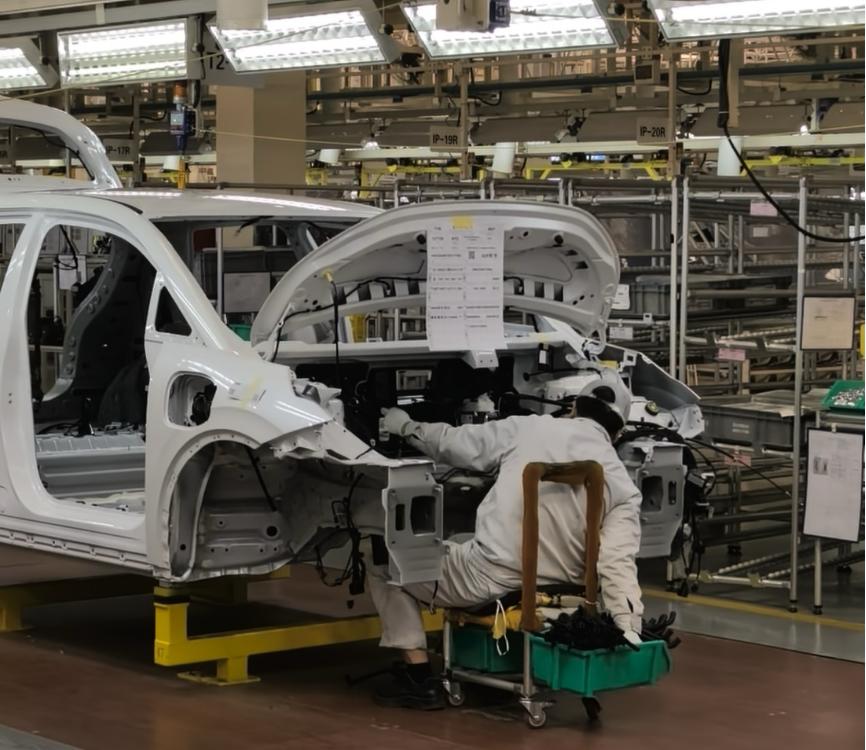
Workers on the production line at GAC Aion's Changsha factory. Photo by Mao Mingjiang from Science and Technology Innovation Board Daily.
Internet Giants Compete for the Trillion - Level Market
On August 28, the stock price of A - share listed company Shanzi High - tech, which had been sluggish for a long time, suddenly soared. This low - priced stock, which was trading at just over 2 yuan, closed with a daily limit. No one expected that the stock would hit the daily limit multiple times in a row and double its price in less than a month.
The secret behind the market's enthusiasm for this stock is the giant behind Shanzi High - tech: Alibaba.
Shanzi High - tech was formerly known as Yinyi Co., Ltd., a real - estate company in Ningbo. After divesting its long - losing real - estate business, it has focused on the new energy vehicle and semiconductor industries. In July this year, Shanzi High - tech announced a strategic cooperation with Tmall via its official WeChat account to explore a customized new retail model for smart cars. It also revealed that "the first cooperative project, the customized V17 model, has entered the prototype testing stage."
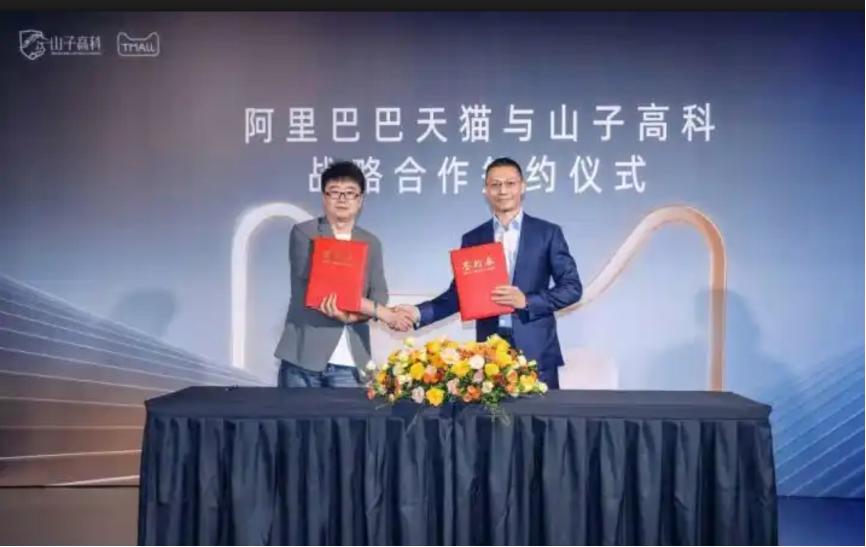
The signing ceremony between Tmall and Shanzi High - tech.
Shortly after the news was announced, Shanzi High - tech announced that it had moved its office from Shanghai to Alibaba's Digital Ecosystem Innovation Park in Yuhang District, Hangzhou. Later, there were rumors that it was the reorganizer of Nezha Automobile. The increasing "Alibaba flavor" of Shanzi High - tech has been the main driving force behind its soaring stock price, which also reflects the market's strong confidence in the "internet giant + new energy vehicle" model.
Science and Technology Innovation Board Daily found that in fact, Alibaba started to layout and enter the automotive industry as early as 2014. In that year, Alibaba established its automotive division with the goal of building a full - chain automotive e - commerce O2O service covering "viewing, selecting, buying, using, and selling" cars. However, at that time, the automotive industry was still dominated by fuel vehicles and 4S stores, so Tmall's car - selling business did not make a big splash.
However, Alibaba has never given up on the automotive industry. It has invested heavily in XPeng Motors and jointly established IM Motors and Zebra Intelligence with SAIC Group. It has also entered the Robotaxi market through AutoNavi and invested in Hello's autonomous driving business.
Alibaba's strategy in the automotive industry is characterized by "AI - driven + closed - loop scenarios", aiming to deeply integrate its advantages in e - commerce, cloud computing, and logistics with the automotive industry chain. In March 2025, BMW announced a deepened AI strategic cooperation with Alibaba to develop a new - generation intelligent cockpit system based on Tongyi's large - scale model.
The Convergence of Internet Giants Signals a Turning Point in the Automotive Industry
Data from the China Passenger Car Association shows that in October 2025, the retail penetration rate of new energy vehicles in China reached 58.7%, a significant increase from 20% three years ago. This means that new energy vehicles have shifted from a niche product to a mainstream choice, and the trillion - level market has become a battleground for internet giants and technology companies like Huawei.
JD.com, leveraging the consumption data of its 600 million active users, has joined hands with CATL's large - scale application of chocolate batteries and GAC Aion's intelligent manufacturing capabilities at its lighthouse factory to enter the market with a low price of less than 50,000 yuan. This division of labor model of "manufacturing + technology + traffic entry" is a typical way for internet platforms to leverage their advantages to enter the traditional automotive market.
"The definition of a 'good car' includes four dimensions: quality, intelligence, battery life and charging, and service. In this cooperation, the three parties focused on creating their own value to achieve a synergistic effect of 1 + 1+1>3," Lu Huan, the marketing director of JD.com's automotive business, told Science and Technology Innovation Board Daily. Tu Xucong, the product manager of GAC's UT models, also said that the UT Super has been carefully designed. It not only supports battery swapping but also retains fast - charging and slow - charging functions, allowing users to charge the vehicle normally even without a battery - swapping station.
The expansion of internet giants in the automotive market is not limited to new car sales. As the second - largest consumer product for families after real estate, the full - life - cycle value of cars is also very attractive.
JD.com's car - maintenance service has established a network of nearly 3,000 self - operated stores and over 40,000 partner stores. Tmall's car - maintenance service has also exceeded 2,500 stores nationwide, covering more than 300 cities. Dongchedi, a subsidiary of ByteDance, has partnered with FAW Toyota to provide full - chain services such as intelligent diagnosis, appointment maintenance, and energy - consumption analysis, converting content traffic into service traffic.
Data shows that the scale of China's automotive aftermarket has exceeded one trillion yuan and is growing at an annual rate of over 10%. This incremental market has become another area of competition for internet giants.
Automotive Intelligence: Technology Empowers Industry Reconstruction
If the market size is the attraction, the arrival of the automotive intelligence era has accelerated the entry of internet giants into the automotive industry.
Pan Helin, a member of the Information and Communication Economics Expert Committee of the Ministry of Industry and Information Technology, told a reporter from Science and Technology Innovation Board Daily that the automotive industry is transforming from a "mechanical product" to an "intelligent terminal", and AI, big data, and cloud computing are the core advantages of internet companies. This complementary relationship makes cross - border cooperation inevitable.
Baidu's deep involvement in the autonomous driving field is the most representative. As of October 2025, Apollo Go has covered 22 cities globally, completed over 17 million trips, and exceeded 250,000 orders per week, with 100% fully unmanned operation. Baidu's large - scale operation of Robotaxi essentially transforms cars into "mobile intelligent spaces", laying the foundation for future ecological expansion.
Meituan's self - developed "Magic Bag 20", equipped with a wiring harness system jointly developed with Dadi Electric, has L4 - level autonomous driving capabilities and can deliver up to ten orders at a time. It has been put into operation in many cities across the country. By combining autonomous driving technology with instant delivery scenarios, Meituan has not only improved delivery efficiency but also accumulated a large amount of real - world traffic data to feed back into technology iteration. This closed - loop of "technology R & D - scenario application - data feedback" is one of the core competitiveness of internet companies.
ByteDance has entered the automotive market through content. Dongchedi has accumulated a large user base through professional automotive content and has extended to the sales and service sectors, forming a closed - loop of "content marketing - online car viewing - offline service". This model leverages ByteDance's advantages in content operation and user reach while avoiding the risks of heavy - asset car manufacturing, becoming a differentiated path for internet companies to enter the automotive ecosystem.
Seek a Second Growth Curve: Ecosystem Collaboration for Win - Win Results
"The strategic layout of internet giants in the automotive ecosystem is driven by the need to find a second growth curve," Zhang Yi, CEO and Chief Analyst of iiMedia Research, told a reporter from Science and Technology Innovation Board Daily. As the growth of mobile internet traffic slows down and the core businesses such as e - commerce and food delivery are decelerating, the intelligent transformation of the automotive industry provides an important direction for their expansion.
Zhang Yi believes that for JD.com, since its foundation lies in retail and logistics, it focuses on car sales and after - sales services. Essentially, it uses its e - commerce platform, supply chain, and logistics network to connect the last mile of automotive consumption.
In Zhang Yi's view, Alibaba's strength lies in building ecosystems and providing services, so it focuses on integrating the entire automotive ecosystem with daily life. For example, payment (Alipay), mapping (AutoNavi), and Tmall Car Maintenance form an integrated service platform from car purchase to use and maintenance. ByteDance and Baidu have strong technological capabilities, so they focus on the software part of cars, such as the system and the car's "brain", aiming to break through the core technological barriers of smart cars. In addition, ByteDance also focuses on the interaction experience of the intelligent cockpit through AI large - scale models and content ecosystems.
"In general, when we say that internet giants 'fall in love with cars', it is not simply about building cars like traditional automakers. Instead, they are sharing the huge cake of the new energy vehicle, especially the smart car market, at the ecosystem level to build their own moats in the industrial chain," Zhang Yi said.
Regarding the impact of the competition among internet giants in the automotive ecosystem on the entire automotive industry, a senior marketing executive from an internet giant said that the entry of internet giants is not to "replace" traditional automakers but to force the entire industry to shift from a product - centric mindset to an ecosystem - centric one.
"Just as food delivery did not eliminate instant noodles but promoted their high - end transformation, internet companies will not disrupt car manufacturing but will restructure the industry's value distribution. If traditional automakers stick to a closed system, they will miss the window period for intelligent transformation. If internet companies ignore manufacturing rules and safety bottom lines, they will not only fail to win a share of the market but may also harm their own platforms."
This article is from the WeChat official account "Caixin AI Daily". Author: Tian Ye, Huang Xinyi. Republished by 36Kr with permission.