The new regulations propose to set a five-second red line. Is the 0-100km/h acceleration the real culprit of the out-of-control incidents?
The automotive industry is entering the era of the strictest supervision.
Recently, the Ministry of Public Security released the latest revised draft of the "Technical Conditions for the Safe Operation of Motor Vehicles", adding multiple safety regulations for passenger cars. For example, the deceleration of vehicle kinetic energy recovery should be ≤0.8m/s², and vehicles should not be pasted with sunshades. Among them, in the default mode after the vehicle is started, the acceleration from 0 to 100 km/h should not be less than 5 seconds, which has sparked extensive discussions.
The compilation instructions of the draft opinion point out that in recent years, there have been frequent accidents of out - of - control acceleration at startup for pure electric vehicles and plug - in hybrid vehicles. The main reason is that when drivers use the high - acceleration mode, they lack sufficient driving preparation and control ability. The background for setting the 5 - second condition is that currently, the acceleration time from 0 to 100 km/h for driving school training vehicles and most fuel - powered passenger cars is generally more than 5 seconds.
Fast cars are prone to accidents, and novice drivers lack skills. This is a common basic understanding among ordinary consumers, automobile manufacturers, and policy - makers, but there are few relevant regulations.
Countries such as Australia have clearly legislated to restrict novice drivers from driving high - powered cars through driver's license grading. Countries such as Germany have chosen to directly increase the difficulty of driving tests, setting up real - vehicle subjects that last more than 40 minutes and involve complex scenarios such as high - speed driving, overtaking, and emergency braking.
Currently, the real - vehicle driving subjects in China's driving tests mostly involve turning and parking operations at a speed of 5 - 10 km/h, as well as straight - line, turning, and U - turn driving on public roads with a speed limit of less than 50 km/h. Novice drivers who have never experienced driving at speeds above 50 km/h will indeed face a significantly increased risk of accidents when encountering models with an acceleration from 0 to 100 km/h within 5 seconds.
However, even the most experienced drivers may face unexpected situations. In professional auto races such as F1, although racers are important, the improvement of vehicle quality is the key to victory. Simply restricting the acceleration from 0 to 100 km/h may not be the best way to prevent vehicle out - of - control.
Is the 0 - 100 km/h acceleration the culprit for vehicle out - of - control?
To solve the accident problem caused by out - of - control vehicle starting, simply restricting the default driving mode may not be the best answer.
Vehicle out - of - control mostly refers to the tail - flick phenomenon, that is, the rear wheels of the vehicle lose grip and start to skid, which is common in high - powered rear - wheel - drive cars. "The most direct solution is to use better and wider tires to increase friction," an engineer who has been engaged in tire development for many years told 36Kr.
Currently, the national standards for tires mainly focus on durability, and the assessment criteria are mostly related to top speed. For example, when the vehicle accelerates uniformly to 160 km/h, the tires should not burst. "The use of tires for high - powered and high - performance cars is still at a stage where enterprises rely on their conscience."
In addition, models with an acceleration time from 0 to 100 km/h within 5 seconds, such as the Tesla Model 3 Performance, Xiaomi SU7 Max, and XPeng P7 high - performance version are all four - wheel - drive models. Since all four wheels are involved in power distribution, the probability of out - of - control for four - wheel - drive models is inherently lower.
However, 36Kr found that the Tesla Model 3/Y Performance provides options such as free power distribution and stability control in the "Track Mode". Users can choose to output all 460 horsepower from the rear wheels and turn off the ESP electronic stability control system at the same time. For safety reasons, Tesla has marked on the startup interface that this mode is for experienced drivers and has reminded users not to use it on public roads.
The Xiaomi SU7 Max has the same function, and its overall horsepower is even greater, reaching 673 horsepower. However, Xiaomi's custom - adjustment mode does not mark exclusive words such as "Track" and does not remind users not to use it on public roads.
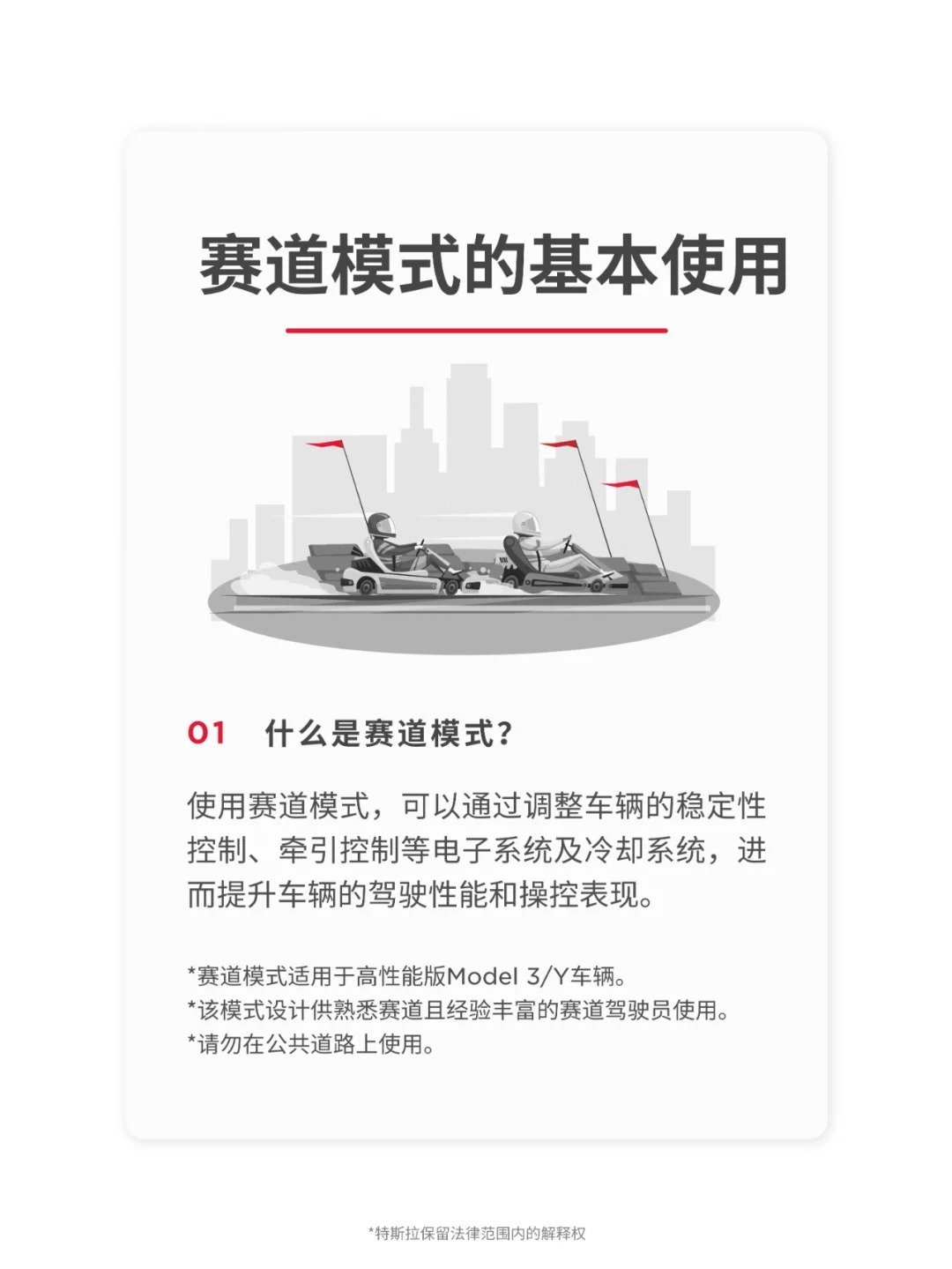
Tesla's official product description
A senior R & D personnel engaged in ESP (Electronic Stability Program) development told 36Kr that ESP can adjust the vehicle's instantaneous power output, braking force distribution, and steering, and is a protective shield for vehicle driving safety. "Generally, cars have comfort mode and sport mode. We will adjust the ESP according to the preset mode to ensure that the vehicle does not lose control within the maximum range."
ESP conflicts with the vehicle's handling and playability because some models reduce the participation of ESP in the track mode to emphasize their sporty attributes. Once ESP does not participate, the task of controlling the vehicle not to skid is entirely left to the driver.
Currently, the driving school courses for obtaining a driver's license do not include this item. Only some racing track license courses and some high - performance driving courses of automobile enterprises include such items.
36Kr found that in the description of the custom driving mode interface of the Xiaomi SU7 Max, it is noted that the role of ESP is "neutral" in the sport and sport + modes.
Nowadays, electric vehicles have entered the era of affordable high - powered cars. With 200,000 - 300,000 yuan, consumers can have the horsepower level of high - performance fuel - powered cars that used to cost 500,000 yuan. In the first three quarters of 2025, the sales volume of new energy vehicles in this price range reached 2 million units. However, ordinary consumers do not have mandatory courses to learn the driving skills of high - powered vehicles.
ESP (Electronic Stability Program) should be a driving guarantee for ordinary consumers, but automobile enterprises are starting to provide consumers with custom driving preferences that are independent of ESP.
A senior R & D personnel from Germany told 36Kr that high - powered engines are the soul of German industry. Locally, neither regulations nor public opinion will restrict users from using high - powered vehicles.
"We only require that the overall vehicle quality can match the high - power, and we will spend more effort on ESP tuning. To match the faster new cars, suppliers in fields such as tires and brakes will also be forced to carry out technological upgrades. That's why German cars can become a symbol of performance."
Improving vehicle driving safety during the product design and quality stages may be more valuable than simply restricting user usage.
The "One - Pedal" mode is tightened again, and the drag feeling will disappear
In addition to the 0 - 100 km/h acceleration, the one - pedal mode has also received attention again.
In July this year, the Ministry of Industry and Information Technology stipulated in the "Technical Requirements and Test Methods for Passenger Vehicle Braking Systems" that in the default working state, the braking effect achieved only by releasing the accelerator pedal should not decelerate the vehicle to a stop. That is, the kinetic energy recovery of new energy vehicles should not make the vehicle come to a complete stop, and electric cars will also have "idling".
The revised draft of the "Technical Conditions for the Safe Operation of Motor Vehicles" released by the Ministry of Public Security this time has strengthened the supervision of kinetic energy recovery.
In the revised draft, for pure - electric and plug - in hybrid passenger cars, when driving on a concrete or asphalt road with an adhesion coefficient ≥0.7 after releasing the accelerator pedal in the drive gear, the overall vehicle braking deceleration should be ≤0.8m/s².
Currently, the coasting deceleration of the Volkswagen Passat is about 0.3m/s², and that of the Buick GL8 is about 0.4m/s². The coasting deceleration of electric vehicles such as Tesla is generally above 1.5m/s². In addition, existing regulations state that when the deceleration is greater than 1.3m/s², the vehicle must turn on the brake lights.
Multiple R & D personnel told 36Kr that the 0.8m/s² condition in the new revised draft can be understood as that kinetic energy recovery will no longer bring the "drag feeling".
Among a series of new experiences of new energy vehicles, kinetic energy recovery has sparked a lot of controversy since its inception. Its technical principle is to use the inertia of vehicle deceleration to reverse the motor and generate and store electrical energy. Therefore, many consumers find that the total driving range may increase after driving in congested roads with frequent deceleration.
Some R & D personnel told 36Kr that the current industry average is that 5 - 10 km can be recovered for every 100 km, and for strong kinetic energy recovery, it can even reach more than 15 km.
"In principle, the faster the deceleration, the more electrical energy is converted per unit time. However, if the deceleration is too fast, the brakes will intervene. The situation varies for each vehicle, but the most efficient kinetic energy recovery is probably at the level of 1.5m/s²."
Therefore, the increase in driving range by kinetic energy recovery and the "drag feeling" caused by inertia are two sides of the same coin. Once the new regulations are implemented, it means that the effect of kinetic energy recovery will be weakened. Consumers will finally be able to get rid of the drag feeling, but the overall vehicle driving range will also be affected.
"The driving range is the core of electric vehicle projects. If kinetic energy recovery cannot be done well, there will be more competition in aspects such as batteries and charging," some R & D personnel told 36Kr.
In addition to the supervision of 0 - 100 km/h acceleration and kinetic energy recovery, the revised draft of the "Technical Conditions for the Safe Operation of Motor Vehicles" also has requirements for many details that affect vehicle safety.
For example, sunshades should not be pasted on car doors and windows. Previously, the national standards for car doors and windows set requirements for the light transmittance of sunshades. The light transmittance of the front windshield and the rear - view mirror vision area should be greater than 70%, and that of other doors and windows should be greater than 50%.
People engaged in the automotive aftermarket told 36Kr that the production requirements for sunshades also mainly focus on light transmittance, reflectivity, and durability. "So the current sunshades are strong in texture, have good adhesion, are not easy to fall off, and there are even some reinforced versions with metal wires."
When a vehicle encounters an emergency and needs to break the window for rescue, these "reinforced" sunshades will increase the difficulty of window - breaking. "For normal glass, it can be broken with two or three strikes. If the sunshade is not right, it may take seven or eight strikes, or only a small hole can be knocked out, but the whole piece cannot be broken."
From these provisions, it can be seen that the direction of this revision of the "Technical Conditions for the Safe Operation of Motor Vehicles" is to reduce the occurrence of accidents and the difficulty of rescue.
Since this year, there have been multiple collision accidents, battery explosion and combustion accidents, and vehicle recalls due to quality issues in the new energy vehicle industry. Challenges such as the "six - second escape from electric cars" have even emerged on the Internet. Not only has the attention to vehicle safety increased, but the difficulty of emergency rescue and escape guides have also become topics of concern for consumers.
With the adjustment and revision of various national standards and regulations, the safety supervision of the automotive industry is entering the strictest era in history.
Automobile safety requires enterprises to conduct repeated tests and continuous verification, which will bring multiple tests of time and cost to enterprises, and may even directly extend the new - car release cycle and reduce enterprise profits.
Facing increasingly strict regulations and public expectations, safety will become a prerequisite for competition in the automotive industry. Sincere commitment and solid investment are needed for the automotive industry to achieve healthy and stable growth.