Turning points, opportunities, and risks in our era
Wang Yuquan is the founding partner of Haiyin Capital and one of the representative figures in China's technology investment field. He has long been concerned about the trends of cutting - edge technologies and industrial transformation. From an investor's perspective, he observes technological breakthroughs in fields such as artificial intelligence, life sciences, and new energy and their reshaping of social structures. At the HBR Management Annual Conference 2025 & New Growth Conference, titled "Turning Points, Opportunities, and Risks in Our Era", he combined decades of industrial research and investment experience to sort out the historical context from the Industrial Revolution to the Digital Revolution, analyzed the underlying logic of large AI models, global layout, and the online society, and explained why the current situation is not a bubble but the starting point of a great era.
The following is an excerpt from the speech of Wang Yuquan, the founding partner of Haiyin Capital, at the HBR Management Annual Conference 2025 & New Growth Conference.
This is a Great Era
In the past few decades, we have witnessed the development of many cutting - edge technologies. Today, let's have some exchanges.
First of all, this is a great era. We are very lucky to live in such a time. Imagine that you live in an era where your neighbor is Watt, who has just invented the steam engine, and many people cheer that this is a great era. However, Watt patented the steam engine in 1776, and the first commercial freight railway did not appear until around 1810, and the first commercial passenger railway appeared in the 1820s. Steamships also emerged around that time. That is to say, it took about forty or fifty years for the economy to really take off in the UK. Before that, the development was not that fast, and there was also a lot of noise. We are now in such an era.
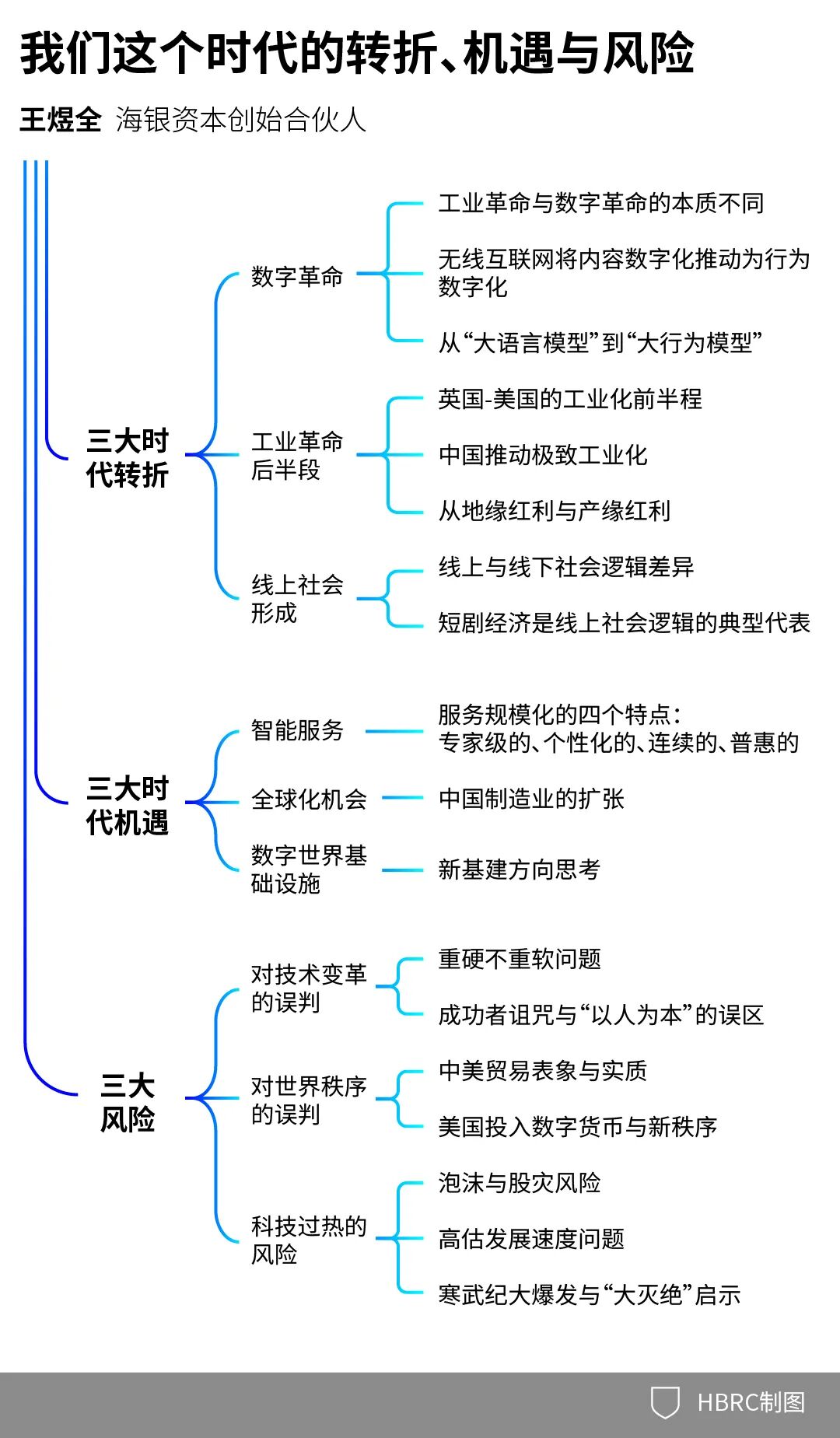
Nowadays, we are all asking, "Is there a bubble in artificial intelligence?" It's not a bubble at all because the huge development is yet to come. Never underestimate the future development. We are even luckier than in Watt's era. We are facing three, rather than one, era - defining opportunities:
The Digital Revolution is one of them.
What we commonly refer to as the Industrial Revolution is actually divided into two stages: the first is the industrial revolution mainly focused on material production; the second is the digital revolution starting from personal computers and software. The logics of these two revolutions are completely different.
An important part of the digital revolution has been overlooked, which is the wireless Internet. It not only allows people to access content anytime and anywhere but, more importantly, aggregates "human behavior data". The PC era was about digitizing content; the Internet era was about putting content online; the wireless Internet era is about "putting human behavior online". This is a huge difference.
Today's large language models extract knowledge and experience from aggregated content and then transform them into service - ready forms. The next step will be the emergence of "large behavior models", which are based on aggregated behavior data, can analyze and guide human behavior, and provide direct action support. This is more valuable than content support because it directly improves people's efficiency and income.
Second, the Industrial Revolution is not over, and China is taking on its second half.
The steam engine was first invented in the UK, but in the early days, the steam engines in many factories were only used as backup power due to a lack of systemization. It was not until the appearance of trains and steamships that the problems of transportation and market coverage were truly solved.
The United States achieved large - scale production on this basis. Ford invented the assembly line and produced 16.5 million cars in 20 years, laying the foundation for American manufacturing. The assembly - line mechanism was later replicated in various industries such as refrigerators and color TVs.
The essence of the Industrial Revolution is large - scale production and large - scale sales. The UK did not achieve it to the fullest, the United States only achieved half of it, while China has taken it to the extreme. This is a particularly important opportunity for China. In the next 30 years, our overseas business is likely to recreate China's GDP. The total income from overseas business may be as large as China's GDP. In the past 40 years, we have enjoyed geographical dividends, being born in China and experiencing 40 years of rapid economic development. In the future, it will be industrial dividends, joining the global army. In the past, we got dividends by fate; today, it's about strategic choices. The global market is small now, just like China's economy before the reform and opening - up. But looking back 40 years later, we will have recreated China overseas.
Third, the online society is taking shape.
The logic of the offline society is advertising, marketing, and logistics; the logic of the online society is data, measurement, and prediction.
In the offline society, enterprises must understand culture and consumers; in the online society, they only need to understand data. Through precise measurement and algorithm optimization, enterprises can continuously adjust their products and services. The short - drama economy is the most typical example. Many people think it is not elegant, but short dramas are the result of algorithm optimization. It doesn't matter if some people don't like them. As long as enough people like them, enterprises can make money. Don't care whether users like it or not; care whether the data looks good or not.
The transfer of humanity from the offline society to the online society will only happen once, and the transfer from the digital revolution to the online world will only happen once. This transfer will create a large number of new opportunities. Because of these huge opportunities, there will be a huge development space in the future. These three types of opportunities will give rise to new giant enterprises, new enterprises with a market value of trillions, in the next 10 - 15 years.
The past Internet and wireless Internet took 10 - 15 years to produce giants. The new enterprises led by artificial intelligence will, in another 10 - 15 years, surpass the previous ones and even become larger. We have reason to expect that by around 203x, the market value of the world's largest enterprise will reach 10 trillion. Today, there may just be enterprises that have just exceeded 5 trillion.
Three Era - Defining Opportunities and Three Risks
Which enterprises can truly enjoy the dividends of high - speed development?
One type is intelligent services. On the one hand, artificial intelligence continues the characteristics of the Industrial Revolution, that is, large - scale production. On the other hand, it solidifies human experience and realizes large - scale output of experience, which we call "large - scale service". Summarize four characteristics: expert - level, personalized, continuous, and inclusive. I use a smart bracelet to collect the body's data and use artificial intelligence for systematic analysis, which can make everyone be monitored and guided by intelligence like being continuously diagnosed by an "old Chinese doctor". This is a tangible benefit we can see.
The second is the opportunity of globalization. This is more unique for China, and we mainly expand through manufacturing.
The third is the infrastructure of the digital world. During the Industrial Revolution, it was very important to build railways, highways, and open up air routes in various places. What is the direction of the digital revolution today? How to carry out infrastructure construction? We can't follow the old path. The routes of 4G, 5G, and 6G are not entirely correct.
Finally, pay attention to three risks.
One is the misjudgment of technological change. We focus on hardware rather than software. We think that artificial intelligence is just adding it to existing businesses to make them better. Wrong. Artificial intelligence needs to be revolutionary and disruptive. At this time, good enterprises will be bitten back by the curse of success and cannot cross over because they can't let go of the previous successful logic. We always talk about "people - oriented", but in the future artificial intelligence era, it will definitely not be people - oriented but machine - oriented. People should assist machines and interfere with them as little as possible because machines are more efficient than people. People are interference factors and factors that reduce efficiency rather than enhance it.
In the future era, algorithms and intelligence themselves are the soul, and the physical form is not important. We have built a lot of humanoid robots with powerful functions but no soul. The technology for the soul has not made a breakthrough. The "physical body" of China's manufacturing industry is very strong, but no real "soul" has been injected into each industry. Only by injecting a real "soul" can it develop in the long run.
The second is the misjudgment of the world order. The Sino - US trade negotiations have achieved results, and our global trade has been continuously rising. It seems that the future is bright. Wrong. You will find that the recent trend in the US is that Silicon Valley is getting very close to politics. Why? Because of the new global infrastructure transformation. What is the US doing? The US is investing in digital currency because the future world order will be based on digital trade. What is collapsing now is the order based on product trade, the previous - generation order. The new - generation order is about how many GPUs and servers there are.
The third is to be vigilant against the risk of over - heating in technology. A bubble will definitely come. It is very likely that there will be a repeat of the 1929 stock market crash around 2029. We will overestimate the speed of future development. When this happens, a bubble will form and then burst. Almost every major technological development is followed by such a stage. People's over - expectations and chasing lead to a decline. If we can foresee this problem in advance and avoid it, we can enjoy the great prosperity of the global economy in the next three or four decades.
Finally, we often say that artificial intelligence will bring about a species explosion like the Cambrian explosion. However, the Cambrian explosion is a unique case in the history of the Earth. More often, there is a "mass extinction". Every real great prosperity is not brought about by a big explosion but by a mass extinction. Suddenly, the environment changes, and artificial intelligence arrives. Most enterprises will "go extinct", and only a few can survive. After the mass extinction, there will be great prosperity, not the prosperity of a large number of species but the prosperity of a few species adopting future business models.
We hope to be the future species so that you can have the opportunity to enjoy great prosperity after the mass extinction.
Wang Yuquan | Speech
Wang Yuquan is the founding partner of Haiyin Capital
This article is from the WeChat official account "Harvard Business Review" (ID: hbrchinese). Author: HBR - China. Republished by 36Kr with permission.