Seize the ecological dominance: Has the "Android moment" of embodied intelligence in China arrived in 2025?
In 2025, the embodied intelligence industry is transitioning from the R & D verification phase to the initial commercialization stage, moving from building robots to putting them into practical use.
In the context of global competition, China's embodied intelligence industry, with its complete supply chain, practical B - end market, and diverse usage scenarios, provides a continuous pathway from underlying hardware to upper - layer applications for ecological construction. It demonstrates unique competitiveness, helping Chinese manufacturers stand at the forefront of this intelligent transformation.
If 2024 was the first year of embodied intelligence, then in 2025, the core narrative of the industry has shifted from "building robots" to "using robots".
Data shows that this trend is rapidly materializing. In 2024, the scale of China's embodied intelligence market reached 418.6 million yuan. As of the first half of 2025, it has grown to 529.5 million yuan. Industry research institutions predict that by 2026, the global embodied intelligence market will exceed 1 billion yuan, with a compound annual growth rate of over 60%.
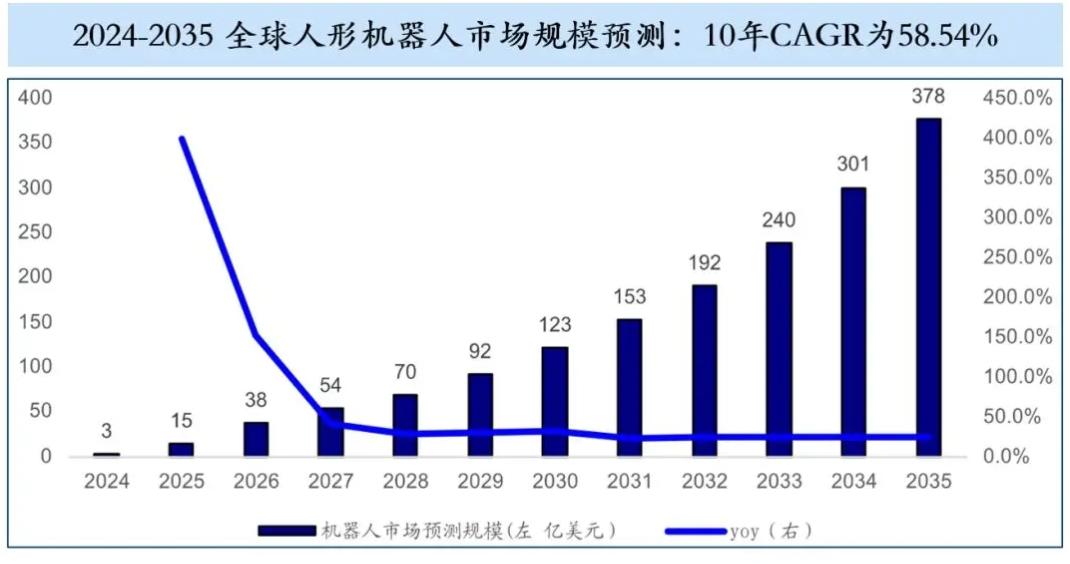
The enthusiasm in the capital market has also soared simultaneously. According to IT Juzi statistics, as of the end of August 2025, the financing volume in the primary market of the domestic robotics field has reached approximately 3.8624 billion yuan, about 1.8 times the 2.1254 billion yuan in the whole year of 2024. Among them, there have been more than 50 financing events related to humanoid robots and embodied intelligence.
More importantly, the number of orders is starting to increase significantly.
In the third quarter of 2025 alone, there were several disclosed large - scale commercial orders worth hundreds of millions of yuan in the industry. For example, in October 2025, Zhipu Robotics signed a framework order worth hundreds of millions of yuan with Longcheer Technology; in the same month, Yuanli Infinite Robotics signed a project worth 260 million yuan with Shihua Cultural Tourism Holding Group; Ubtech won a 126 - million - yuan bid for the Guangxi Embodied Intelligence Data Collection and Testing Center project; Zhipingfang cooperated with a subsidiary of Huike Group, planning to deploy over 1000 robots in three years with an order value of nearly 500 million yuan; Zhipu Robotics and Unitree Technology jointly won a 124 - million - yuan OEM project from China Mobile (Hangzhou) Information Technology Company...
These figures reflect a consensus that the embodied intelligence industry is transitioning from the R & D verification phase to the initial commercialization stage.
What really determines the industry landscape is no longer just the hardware parameters, but the ability to build a content and ecological platform that enables robots to understand tasks, execute work, and continuously evolve.
This can be seen from the recent layouts of leading manufacturers. For example, the Beijing Humanoid Robot Innovation Center, in collaboration with Ubtech, announced the official opening of the general embodied intelligence platform "Huisi Kaiwu" SDK (Software Development Kit); Zhipu Robotics launched the "Lingchuang" platform, claiming to be the world's first zero - code robot content creation platform. These actions clearly signal that the competition in embodied intelligence has shifted from who can build robots to who can build ecological platforms.
Some questions worth considering are: How are the players in the embodied intelligence track laying out their ecosystems? Why is the ecosystem so crucial? Where is the current state of the embodied intelligence ecosystem? How can one win in this game?
The embodied intelligence ecosystem has become the new "battleground" for Chinese manufacturers in 2025
The fact is that several leading domestic manufacturers are making moves around the ecosystem. Compared with the early - stage hardware competition of "who can build robots", the focus of each manufacturer is now rapidly shifting towards ecosystem construction.
The landmark actions of this shift are concentrated in the second half of 2025. However, each manufacturer's path is different.
Zhipu Robotics launched the "Lingchuang" platform, claiming to be the world's first zero - code robot content creation platform. Users can generate robot task scripts and action logic simply by describing them in natural language and directly deploy them on Zhipu's robots. This platform is equivalent to the "WeChat Mini - Programs in the robot world". By lowering the development threshold and opening up task templates, it activates the external developer ecosystem, thus building a distribution system where content equals tasks.
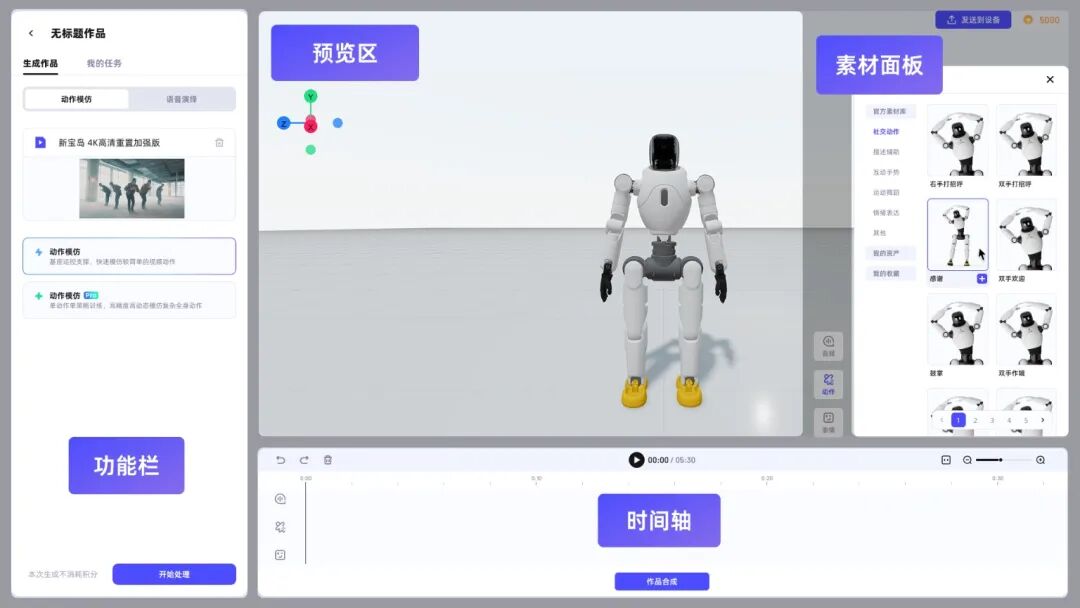
The advantage of this ecological path lies in its low development threshold, fast ecosystem spread, and high content activity. However, there are also potential risks, such as the lack of unified ecological standards and the difficulty in fully guaranteeing task quality and security.
Ubtech chose a different path.
It collaborated with the Beijing Humanoid Robot Innovation Center to build and open the general embodied intelligence platform "Huisi Kaiwu" SDK. This platform is known as the world's first general - purpose embodied intelligence platform with one brain for multiple functions and multiple machines. It provides a complete toolchain from skill invocation, agent configuration to scenario deployment, forming a closed and highly consistent ecological system with the company's internal application ecosystem, including the Walker series of industrial robots, educational and family care robots, etc.
The advantages of this path are obvious: it has a stable system, strong software - hardware collaboration, and fast implementation speed, making it suitable for high - security scenarios such as industry and education. However, it has a high degree of closure, a high threshold for third - party access, and relatively limited external innovation and ecosystem expansion speed.
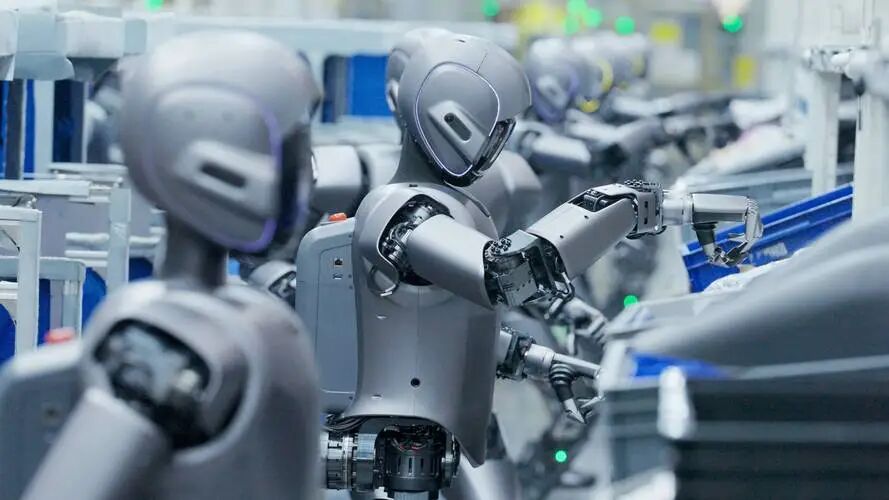
Fourier Intelligence continued its tradition of openness in the medical and industrial robotics fields. In Q2 of 2025, the company officially launched the prototype of the robot application market, opening more than 30 standardized interfaces and secondary development tools, and inviting external developers to create functional plugins and task modules. This path is closer to the "Android ecosystem", with modular and open interfaces as the core. By attracting developers to co - build, it forms content diversity, thereby enhancing platform stickiness.
Under this path, the ecosystem has high diversity, fast innovation speed, and can quickly form long - tail applications. However, it also brings fragmented interface standards, weak consistency in user experience, and the commercialization path still needs to be verified.
Almost simultaneously with domestic manufacturers, foreign humanoid robot players are also accelerating their ecological development. Figure AI focuses on accessing through the semantic layer of large models + the standardized execution framework of NVIDIA middleware; Tesla focuses on building a full - chain closed - loop of hardware + operating system + its own factory applications, similar to Apple's closed system.
It can be seen that a clear consensus is emerging: the competition in embodied intelligence is no longer a single - point technology competition but an ecological system competition.
What is the importance of the "Android system" in the world of embodied intelligence?
A question worth considering is why the ecosystem is so important?
Actually, as humanoid robots start small - scale commercialization, the trend of hardware homogenization is gradually emerging.
In core modules such as joint servos, electronic control systems, and sensor suites, the domestic supply chain has formed a relatively complete and generalized system. Now, not only Ubtech, Fourier, and Zhipu Robotics, but even some small and medium - sized manufacturers can "build walking humanoid robots". In other words, building a robot is no longer a difficult problem; the real challenges are implementation, reuse, and rapid deployment.
However, the diversification of customer needs makes this challenge even more complex. For example, the security scenario emphasizes patrol routes, the medical scenario emphasizes interaction with patients, and the retail scenario requires connection with the cashier system and inventory system. Almost every task needs to be customized, resulting in high development costs and long cycles, which directly slow down the commercialization process.
Data shows that it generally takes 3 - 4 years to develop a new humanoid robot from project establishment to market launch, and the cost is generally over 100,000 yuan. After large - scale production, this figure will drop significantly. For example, the current cost of Tesla's Optimus Gen2 is 50,000 - 60,000 US dollars, and some institutions predict that the cost will be between 20,000 and 30,000 US dollars after large - scale production.
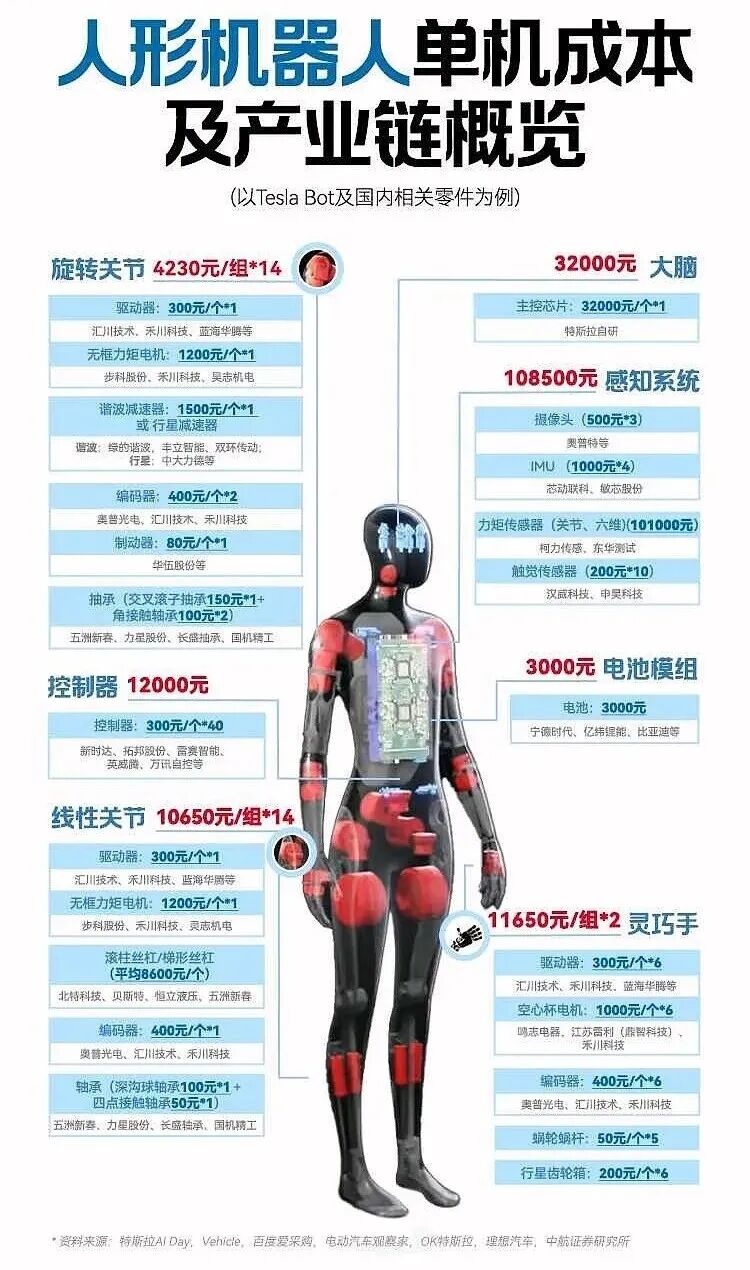
This is where the value of the ecological platform lies. It standardizes and modularizes common tasks and interaction processes into reusable functional plugins. Like building with Lego bricks, developers and customers can quickly splice and adapt. This not only significantly reduces deployment costs but also enables robots to be plug - and - play in different scenarios, greatly accelerating the commercialization process.
Therefore, ecosystem layout is becoming a strategic battle for embodied intelligence manufacturers.
In the past, the competition focused on hardware performance, such as who could build a more stable, faster, and more human - like robot. Now, what determines the competitive landscape is who can establish the standards for task content and the entry point for developers first.
The ecological actions of Zhipu, Ubtech, and Fourier are essentially about seizing this "underlying standard - setting power". Zhipu uses the zero - code platform to lower the content threshold, hoping to establish the ecological grammar of "content equals task" first; Ubtech tries to control the experience standard of software - hardware integration with "Huisi Kaiwu"; Fourier opens up interfaces and tools to promote external developers to co - build the ecosystem, enhancing the platform's potential through the scale effect.
At the current stage, whoever can attract enough developers and accumulate enough task modules first will have the opportunity to become the "formulator of the basic - layer language" in the future industry ecosystem.
Just like the competition between mobile phone systems, iPhone initially led with excellent hardware. Now, Android occupies about 70% - 72% of the global smartphone market share, while iOS only accounts for about 28%. What drives this change is the openness of the Android platform to developers. The same is true in the field of embodied intelligence. A platform without an ecosystem is just an advanced toy, while a platform with an ecosystem can give rise to an industry.
The window period for ecosystem competition has opened. However, this window period will not last long. Once a platform forms a scale advantage and a developer community first, the industry standards and landscape may solidify rapidly.
There is not much time left for the players.
Amid the market boom: the difficult - to - promote synergy in the embodied intelligence industry
Hardware is being mass - produced, models are being upgraded, operating platforms are being launched, and even zero - code development tools are starting to appear. The current embodied intelligence field seems to be prosperous.
However, the reality is not so optimistic.
For example, the Kepler K2 robot started mass production in August 2025, with an annual planned production of only about 100 units; Songyan Power delivered 105 units in July, although the month - on - month growth was 176%, the base was small. Although the cost has decreased significantly, the application scenarios are limited. For example, for some products of Zhongqing Robotics, the price is as low as 38,500 yuan, but the orders are mainly concentrated in non - core scenarios such as display performances and data collection.
Judging from the market performance, the embodied intelligence field still has a long way to go to form a large - scale reusable commercial closed - loop.
The root of the problem lies not only in the visible bottlenecks such as immature technology but also in the dual constraints of market logic and industry structure.
It should be noted that foreign manufacturers, such as Tesla and Figure AI, generally follow the vertical closed - loop route of "hardware + software + self - owned scenarios": centralized R & D, unified standards, but a closed ecosystem with limited expansion speed. This model is suitable for a small number of standardized applications such as automobile manufacturing and warehousing operations, but it is often difficult to replicate quickly in the diverse and complex service and government - enterprise markets.
In China, the implementation of embodied intelligence basically relies on ToB projects, which often leads manufacturers to fall into the "customization quagmire" during delivery. In order to sign contracts and pass acceptance, they quickly add functions and conduct partial development. As a result, the content cannot be reused, experience cannot be accumulated, and the ecosystem cannot be developed. The delivery pressure also makes manufacturers focus more on "how many contracts can be signed" rather than "whether the ecosystem is active"; investors generally are not willing to support development platforms or standard systems that have no short - term returns.
In this logic, ecosystem construction has become a luxury. Manufacturers would rather invest resources in the next prototype than in cultivating a developer ecosystem with no visible returns. As a result, robots can be shipped, but there is no sustainable growth in the ecosystem.
Embodied intelligence does not have a unified entry point like the mobile Internet, nor can it be abstractly deployed like a cloud platform. It must be strongly bound to the physical world and real tasks, which means that each task is coupled with specific hardware, environment, sensors, and execution structures. Therefore, most manufacturers have to develop both hardware and software, self - developing control systems, motion planning, perception algorithms, and model adaptation. Although this "closed - door" model has high barriers, the ecosystem is sealed off, and external developers cannot access it.
Although many enterprises have launched content creation platforms or zero - code tools, in essence, they are still single - point tools. Without a unified task language, interface protocol, simulation environment, and developer revenue system, a real ecological flywheel cannot be built.
In general, without unified standards, content cannot be reused; with customized project delivery, the ecosystem cannot be accumulated; with too many self - developed systems, external developers cannot enter; without a platform revenue model, developers cannot continue. The limitations of market logic and the particularity of the industry form are the core problems behind the difficulty of building an embodied intelligence ecosystem.
Once, the mobile Internet was able to take off quickly not only because of the App Store but also because Apple and Android established unified API standards, complete SDK suites, and standard development processes. Developers could write a set of code that could run on all devices; the same is true for industrial software such as CAD, CAM, and PLM, which rely on standard formats, graphics engines, and plugin systems to drive an entire industry chain and service providers.
For embodied intelligence to truly enter the ecosystem - driven stage, someone must jump out of the device perspective and build a set of intermediate platforms that are adaptable to hardware and reusable in multiple scenarios, change the industrial structure of embodied intelligence, and catalyze real productivity.
In the new AI cycle, understand the "Chinese characteristics" in the embodied intelligence track
The other side of the challenge is often the entrance to opportunity.
It should be noted that China has the most complete upstream and downstream supply chain for robots. Motors, reducers, vision modules, computing power chips, and sensors can all be domestically substituted.