Liquor e-commerce platforms engage in fierce competition during Double Eleven. Feitian Moutai is priced as low as 1,499 yuan.
At the beginning of October, when e-commerce platforms record-breakingly launched the Double Eleven promotion ahead of schedule, many posts about "snatching cheap alcohol" and "finding discounted prices" emerged on social platforms, diverting users to groups on Xiaohongshu and WeChat.
These active groups gathered nearly 500 people in just one month. They studied the platform rules and practiced their hand speed, taking pleasure in grabbing well-known alcohol at discounted prices.
Simultaneous with the "snatching alcohol" craze was the fierce promotion war of alcohol on e-commerce platforms. During Double Eleven, the group-buying price of Feitian Moutai in third-party stores on Pinduoduo dropped to as low as 1,499 yuan. Tmall and Douyin implemented "official instant discounts" to replace the cumbersome "cross-store full discounts"; JD advocated "no need to combine orders" and launched the "authenticity verification for famous alcohol" label, fulfilling the promise of 100% genuine Moutai and Wuliangye on JD.
On the other hand, many alcohol merchants stated bluntly that they had stopped low-price promotions. Behind this is the normalization of the 10-billion-yuan subsidy and the popularization of instant delivery from front warehouses, which have completely changed consumers' inventory logic and triggered a fierce competition between platforms and alcohol enterprises for pricing power.
As more young people no longer stock up on alcohol for low prices, the traditional meaning of Double Eleven is gradually fading.
△Image source: Pexels
Scalpers Exit, "Alcohol Snatchers" Revel
Two hours before the Sichuan alcohol coupons were available for grabs, at 8 a.m. on October 24, in an active "alcohol snatching" communication group on Xiaohongshu, the group owner issued an instruction: "The Sichuan alcohol coupons are available for grabs at 10 a.m. every day. Wuliangye can be bought for less than 700 yuan. The coupon-grabbing activity lasts for one month. Those who need it, please read the announcement and join the internal group."
The so-called internal group mentioned by the group owner is actually a WeChat group. With continuous posts about the "list of discounted alcohol prices" diverting traffic, this alcohol snatching communication group gathered nearly 500 people in less than a month, most of whom were consumers with a demand for alcohol. The group owner, citing platform restrictions, guided users to the WeChat group and released more detailed "alcohol snatching" guides.
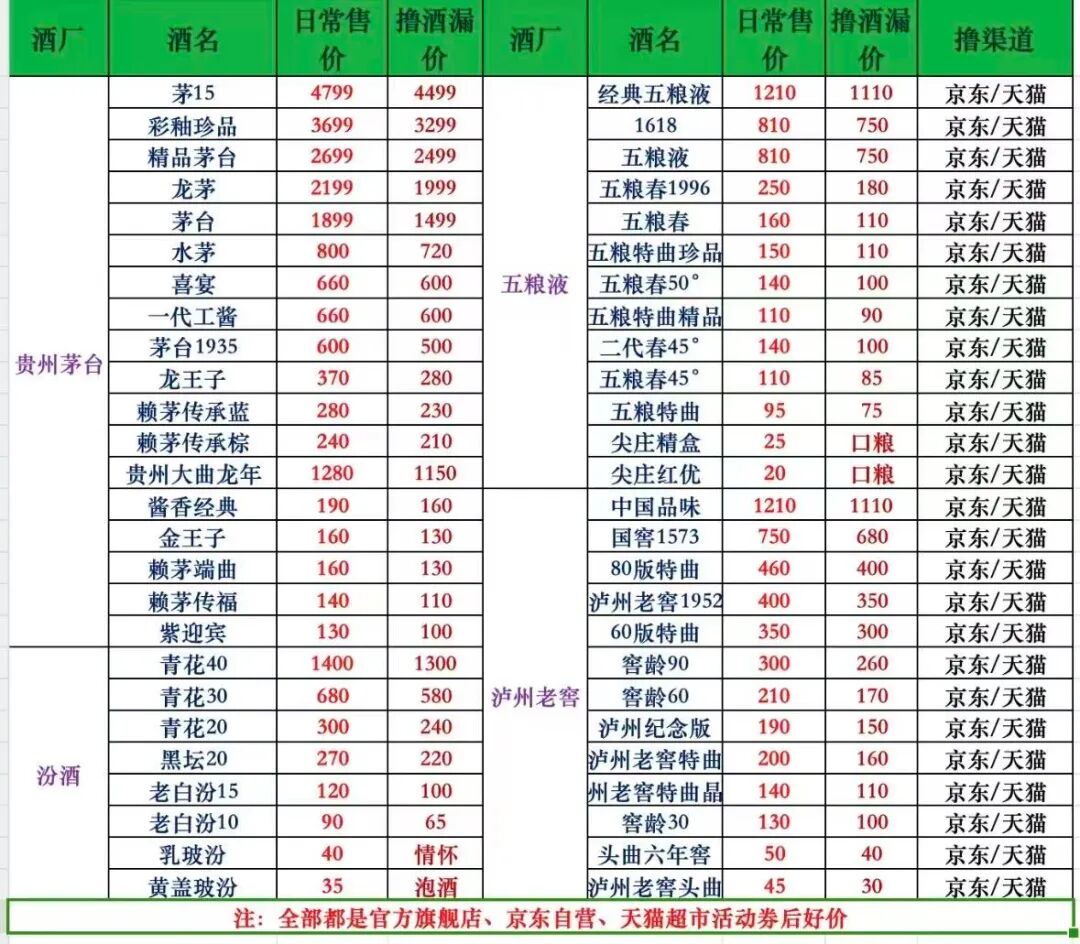
△Discounted alcohol compiled by "Taoke". Image source: Social media
After joining the WeChat group, a reporter from Times Weekly learned that the conditions and rules for "snatching alcohol" are complex. Being a member of the e-commerce platform is the basic requirement. One also needs to grab coupons in advance, recharge the platform supermarket card, and stack membership points. Moreover, the promotions change prices quickly and the quantity is limited, so the "discounted deals" disappear in a flash. Even at night, whenever a consumer posts a screenshot of a successful order, it will attract envious looks and quickly spark discussions.
On October 30, Xiao Xiao, who was stocking up on alcohol for the New Year's Eve dinner, showed off his results. He bought a 1-liter bottle of Jiannanchun Crystal Sword at the JD self-operated flagship store at a post-coupon price of about 560 yuan, which was 276 yuan per bottle lower than the price after a 10% discount at the Taobao flagship store of Jiannanchun.
Zhang Ying, who has rich experience, shared his successful experience. To buy Wuliangye Puwu at a low price of about 645 yuan, he needed to combine orders to 800 yuan, use the Sichuan alcohol coupon of "800 yuan minus 160 yuan", and then stack JD beans, and skillfully use payment channels such as UnionPay QuickPass. This experience was accumulated by Zhang Ying last year when he grabbed more than 10,000 yuan in coupons to buy tobacco and alcohol: "I can grab them every day if I want. It's all about practicing my hand speed."
Behind the "snatching alcohol" craze is a mechanism constructed by platforms, alcohol enterprises, and e-commerce promoters.
Liu Yang, the person in charge of an e-commerce promotion company, revealed its profit model: "In essence, it is the commission for off-platform traffic on the platform. For example, a certain alcohol enterprise, as the seller, sets up products on commission platforms such as Alimama or JD Alliance and agrees on the commission. E-commerce promoters, commonly known as Taoke, distribute exclusive links through groups and content platforms. Once the user confirms the transaction, the system will automatically deduct the commission from the seller's payment and pay it to the promoter. The seller spends money to buy sales.
"Alcohol has high natural profits and high commissions. Many peers operate vertical groups such as alcohol groups and mother-and-baby groups, and insert advertising links of other products in the groups to attract users to place orders and obtain more commissions." Liu Yang explained to the reporter from Times Weekly.
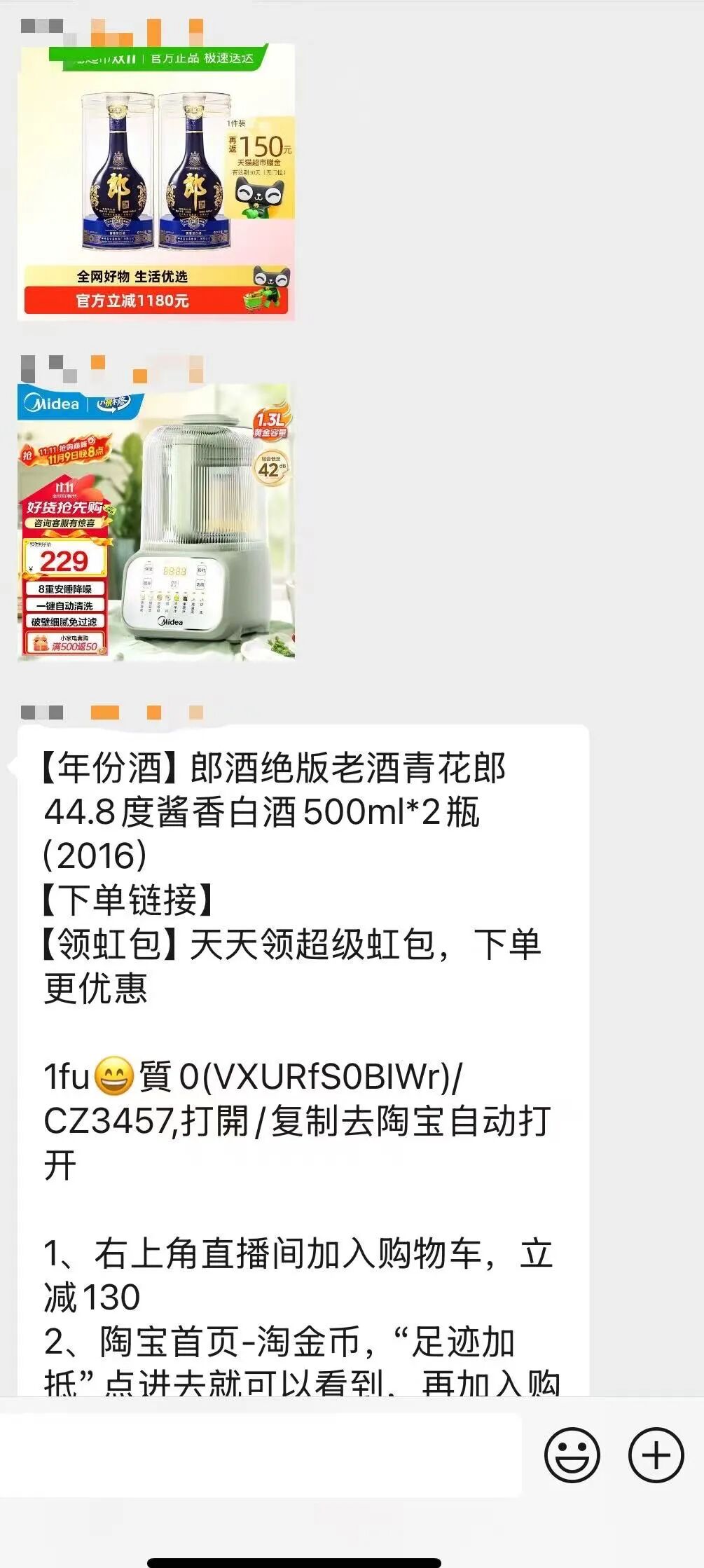
△A WeChat group for "snatching alcohol".
From an industry perspective, the financial attribute of high-end well-known alcohol is gradually fading. Many scalpers who took over the inventory through top live-streaming hosts during Double Eleven last year have largely exited the market after this round of reshuffle. The consumption scenario of alcohol has returned from stockpiling to the real drinking needs of consumers like Xiao Xiao. It is against this background that the alcohol snatching groups have become popular.
"Unlike in the past, the price after the e-commerce promotion subsidy is not much different from my purchase price, but it is very low for consumers." A wine merchant from Bairong told the reporter from Times Weekly.
The 10-billion-yuan Subsidy Breaks Through the Alcohol Price System, and the 1,499-yuan Moutai Becomes a Signal Light
Every Double Eleven, the e-commerce channel becomes the "main battlefield" of the alcohol industry.
Data from the Taobao and Tmall platforms show that from the start of pre-sales on October 15 to October 28, the core brands of alcohol on the Taobao system achieved double-digit growth year-on-year. The growth of liquor, beer, and health food wine all exceeded 50%; JD's battle report showed that as of October 31, the turnover of local characteristic alcohol increased by more than 100% year-on-year, the turnover of the eighth-generation Wuliangye Puwu increased by 10 times year-on-year, and the turnover of the official flagship store of Huazhi Wine Co., Ltd. increased by more than 400 times year-on-year.
At the same time, in the past year, the proportion of new customers of alcohol on Tmall was as high as 70%. Among them, the number of young users aged 18 - 29 has exceeded 10 million, accounting for 30%. For alcohol enterprises that want to attract young people, the e-commerce channel is an important position that must be grasped.
But on the other hand, the price system of alcohol has been shaken again and again at the cost of this growth.
During this year's Double Eleven, in the third-party stores in the 10-billion-yuan subsidy area of Pinduoduo, after inviting two people to form a group, the subsidized price of a 500-ml 53% Feitian Moutai was 1,499 yuan per bottle; Tmall Supermarket on the Taobao system adopted the model of "limited-time rush purchase + subsidy", and the price after subsidy was also 1,499 yuan per bottle. This price is the same as the official guide price of Moutai, and the price difference with offline retail is more than 400 yuan. The price on the JD platform was relatively stable. The price of Moutai in the self-operated store was 1,899 yuan per bottle, and the price after subsidy in the self-operated area of alcohol in JD Supermarket was about 1,869 yuan per bottle, more than 20% higher than the group-buying price on Pinduoduo.
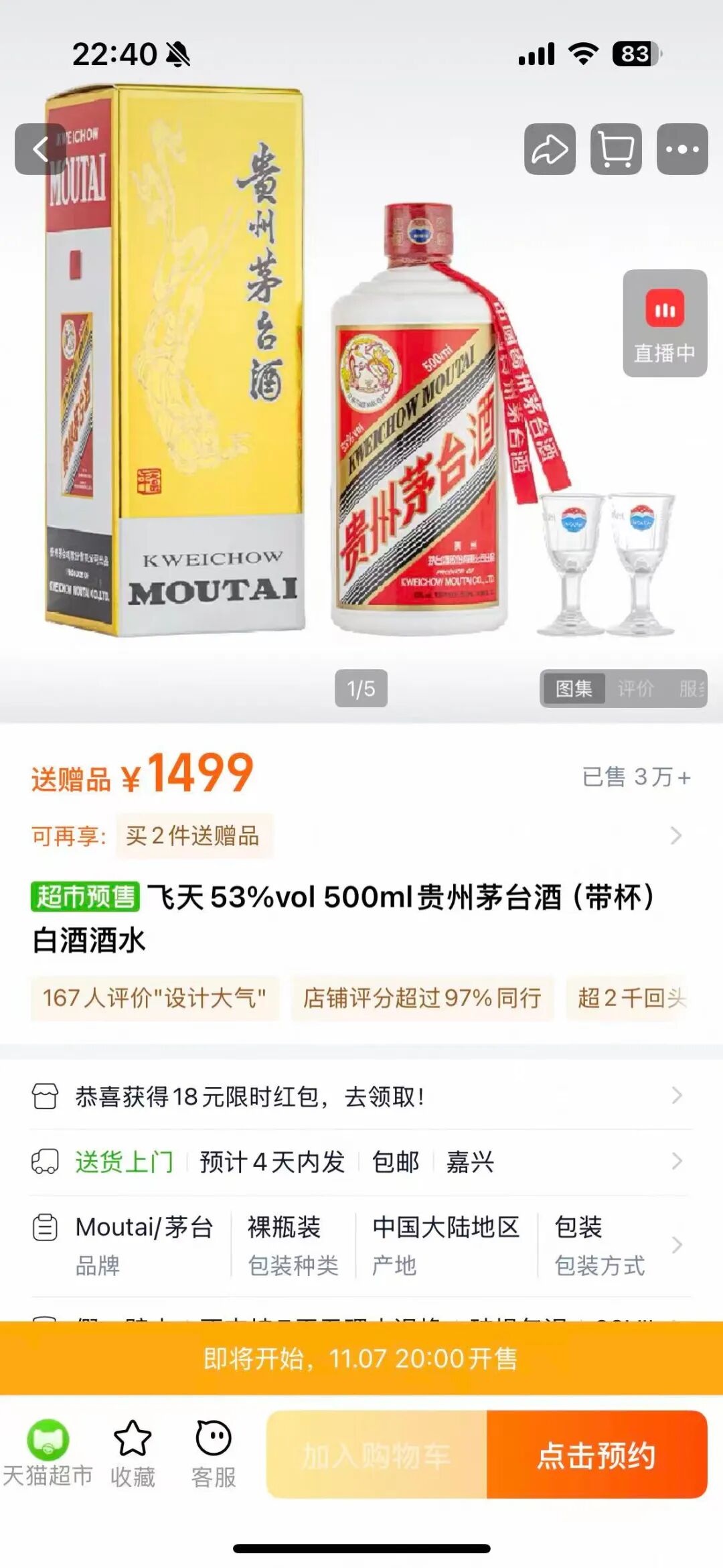
△The subsidized price of Feitian Moutai in Tmall Supermarket on Taobao is as low as 1,499 yuan per bottle.
The pricing power that alcohol enterprises have firmly controlled through the distribution system in the past is now being gradually eroded by the subsidies of e-commerce platforms. This price differentiation has shaken the alcohol price system and seriously eroded the profits of channel merchants.
This confrontation was revealed before the Double Eleven promotion. In mid-to-late October, many well-known alcohol manufacturers such as Moutai, Xijiu, and Wuliangye successively issued "notices" to maintain the price system, reminding consumers to avoid the risks of buying alcohol from non-formal channels.
The reporter from Times Weekly learned that due to the continuous decline of alcohol prices this year, some channel merchants who sold goods at low prices to recover funds during Double Eleven last year have stopped high-investment promotion and low-price promotions this year. "The price competition of well-known alcohol online is approaching the break-even point. There is no profit in participating in low-price promotions, so it doesn't make any sense."
All this has pushed platforms and alcohol enterprises onto the battlefield for pricing power.
The "authenticity verification for famous alcohol" label on JD and the full-link authenticity guarantee system for alcohol on Meituan Flash Sale are all aimed at building a healthy and trustworthy consumption ecosystem. However, their underlying business logic still needs traffic and turnover to support, and the 10-billion-yuan subsidy is their sharpest weapon.
The price gaps created by the 10-billion-yuan subsidy have led to the revelry of "alcohol snatchers". While alcohol enterprises have to embrace the online market to gain incremental customers and young customer groups, they firmly defend the price lifeline.
Young People No Longer Stock Up on Alcohol, and the Traditional Meaning of Double Eleven is Fading
The deeper reason for the reconstruction of the sales logic of alcohol during Double Eleven comes from the subversion of consumption habits by technology and the internal drive of the industry's own adjustment period.
With the maturity of the front warehouse model, e-commerce logistics has completed the transformation from long-distance and centralized to short-distance and distributed, realizing the rapid delivery of alcohol products. The technological innovation is fundamentally dissolving the original meaning of Double Eleven.
Taobao Flash Sale joined Tmall Double Eleven for the first time this year. The official flagship stores on Tmall such as Huazhi Wine Co., Ltd. and 1919 launched the "integration of short and long distances" service, with the fastest delivery within half an hour.
The reporter from Times Weekly learned from Taotian that since October, the flash sale orders of the official flagship store of 1919 on Tmall, which is associated with more than 2,000 offline stores, have increased by 20 times compared with September. The number of people entering the flagship store and the browsing frequency have increased by 5 times compared with Double Eleven last year, and the number of new customers has increased by 90% year-on-year.
The battle report released by Meituan Flash Sale on November 1 showed that within 24 hours since the start of the promotion on October 31, the sales volume of Waima Delivery increased by 300% year-on-year, and the sales volume of the lightning warehouses for alcoholic beverages increased by nearly 500%.
When consumers can receive the alcohol they order within 30 minutes, and with the normalization of the 10-billion-yuan subsidy, consumers have no need to stock up on alcohol for low prices, indicating that the traditional Double Eleven sales logic of alcohol centered on "stockpiling" is fading.
Meanwhile, the adjustment cycle of the alcohol industry has accelerated this transformation. In the stage of oversupply, a large amount of inventory needs an outlet, providing sufficient ammunition for the platform's 10-billion-yuan subsidy and low-price sales.
The e-commerce ecosystem around alcohol is also evolving. Liu Yang said that the high profit margin of alcohol brings high commissions, attracting a large number of "Taoke" and group operators. However, this business with no entry barriers is difficult to make long-term profits in actual operation.
"Although well-known alcohol has high traffic, the commission for products in official flagship stores is very low, only a few yuan per order. If the products are not from official and authentic sources, users will return the goods and leave the group. Although the commission for non-well-known alcohol can generally reach more than 60%, it faces difficulties such as difficult product selection and low user trust. The real order volume cannot be guaranteed, and the cost of acquiring users and operating groups is also getting higher and higher." The peers that Liu Yang knows started to enter this field in the second half of 2022. After doing it for half a year, they all found it difficult to run a profitable model. "Anyway, someone tries every year, but none of them can last."
This year's alcohol battlefield during Double Eleven is an inevitable result of the resonance of technological iteration, industry cycle, and platform strategy. Instant retail has met the immediate drinking needs and accelerated the end of the stockpiling era; under the in-depth adjustment of the industry, the already tense relationship between manufacturers and channels has been fully intensified by the platform subsidies.
As more and more young people no longer stock up on alcohol, and as the 1,499-yuan genuine Moutai becomes more normalized, an era of alcohol dominated by young people, driven by scenarios, and with transparent prices may not be far away.
(Xiao Xiao, Zhang Ying, and Liu Yang are pen names at the request of the interviewees)
Reporter: Xing Wenwen
Editor: Yang Chunxia
Operator: Jiang Ziyu
Proofreader: Lu Yanping
This article is from the WeChat public account "Times Weekly", author: Xing Wenwen, published by 36Kr with authorization.