Is the market value lower than the cash assets? It's time to revalue NIVF.
On October 29 local time, the Federal Reserve initiated its fifth interest rate cut since September 2024. Along with this process, the popularity of small - cap stocks in the US stock market has gradually returned.
In fact, driven by the expectation of interest rate cuts, the Russell 2000 Index, which represents the performance of the US small - cap stock market, has been on an upward trend since April this year.
According to historical experience, the restart of the Federal Reserve's interest rate cut cycle first benefits small - cap stocks. Benefiting from the low - interest rate environment, small companies can often directly improve their profitability through lower financing costs. Also, due to the improvement of market liquidity and the increase in risk appetite, interest rate cuts are expected to stimulate investors to bargain - hunt those neglected small - cap stocks with high - quality fundamentals.
Previously, since 2022, US small - cap stocks have been suppressed for a long time. Naturally, there are many companies in the current market with good profit expectations but whose valuations have not yet reflected their true value.
In October this year, US investment research institution Zacks first covered First Renhui (stock abbreviation: "NIVF") and gave it a valuation of $15 per share. At the time of the report's release, the stock price of First Renhui was only $1.81.
So, what are the reasons for the gap between the institutional judgment and the market performance? Can First Renhui support the target price of $15 per share?

With market value lower than cash assets, why is NIVF undervalued?
The current US stock market presents a significant pattern of "overvalued large - caps and undervalued small companies". On one hand, the "Magnificent Seven" in the US stock market, such as Apple, Microsoft, and Alphabet, are in the limelight. NVIDIA refreshed human history with a market value of $5 trillion. On the other hand, there is insufficient liquidity in a large number of small - and medium - cap stocks. There are even individual stocks like First Renhui, whose market value is lower than the company's cash assets.
Currently, First Renhui holds approximately $1.3082 million in bank cash, approximately $2.1137 million worth of virtual currency SOL, and has paid a deposit of approximately $3.6147 million for land purchase. In total, it holds approximately $7.0367 million in cash assets.
However, as of November 3 local time, the market value of First Renhui was only about $1.34 million, far less than its available cash.
This shows that this individual stock has been "misdirected" to some extent by the overall environment of the US stock market.
Of course, the market's concerns are not unfounded. Since 2023, First Renhui has been in a continuous state of loss. Considering its previous business structure mainly focused on medical services, most companies of the same type in the US stock market have not yet achieved profitability.
Looking at First Renhui itself, the scale of its losses has actually been narrowing year by year, and it has gradually expanded its diversified business in recent years. For example, in February this year, it acquired the laboratory services and related intellectual property rights of MicroSort to expand the scope of its medical services. In June, it started real - estate development business in the UAE. At the same time, it also laid out in the blockchain field and was recently hired to conduct physical asset tokenization agency for artworks worth up to $200 million.
On the 3rd of this month, the company newly disclosed a development. It plans to reverse - acquire the mining assets of SAXA at a transaction consideration of $5 billion, specifically including two mines of the latter located in Arizona and California in the United States. If the merger and acquisition is successful, First Renhui is expected to enter the US rare - earth and precious - metal mining industry through this.
Compared with the medical service industry, real estate and mineral mining are industries with relatively certain profitability. Expanding its diversified business map is expected to contribute new growth points to First Renhui's revenue and profit. Especially driven by the real - estate business, Zacks predicts that First Renhui may turn losses into profits in 2026 and achieve significant growth in net profit in the following three years.
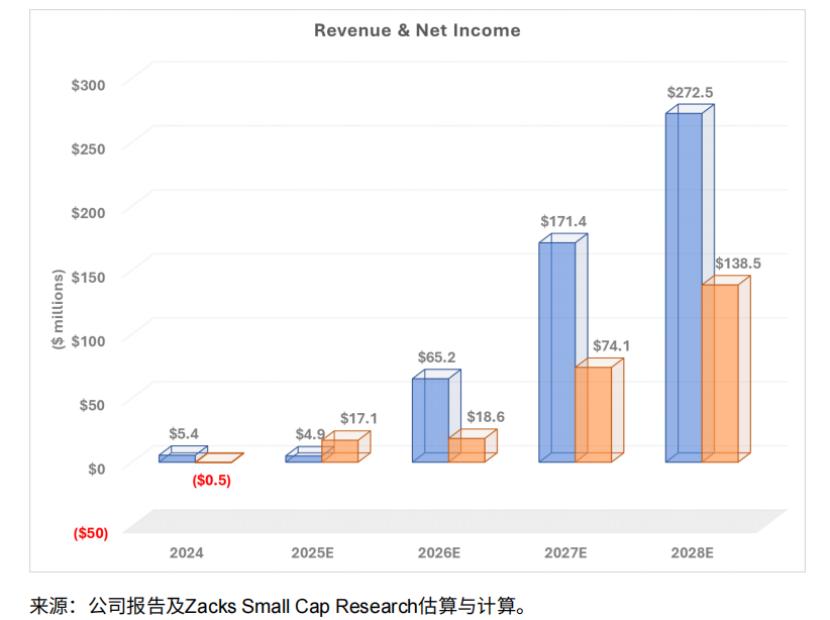
Zacks' profit forecast for First Renhui
In fact, if it weren't for the impact of acquisitions and other matters, First Renhui would have been expected to achieve profitability within this year.
The Zacks model predicts that its adjusted earnings per share for this year will be - $2.19. However, it should be noted that this does not include the gains from two bargain - purchases. A valuation report issued by one of the Big Four accounting firms previously showed that First Renhui had a bargain - purchase gain of $19.1 million after acquiring the intellectual property rights and related assets of flow cytometry. There was also a similar gain of $3.52 million after the acquisition of MicroSort in February this year.
It is precisely these acquisition matters that have dragged down the company's stock price to some extent.
Take the acquisition of MicroSort as an example. At that time, First Renhui paid $750,000 in cash, and the remaining amount was paid in the form of an equivalent number of Class A new shares. Objectively, this would put downward pressure on the stock price at that time.
It is a common financing behavior for listed companies to issue new shares. Official information shows that part of the capital expenditure for First Renhui's real - estate projects and the $5 billion required for the acquisition of SAXA's mining assets will also be raised in this form. At that time, First Renhui will issue 500 million shares of stock at a price of $10 per share to SAXA's shareholders as consideration. After the completion of the transaction, it may also issue an additional 50 million new shares at a price of $5 per share.
Therefore, it can be predicted that when First Renhui issues new shares again to raise funds for the above - mentioned matters, its stock price will also bear temporary technical pressure.
However, after the transaction is completed and the $5 billion in assets is injected, based on the planned issuance of 582 million shares, the net value of the newly injected assets is expected to reach $8.6 per share.
Compared with the current stock price of less than $1, First Renhui can be considered "significantly cheap".
Overall, the low valuation of First Renhui is due to both fundamental factors such as the single revenue structure in the early stage and the temporary "book loss" caused by the impact of acquisition matters. Objectively, it is also dragged down by the issuance of new shares. So, with the overall preference for small - cap stocks expected to improve, apart from being "significantly cheap", is there any room for imagination in First Renhui's future growth?

High - end real estate in the Middle East: an engine for profit growth
A definite answer is that First Renhui currently holds a scarce land parcel.
As the first step in its real - estate business layout, in June 2025, First Renhui purchased a piece of land in Ras Al Khaimah, the largest city and capital of the Emirate of Ras Al Khaimah. This land parcel is located in the Ras Al Khaimah beach area, adjacent to Al Marjan Island. The Wynn Resort under construction on the island is expected to open in early 2027, and it will become the only "Las Vegas" in the UAE region at that time.
According to the plan, First Renhui will cooperate with the well - known UAE developer BNW Real Estate Development LLC to develop a high - end residential complex with an area of more than 525,000 square feet on this land parcel. Collaborating with a local developer, targeting high - end residences, and being adjacent to a resort almost guarantees the future customer source and sales of this project.
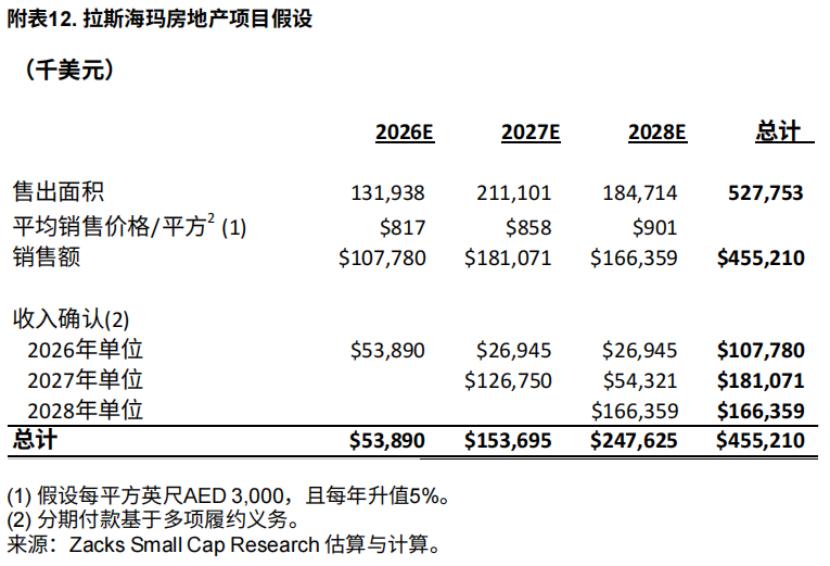
Zacks' assumptions for the future sales and revenue conversion of the Ras Al Khaimah real - estate project
According to the management, the project has now entered a critical implementation stage. More than four months after acquiring the land, the preliminary design plan of the project has been basically completed, and the development process is about to start. It is expected that pre - sales can be launched in the first half of 2026.
According to Zacks' calculations, the total sales of this project will exceed $450 million, and the net profit will be about $200 million. Based on the initial investment cost of about $24 million, First Renhui will enjoy about one - third of the net investment income.
Reflected in the financial data, benefiting from the contribution of the real - estate business, Zacks expects that First Renhui's net profit from 2026 to 2028 will reach $18.6 million, $74.1 million, and $139 million respectively.
If calculated based on the 11.7 million issued and outstanding shares, Zacks predicts that its earnings per share from 2026 to 2028 will reach $1.59, $6.35, and $11.87 respectively. This is significantly higher than its current stock price of less than $1.
The management revealed that the Ras Al Khaimah project is only the first step for First Renhui to enter the real - estate field. In the future, it plans to develop the real - estate sector into one of the company's pillar businesses.
From the market environment in Ras Al Khaimah, the local area has potential for real - estate growth.
In terms of the supply - demand structure of housing sources, since 2025, the market supply has started to lag behind the market demand. The value of real - estate assets and the rental return rate have continued to rise. The local population nearly doubled between 2005 and 2023, laying the foundation for meeting market demand. At the same time, the UAE's Golden Visa program provides long - term residency for foreigners investing in real estate. The 10 - year renewable visa allows individuals to live, work, and study locally, which is beneficial for international investors.
In addition, according to data statistics, about 30,000 Chinese immigrants move to the UAE every year.
However, First Renhui maintains a cautious approach in real - estate investment and focuses on high - end product positioning. It clearly identifies high - end residences, coastal vacation properties, and cultural and tourism real estate as key directions.
On the other hand, in the sales aspect, the Ras Al Khaimah project will adopt a hybrid sales mechanism, taking into account both traditional offline sales and real - estate tokenization. The latter is expected to help investors achieve efficient cash flow back. More importantly, First Renhui also uses it as an important pilot for exploring real - world asset tokenization (abbreviated as "RWA").
The management admitted that if the first project is successfully implemented and generates good returns, the company will replicate the "development + tokenization" model in the UAE and even the entire Middle East region, forming an expandable and replicable growth engine.
This also leads to another business it previously laid out - digital asset management.

A pioneer in the trillion - dollar RWA market
Digitally dividing the ownership of some properties through RWA can not only improve asset liquidity but also upgrade the real - estate development model from the traditional capital - intensive one to an ecological platform of "development + digital finance", with broad future imagination space.
High total value, poor liquidity, clear property rights, and quantifiable prices are the main characteristics that make real estate an ideal target for RWA. However, for First Renhui, real - estate projects are just the starting point for its exploration of digital asset management.

Left: Ms. Fang Xiyu, Co - founder and Chief Marketing Officer; Right: Mr. Xiao Yongfeng, Founder and Chief Executive Officer
In June this year, it planned to invest $30 million in the digital asset staking business in the Solana ecosystem. So far, the rate of return has been stable, which to some extent verifies its execution ability and risk - control system in the field of crypto - assets.
Not long ago, it also cooperated with the World Chinese Museum and served as the global exclusive agent for the tokenization of its artworks. The first batch of tokenized artworks was valued at $2 million. Based on the successful initial promotion, it will be further expanded to other art assets in the future, with a total value of up to $200 million.
Specifically, First Renhui is fully responsible for all core links in the entire tokenization process, including asset screening and due diligence, independent valuation and authenticity verification in cooperation with authoritative institutions, designing the tokenization structure and compliance issuance plan, connecting with global trading platforms and liquidity providers, and marketing and international investor relations management.
Finally, it will charge 15% of the total value of the tokenized assets as service fees - this has contributed a new source of income for it.
According to Deloitte's "2023 Art and Finance Report", the wealth scale of artworks and related collectibles held by ultra - high - net - worth individuals globally reached $2.174 trillion in 2022 and is expected to climb to $2.861 trillion by 2026.
Looking at the entire RWA market, Boston Consulting predicts that the scale will exceed $10 trillion by 2030.
This means that acting as an agent for art RWA not only enhances short - term performance but also accumulates a first - mover advantage for future opportunities in the trillion - dollar market.
Just as some technology companies are cautious about art RWA due to the lack of fair value in pricing, First Renhui has taken the lead in establishing a multi - level risk - control and value - verification system during its exploration. For example, it has introduced third - party professional evaluation institutions such as internationally renowned art consultants, art history experts, and cultural heritage certification organizations to ensure that the valuation is based on historical transaction data, scarcity analysis, and academic research. It has also cooperated with institutions such as