Lujiazui Lansheng, Hangzhou Bay Cullinan, Zhejiang Maybach... Why do their names all contain the number "9"?
The extended - range version of XPeng X9, IM LS9, Leapmotor D19... Recently, in the new - car market, there have been continuous releases of products with the number "9" in their names.
"New energy vehicles like to be named after numbers. Last year, the number '7' was popular, and this year, it's all about '9'," a netizen posted on social media.
According to incomplete statistics from China New Jingwei, in the past three months, car manufacturers have released 10 new cars with the number "9" in their names, which is the same as the total number for the whole year of 2024. Among them, 5 models were released in September. Before the end of the year, at least 3 more models from the "9" series will be launched.
Why are they being released in clusters?
Focusing on the positioning of the "9" - series cars launched by car manufacturers in the second half of this year, all models belong to the high - end flagship models of each brand. Their software and hardware configurations represent the current highest level of the brand.
For example, the extended - range version of XPeng X9, launched on November 6th, is XPeng's first extended - range product. It supports 800 - volt high - voltage and 5C ultra - fast charging. It features the first zero - gravity seats with integrated airbags and is also the first to be equipped with XPeng's three - row electric triple - folding function.
The co - CEO of IM Motors said at the pre - sale launch event of IM LS9 on the 4th that IM LS9 integrates the more than 70 - year - old car - making heritage of SAIC Group and is the culmination of the group's cutting - edge technologies.
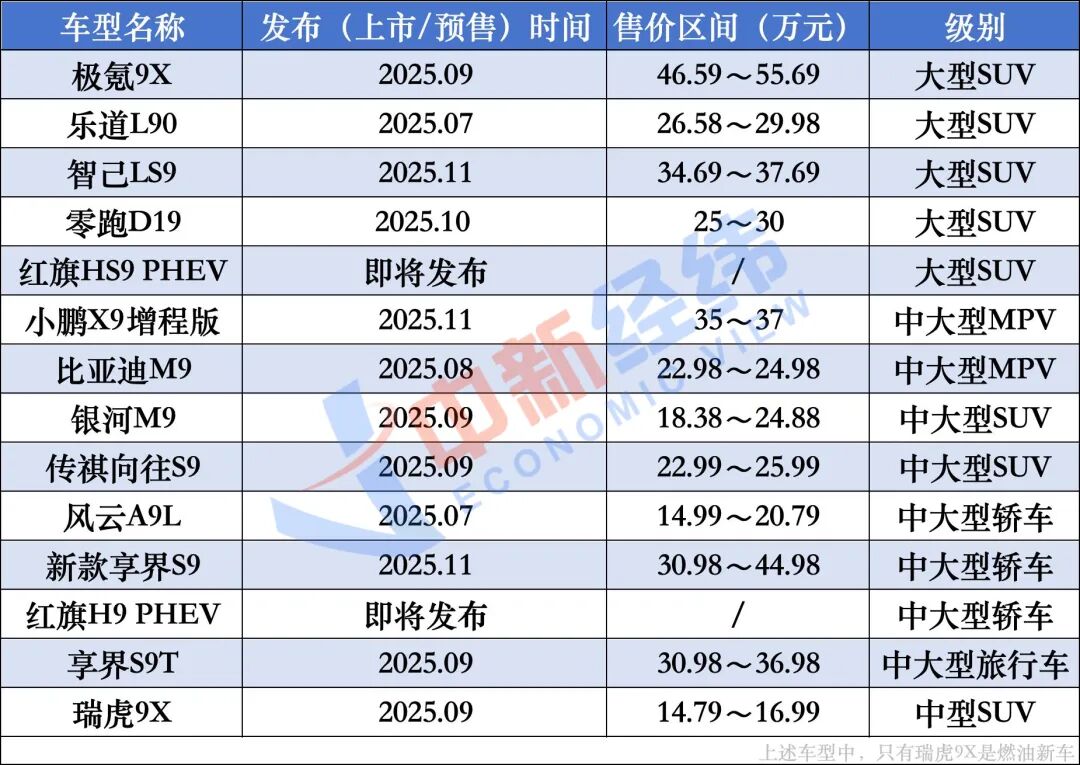
Information on the "9" - series new cars launched in the second half of this year. Table made by Gong Chenyuan of China New Jingwei.
In the view of Zhang Hong, a member of the Expert Committee of the China Automobile Dealers Association, launching flagship models from the "9" series is an important strategy for car manufacturers to upgrade their brand image. By showcasing top - notch technologies and product capabilities, they can enhance the overall brand image and value and attract consumers who pursue high - end experiences.
"When multiple brands launch '9' - series models in a concentrated manner, it is easy to form a market demonstration effect. Consumers may, due to herd mentality or following market trends, think that '9' - series models are the mainstream choice, thus increasing the certainty of their purchase decisions," Zhang Hong analyzed.
In terms of vehicle class, the "9" - series cars launched since the second half of this year are concentrated in the large - car and mid - large - car segments. For example, IM LS9 is a large SUV, and the extended - range version of XPeng X9 is a mid - large MPV.
In terms of the launch rhythm of car manufacturers, most mainstream car manufacturers first launched mid - large (medium) "7" - series cars and then large (mid - large) "9" - series cars. For example, Zeekr launched Zeekr 007 at the end of 2023, positioning it as a medium - sized car; and launched Zeekr 9X in September 2025, positioning it as a large - sized car.
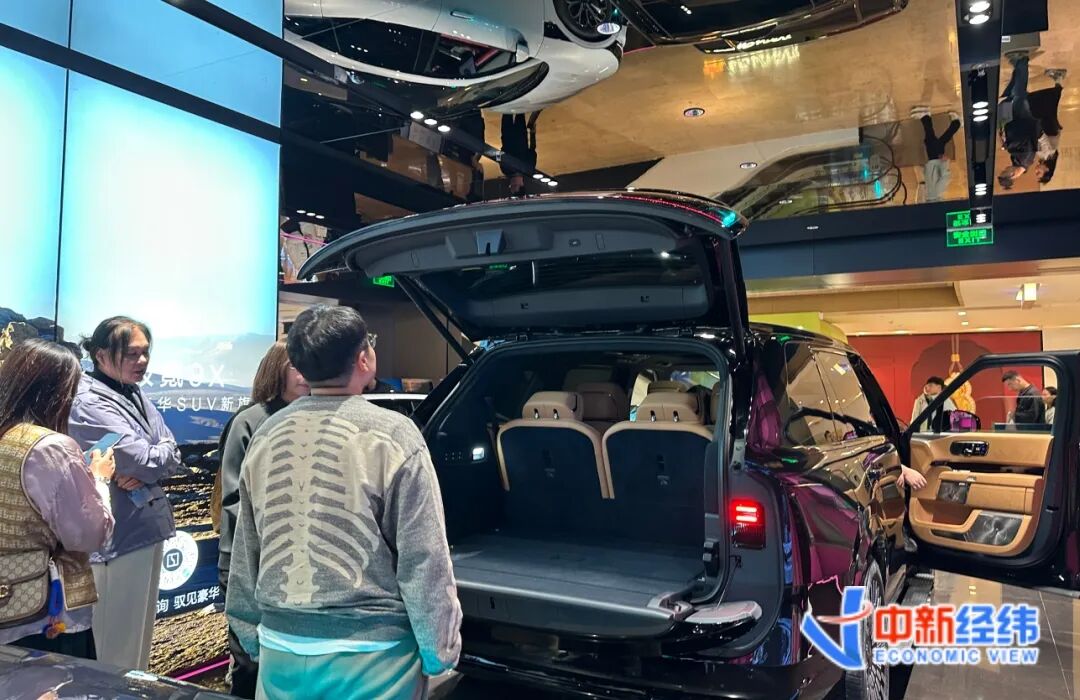
File photo taken by China New Jingwei.
"Against the background of shrinking profits for car manufacturers, focusing on high - end large cars is an important direction for car manufacturers to enhance their brand image and find a breakthrough for profits, but it is not the only option. Due to high - end configurations and complex technologies, the unit prices of high - end large cars are generally higher, and the gross profit margin is usually 10 to 15 percentage points higher than that of ordinary models. Car manufacturers can relieve profit pressure through high unit prices and high gross margins," Zhang Hong added.
"The Range Rover of Lujiazui, the Cullinan of Hangzhou Bay"... Is it appropriate?
It is worth noting that although the "9" - series cars represent the current highest technological level of car manufacturers and are integrated with high - end configurations, their prices are far lower than those of the traditional luxury cars they are benchmarked against.
In terms of price distribution, the price range of the "9" - series cars launched in the second half of this year is concentrated between 200,000 and 500,000 yuan. Some models even adopt an affordable pricing strategy and compete in the mainstream market below 200,000 yuan.
"The listing prices of most '9' - series cars are lower than the prices defined during product development. For example, a product originally defined to be priced between 400,000 and 500,000 yuan will have its price reduced to between 300,000 and 400,000 yuan when it is launched one year later. The fundamental reason is that new energy vehicles have strong technological attributes," said Wang Shen, the general manager of data insights in the China region of J.D. Power.
Zhang Hong believes that Chinese car manufacturers have achieved lower prices with the same - level configurations through technological innovation and supply - chain integration. This reflects the maturity and cost - control ability of China's new energy industrial chain and is the result of technological accumulation and large - scale production. However, the concentrated listing of "9" - series cars also reflects the competition among car manufacturers in the high - end market. Some models have poor sales due to unclear positioning or excessive configurations.
According to data from the China Passenger Car Association, in September this year, the sales volume of new energy vehicles priced above 400,000 yuan was 34,900 units, a year - on - year decrease of 20.4%. The sales volume of fuel - powered vehicles in this segment was 40,800 units, a year - on - year decrease of 6%. In the first nine months of this year, the sales volume of new energy vehicles in this price range decreased by 20.2% year - on - year, and that of fuel - powered vehicles decreased by 1.5%.
On social platforms, many "9" - series cars are also called affordable alternatives to traditional luxury cars by netizens. For example, IM LS9 is the "Range Rover of Lujiazui", Zeekr 9X is the "Cullinan of Hangzhou Bay", and Leapmotor D19 is the "Maybach of Zhejiang"... Some senior executives of car manufacturers also claim at relevant product launch events that their models are fully benchmarked against traditional luxury cars worth over one million yuan.
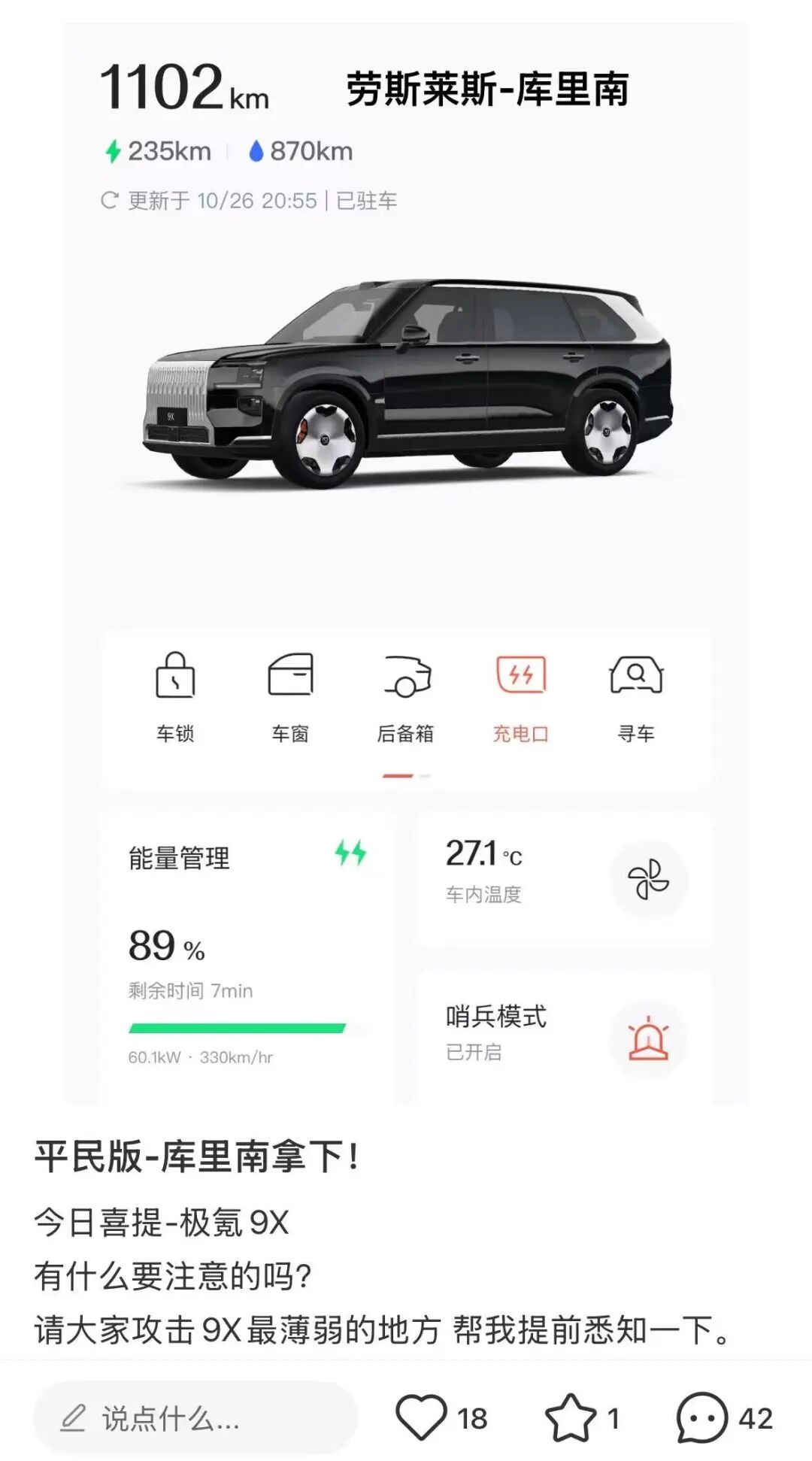
Screenshot from a social platform.
Industry insiders believe that this statement should be viewed rationally. Zhang Hong believes that from a positive perspective, the above statement reflects the ability of Chinese brands to provide high - end experiences with high cost - performance, meeting consumers' yearning for luxury. Of course, potential problems should also be noted. If the benchmarking is over - emphasized, the brand's own characteristics and the real needs of users may be ignored, leading to a focus on configuration stacking rather than value creation.
"I don't recommend such comparisons. The consumer groups of the two are not exactly the same. When car manufacturers do marketing, they need to clarify the actual value that the product brings to users," said Wang Shen.
With the increasing number of "9" - series cars, in which directions should future new cars strive?
In response, Zhang Hong said that with many car manufacturers flocking to the market, most models sell less than 3,000 units per month, and terminal discounts generally exceed 10,000 yuan, indicating that the market is approaching saturation. Most "9" - series cars mainly focus on similar selling points such as large space, luxury configurations, and intelligent technologies. Consumers' aesthetic fatigue towards homogeneous products is gradually emerging, and they pay more attention to brand reputation, service experience, and the practicality of basic functions when purchasing cars.
Zhang Hong suggested that later - entrants should adopt a "differentiation + refinement" strategy, such as concentrating resources to break through a core technology (intelligent cockpit interaction experience, high - efficiency energy - saving power system, etc.) to create a differentiated advantage.
When talking about future market competition, Wang Shen said: "Engines and gearboxes may re - enter the field of new energy '9' - series cars. New - force car manufacturers do not have much technical reserve in the mechanical hardware aspect, while Chinese traditional car manufacturers have certain technical advantages and still have great opportunities in the future."
This article is from the WeChat public account "China New Jingwei" (ID: jwview), written by Gong Chenyuan and edited by Li Xiaoxuan. It is published by 36Kr with authorization.