Seres gave the market a big shock.
On November 5th, SERES officially listed on the Hong Kong Stock Exchange. At the close of trading on that day, its market value exceeded HK$220 billion, but the stock price once broke below the issue price. In the face of market concerns about its over - reliance on Huawei, Zhang Zhengping, the president of SERES, said that the company will expand globally and is not worried about Huawei's cooperation with other automobile companies.
01
A Nervy but Successful Debut on the Stock Market
In the first half of its life, SERES, an established automobile - manufacturing enterprise in Chongqing, made money by building trucks and selling motorcycles. In the second half, it met Huawei, tightly bound itself to the tech giant, and achieved a remarkable turnaround with the "AITO" brand. It has become a super "second - party" in the automobile circle.
On November 5th, nearly 10 years after its A - share listing, SERES listed on the Hong Kong Stock Exchange. With a net fundraising of HK$14.016 billion, it became the largest IPO of a Chinese automobile enterprise to date and the largest IPO of an automobile enterprise globally since 2025.
What was a bit of a thrill was that SERES' stock price dropped as soon as the market opened on its listing day, with the intraday decline once exceeding 10%. It only suddenly rose in the last 20 minutes before the close, maintaining its dignity. The stock closed at HK$131.5 per share on that day, the same as the issue price. On November 6th, SERES' Hong Kong - listed shares fell 4.94%, breaking below the issue price.
The capital market's cautious attitude was unexpected. Previously, public data showed that the public offering part of SERES' Hong Kong share offering was over - subscribed 133 times, freezing HK$178 billion in funds and attracting 204,000 retail investors. Why did it become less popular after the listing?
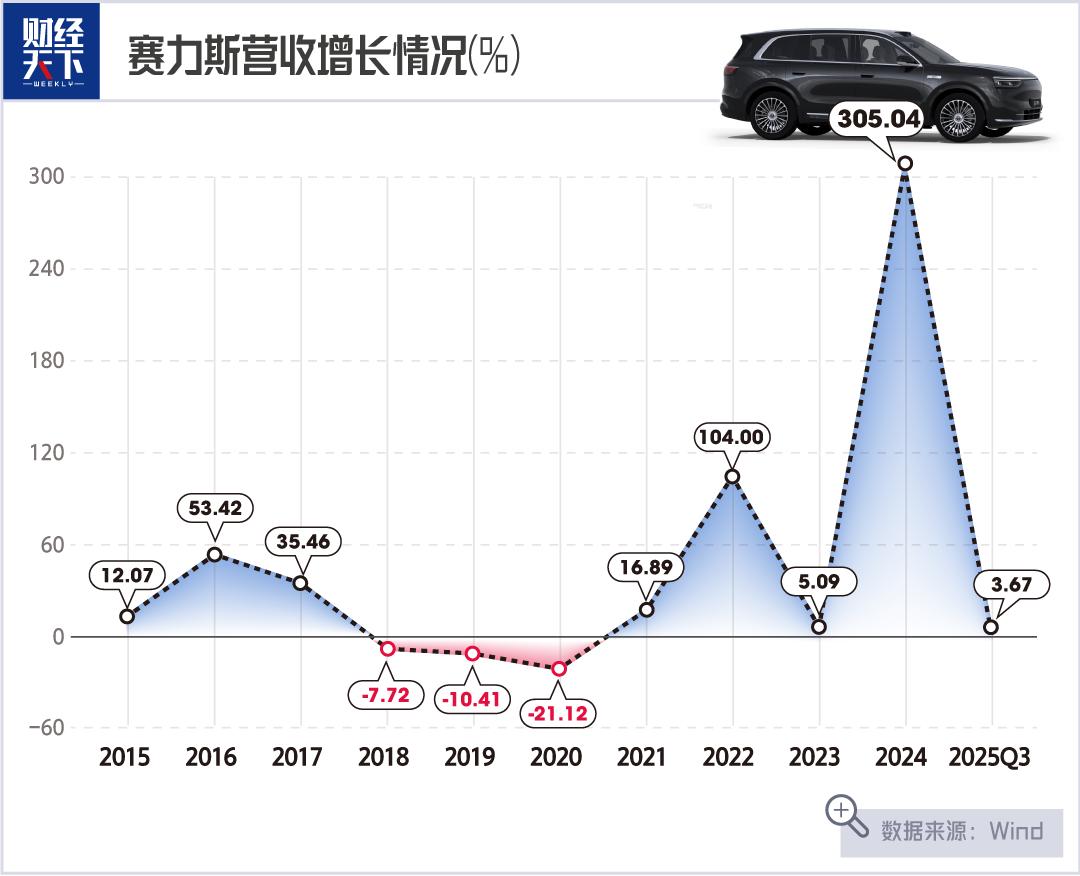
Many investors believe that SERES' current core competitiveness highly depends on Huawei's in - depth empowerment. Without substantial breakthroughs in its own key technologies, it may be difficult to support its high valuation. In addition, the company's sales volume in the first three quarters of this year decreased by 7.79% year - on - year, and the revenue growth rate also slowed down significantly to 3.67%. These signals increased market concerns.
Qi Zheng, an employee of SERES, does not deny some of the outside analyses. "Our current R & D capabilities are more focused on function verification and engineering testing," Qi Zheng told Caixin Weekly. Key technologies such as the ADAS (Advanced Driver Assistance System) central super - computing platform, chips, and intelligent algorithms, which are the most core for automobile - manufacturing enterprises, are currently still provided by Huawei. The company requires us to coordinate well between Huawei and suppliers to ensure that all technologies can be stably implemented and meet mass - production requirements.
SERES' predecessor was Chongqing Xiaokang Industry Group (referred to as "Xiaokang Co., Ltd."), an automobile enterprise mainly engaged in traditional fuel - powered vehicle manufacturing, especially focusing on the production and sales of minivans and economy SUVs. In 2016, Xiaokang Co., Ltd. underwent a comprehensive transformation and launched the "AITO" brand through cross - border cooperation with Huawei in 2021. Later, it successively launched four SUV models: AITO M5, M7, M8, and M9.
Before 2021, Xiaokang Co., Ltd. was just an obscure player in the automobile market: its stock price was once below 7.5 yuan, and its annual revenue was less than 20 billion yuan. After cooperating with Huawei, it was in a slump for a long time: from 2020 to 2023, it accumulated a loss of nearly 10 billion yuan. In 2022, Xiaokang Co., Ltd. was renamed SERES.
2024 was a lucky year for SERES. Thanks to the popularity of the AITO M7, the company's daily revenue reached 400 million yuan, and the daily net profit was about 16 million yuan. It became the fourth new - energy automobile enterprise globally to achieve profitability after Tesla, BYD, and Li Auto.
On September 30th, 2025, SERES' A - share price once climbed to 174.35 yuan, and its market value also reached a high of about 300 billion yuan, completing its transformation from an edge automobile enterprise to an industry up - and - comer. From 2022 to 2024, SERES' revenue increased from 34.1 billion yuan to 145.2 billion yuan, more than quadrupling in just three years.
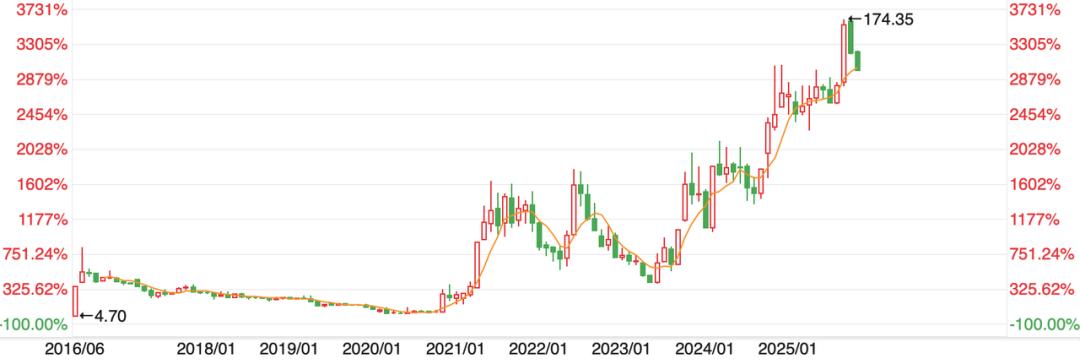
▲ Chart of SERES' stock price trend since its listing in June 2016, monthly K - line
In the first half of 2025, SERES Automobile, a subsidiary of SERES Group, completed a strategic financing of 5 billion yuan. As of June 30th, the company held cash and cash equivalents of more than 21.665 billion yuan.
However, the more brilliant SERES' achievements are, the more prominent its dependence on Huawei becomes.
From the annual financial reports, SERES needs to purchase a large number of automobile parts such as intelligent driving and intelligent cockpits from Huawei every year. From 2022 to the first half of 2025, the relevant procurement amounts were 5.8 billion yuan, 7.2 billion yuan, 42 billion yuan, and 20 billion yuan respectively, showing a rapid growth trend.
In addition, SERES deeply relies on Huawei's sales channels and marketing system, selling AITO vehicles through more than 700 Huawei experience centers. As a result, SERES' advertising, image - store construction, and service fees have been continuously rising. This expense increased from 4.036 billion yuan in 2022 to 18.111 billion yuan in 2024. In the first half of 2025, this expenditure was 8.431 billion yuan.
On November 5th, the day of its Hong Kong - stock listing, in the face of outside doubts, Zhang Zhengping, the president of SERES, admitted that the company will expand globally and is not worried about Huawei's cooperation with other automobile companies.
It is reported that SERES will use US$1.8 billion of its listing funds to support overseas expansion and hopes to catch up with companies like Tesla in emerging industries such as humanoid robots. "We want to go global, which will make it easier for our customers and investors to understand SERES' business," Zhang Zhengping said.
02
Concerns Triggered by Declining Sales
This year, the competition in the automobile market has been extremely fierce. The "price war" has squeezed the profit margins of many automobile enterprises. Data from the Passenger Car Association shows that the profit margin of the automobile industry in the first three quarters of this year was 4.5%, lower than the average level of 6% for downstream industrial enterprises.
In the first three quarters of this year, SERES' revenue reached 110.534 billion yuan, a year - on - year increase of 3.67%; the net profit attributable to shareholders of the listed company was 5.312 billion yuan, a year - on - year increase of 31.56%; the net profit margin also rose from 3.27% at the end of 2024 to 5.10%. It was really not easy to achieve such results.
Although its revenue and growth rate are not as good as those of large enterprises such as BYD, Great Wall, and Chery, its net profit has the fastest year - on - year growth rate, and it is also one of the few automobile enterprises whose profit growth rate far exceeds the revenue growth rate.
However, looking at the sales volume in the first three quarters, SERES experienced a 7.79% decline, which was in contrast to the overall growth trend of the industry. Data from the China Association of Automobile Manufacturers shows that in the first three quarters of 2025, the cumulative sales volume of new - energy vehicles in China exceeded 11 million, a year - on - year increase of more than 34%.
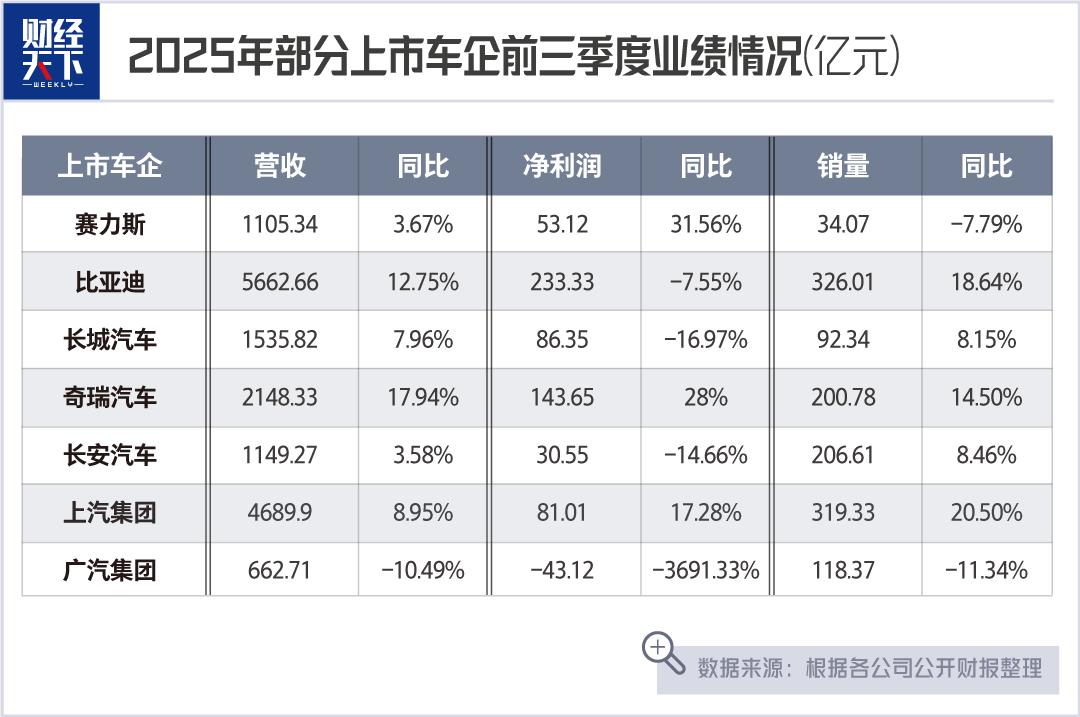
The decline in SERES' sales volume has triggered market concerns about its growth sustainability.
Currently, SERES' products on sale include the AITO brand, as well as fuel - powered vehicle brands such as DFSK (Dongfeng Xiaokang) and Fengguang, its own new - energy brand Landian, and commercial vehicle products such as Ruichi.
Looking at the annual sales volume, from 2022 to 2024, the sales volume of DFSK decreased from 65,000 to 43,500, and the sales volume of the Fengguang brand decreased from 74,900 to 28,100. In the first half of this year, their sales volumes were 19,700 and 7,525 respectively. Landian performed relatively well, with its sales volume increasing to 34,200 in 2024 and 11,200 in the first half of this year.
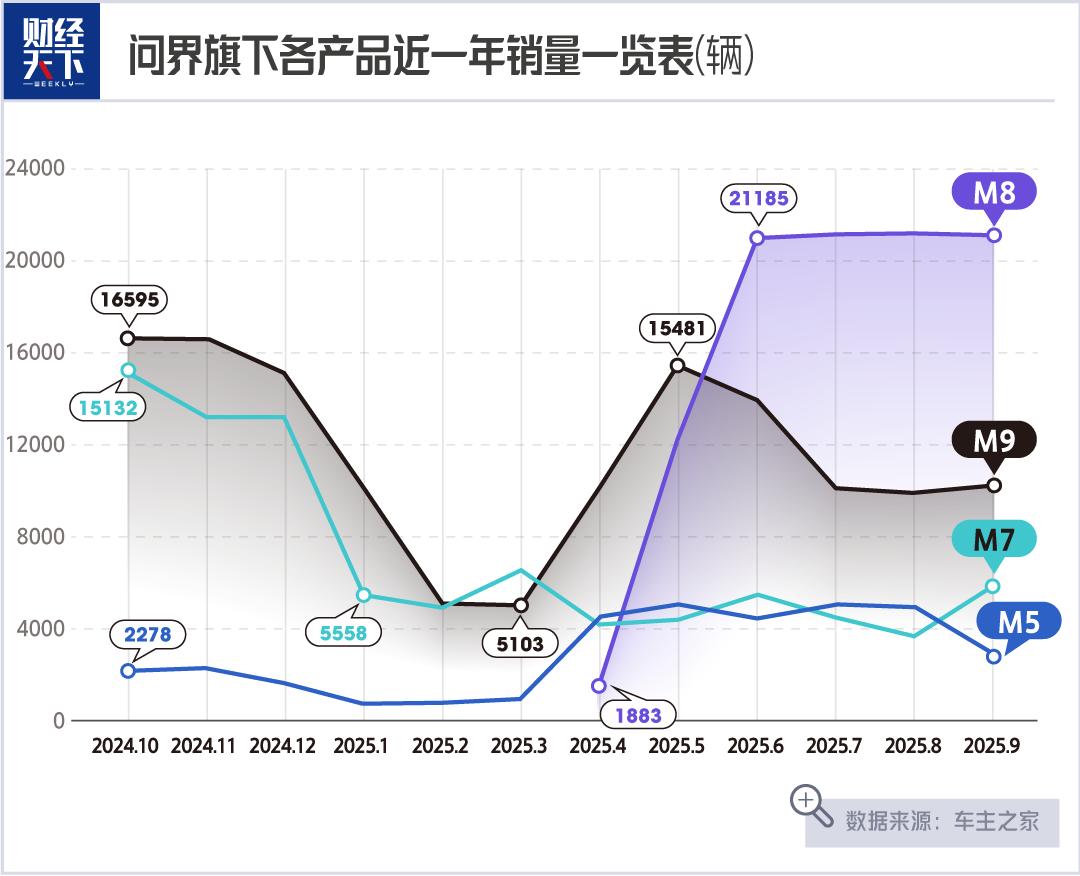
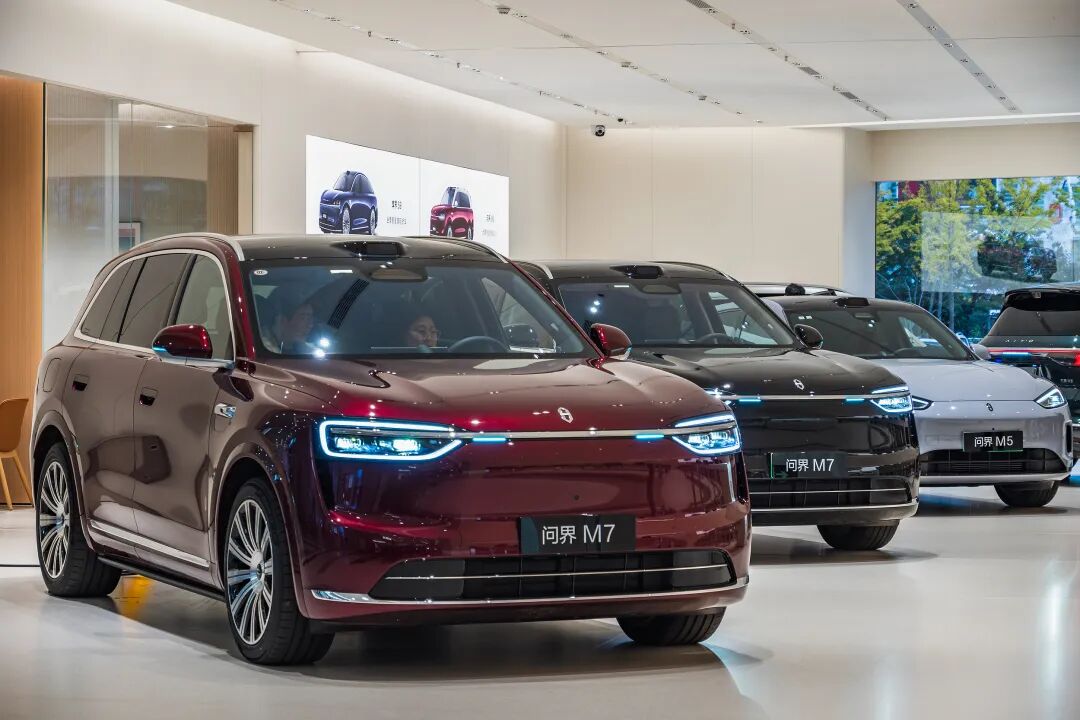
The AITO brand is the main sales driver for SERES. Currently, there are four models on sale: AITO M5 (with a guide price of 229,800 - 249,800 yuan), M7 (249,800 - 379,800 yuan), M8 (359,800 - 449,800 yuan), and M9 (469,800 - 589,800 yuan).
Among them, the AITO M5 has the most mediocre performance. In the past more than nine months, its average monthly sales volume was only more than 3,000 units. The AITO M7 could achieve a sales volume of over 10,000 last year, but its performance was mediocre in the first half of this year. After an annual facelift in September, its sales volume gradually approached 6,000 units.
The annual facelift model M9 launched in March this year and the AITO M8 launched in April this year accounted for most of the brand's sales volume in the first three quarters. This may also explain why SERES' net profit per vehicle can reach 15,600 yuan, 1.6 times that of Great Wall Motors and more than twice that of BYD.
It is worth noting that the luxury car market has limited space. Data from the Passenger Car Association shows that from 2019 to 2022, the sales volume of passenger cars priced above 400,000 yuan was less than one million. In 2024, the sales volume was 870,000, and in the first three quarters of 2025, it was 540,000. In addition, the cumulative sales volume in the 300,000 - 400,000 yuan market was just over two million. In the first three quarters of this year, the sales volume of passenger cars in this price range was 1.61 million.
Moreover, the current market for vehicles priced above 300,000 yuan is mainly dominated by mid - size and large SUVs with extended - range power. In the long run, with the maturity of pure - electric technology and the popularization of charging networks, the high - end market may accelerate its layout towards the pure - electric route. SERES, which has over - invested in extended - range technology, may face the risk of losing market share.
In addition, for AITO, the positioning and pricing of its next new model need to be very cautious. Once there is a deviation, it is easy to compete with brands such as Zhijie, Xiangjie, Zunjie, and Shangjie.
03
Attempts at Breakthrough
SERES is aware of the market concerns. In its prospectus, it directly states that if there is a significant change in its cooperation relationship with Huawei, it may have a significant adverse impact on the company's business, financial condition, and operating performance.
To address this, SERES has found two new fulcrums: one is to continue to expand overseas to find incremental markets; the other is to layout the currently popular robot track.
Specifically, the M5, M7, and M9 models under the AITO brand are planned to enter the European market. To adapt to local market regulations and brand strategies, the logo on the vehicle's front face will be changed from "AITO" to "SERES"; in October this year, the first overseas new - energy strategic model of DFSK, the mid - size SUV E5 PLUS, officially rolled off the production line at the Shuangfu Factory of SERES in Chongqing.
In addition, to improve local supply capabilities, SERES has set up a production base in Indonesia, mainly producing non - AITO brand fuel - powered vehicles, hybrid SUVs, and light commercial vehicles, covering Southeast Asia and other emerging markets, with a designed annual production capacity of about 20,000 vehicles.
From 2022 to the first half of this year, SERES' overseas revenues were 3.922 billion yuan, 4.976 billion yuan, 4.211 billion yuan, and 1.422 billion yuan respectively.
The robot track that SERES has laid out is expected to become its second growth curve.
In October this year, Chongqing Phoenix Technology Co., Ltd., a subsidiary of SERES, signed a cooperation framework agreement on embodied intelligence business with Beijing Volcengine Technology Co., Ltd. The two parties will conduct collaborative research on intelligent robot decision - making, control, and human - machine enhancement technologies for multi - modal cloud - edge collaboration.
According to Tianyancha App, Phoenix Technology was established in March 2025 and later invested in Beijing Saihang Embodied Intelligence Technology Co., Ltd., which