AI startups are caught in the collective illusion of "chasing the fastest ARR".
In the era of AI, everyone has a question: what is the moat for enterprises?
Not long ago, Bryan Kim, a partner at a16z, put forward an impressive view: momentum is the moat for AI products.
The reason he gave is that growth is so important because the development in the AI era is extremely rapid. Only by winning users' minds first can you build more traditional "moats" in aspects such as product and distribution.
Of course, not everyone agrees with this view.
Not long ago, Kyle Harrison, a partner at Contrary Venture Capital, wrote in an article that Bryan's idea is actually a bit similar to Elon Musk's. Musk once said, "Moats are not very useful. That's an old - school approach. If the only way you can defend against competition is a moat, you'll eventually be overtaken. What really matters is the speed of innovation."
However, the key difference between the two lies here. The "momentum" emphasized by the former mainly refers to revenue growth, especially the growth rate of Annual Recurring Revenue (ARR). He regards rapid growth as the most important signal in the early stage of a company.
The problem is that when people focus too much on "how fast it grows", some existing problems in the venture - capital system will be magnified: enterprises will be forced to take shortcuts, ignore long - term construction, and only pursue good short - term figures.
Here is the original article written by Kyle Harrison:
01
When Capital Only Chases the "Top 5%", the Startup Ecosystem Kidnapped by Myths
This is the classic "to a man with a hammer, everything looks like a nail". Whether it's Bryan's "I'm not interested unless you can grow your Annual Recurring Revenue from $0 to $2 million in 10 days" or Hemant's "Triple growth is outdated. You need to grow from $1 million to $20 million and then to $100 million to be interesting", they all reflect this way of thinking.
This is the mindset of those who manage multi - billion - dollar funds. They need the largest possible returns, so each company should aim for the largest possible returns to be considered interesting.
I've always thought that there is no absolutely correct way to start a business. Every founder has their own path, and as long as it is legal and compliant, there is no problem.
But what worries me is that many people are using the wrong method - with a hammer in hand, everything looks like a nail. This way may limit the growth of the next - generation companies, making it difficult for them to break through the scale bottleneck and only allowing them to stay at a "medium - sized" level, rather than growing into truly influential multi - billion - dollar companies.
You can say "aim for the moon and you might hit a star", but the fact is that the way you build a company basically determines how far it can go.
It's almost impossible to grow a company from $1 million to $20 million and then to $100 million by "playing it safe". You have to be more aggressive and efficient in every aspect, such as pricing, marketing, recruitment, and R & D. Except for a very few exceptions that can achieve a large scale with very few people, most companies often have to adopt a non - sustainable high - pressure growth method to grow rapidly.
For example, Wealthfront has been established for 17 years, and now it has a revenue of $308 million and a net profit of $123 million. It's already a very excellent company to achieve this. But in the eyes of some large - scale venture capitalists, such achievements are "not good enough" - they are pursuing "super unicorns" that can reach a market value of $10 billion or $100 billion.
The problem lies here. In reality, among all listed companies, less than 5% have a market value of over $10 billion, and those with a market value of over $100 billion are even rarer. That is to say, venture capitalists are only chasing the top 5% of extremely successful companies, while ignoring the 95% of good companies that are stable, profitable, and can create long - term value.
When this kind of thinking dominates the market, entrepreneurs start to imitate, and investors follow suit. Eventually, the ecosystem is kidnapped by the "myth of top - tier companies".
And those companies that can originally make good products, support their teams, benefit employees, and satisfy customers, that is, the enterprises that can truly support the "middle class" of the economy, are squeezed out of the stage instead.
02
Competition Is for Fools
The irony of the statement "momentum is the only moat" is that the so - called "momentum" is actually often an anti - moat.
Peter Thiel said a famous quote in Zero to One: "Competition is for fools."
Tolstoy wrote: "All happy families are alike; each unhappy family is unhappy in its own way." In the business world, it's the opposite - each successful company has its own unique way of success, achieving a monopoly by solving a problem that others haven't solved; while failed companies are surprisingly similar: they are all trapped in competition.
Now, many people are chasing "momentum", which is this kind of pointless competition. Almost every week, we can hear that a company has "achieved millions of dollars in ARR (Annual Recurring Revenue) in just a few months". It sounds exciting and immediately attracts a large number of imitators.
So everyone starts to flock into the same field: legal AI, AI code generation, AI writing, AI integration, AI orchestration... In each direction, there are companies that have "achieved $100 million in ARR the fastest". Later, some people started to pursue "achieving $1 billion in ARR the fastest".
The problem is that this kind of "momentum" often attracts more competitors and capital, rather than a more solid moat. Competition will make the already difficult - to - maintain business model even harder to establish.
For example, in the code - generation field, Cursor's ARR has reached $1 billion, and the revenues of companies like Lovable, Windsurf, and Devin have also exceeded $100 million. But most of these companies are highly dependent on Anthropic for computing resources and have to invest huge costs in sales and marketing to compete for customers. As a result, the already fragile profit margin is completely squeezed by the "momentum of competition".
The so - called "momentum", which seems to make the company run faster, may actually be an accelerator towards a cliff.
03
The "Illusion" of AI Growth
As someone commented under Bryan's post "Momentum is the only moat":
"What can grow from $0 to $2 million in 10 days can also fall back to zero in 10 days."
This sentence points out the biggest risk of momentum - driven companies - they can grow fast, but they can also fall even faster. Many over - hyped industries are like this.
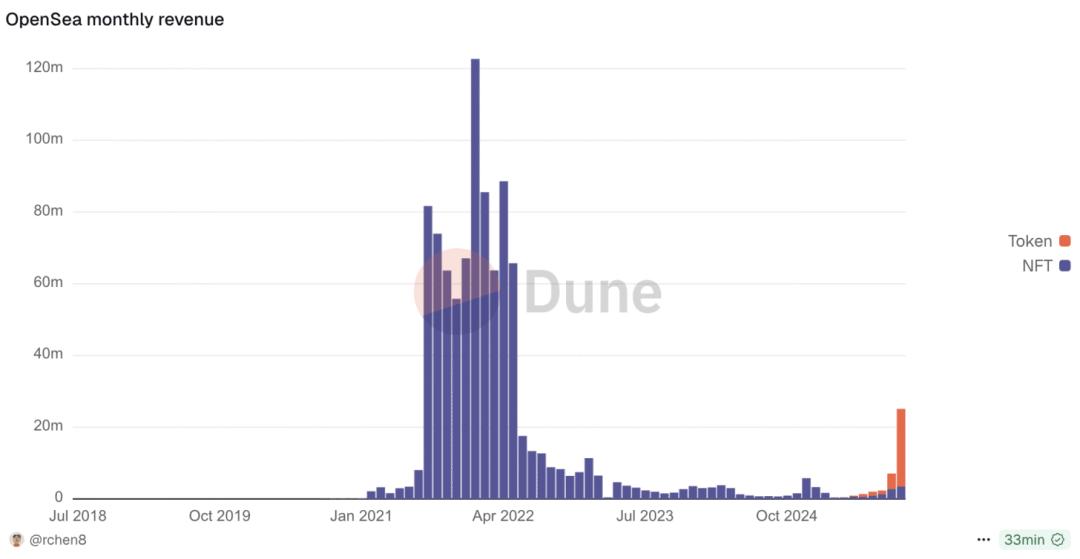
For example, OpenSea. At the peak of the cryptocurrency market in 2021, its monthly revenue was as high as $122 million, and the company's valuation soared to $13.3 billion. But once the trend passed and the market crashed, OpenSea has not been able to return to that peak.
This doesn't mean that OpenSea is a bad company. In fact, its annualized revenue is still $365 million, but it is obviously not in line with the previous valuation. And those institutions that invested at the peak have already suffered painful impairments.
Worse still, this situation is also common in today's AI industry. Many companies calculate their revenues in a "bloated" way to look like they are growing rapidly:
They include the revenues from the free - trial period in their annual revenues;
They annualize one - time project revenues;
They even sell $2 worth of services for $1 just to make the growth curve look better.
This kind of growth created by "momentum" is actually unsustainable. Investors are buying not the real value of the enterprise, but a short - term illusion.
Yoni Rechtman of Slow Ventures said an interesting thing: "It's both a marathon and a sprint."
The problem is that momentum - driven investors often only see the sprint part. By the time the finish line appears, they are already out of breath.
04
Momentum ≠ Speed of Innovation
Elon Musk said that the moat is actually not that important, and what really matters is the speed of innovation. But many people misunderstand the "speed of innovation" as "market popularity" or "growth momentum".
Alex Immerman, a partner at a16z, added very vividly: "Momentum is not a moat, but a boat." It means that momentum can take you to the island where you can build a moat, but it is not a moat itself.
In the early stage, a company relies on momentum; only when it develops to a certain scale can it truly build a moat. Even in the era of ChatGPT, the essence of these moats remains the same - they still come from switching costs, network effects, economies of scale, brand, and proprietary data. It's just that now models are easier to obtain, product components are cheaper, and the development speed is faster, but the defense logic remains the same.
The "speed of innovation" mentioned by Musk does not refer to how much you produce, but your ability to drive the innovation cycle. Many companies seem to be growing rapidly with impressive revenue data, but that is often achieved by burning money or inefficient models, and it does not mean that they really have an engine that can continuously generate high - quality innovation.
True high - speed innovation comes from better products, stronger technological breakthroughs, and teams that can quickly eliminate inefficiencies.
Even worse, now a large number of investors chasing "momentum" are actually magnifying the problem - they push up short - term momentum while covering up the risk of lacking real innovation ability.
05
Summary
When there is enough capital, it can actually cover up many problems. Every large company is scrambling to invest in those companies that "might become the next top 1% winner", for fear of missing the opportunity. So they place their bets earlier and earlier - as soon as they see a little sign of success, they will immediately pour in money.
The result is that many companies with unproven business models, unstable economic logics, and average team execution abilities can also get huge amounts of financing. With more money and attention, they can attract more talents, more capital, and more media exposure, making the originally unhealthy model look more like a "success paradigm".
Worse still, this will affect the next - generation entrepreneurs. Everyone starts to copy these routines: rapid financing, burning money for expansion, and telling stories based on short - term growth data, rather than polishing truly sustainable products and business engines.
Momentum is indeed important, but it is not a moat. What really determines the fate of an enterprise is whether it can build a high - quality, long - term sustainable innovation engine. If "chasing hotspots" is regarded as the core of growth, it will only make the entire ecosystem more and more impetuous.
In the end, the ones that will remain are still the top 1% of founders - they will create great companies whether or not there is capital to boost them. And those in the middle 50% of enterprises - not the worst, nor the best, just those short - lived companies swept up by the wave - will be forgotten by the era.
This article is from the WeChat official account "Crow Intelligence Talk", author: Intelligent Crow, published by 36Kr with permission.