DJI and Insta360 haven't yet determined the top position, but a large number of competitors are already on the way | Zhiliao
Author | Zhang Ziyi
Editor | Yuan Silai
Who is really the number one in the panoramic camera market share?
This seemingly simple question has evolved into a Rashomon-like situation.
On October 28, a report released by consulting firm Jiqian Consulting showed that the market share of Insta360 in the global panoramic camera market dropped from 92% in the second quarter to 49% in the third quarter, while DJI took 43%. In terms of revenue, DJI accounted for 66% of the entire market, becoming the number one in the global action camera segment, with Insta360 at 13%.
Subsequently, another firm, Frost & Sullivan, released a report showing that in the third quarter, the global market shares of Insta360 and DJI were 75% and 17.1% respectively. Insta360 far outpaced DJI.
Some investors inquired with Insta360 about the market share dispute, but the company did not directly respond to which report had inaccurate data. Regarding the recent price war between Insta360 and DJI, Liu Jingkang, the chairman of Insta360, responded that the price competition initiated by competitors after entering the panoramic camera market has created conditions for market expansion. Increasing the market volume through competition is the common goal of the industry.
These two reports reflect the current unpredictable nature of the market.
Before DJI launched its first panoramic camera, the Osmo 360, Insta360, with its X series of panoramic cameras, almost defined the form and usage of consumer-grade panoramic cameras. The revenue from the X series products has accounted for about 50% of the company's total revenue for many years.
However, within just 90 days of the launch of the DJI Osmo 360, it demonstrated strong competitiveness, clearly impacting Insta360's dominance.
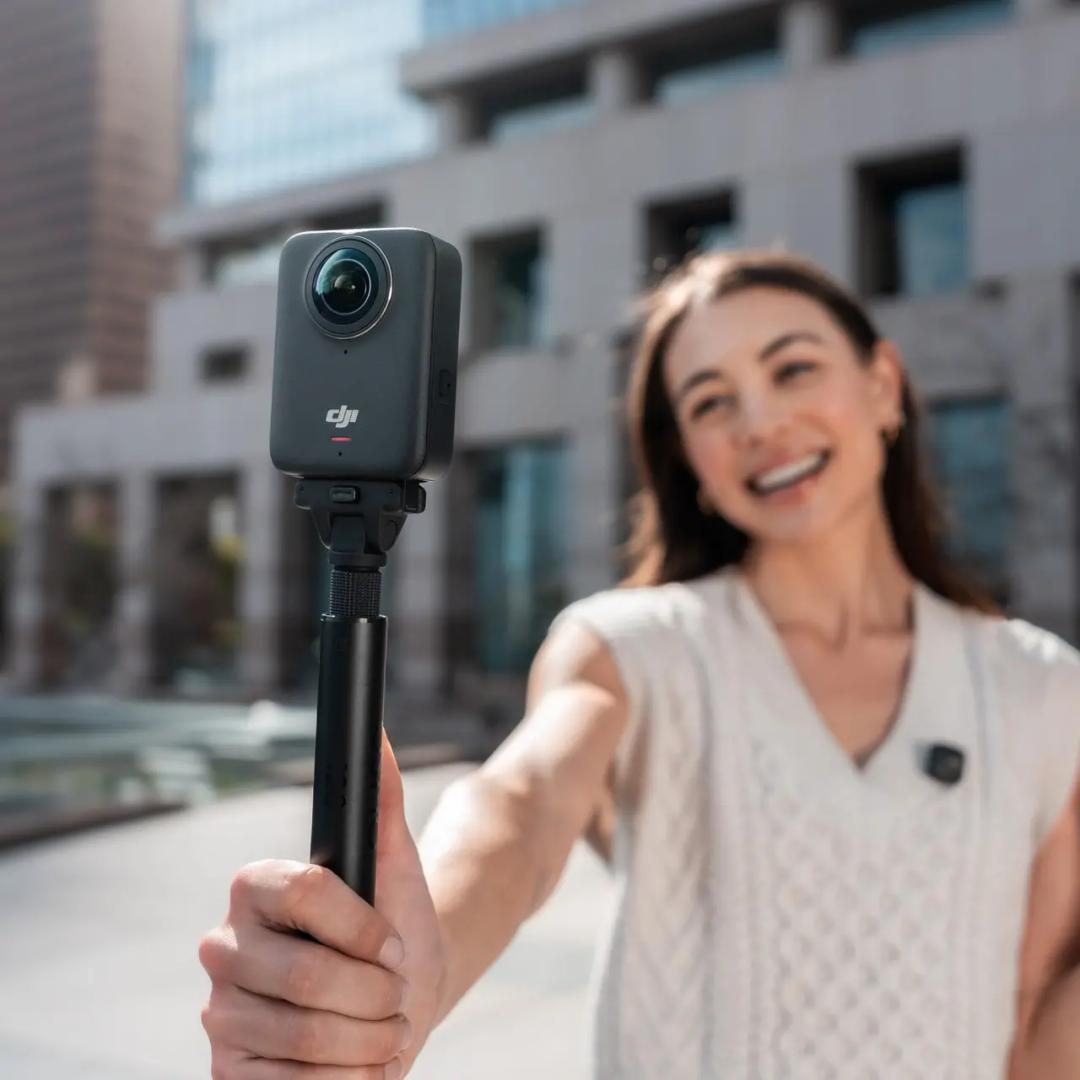
DJI OSMO 360 (Source: DJI official website)
And it is not the only competitor in the market.
According to an incomplete statistics by Yingke, in the past two years, at least seven entrepreneurs from hardware companies or Internet giants have entered the intelligent imaging track. This includes Ma Ji, a former Xiaomi executive, who founded Light Realm to develop AI imaging consumer hardware; Su Tie, the former product leader of DJI Ronin, who targeted the AI instant camera track; Photon Jump, invested in by Dreame, which launched an action camera; and Looki, founded by a former Meituan executive, which released a multi-modal AI wearable device.
The news of mobile phone giants entering the market has added fuel to the fire. OPPO and vivo have both been reported to be developing handheld gimbal cameras. Honor, in the promotional images of its AI concept phone, added a gimbal camera to the phone, which can be unfolded from the back of the phone and can take photos and videos from any direction.
These giants can leverage huge supply chains and financial resources. Coupled with the mobile phone as a natural entry point, they are capable of shaking up the market.
The global popularity of short videos has made recording and sharing the most common needs.
Since the launch of the DJI Osmo Pocket 3 nearly two years ago, it has been in short supply. Data shows that as of the end of August this year, the total sales of this product have exceeded 10 million units. Calculated based on the price of the standard version, its revenue has exceeded 30 billion yuan.
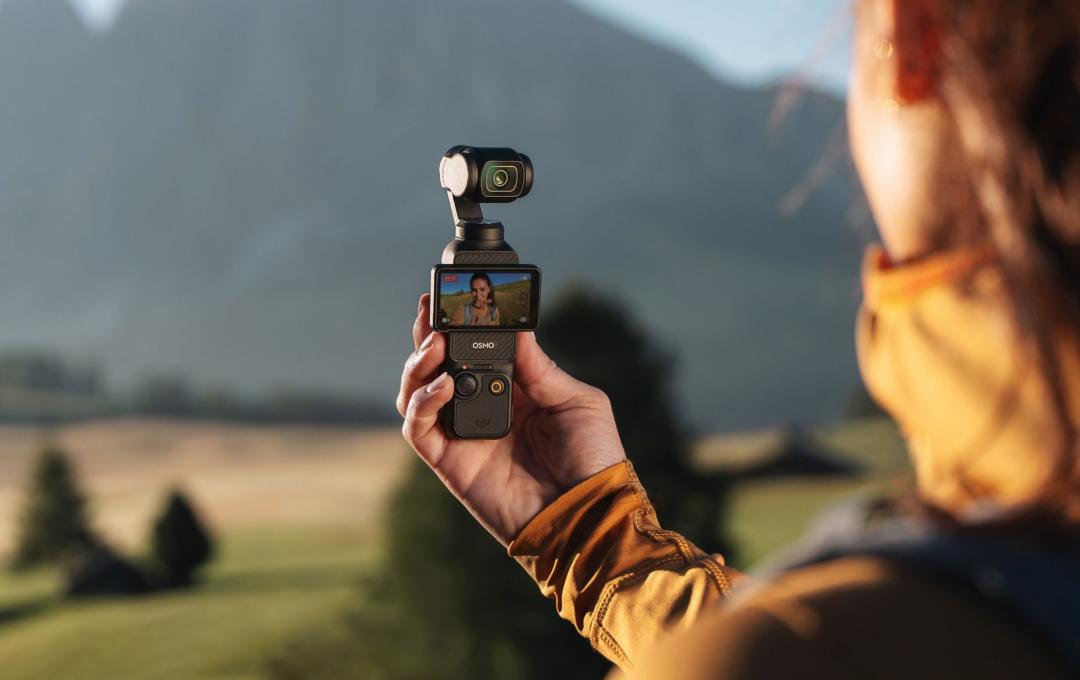
DJI OSMO POCKET 3 (Source: DJI official website)
After Insta360 went public, its market value soaring to hundreds of billions has brought the intelligent imaging track into the spotlight.
According to a calculation by Zheshang Securities, currently, there are 520 million vlog users and 220 million outdoor sports consumers globally. The annual shipment of intelligent imaging devices is 46.57 million units, with a current penetration rate of only 6%.
When the growth of the consumer electronics track is generally sluggish, any ambitious company or individual will not miss this opportunity opened up by DJI and Insta360.
The past winners are far from being able to rest easy, and the new entrants are not certain to break through the defenses. For the intelligent imaging track, an era of fierce competition has arrived.
01 Sub - needs in Niche Scenarios
Avoiding direct competition with DJI and Insta360 is a common consensus among new entrants in the intelligent imaging field.
However, completely bypassing these two giants is an impossible task. What they can do is to find niche scenarios or make distinctions in form and usage.
As Sun Yang, the founder of Looki, told Yingke in an interview: "Actually, Looki is not an action camera. It is a new category we have defined, and taking pictures might be its least interesting function."
Compared with action cameras that pursue high - definition shooting, image quality is not Looki's main pursuit. Using the camera to record daily life is the first step for Looki to integrate AI and hardware into real - life scenarios. Next, they hope to analyze this data and provide support to users in various daily scenarios.

Looki L1 (Source: Looki official website)
For example, before having a late - night snack, you can ask Looki AI how many calories you have consumed today; during a workout, attach Looki to the fitness equipment for recording, and then ask the AI at home if you have made progress; after having an argument with your child, Looki AI can help you analyze the reason and guide you on how to communicate better with your child...
The Looki team believes that the Looki L1 is an AI interaction entry centered around humans by perceiving and understanding the physical world through a wearable camera form. This is why the Looki L1 is defined as the world's first multi - modal AI wearable device.
This is a bold and interesting concept. However, after analysis, it can be found that the target user group of Looki overlaps to some extent with that of Insta360's GO series products, targeting scenarios such as tourism and parent - child activities. But due to its neck - hanging form, it can track for a longer time and may be more deeply integrated into users' lives.
Another company, XbotGo, has targeted the imaging recording needs of team sports competitions.
In the United States, more than half of teenagers participate in systematic and regular sports training. Sports training actually has a great demand for recording, not only for memory or entertainment, but also for helping participants with training and tactical analysis. Hiring a professional photographer is expensive, and the recording perspective is also limited.
Tan Kefeng, the founder of XbotGo, discovered this need. When accompanying his child to a sports competition, he found that parents taking pictures of the game had difficulty taking a stable video of a 40 - to 50 - minute game with a mobile phone without shaking, and they could not capture the exciting scoring moments on the field in time.
Based on this, XbotGo designed a product that combines a "universal gimbal + mobile phone computing power", which is mainly optimized for the sports field scenario. Take the XbotGo Chameleon as an example. This product is suitable for sports scenarios such as basketball, football, and ice hockey. Combining a mechanical gimbal and AI prediction algorithms, it ensures a stable and smooth picture and supports target tracking shooting within a range of 1 - 100 meters. The APP provides one - click live streaming, AI automatic editing, and remote control functions.
In comparison, Photon Jump's products seem to be more confrontational with the giants. However, its chosen entry point is AI.
At this year's IFA exhibition, Photon Jump released its action camera product. The biggest highlight of this product is that through natural language processing technology, it can parse fuzzy semantic instructions and predict user intentions. Users only need to say "Capture this wonderful moment" or "Make this video more cinematic", and the camera can accurately respond and execute.
"The exciting part of the imaging product track is that the form of the product is not fixed. There are a wide variety of video - shooting devices. AI can be incorporated, as well as image transmission technology and the technologies used in the drone industry." Yuan Qian, the CEO of Photon Jump, told Yingke.
Indeed, the form of cameras has remained the same for decades. Just in the category of handheld intelligent imaging devices alone, countless products have emerged. Its form and function are far from reaching the stage where innovation stops. This is also what Liu Jingkang has repeatedly mentioned as the "open world" - seemingly monolithic, but actually full of opportunities for innovation.
02 Can Mobile Phone Manufacturers Change the Market?
During the two - year period when the DJI Osmo Pocket 3 was extremely popular, mobile phone manufacturers did not pay much attention to handheld gimbal cameras.
At the end of September, Jiemian News reported that OPPO has initiated the project of intelligent imaging products, which will compete with products led by GoPro and DJI in the handheld intelligent imaging device market. Vivo launched a project for a handheld gimbal camera at the end of last year, involving more than 200 people.
Mobile phone manufacturers have never slackened in the field of "shooting" over the years.
If we look at the technological updates of mobile phone manufacturers in the imaging track over the past three years, they mainly focus on parameters, cooperation with high - end camera manufacturers, or more expensive, high - end, and exclusive hardware.
This has been a practice that has continued for many years. Updating photography parameters and improving capabilities are always the highlights of product launches.
In 2023, OPPO announced that it invests more than 1 billion yuan in imaging every year, with a team of more than a thousand people. All leading manufacturers dare not slack off because the performance of photography and videography is the key factor attracting users to change their phones.
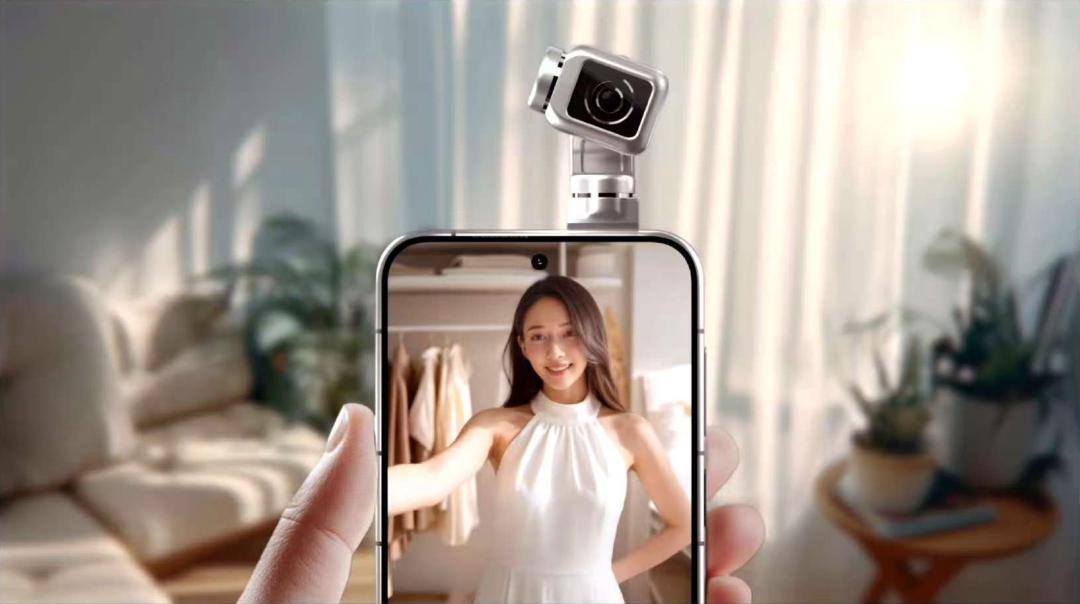
Honor ROBOT PHONE (Source: Honor product launch)
Since mobile phones disrupted the camera market, manufacturers have never come up with new ways to use imaging devices.
However, while mobile phone manufacturers were pouring money and manpower into algorithm development and chip manufacturing, the DJI Pocket 3 emerged.
The DJI Pocket 3 has grown along with the popularity of Xiaohongshu. Although it seems to have a low entry barrier, due to many ingenious designs, it not only sold out quickly but also generated extremely high profits. When the net profit margin of mobile phone manufacturers' hardware is less than 5%, the DJI Pocket 3, with its light and flexible form, demonstrated a money - making ability like a printing press.
Its rise is a classic example of "disruptive" innovation: it does not enter the existing market to compete with the leaders but directly creates a new usage habit and attacks existing players from another dimension.
The market value of Insta360 reaching hundreds of billions after going public has further stimulated mobile phone manufacturers.
Just as short - video platforms took away users' time from WeChat when they first emerged, mobile phone shooting is no longer the only option for consumers. The existence of gimbal cameras and action cameras, which were originally supplements to mobile phone shooting, will further affect some people's enthusiasm for changing phones as mobile phone shipments decline.
In a sense, mobile phone manufacturers entering the handheld imaging track is more of a defensive move than an offensive one.
The possibility of innovation in intelligent imaging devices and the penetration rate of less than 10% in the imaging device track are alluring but also full of competition.
03 A Business with a Low Entry Barrier
To date, it is not difficult to develop a basic imaging device product in the Pearl River Delta region.
Take the intelligent bird - watching feeder product as an example. It is a quite popular emerging category overseas. Wei Mingzhi, an entrepreneur in this industry, told Yingke that it only takes two to three months to assemble an intelligent bird - watching device in the Pearl River Delta.
"There are five or six large suppliers of lens modules alone; for chip design, you can find a solution provider, and they will solve the problem of product software and hardware adaptation. Factories can't do this, but solution providers can; for the shell of the bird - watching device, you can find a common mold. Every step of the entire industrial chain has different people specializing in it. As long as you find the right people, you can assemble the product." Wei Mingzhi said.
Yingke learned that most of the lenses used in intelligent bird - watching devices are evolved from security lenses. Many domestic security product companies have switched to producing intelligent bird - watching feeders after facing over - capacity and declining sales.
This is one side of the redundant Chinese industrial chain. The most expensive intelligent bird - watching feeders sold on Amazon do not exceed $200, and products priced at dozens of dollars flood the Amazon platform.
Of course, it is more difficult to manufacture imaging device products with brand influence and price competitiveness overseas like DJI and Insta360.
Zheshang Securities found that the optical module of intelligent imaging devices accounts for more than 50% of the cost, including chips, sensors, lenses, and software. Chips and sensors are mainly supplied by overseas suppliers, while lenses have achieved domestic substitution. The difference in hardware mainly lies in the supply chain, and the difference in intelligent imaging devices lies more in software algorithms.
This is also the view expressed by several intelligent imaging entrepreneurs in interviews: every component of the product can be produced or even customized by a suitable factory, but the core performance of the product, including image quality, heat dissipation, and anti - shake, can only be achieved through algorithms. Hardware is the foundation, and the combination of software and hardware can build a real barrier.
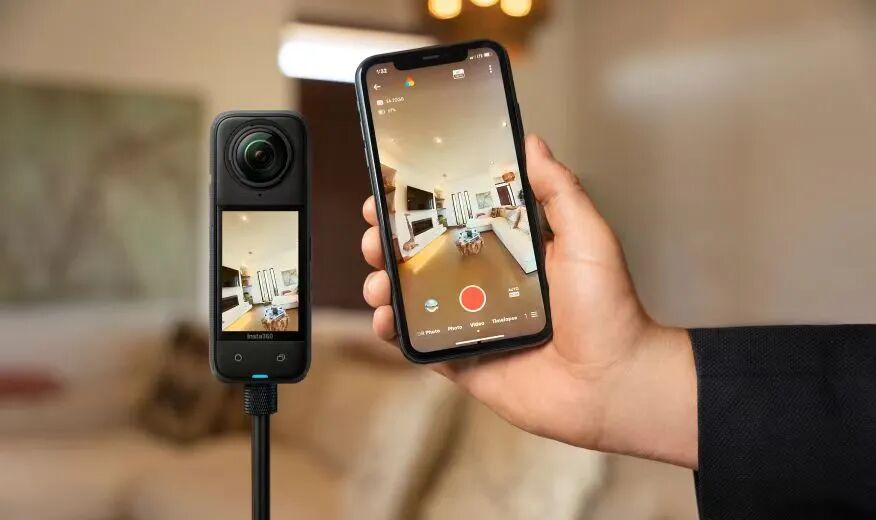
Insta360 X5 (Source: Insta360 official website)
In fact, Insta360 stated in its latest investor relations activity record that more and more consumers are choosing Insta360 because of its differentiated advantages, including the hardware design of replaceable lenses and exclusive software functions such as panoramic cloud storage and AI automatic editing. These are the core competitiveness of Insta360 in the panoramic camera field.
DJI also has its own significant "moat". Thanks to years of technological accumulation and proficient technology reuse, the electronic anti - shake technology of DJI's Action series action cameras is directly transplanted from the three - axis gimbal algorithm of drones, which can not only achieve anti - shake effects but also provide a smooth picture similar to that of a three - axis stabilizer during handheld shooting.
It can be said that even if mobile phone manufacturers want to enter the market, it will not be easy.