A Shenzhen hardware company develops AI companion robots, secures investment from HSG, and exceeds one million users | Insight Global
Editor's Note: As going global becomes an increasingly core strategy for Chinese companies, how to conquer the global market has become an extremely professional topic. In the evolution of globalization, many Chinese brands have stood at the forefront. In view of this, Yingke has launched the "Insight Global" column to explore the cutting - edge directions and opportunities for Chinese brands to go global from the perspective of brand growth and change, providing inspiration and food for thought for companies going global and the industry.
This is the 53rd issue of our column. In 2018, when the companion robot track was just taking shape, Enabot Technology launched its first product, the EBO S, starting from pet companionship to solve users' pain points in remote monitoring and interaction. After the product was launched, it unexpectedly tapped into the vast market of human emotional companionship. The team integrated large - model AI dialogue and multi - modal emotional interaction technology on the basis of mobile monitoring capabilities to enhance the real companionship experience. Currently, the products have entered more than 160 countries around the world, with over one million users.
Author | Huang Nan
Editor | Yuan Silai
When a group of employees from large companies left their jobs to start a business, the companion robot field was not yet very popular. However, they were already convinced that it would become a market with millions or even tens of millions of users.
In 2018, they founded Enabot Technology in Shenzhen. Since many team members were pet owners and couldn't find a satisfactory pet companion robot when they were away from home, Enabot decided to enter this field.
Soon, there were key breakthroughs in perception algorithms, multi - modal interaction, and indoor navigation technology. The Enabot team saw a clear path to turn their ideas into reality. In December 2019, Enabot launched its first mobile robot product, the EBO S, with a round, tumbler - like shape. It has the function of full - house mobile monitoring and can crawl under various furniture to find hiding pets.
This product performed well in the early stage, raising more than 2 million yuan on an overseas crowdfunding platform. However, it was far from being a hit.
Just as the NVIDIA GPU couldn't have predicted that it would be widely used in AI computing decades later, the turning points for many companies come unexpectedly. Enabot soon discovered something peculiar.
After the EBO S, initially positioned as a "pet companion robot", was launched, users quickly discovered many scenarios far beyond its preset functions. The children of elderly people living alone can use it to remotely understand their parents' living conditions; for toddlers in the most active stage of babbling, the EBO S can act as an "electronic nanny" for real - time monitoring; long - distance couples can also use it to achieve remote companionship.
They quickly responded by starting to develop home robot products such as the EBO X in addition to the pet companion product EBO S, further focusing on the care of the elderly and children.
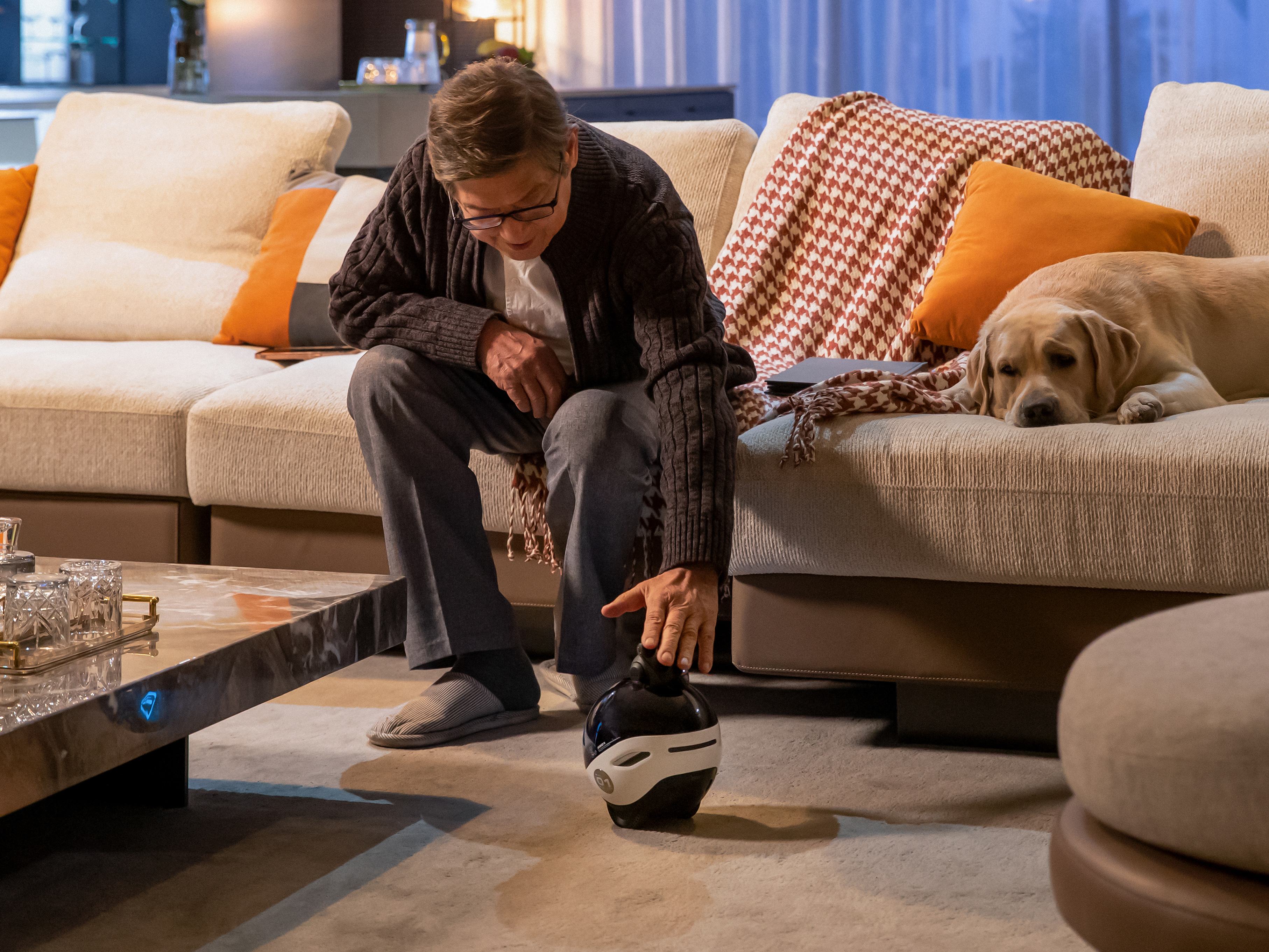
Enabot's home robot product, the EBO X (Source: Company)
As of September 2025, Enabot's global user base has exceeded one million, and its products have entered more than 160 countries and regions around the world. Before that, the company had received multiple rounds of financing from leading institutions such as Sequoia Capital, Longfor Capital, and Jihe Ventures.
MarketsandMarkets predicts that the global market size of emotional companion robots may exceed $10 billion in 2027, with a compound annual growth rate of over 17%. Among them, the category with mobile capabilities and emotional interaction functions will be the fastest - growing segment.
In an era that values emotional value, companion robots may become more deeply integrated into people's lives. However, due to the subtle and changeable nature of human emotions, companies need to have more respect.
From Pet Companionship to Human Companionship
In the field of companion robots, there are significant differences between the core needs of pet companionship and human companionship. Tong Shaonan, the brand manager of Enabot, told Yingke that pet companionship focuses more on the dual requirements of "monitoring + interaction", while human companionship emphasizes emotional resonance and scenario adaptation. Therefore, the directions of functional design, user experience optimization, and R & D iteration for related products also differ.
In the past, in the pet companionship scenario, users faced pain points such as limited perspectives in remote monitoring and one - way interaction.
Although traditional monitoring devices can present the real - time status of pets, their functions are limited to observation and cannot initiate interaction with pets actively. When a pet remains stationary for a long time, traditional monitoring devices also have difficulty effectively addressing implicit needs such as "whether it means there is a health problem" or "whether the pet is bored at home alone".
Robot technology has precisely solved this pain point. To address users' anxiety about being unable to interact with their pets in real - time, Enabot has integrated interactive modules that pets like, such as laser pointers and cat wands, into its pet companion robots based on their mobility and perception systems. It has developed functions such as remote - controlled touch and guiding pet activities. Even when users are away from home, they can use the app to remotely control the robot to actively interact with their pets.
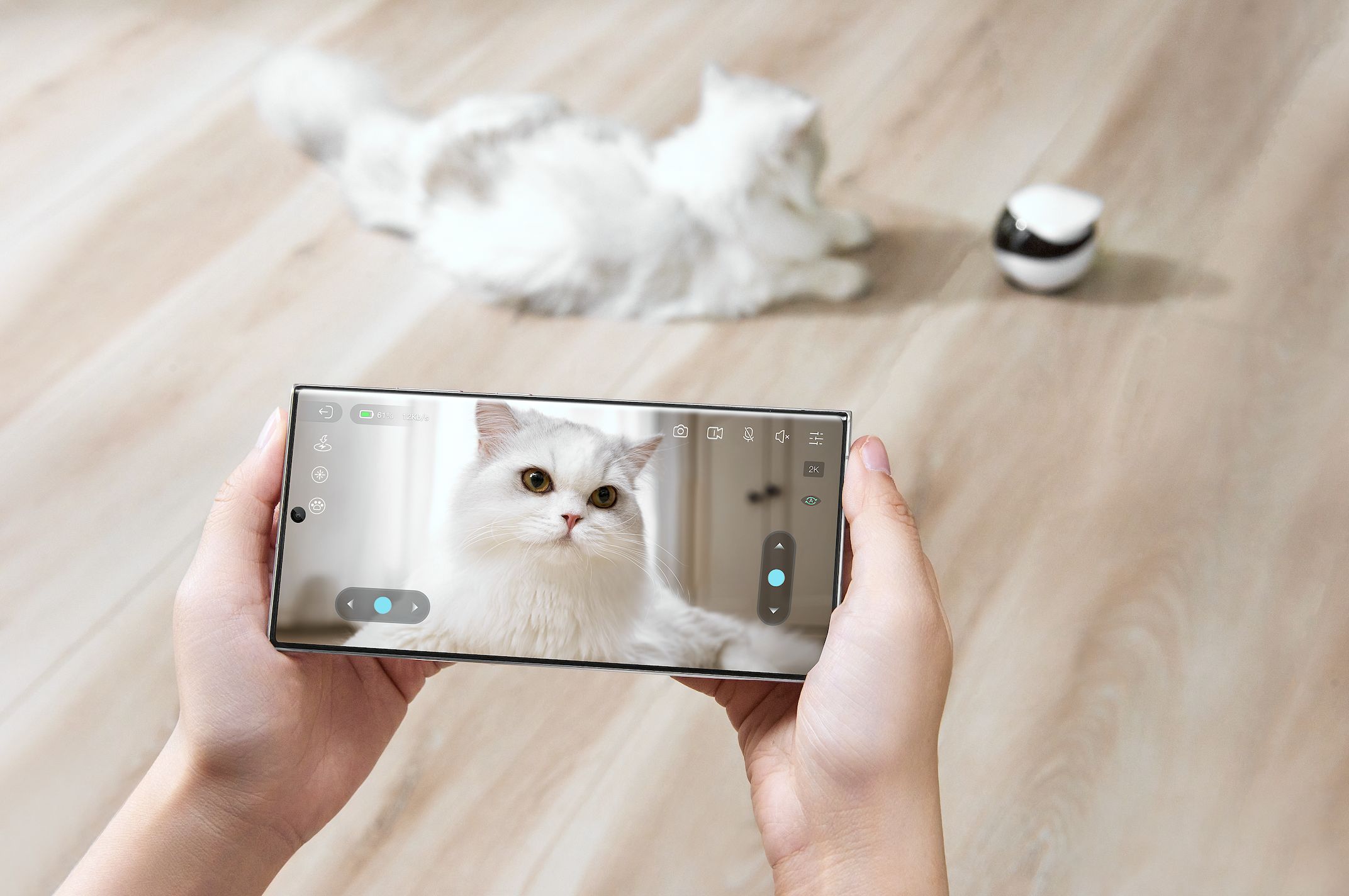
The remote interaction function of Enabot's pet companion robot (Source: Company)
In contrast, in the human companionship scenario, the product design logic has changed, shifting from solving functional problems to meeting emotional needs.
Humans' expectations for companionship go far beyond basic information transmission or security monitoring. They long for real - feeling, resonant interaction experiences.
This means that robots must have stronger emotion perception and natural interaction capabilities.
"We not only need to build a real sense of companionship through voice, expressions, and conversation content, but also must consider the wide age range of users to ensure that the operation is simple enough," Tong Shaonan explained to Yingke. "Any complex learning process will disrupt the natural and smooth emotional connection."
In terms of functional architecture, Enabot has adopted a design scheme of "practical functions + emotional companionship". On the one hand, it provides practical functions such as security patrols and event reminders through its autonomous mobility and environmental perception capabilities; on the other hand, with the help of AI emotional algorithms and anthropomorphic interaction, it can recognize users' faces, initiate reminders at regular intervals, provide entertainment content, initiate video calls, and even indirectly relieve users' anxiety by interacting with pets.
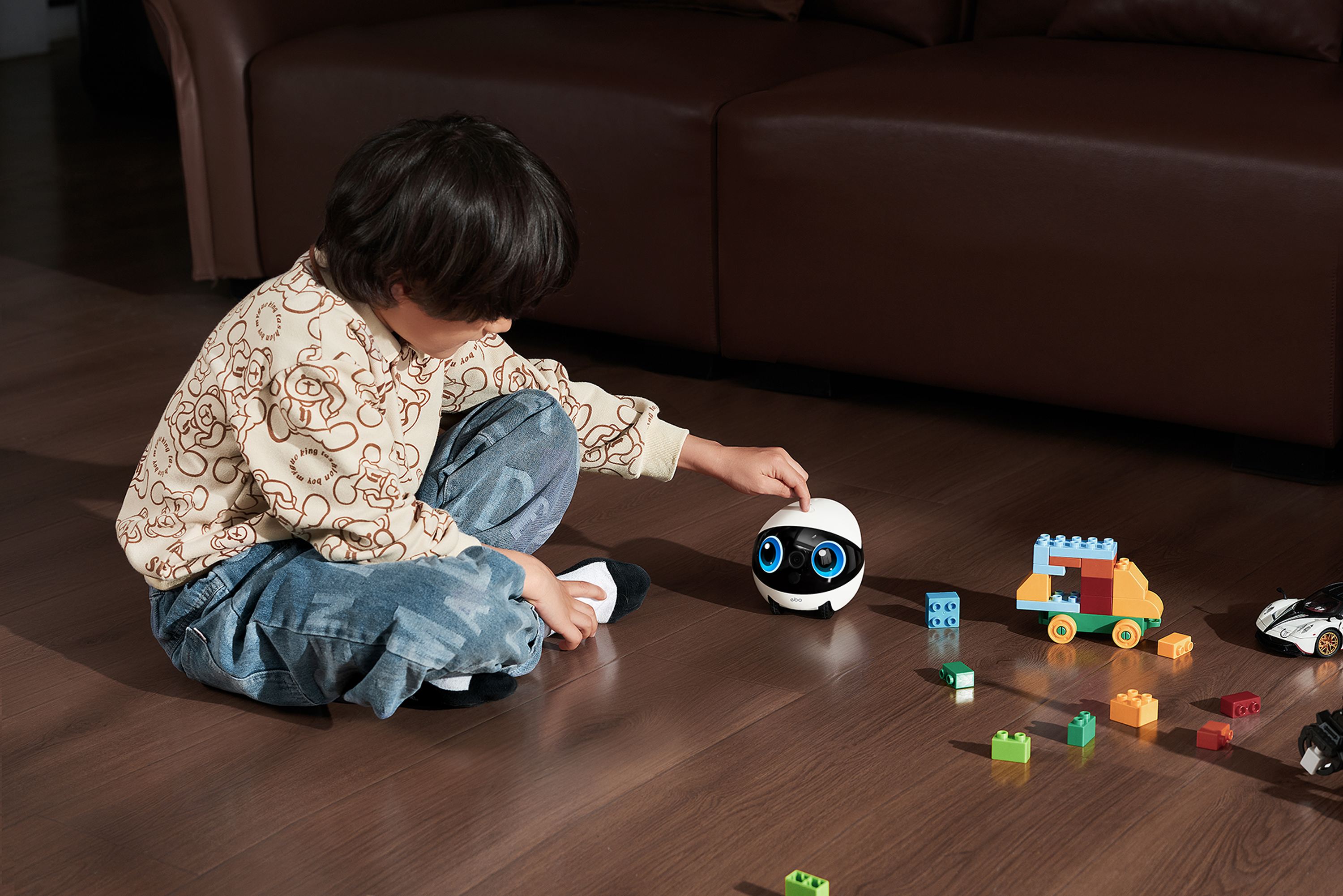
Combining practical functions and emotional companionship (Source: Company)
To break users' inherent impression of robots as "mobile monitors", Enabot has focused on strengthening the dialogue ability and role diversity of large - model AI. Its home companion robot products are equipped with multiple large - model assistants, supporting six - role switching and offering more than 20 dialects and local accents, such as those from Beijing, Henan, and Guangdong.
The evolution of consumer - grade companion robots follows a clear path. However, with the rapid growth of the market, the competition in this field has become fierce even before it has fully matured.
In the view of the Enabot team, in this situation, companies need to strike a balance between functional design, form structure, and cost control to avoid falling into homogeneous competition.
Therefore, Enabot's technological iteration is relatively rational and does not aim to stack a large number of AI functions. "If a brand blindly introduces AI technology but the product is out of touch with the user experience, resulting in a rigid and jerky interaction, it will be difficult to build an emotional resonance with users," Tong Shaonan said.
Whether it is solving the problem of pet companionship or pursuing a combination of practical and emotional value in human companionship scenarios, Enabot's goal has always been clear: to go deeper and more detailed in specific scenarios. This also represents the breakthrough strategy of some hardware companies today, focusing on doing simple functions thoroughly rather than aiming for comprehensiveness.

Enabot's robot production workshop (Source: Company)
"Electronic Doppelgänger" vs. Virtual Friend
In the social landscape of the post - pandemic era, the "loneliness economy" is expanding at an unprecedented pace. According to Statista research data, more than 60% of urban single - dwellers around the world say they need non - human companions to relieve their loneliness.
From providing companionship for young single people, to safeguarding the health of empty - nesters, to soothing the emotions of urban white - collar workers, when offline interactions become uncertain, companion robots have become a new way of emotional connection.
Interestingly, when companion robots enter the global market, different cultural backgrounds are shaping the diverse needs and expectations of users for companion robots.
For example, in the East Asian market represented by China, the positioning of companion robots goes far beyond that of ordinary smart devices and is given the deeper expectation of being a "family emotional bond".
This positioning stems from the unique family structure and emotional patterns in East Asian societies. According to Enabot's user research profile, complex families such as dual - income families with children and families with relatives living in different places are the core user groups. Their core demand for the product is to break through the spatial barrier, achieve a "sense of remote co - presence", and complete delicate emotional expressions.
Therefore, Enabot has designed some functions with a strong sense of ritual. When a family member living in a different place has a birthday, users can remotely control the Enabot robot's eye lights to play pictures to convey blessings; its custom - expression function also allows users to interact with their parents using cute text and dynamic patterns. These interactive designs precisely fit the high - frequency and intensive family interaction patterns in East Asian societies.
The European and American markets present a completely different demand picture. Foreign users value the anthropomorphic interaction and emotional resonance capabilities of robots more and regard them as "electronic pets" or "virtual friends".
Tong Shaonan told Yingke that European and American users prefer low - intrusion companionship, that is, contact with a sense of boundaries. They want to feel the presence of the robot but do not want to be disturbed by frequent interactions. This difference in demand stems from both the emphasis on personal space and the relatively independent family structure.
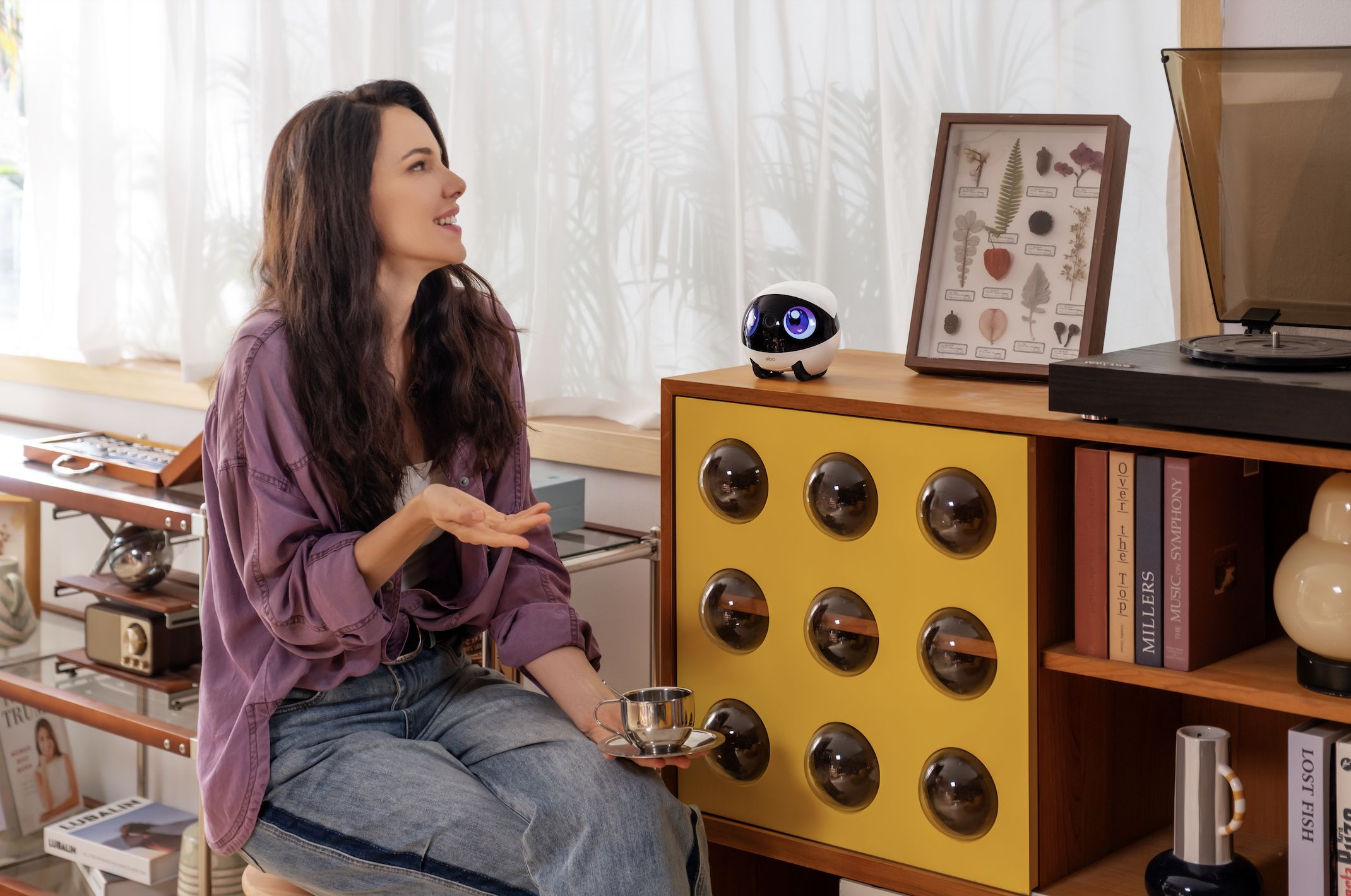
European and American users pay more attention to anthropomorphic interaction and emotional resonance capabilities (Source: Company)
In practical use scenarios, the Enabot robot is more like a "restrained intelligent butler".
In terms of practical functions, it is a reliable mobile security guard. The robot can monitor environmental changes in standby mode, remind users when it detects abnormalities, and conduct secondary checks, effectively improving the passive viewing nature of traditional fixed monitoring devices.
In terms of in - depth companionship, users expect the robot not only to remember their preferences and adapt to their personalized communication rhythm but also to be a partner for co - creation, such as jointly conceiving a story framework or designing simple interactive games.
Meanwhile, European and American users show a distinct tendency to solve problems independently. When the device malfunctions, they prefer the robot to detect the problem through its self - diagnosis function and attempt self - repair, only uploading necessary logs to the specified platform.
This "minimal human intervention + closed - loop data flow" model not only meets users' demand for the independent operation of the product but also strengthens privacy protection by reducing data interaction links.
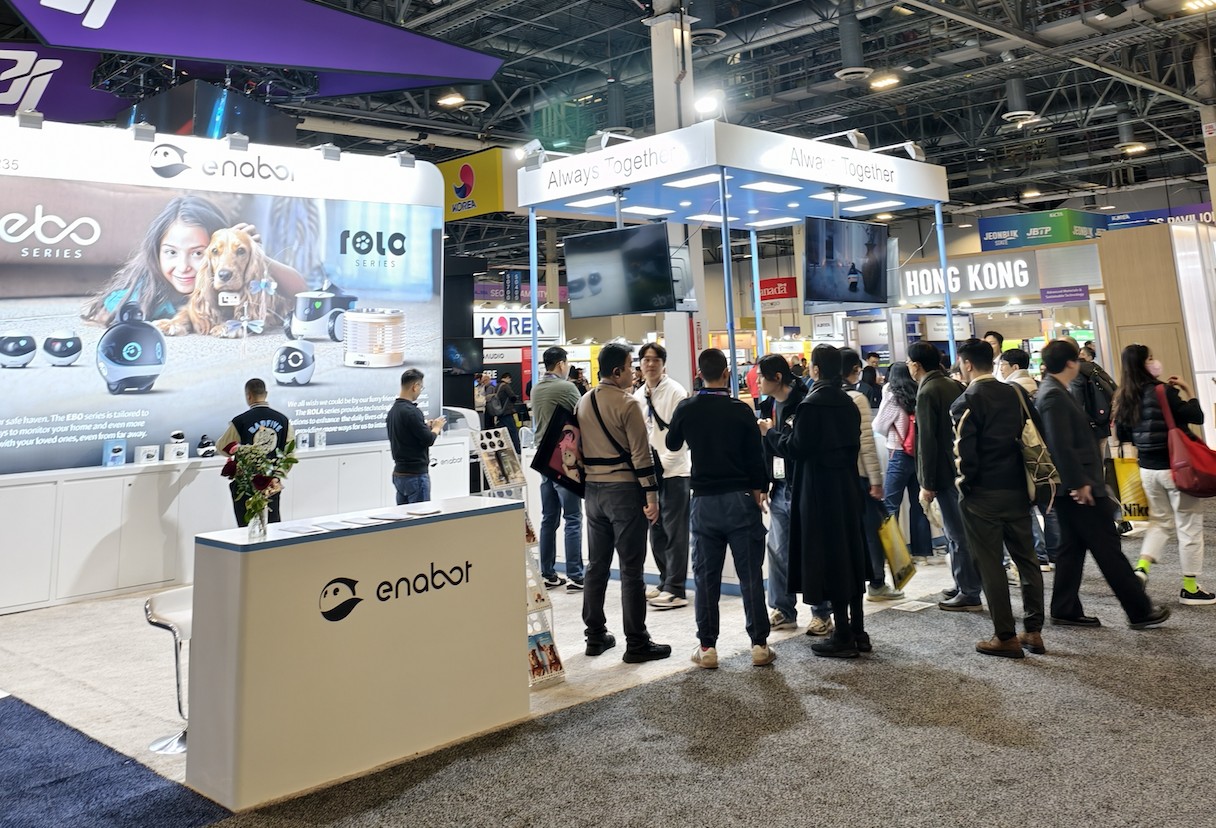
Enabot's products at an overseas exhibition (Source: Company)
The essence of companion robots is always "the embodiment of relationships". Looking at the global market, they not only carry on family emotions but also reflect respect for personal space. Behind these differences lies a deep understanding of users' pain points.
Currently, the industry is at a critical juncture of transformation from "instrumental rationality" to "emotional value". The development of companion robots is no longer limited to functional iteration or technological breakthrough but has shifted to a deeper value reconstruction - how to make technology better serve human emotional needs and how to find the right balance in human - robot coexistence.
In this process, Enabot's rapid rise has proven an effective development path. From solving functional pain points to meeting emotional needs, companies that can accurately grasp users' real needs will gain an advantage in future market competition.