Chinese astronauts no longer eat pre - made meals. They are roasting chicken wings in space.
In November 2025, a scene full of "the smell of life" took place in China's space station, Tiangong.
The crew of Shenzhou-21 brought a new device - a hot air baking machine. After meeting up with their "comrades" from Shenzhou-20, they couldn't wait to unpack the marinated chicken wings, fix them on a special skewer rack, and put them into the machine.

The raw chicken wings are still shaking in a weightless state | Xinhua News Agency
28 minutes later, when the astronauts ate that plate of sizzling and fragrant Orleans roasted chicken wings, a historic moment was born.
This marks the first historic leap from "heating" to "cooking" in China's space station, and it is also the first time in human history that people have truly cooked and eaten in space.
To understand why the smell of roasted meat is so precious, we have to go back to the era when astronauts could only "eat dry rations".
It took us twenty years to go from cold meals to hot meals.
The Chinese astronauts' space dining table started in 2003. During Yang Liwei's 21 - hour flight, he ate packaged ready - to - eat foods and drinks.

He also ate a mooncake to fit the occasion | Weibo @ Our Space
Two years later, Shenzhou-6 achieved a historic breakthrough: astronauts could eat hot meals and drink hot beverages. Later, popular Chinese home - cooked dishes like fish - flavored shredded pork and Kung Pao chicken were also packed in vacuum bags and sent into space.
Entering the space station era, the astronauts' menu is even more luxurious. More than 190 kinds of dishes are served in rotation, and there is even a special "space kitchen" equipped with a food heater, a water dispenser, and a refrigerator that can store fresh apples. It can be said that we have perfectly solved the problems of "eating enough" and "eating well".
But there is a key difference here: "heating" and "cooking" are two completely different concepts.
Heating is a purely physical process. All previous space dishes were fully cooked on the ground and then specially processed and packed. What astronauts do in space is just the last step of "reheating", which is what the hot air heating device used in the Tiangong space station does.

Chinese astronauts mainly eat reheated pre - made dishes | Xinhua News Agency
While cooking involves not only physical reactions but also chemical reactions. The high temperature of 190°C causes the Maillard reaction between proteins and sugars in food, producing a crispy crust and rich flavor. This is the transformation from raw materials to finished products, which is real cooking.

The sizzling and fragrant roasted meat is completely different from simply heated food | Soogif
This desire for freshly cooked meals is not just about satisfying one's appetite.
Astronauts have to stay in the enclosed space station for several months or even half a year, facing the same cabin walls, the same instruments, and the same packaged foods day after day. Roasting a plate of sizzling chicken wings with their own hands is not just an added bonus but a necessity. In the words of the China Astronaut Research and Training Center, this is a key factor in ensuring the mental health of astronauts during long - term on - orbit stays.
To trigger the fragrant Maillard reaction, a sufficiently high temperature and a specific heating method are required. In space, this is as difficult as climbing to the sky (although going to space is already like climbing to the sky).
The first hurdle: In a weightless world, "heat" won't move on its own.
Why is it so difficult to roast food in space? First of all, the laws of physics are playing a trick on us.
On Earth, when you turn on the oven, the heating tube heats the air below. The hot air becomes less dense and naturally rises; while the cooler air above, which is denser, sinks. This back - and - forth movement forms an air circulation called "thermal convection", which is like an invisible hand gently baking every corner of the food evenly.

The air convection in the oven can efficiently roast food | Soogif
But in the microgravity environment of the space station, there is no gravity, so there is no difference between "up" and "down", and no concept of "light" and "heavy": The heated air won't rise on its own. It will just lazily stay near the heating tube, forming a stagnant hot air mass. As a result, the heat transfer efficiency in the oven becomes extremely low, and the food can only be heated slowly mainly by thermal radiation, which is like "exerting power from a distance".
How exaggerated is this phenomenon? In 2019, astronauts on the International Space Station conducted a famous experiment: baking cookies.
They used a special space oven and put the chocolate chip cookie dough that had been tested countless times on the ground into it. On the ground, these cookies only take 18 minutes to bake; but in space, the first cookie was baked for 25 minutes and was still raw when taken out. The astronauts didn't give up and kept extending the baking time. It wasn't until the fourth cookie, which was baked for a full 120 minutes, that is, two hours, that it was barely cooked.

The cookie - baking experiment in 2019 | PA Media
So, as you can see, without thermal convection, it is a huge physics problem to roast food evenly and efficiently in space.
The second hurdle: Deadly lampblack, the "invisible killer" in an enclosed space.
Well, even if we don't care about the time cost and just roast the food slowly, it still won't work. A more dangerous problem arises: lampblack.
Roasting a dough containing only sugar and butter may only produce some aroma. But when roasting chicken wings or steaks, at high temperatures, the fat will decompose and atomize, producing a large amount of lampblack particles. In a kitchen on Earth, we turn on the range hood and the lampblack is sucked away. But the space station is an enclosed ecological system isolated from the outside world with 100% internal air circulation. Here, any trace of lampblack is a disaster.
These tiny lampblack particles will never settle due to gravity. They will float to every corner of the space station, being everywhere like ghosts. They will clog the air filters in the life - support system, which are more precious than gold, and cause the entire system to malfunction. Even more terrifying, lampblack contains a variety of harmful and even carcinogenic chemical substances. Once the air inside the cabin is polluted, it will pose a huge threat to the health of astronauts.
So, the biggest challenge in space cooking has never been how to generate heat, but how to completely control the exhaust gas and residues generated during cooking.
Chinese wisdom: Incorporating a fan and a range hood into the oven.
Facing these two major problems, this "hot air baking machine" in China's Tiangong space station provides a genius solution.
First of all, the answer to the problem of the disappearance of thermal convection is in its name: "hot air". The engineers installed a fan inside the oven. Since the air won't move on its own, they use the fan to force it to move.
This heated air forms a forced circulation inside the enclosed oven, actively and evenly blowing over every surface of the food. In this way, through engineering means, the effect of thermal convection on Earth is violently simulated under microgravity. That's why it only takes 28 minutes to roast a plate of chicken wings instead of two hours.
For the deadly lampblack problem, our engineers came up with an ingenious idea: They built a range hood directly into the oven.
When this oven is working, the inside is a completely enclosed circulation system. The lampblack generated during baking has no chance to escape into the space station and is sucked into a sophisticated purification device by the built - in fan.
Here, the lampblack first undergoes "high - temperature catalysis", which is a bit like the exhaust gas purifier in a car, breaking down harmful organic substances into harmless carbon dioxide and water. Then, the gas passes through multiple layers of filters to completely remove solid particles like PM2.5. Finally, only clean air is allowed to return to the oven for the heating cycle.
At the same time, to prevent food and gravy from floating around in the weightless environment, there is also a special skewer rack and a residue collection device inside the oven.

The final appearance of this baking machine is quite beautiful and simple | China Daily
It can be said that this machine is no longer just a simple oven. It is a miniature space cooking workstation that integrates forced thermal circulation, air purification, and waste management.
Can we eat Mapo Tofu in space?
Since "roasting" has been achieved, is it still far from the essence of Chinese cuisine, such as "steaming, boiling, frying, and stir - frying"? The answer may be a bit disappointing: It is very far away, even several orders of magnitude more difficult than roasting.
Take "stir - frying" for example.
The essence of stir - frying lies in a hot pan and boiling oil. But in a weightless environment, the oil won't stay at the bottom of the pan. Due to surface tension, it will "climb" all over the inner wall of the pan. When you put the vegetables in or try to toss the pan, countless boiling oil droplets will instantly explode, turning into thousands of "high - temperature bullets" floating in the air, which are devastating to astronauts and precision instruments.
Another example is "steaming" and "boiling".
These two methods seem safe as they only use water. But what will happen if you suddenly open the lid of a steamer or a soup pot in an enclosed space station? A huge amount of high - temperature steam will instantly pour into the cabin, which is equivalent to detonating a "steam bomb". It will immediately overload the humidity and temperature of the entire space station, paralyze the precise air circulation system, and may even cause water droplets to condense on the surface of cold electronic devices, causing large - scale short - circuits.
So, in the foreseeable future, astronauts may still need to wait for the birth of a fully enclosed and fully automatic intelligent stir - frying robot to enjoy a plate of freshly stir - fried Mapo Tofu.
From the toothpaste - like food that can only supplement energy to today's plate of sizzling roasted chicken wings, behind it is the unremitting efforts of several generations of aerospace people. The core of this journey has gone beyond simple engineering and entered a deeper level of humanistic care.
Because we know that no matter how far into the deep space human footsteps may go, the desire for freshly cooked food and the smell of life from the Earthly home will always be the warmest power supporting us to explore the unknown.
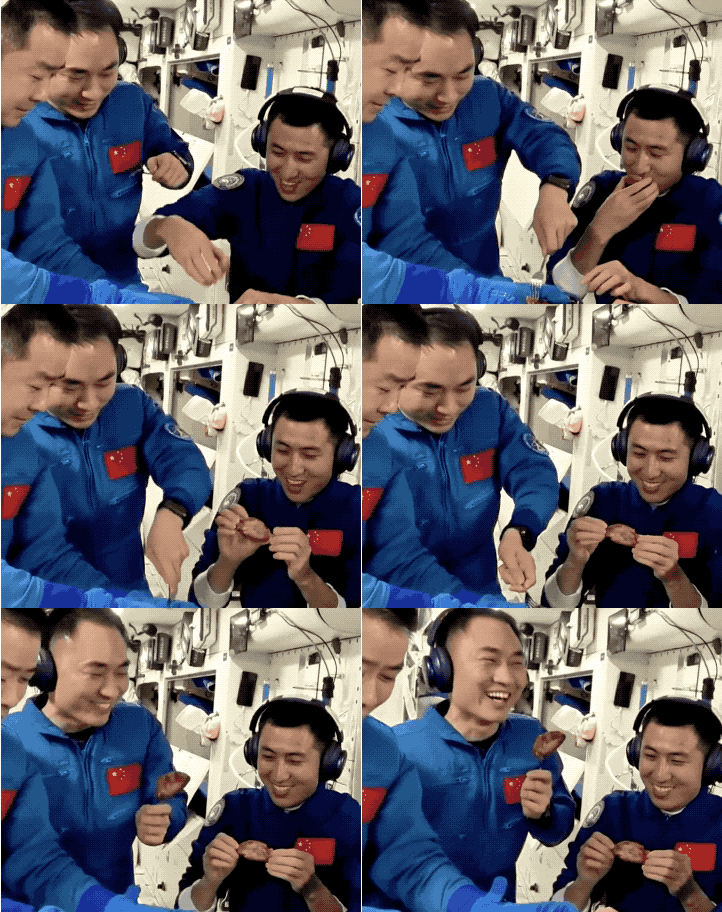
Photo | Xinhua News Agency
Source of the title photo: China Daily
This article is from the WeChat official account "Guokr" (ID: Guokr42), author: steed, published by 36Kr with permission.