US dollar funds are making a comeback in China's innovative drug sector.
In September 2025, Hengrui Medicine completed another NewCo deal. It reached an exclusive licensing agreement with Braveheart Bio of the United States for its self-developed small molecule inhibitor of cardiac myosin, HRS-1893. The upfront payment was $65 million, and the total transaction value could reach up to $1.013 billion. It is worth mentioning that this is already Hengrui Medicine's fourth BD deal this year, and the current total value of BD deals has exceeded $15 billion.
This is undoubtedly an eye-catching figure. However, in the current context of frequent large-scale BD deals, it is not really a novelty. Instead, the investors behind these deals are more noticeable. It is reported that among Hengrui's four overseas BD deals this year, except for Merck KGaA, the other three investors are from US dollar funds. This just reveals an increasingly obvious industry phenomenon, that is, US dollar funds are making a comeback in the Chinese innovative drug market.
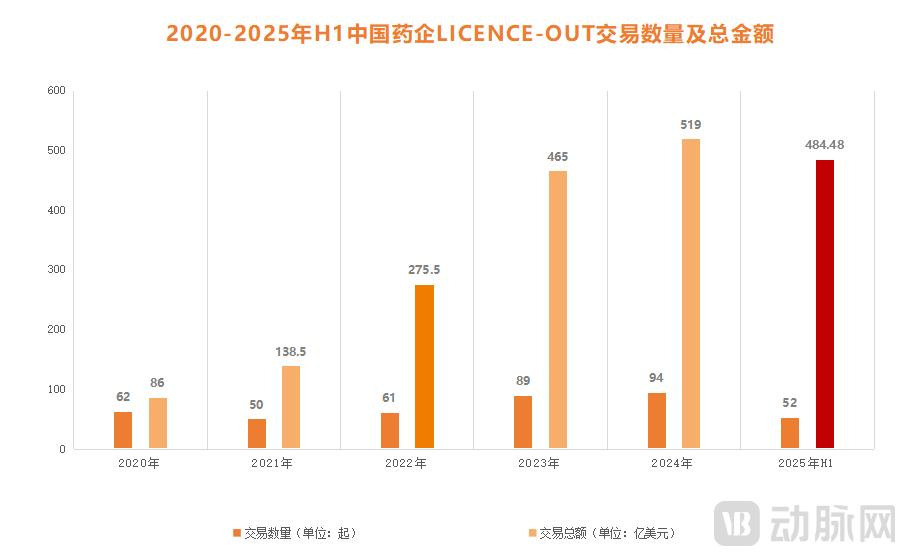
Figure 1. The number and total value of licence-out deals of Chinese pharmaceutical companies from 2020 to H1 2025 (Data source: Pharmcube)
This is not groundless. As early as at the JMP Conference held in January this year, many US dollar funds stated that they would increase their investment in the Chinese innovative drug market. The facts also prove this. Taking the most intuitive BD deals as an example, according to an incomplete statistics by Arterynet, in the first half of 2025, the total value of licensing-out deals of domestic innovative drugs reached $48.448 billion, which is infinitely close to the total value of deals in the whole year of 2024 ($51.9 billion), and the proportion of US dollar funds involved exceeded 80%.
In addition, in terms of cornerstone investments, US dollar funds also showed strong performance. Since the Hong Kong Stock Exchange officially launched the "Technology Company Special Channel" policy in May 2025, the Hong Kong stock market has witnessed long-awaited excitement. Currently, a total of 18 medical companies have successfully listed, and their stock prices have generally shown a significant upward trend. In this process of upsurge, cornerstone investors have become the key driving force. According to a report released by Goldman Sachs, the subscription amount of cornerstone investors accounted for 42% of the total IPO fundraising in the Hong Kong stock market for the whole year. Among them, overseas investors contributed as much as two-thirds, and they are mainly US dollar funds.
It can be seen that after a major retreat in the past few years, US dollar funds are making a comeback with even greater momentum. So, what is the investment strategy of US dollar funds this time? And what changes will it bring to the Chinese innovative drug market? This deserves the attention of the entire industry.
01
Why are US dollar funds targeting Chinese innovative drugs again?
Around 2010, a group of US dollar funds represented by Hillhouse Capital, Lilly Asia Ventures, and Fidelity Asia Ventures successively participated in the early-stage investments of innovative drug companies such as BeiGene, Innovent Biologics, Junshi Biosciences, and Ascentage Pharma. This is regarded as the beginning of US dollar funds' increased investment in domestic innovative drug companies.
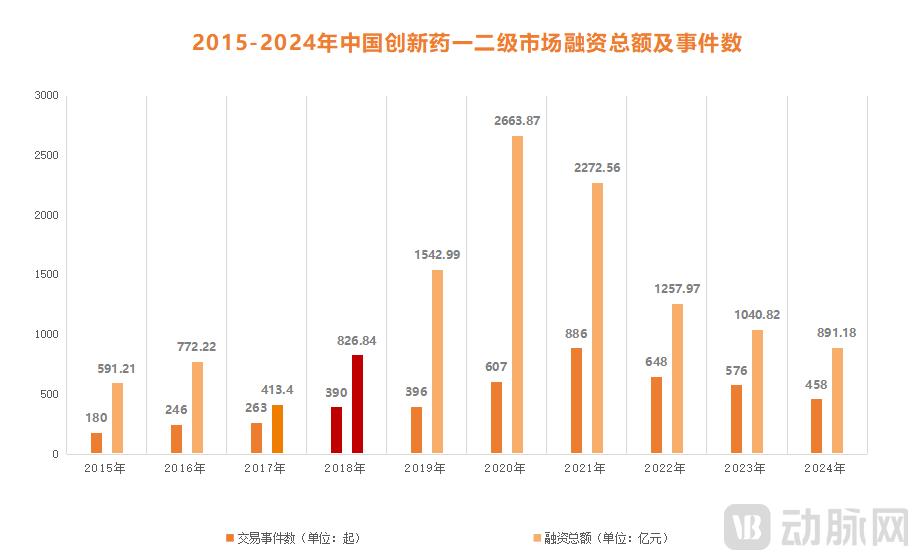
Figure 2. The total financing amount and the number of financing events in the primary and secondary markets of Chinese innovative drugs from 2015 to 2024 (Data source: Pharmcube)
In 2018, with the official launch of the Hong Kong Stock Exchange's Rule 18A, the investment of US dollar funds in Chinese innovative drugs entered a period of explosion. According to the investment and financing database of Pharmcube InvestGo, in 2018, the total financing amount in the primary and secondary markets of Chinese innovative drugs was 82.684 billion yuan, which was much higher than that of the previous three years. Among them, the investment proportion of US dollar funds exceeded 60%, becoming the core force driving the surge in innovative drug financing.
However, all prosperity comes to an end. Starting from 2022, with the frequent break-even of innovative drugs in the secondary market and the bursting of the high-valuation bubble, the once prosperous Biotech track suddenly cooled down, and the capital winter swept in. According to the data, in 2022, the total financing amount in the primary and secondary markets of Chinese innovative drugs dropped sharply to 125.797 billion yuan, only half of the peak in 2021. Among them, the investment proportion of US dollar funds fell below 25%, and more than half of them were for "protecting the market" in follow-on rounds of financing rather than for new projects. Thus, a "great escape" is accelerating among US dollar funds, either reducing investment or directly disbanding their teams in China.
However, this stage did not last long. Starting from the beginning of 2024, US dollar funds are back in full swing. So, what are the deep-seated reasons for the accelerated return of US dollar funds this time?
This can be analyzed from three aspects. First of all, it is of course due to the US dollar funds themselves. Taking MNCs, which have the greatest demand for Chinese innovative drugs, as an example, under the huge pressure of the patent cliff, increasing investment in Chinese innovative drugs is undoubtedly the best choice to fill their pipeline gaps and maintain performance growth.
According to Bloomberg's calculation, from 2024 to 2030, the annual sales of major pharmaceutical companies in the United States and Europe will face generic drug competition due to patent expirations, amounting to approximately $360 billion. This will inevitably create a huge revenue gap, and internal R & D cannot fill this gap in a short time. However, by obtaining late-stage assets and mature pipelines directly through BD or mergers and acquisitions of Chinese innovative drugs, growth can be hedged in terms of time. In this regard, the person-in-charge of a US dollar fund said, "When the R & D risk is too high and internal output is limited, external acquisition has obviously become an inevitable means for a group of MNCs to maintain innovation vitality and capital returns."
Of course, there are pre-conditions for "buying and selling". The key reason why US dollar funds are making large-scale bets at present is the significant improvement in the overall quality of Chinese innovative drugs.
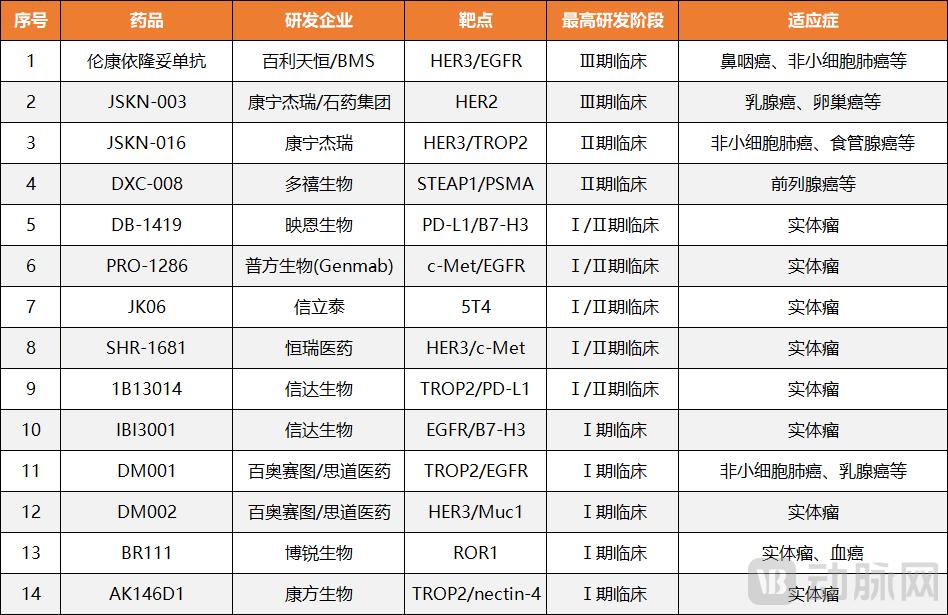
Figure 3. The situation of 14 domestic first-in-class bispecific ADCs
According to an exclusive analysis report released by Bloomberg in July 2025, in 2024, the number of new drugs entering the R & D stage in China exceeded 1,250, which is infinitely close to the approximately 1,440 in the United States. In addition, in terms of the "gold content" of the pipelines, Chinese pharmaceutical companies are leading the global innovative therapy model represented by "bispecific antibodies + ADCs". Currently, 14 domestic first-in-class bispecific ADCs have entered the clinical stage, and 4 of them have advanced to Phase II or III, including BL - B01D1 of Sichuan Baili Tianheng Pharmaceutical Co., Ltd. and JSKN003 of Alphamab Oncology. Of course, in addition to the improvement in overall quality, the Chinese innovative drug market is gradually returning to a reasonable valuation stage, which makes the current increase in investment by US dollar funds more cost-effective and strategically certain.
The last key factor lies in the fundamental changes in the global capital market. In business terms, during the golden decade of Chinese innovative drug venture capital in the past, China was definitely the market where investors outside the United States made the most money, and there was no other. Focusing on the present, the Chinese market, with its huge innovative drug market scale and stable politics and economy, is undoubtedly the best choice for US dollar funds to obtain high investment returns.
However, the current situation has changed. In the past, US dollar funds dominated the market, but now many capitals from Europe, the Middle East, and East Asia have begun to pay attention to Chinese innovative drug assets and are making unprecedented investments. Taking Japan as an example, just Takeda has invested a total of up to $15 billion in Chinese innovative drugs through BD in the past three years. This undoubtedly makes US dollar funds feel unprecedented competitive pressure. Therefore, they can only compete with global capital for high-quality Chinese innovative drug assets in a more radical way.
So, overall, the return of US dollar funds this time is actually a "two-way pursuit": on the one hand, Chinese innovative drugs in a critical development stage really need US dollar funds to solve the current capital dilemma and seek overseas market expansion; on the other hand, under the drastic changes in the global competition pattern, US dollar funds are also eager to find new growth points, and the continuously improving Chinese innovative drugs fully meet their needs for high-return and high-potential asset allocation.
02
From "global layout" to "certainty first"
When talking about the changes in the return of US dollar funds this time, many industry insiders gave almost the same answer, that is, the overall strategy of US dollar funds to increase investment in Chinese innovative drugs is shifting from the past pursuit of globalization to the pursuit of certain results.
How to understand this specifically? Through case analysis and integration of professional views, Arterynet has refined it into three key dimensions. The first dimension is the change in investment targets: US dollar funds used to focus more on the enterprises themselves, but now they focus more on pipelines and products.
Specifically, in the early days, when facing Chinese innovative drugs, the main way for US dollar funds to participate was direct investment, that is, by investing in the company's equity to deeply bind the development prospects and overall value of the enterprise. However, now, most of the cooperation of US dollar funds is through BD deals, and the focus of investment has shifted to pipelines and products. This means that they no longer widely bet on the whole of a certain company, but are more inclined to invest in a specific and high-potential drug pipeline or a single product.
There are reasons for this change. In the past, US dollar funds favored direct investment based on the pursuit of the macro-narrative of "high growth and high return" in the Chinese innovative drug industry, believing that pharmaceutical companies would eventually go public, bringing an overall surge in equity value. However, now, the uncertainty of this model is increasing, and the participation is also heavier. Focusing on a single pipeline and product can confine "certainty" and "risk control" within quantifiable transaction terms.
The second dimension of change is reflected in the investment strategy: Facing Chinese innovative drugs, US dollar funds are gradually transitioning from the past "casting a wide net" layout to "targeted fishing".
As we all know, in the early days, relying on their global vision and capital advantages, US dollar funds always adopted the "casting a wide net" model in the Chinese innovative drug field, targeting multiple potential tracks and quickly investing in a large number of start-up companies in these tracks, hoping to bet on a "dark horse". Indeed, this model has indeed had many successful cases, but the drawbacks are also relatively obvious: on the one hand, the investment targets are overly concentrated, and once the track collapses, all will be affected; on the other hand, the quality of the projects is uneven, and it is difficult to exit in the follow-up, especially in the current complex situation, these problems have become more prominent.
Therefore, US dollar funds have made adjustments. Li Jia'an, a partner of LongRiver, an investment firm focusing on innovative drug investment, said in a recent interview, "Since 2022 and 2023, our requirement for almost all investment projects is that they must have a clear 'going global' positioning. To be acquired by international large-scale pharmaceutical companies or participate in global competition, the products must be globally innovative." Another fund manager also expressed a similar view. When choosing innovative drug targets, there are only two hard criteria: "First, do you have the experience of successfully selling your assets? Second, is your execution ability strong? Other things are not that important." It can be seen that the current purpose of US dollar funds is more clear, and the core logic of investment is gradually moving towards "certainty first".
The third dimension of change is the participation method. US dollar funds are gradually shifting from the past single-type financial investment to an ecological layout of "deep empowerment and long-term companionship".
Taking the increasingly normalized NewCo as an example, this actually binds US dollar funds and Chinese innovative drugs more deeply. It is no longer a simple investment cooperation. Instead, both parties are jointly responsible for the R & D of pipelines and products and the subsequent commercialization promotion, and jointly bear the risks, while also more evenly distributing the benefits. According to the data, in the first quarter of 2025 alone, Chinese innovative drug companies have completed 13 NewCo deals, with a cumulative amount exceeding $10 billion.
In this regard, a senior investor focusing on NewCo said, "The reason why NewCo is highly regarded is that on the one hand, most US dollar funds maintain close communication with MNCs and clearly know what kind of targets, indications, and technical paths they need; on the other hand, in the face of the increasingly complex market situation, US dollar funds have gradually realized that only when capital, technology, and commercialization are truly tied together can the early-stage high risks be diluted while the late-stage high returns can be magnified. Obviously, NewCo provides a more rational and practical cooperation path."
In fact, in addition to NewCo, the sign of US dollar funds' in-depth participation in the Chinese innovative drug ecosystem is also reflected in their earlier involvement in innovative drug R & D, such as conducting a large number of scientific research cooperation with Chinese scientific research institutions and directly investing in the transformation of early-stage laboratory results. In addition, US dollar funds have also established or significantly expanded their local investment teams in China in batches, aiming to be closer to the Chinese market and form a full-chain ecological closed-loop covering research - transformation - industrialization, so as to lock in and incubate innovative drug projects with breakthrough potential at the first time.
Looking back, US dollar funds are no longer just financial onlookers in the past, but have become "co-founders" deeply bound to the Chinese innovative drug ecosystem. This transformation of identity reflects that US dollar funds have a deeper understanding of the Chinese innovative drug market and also indicates that the Chinese innovative drug industry has entered a more rational and mature development stage.
03
Are the advantages greater than the disadvantages, or vice versa?
During the period when US dollar funds directly invested in Chinese innovative drugs, we witnessed the rise of a group of innovative drug companies such as BeiGene, Innovent Biologics, and Junshi Biosciences. Currently, they have all become key forces in the Chinese biomedical industry, and are opening up the second growth curve of high-quality development through differentiated innovation and global layout.
However, now, US dollar funds have changed from direct investment to various ways of increasing investment, such as BD, mergers and acquisitions, participating in cornerstone investments, and increasing holdings in the secondary market. So, what will this bring to Chinese innovative drugs this time?
On the one hand, it is of course very intuitive capital support. According to an incomplete statistics by Arterynet, from January 2024 to June 2025, the upfront payments obtained by Chinese innovative drugs through overseas BD have exceeded $10 billion. In the environment of a capital winter, difficulties in listing, and commercialization involution, this capital is undoubtedly a "life-saving straw". It not only gives more innovative drug companies the capital to survive first, but also can better promote pipeline R & D and subsequent commercialization processes.
In fact, many innovative drug companies have already benefited from this. For example, Ying En Biopharma has sold its license - out for...