Tencent has created a super unicorn worth 16 billion: It plans to go public and compete with Cambricon.
This autumn, Tencent has achieved successive successes. One of its heavily - invested super unicorns, Enflame Technology, has restarted its IPO counseling (on the Science and Technology Innovation Board). Previously, its bet on SiJi Intelligence submitted its prospectus to the Hong Kong Stock Exchange, and its investment in Minglue Technology successfully went public.
Everyone knows Cambricon, and may also know Moore Threads, Enflame Technology, Biren Technology, Muxi Technology, etc. Enflame is their competitor, focusing on domestic GPUs. According to Hurun data, its valuation was disclosed to be 16 billion yuan.
An obvious characteristic is that Enflame has a deep - seated binding relationship with Tencent.
Just five months after its establishment, Tencent led a 340 million yuan investment in it, breaking the industry record that year. In the following years, Tencent continuously participated in multiple rounds of investment and became its largest institutional shareholder, holding approximately 20% of the shares.
Despite Tencent's support, the market environment in Enflame's field is complex.
One of Enflame's major customers is the computing power center. Even if there are technological breakthroughs, whether customers dare to use and are willing to use domestic solutions is another matter, and the process is not accomplished overnight.
Another challenging factor is that the construction of computing power centers is strictly regulated (requiring approval). Since April 2025, many regions have received notices of "window guidance" for the construction of computing power infrastructure.
According to Pencil News, the approval rate is usually no more than 10%. This means that the number of enterprises that need to buy graphics cards has decreased.
This article will analyze the rise of Enflame Technology and the future opportunities and challenges of domestic GPUs.
01
We really should thank AMD for the cultivation of domestic GPU talents. The founding teams of many domestic GPU unicorns came from AMD. For example, the boss of Muxi, which recently went public, Chen Weiliang, was once the global head of GPU SoC design at AMD.
Then there is Enflame Technology in this article. Its founder is Zhao Lidong, who graduated from the Department of Electronic Engineering at Tsinghua University. He once served as a senior director in the product engineering department at AMD's US headquarters. Its co - founder is Zhang Yalin, who worked at AMD's Shanghai R & D center for 11 years.
In March 2018, these two veterans founded "Enflame Technology" in Zhangjiang, Shanghai. Five months later, Tencent came: it led a 340 million yuan investment in Enflame Technology, setting a financing record in the chip field that year.
From 2018 to 2025, "Enflame Technology" released about three generations of products. There are training chips as well as inference chips. Let me explain a bit more here. What are training chips for? They are used to train large models. And inference chips? They are used to run large models.
In December 2020, the first - generation training chip was launched. One year later, the first - generation inference chip was launched. After the launch, VC Wuyuefeng led another 700 million yuan investment in it.
In the next two years, Enflame Technology successively launched its second - generation and third - generation products.
Of course, Enflame Technology doesn't only focus on GPUs. It also develops AI acceleration cards, computing power cluster systems, software platforms and services, etc.
Why? Because its major customers are computing power centers (operators), and customers have multiple needs.
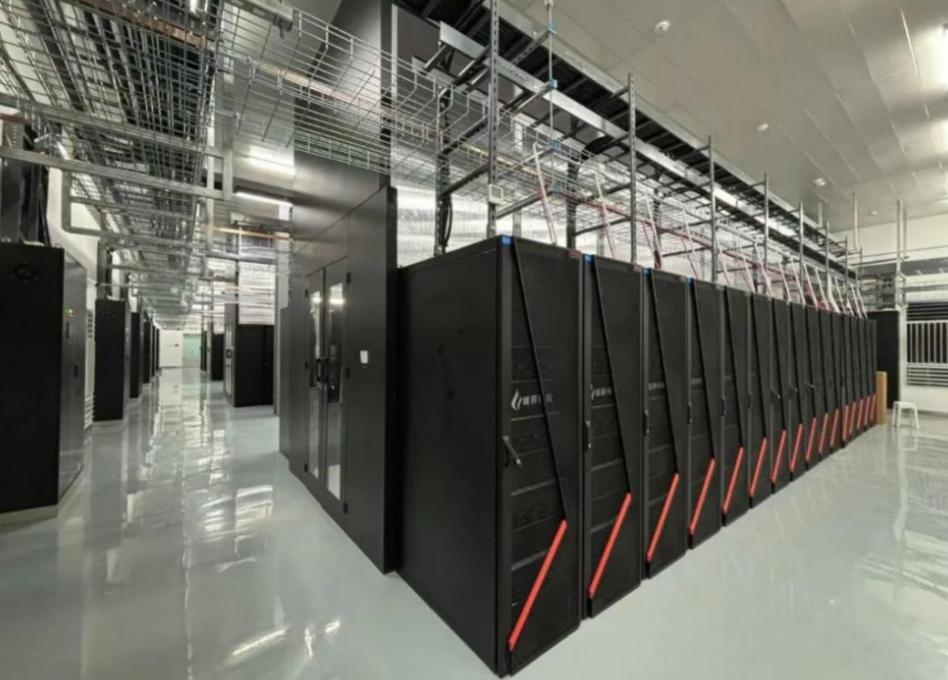
Enflame Technology's products installed in computing power centers. Source: Enflame's official WeChat account
As a computing power center, it's true that I need GPUs. But if the computing power requirement is very high, I need a computing power cluster system to connect thousands of servers together to train large models. I also need AI programs to run on these hardware, which requires software platforms and services.
When it comes to this application scenario, I believe many people can understand why domestic GPUs can rise. It's because of domestic substitution.
Let's take a very compelling example. Enflame Technology's largest shareholder (holding about 20%) - Tencent. Who did it mostly buy GPUs from before? It almost entirely relied on NVIDIA.
For example, Tencent mainly used NVIDIA's A100 for AI inference, while China Mobile's computing power clusters mostly adopted NVIDIA's H100.
So this is a monopolized market. Once there is a monopoly, several problems will inevitably arise: one is supply disruption due to export controls; the second is high cost, with the single - card cost exceeding 100,000 yuan; the third is the closed software ecosystem, making it difficult for enterprises to customize.
Whoever can solve these three pain points will be supported by the industry.
What's Enflame Technology's solution?
1. Make the products cheaper. The price of Enflame's S60 is "significantly lower" than that of NVIDIA chips with the same performance.
2. In terms of software, it opens the "Yusuan" platform to support customers' secondary development. For example, it can quickly adapt to the sudden computing power demand of Meitu's "AI dressing change". Of course, it also supports customized ten - thousand - card clusters.
In addition, since it is a Chinese company, there is naturally no issue of export controls.
02
So, to what extent has the problem of "domestic substitution" of GPUs been solved today? If you're talking about market share, it might be 30 points (out of 100). Why? Because they can't be sold.
The real problem is that if customers are given free choice, computing power centers will hardly buy domestic chips. It's very simple. If they buy them, they won't be able to sell the computing power and will end up with unsold inventory. Pencil News has confirmed this phenomenon with several leading AIDC companies. Even Huawei, the leader among domestic chips, faces this market situation.
Customers won't vote with their feet: what they buy is not just the card, but the ultimate experience and result. Although the performance of the card is important - the performance of some domestic chips can already match NVIDIA's in specific indicators - however, what determines whether a chip is "good to use" is far more than just the hardware parameters. The software ecosystem is also very important, and this is the biggest shortcoming of domestic GPUs.
It's like having a mobile phone with extremely strong performance but no apps to use.
Therefore, the market share of domestic GPUs is still very small at present.
According to the forecast data of international institutions such as Bernstein in 2025, in the Chinese AI computing power chip market, NVIDIA ranks first with a 54% share, Huawei exceeds 20%, and AMD, Cambricon, and other domestic GPUs together account for less than 20%.
Some people may ask: Isn't there still 30% - 40%? That's a good result. There are many "policy orders" and "information technology application innovation orders" in this share. In a free - market economy, the share of domestic GPUs would be even smaller.
Specifically for Enflame Technology in this article, its share in the Chinese AI computing power chip market is extremely low.
03
If we go back five years, there were blue oceans and opportunities everywhere for domestic GPUs. But today, it's not that easy. A direct reason is that there are enough computing power centers, and most of the cards that need to be bought have already been purchased.
Regarding computing power centers, three years ago, building computing power centers was very popular. But now, building computing power centers has become a field that "requires approval", and the approval pass rate is very low.
According to Pencil News, the pass rate may be lower than 10%.
Since April 2025, many regions have received notices of "window guidance" for the construction of computing power infrastructure and carried out a nationwide survey of computing power.
Therefore, state - owned enterprises, local governments and other institutions have significantly reduced their investment in computing power centers. For private enterprises, if they don't have enough operation cases in the past three years, the approval pass rate is almost zero.
Tighter approval means that computing power centers are regarded as an "over - heated field", and it means that the orders for domestic GPUs may decrease.
In the competitive landscape, apart from super giants like NVIDIA and Huawei, new players also need to face competition from super unicorns such as Cambricon, Enflame Technology, Biren Technology, Moore Threads, Muxi Technology, etc.
In this situation, if the target is "general - purpose GPUs", the opportunities are slim. But if it's a chip for a vertical industry - such as a dedicated chip for medical imaging AI - there may be opportunities.
There is a core logic here: in dedicated scenarios, the user experience of "general - purpose GPUs" is worse. This "worse" doesn't mean that the latter doesn't have these functions, but its cost, efficiency, and power consumption are unbearable.
General - purpose GPUs are all - rounders. When performing special tasks - such as game design - only the circuits related to rendering are needed, and other irrelevant circuits will idle, consuming more power.
Will the above bring other impacts? For example, will the production price be higher, and will the chip size be larger? Just from these economic calculations, the potential opportunities of "dedicated chips" are reflected.
Take medical chips as an example.
According to the research data of QYResearch, the global revenue scale of artificial intelligence medical imaging analysis chips was about 20.76 billion yuan in 2024. It is expected that the revenue scale will be close to 85.7 billion yuan by 2031, with a compound annual growth rate of 22.2% from 2025 to 2031.
What do medical fields need AI chips for? There are needs for AI - assisted diagnosis, precision medicine, and drug R & D. These needs are relatively new, and the hardware requirements are also evolving. There may be opportunities to overthrow the giants.
This article does not constitute any investment advice.
This article is from the WeChat official account "Pencil News" (ID: pencilnews). The author is Xi Wen, and it is published by 36Kr with authorization.