The Hidden Battle in AI Entrepreneurship in 2025: Some Have Secured Over 100 Million in Orders in Half a Year
The wave of AI has arrived with an irreversible and roaring momentum.
In the face of this disruptive force, whether they are battle - hardened "veterans" from large enterprises, returnee elites with a halo and rich knowledge reserves, fresh graduates full of innocence, or even unknown grassroots groups, all have stepped onto a brand - new starting line.
Multiple AI entrepreneurs told Time Finance that in this wave of AI, they saw new solutions to past business problems and new opportunities in future trends.
This is not only a technological innovation but also a comprehensive competition regarding speed, cognition, and execution.
Currently, global tech giants continue to maintain high - level investments in the field of artificial intelligence. However, a report released by Goldman Sachs points out that generative AI might be a bottomless capital pit of "too much investment, too little gain", that is, a huge pit that may never bring long - term positive returns to investors.
On one hand, there are doubts about the "bubble theory", and on the other hand, AI continues to stir up new waves of enthusiasm. For AI entrepreneurs and investors who have entered the field, how to "take risks" successfully has become the most important topic. A keen sense of trends, the courage to make mistakes, and extremely flexible organizational capabilities may be even rarer chips.
On this "new continent" full of uncertainties, some are betting on the AI content ecosystem, some are deeply involved in robot interaction, and some are tackling agent technology. Each is using a differentiated approach, trying to find the ticket to the future first in the gaps surrounded by giants.
Independent Entrepreneurs Compete with "Veterans" from Large Enterprises
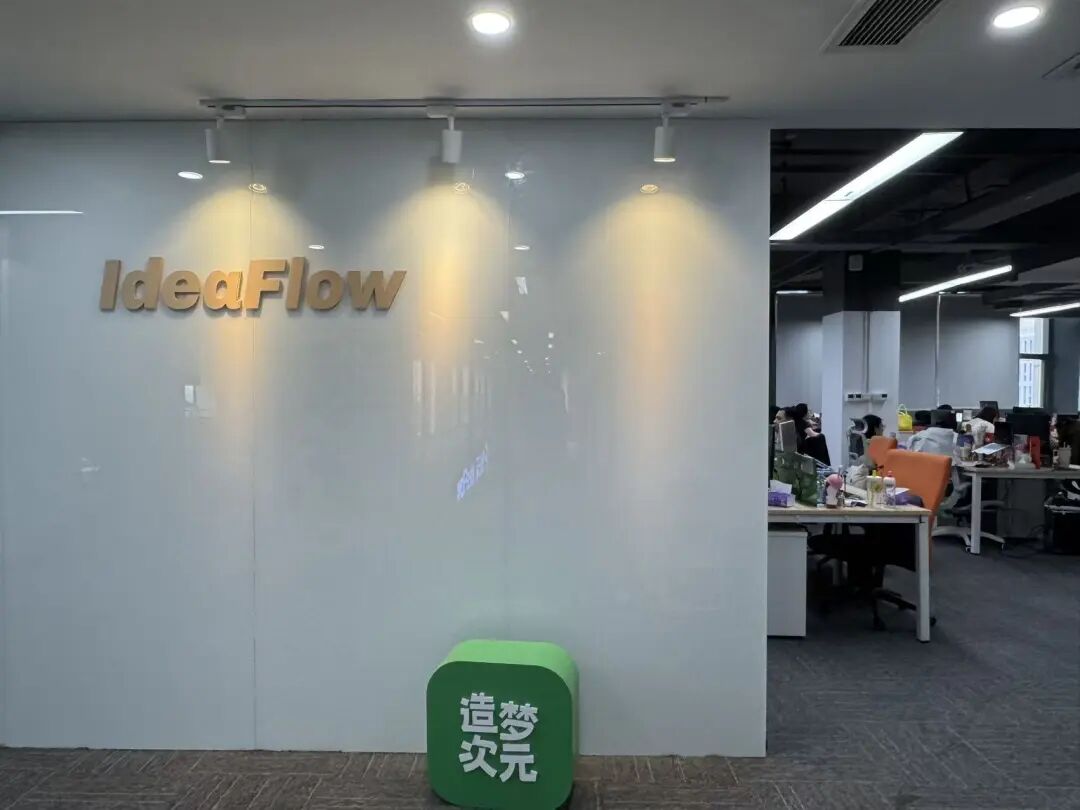
IdeaFlow Office. Source: Photo by Time Finance
"I've never had a regular job." When Time Finance interviewed Shen Qiaojin, the founder of Dream Dimension, in an office building in the Software Industry Base in Nanshan District, Shenzhen, he smiled and used a plain sentence to define his more than a decade of "unorthodox" entrepreneurial path.
As a serial entrepreneur, Shen Qiaojin's startup capital comes not only from angel investors but also from his own entrepreneurial accumulations. Starting from doing scattered Internet - related projects in college, he embarked on an "unrestricted" entrepreneurial practice. In his view, all the experience he has accumulated so far comes from personal trial - and - error on the cutting - edge.
From being an "individual webmaster" to founding a general face - recognition identity verification company, and then establishing an interactive video platform, before founding Dream Dimension, Shen Qiaojin was seeking a way out in projects related to "interactive video".
At the end of 2022, the wave of generative AI hit. When he saw ChatGPT having a conversation with users about "how to live a good life after the age of 30", "I felt that AI had cracked the emotional code of humans," Shen Qiaojin said. At that moment, he realized that this subversive progress in large - model technology would make the dream that he couldn't achieve in his previous startup possible - AI could lower the threshold of content creation and create more personalized supplies.
After the Spring Festival in 2023, he led the core team from his "interactive video" startup and quickly prepared and founded the AI - driven content company "IdeaFlow" in just three or four months, and launched "Dream Dimension", positioning it as a "new - generation AI interactive content platform".
In Shen Qiaojin's vision, AI will reconstruct a new universe parallel to the real world in "Dream Dimension", and what he wants to do is to help creators incubate the first batch of native "AI internet celebrities" in this new universe and have them all signed under the "Dream Dimension" brand. "IP - based operations can make users develop emotional memories of AI characters instead of one - time consumption." As of June 2025, the cumulative number of users of the Dream Dimension app has exceeded 10 million, and the average daily active interaction time per user exceeds 100 minutes.
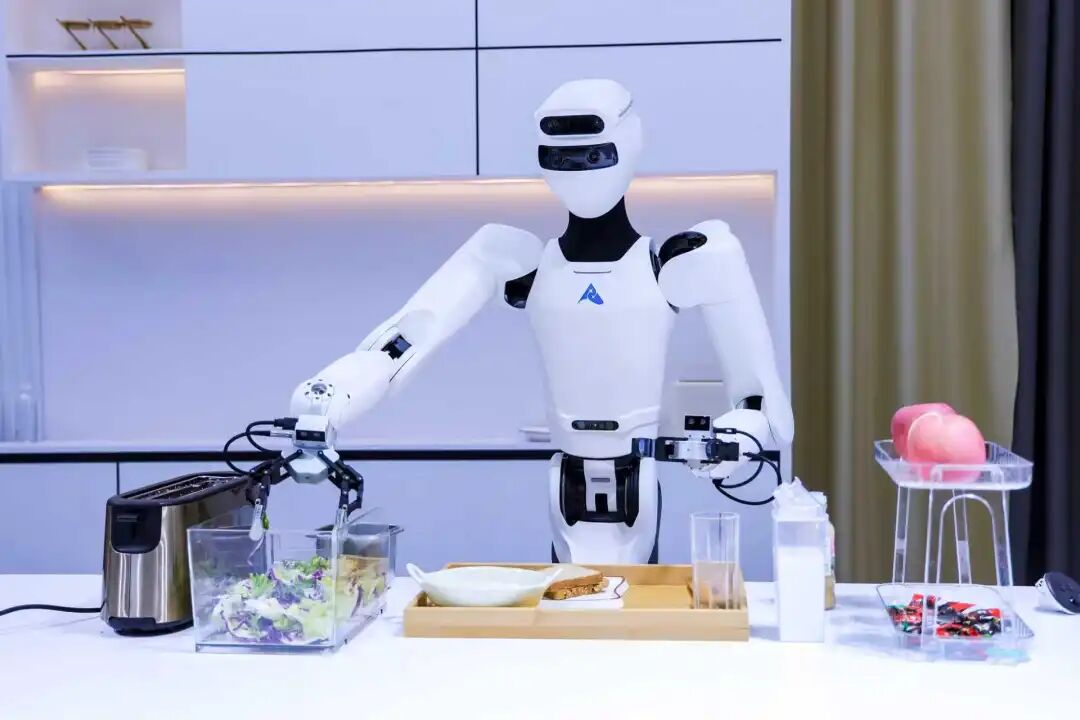
Astribot S1 Robot of Astrobot Intelligence. Source: Photo by Time Finance
Less than 2 kilometers away from IdeaFlow, in the Shenzhen Bay Technology Ecological Park, Lai Jie, the founder of Astrobot Intelligence, plunged into this wave of AI almost at the same time as Shen Qiaojin.
Before knocking on the doors of investors, Lai Jie had a glorious "dual" resume in the eyes of outsiders - the former head of Baidu's Xiaodu robot team and the first employee of Tencent's Robotics X Lab. At Tencent, as the core architect, he helped Dr. Zhang Zhengyou, a top - notch scientist, build the framework of the Robotics X Lab. At the end of 2022, before ChatGPT emerged, he made an extremely "bold" move - leaving Tencent and leading a team to start a business, establishing Astrobot Intelligence to develop AI robots.
Behind this is Lai Jie's sudden enlightenment. In 2022, he was inspired by the concept of the "world model" proposed by Yann LeCun, the chief AI scientist at Meta: For AI to achieve true intelligence, it needs to break free from the shackles of the Internet, interact with and learn from the real world, and obtain real feedback.
"At that moment, I suddenly understood. What he described was exactly a robot!" Lai Jie realized that robots are not only the "actuators" of AI but also the "sensors" of AI. Large models need robots to obtain physical - world data that they can never get on the Internet to complete their own learning cycle.
With this concept, "On the first day Astrobot Intelligence was established, I told the team that we should Design for AI and build a 'robot designed for AI'," Lai Jie said.
At the World Robot Conference (WRC 2025) in August this year, Astrobot S1 of Astrobot Intelligence could smoothly complete a series of long - sequence tasks and complex operations such as preparing breakfast, making coffee, sorting items, ironing and cleaning, playing music and dancing, and playing games with people, attracting many audiences to stop and watch. Behind Astrobot S1, the in - depth coupling of "AI intelligence" and "super - strong operation" makes people see that the "AI robot assistant" is stepping into reality.
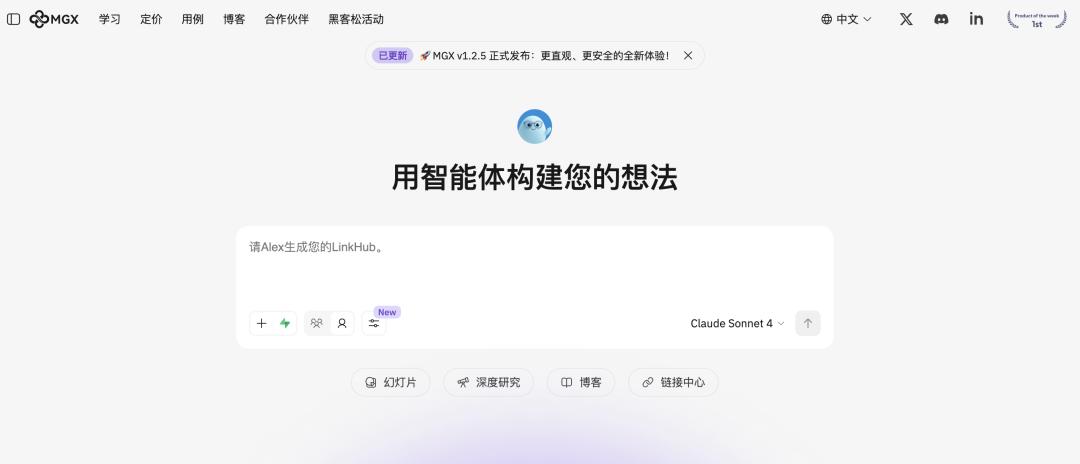
MGX, a product of DeepWisdom
Another person with a background as an elite from a large enterprise is Wu Chenglin, the founder and CEO of DeepWisdom. He has experience in implementing AI projects involving billions of users and trillions of data at companies like Tencent and has won dozens of internal awards at Tencent and Huawei.
"Our original intention of starting a business after leaving a large enterprise is very clear: to reduce the cost of AI implementation and turn large - enterprise - level AI technology into products that ordinary enterprises can afford and use." Wu Chenglin's goal has been grand from the start - to redefine the concept of a company.
He believes that "a one - person company + an AI legion" should become the norm in society: One person can have an entrepreneurial team - with multiple expert agents to help complete all work. Future business giants may no longer emerge from the boardrooms in Silicon Valley but from any bedroom or coffee shop with Wi - Fi."
When ChatGPT was released in November 2022, Wu Chenglin predicted that natural - language programming would soon arrive and proposed that "multi - agent systems are the technology stack for the next generation of AI". At the beginning of 2023, he developed the prototype of MetaGPT in seclusion. The agent product MGX launched by DeepWisdom in February this year achieved an annual recurring revenue (ARR) of over $1 million in just one month after its launch without any promotion costs, and currently, the number of registered users globally has exceeded 500,000.
Breaking Through the Gaps Surrounded by "Giants"
Although the starting line of AI is fair, the tracks are already filled with the figures of "giants". How to survive in the gaps between "giants" is a question that entrepreneurs must answer. In the conversations between Time Finance and multiple founders, their answers vary.
"Many people are worried that it will be a story where nothing can grow under the big trees. But if you use things that haven't happened yet as obstacles to limit your exploration of the market and technology from the very beginning, then this entrepreneurial thing will definitely not succeed," Zhou Jiahao, the chairman of Shenzhen Shenyuan Artificial Intelligence Technology Co., Ltd. (hereinafter referred to as Shenyuan AI), told Time Finance.
Born in 1994, Zhou Jiahao is one of the youngest representatives among these entrepreneurs. In March 2025, he co - founded Shenyuan AI with an expert team from the University of Science and Technology of China. Relying on the team's technological accumulations from previous entrepreneurial experiences, he led the company to achieve a technological leap in two months and released the world's first L4 - level agent mother system "MasterAgent" in May, which supports one - click generation of multi - agent clusters and autonomous professional collaborative delivery of results.
Facing fierce competition, Zhou Jiahao ranks "maintaining an agile development mechanism and efficiency" first in his "multiple - pronged plan". When a problem arises, their principle is to "immediately hold a meeting to discuss and solve it" without any delay. "As long as users put forward a requirement, we will thoroughly study it, quickly implement the ideas, and complete the task perfectly."
At the beginning of this year, Zhou Jiahao and his team came to Shenzhen because they saw a large number of business opportunities and extremely high execution efficiency in this city, which is a paradise for entrepreneurs. "Facts have proved that it was right for us to come to Shenzhen. The development in Shenzhen in the past six months is equivalent to that in the past four years."
With "efficiency" as the top priority, MasterAgent has been "racing" on the path of commercialization since its launch. According to Zhou Jiahao, the contract value completed by Shenyuan AI so far has exceeded 100 million yuan, covering various vertical industries such as finance, healthcare, automobile manufacturing, legal services, and government services.
Compared with making a quick move, as a serial entrepreneur, Shen Qiaojin's way to break through is to find "non - consensus".
"The opportunity for application companies lies in building 'non - consensus' barriers," Shen Qiaojin summarized. "Large - model manufacturers are like 'operating systems'. Startup companies cannot just develop simple tools because they will be 'eaten up' with the update of the operating system. They must do things that the 'operating system' cannot do - build a content ecosystem." To keep up with the latest industry trends, chatting with technology researchers has almost become a daily routine for Shen Qiaojin.
Wu Chenglin, on the other hand, digs into "organizational innovation" internally. Referring to the experiences of successful "giants", he hopes to build an academic - cycle organization within DeepWisdom, so most of the company's codes are internally visible. As the CEO, he will examine the code details of each person during the probation - conversion, defense, and performance - evaluation processes and welcomes everyone to find bugs in the CEO's code. Moreover, most of the company's internal work is published through open - source and academic channels to build an academic cycle.
The extreme pursuit of organizational efficiency has given rise to the "root group" at DeepWisdom - a "super - team composed of programming elites and AI agents" with the highest authority to "find and solve problems from end to end", completely avoiding long - winded requirement - transmission processes.
Actually, these ways of breaking through are also confirmed by the data disclosed by Jinqiu Fund, a professional investment institution in the AI field. According to Jinqiu Fund's observation, there are three signals for rapidly growing companies in the past year: solving specific pain points, developing products that fill the gaps, and having strong execution capabilities.
Yang Jie, the founding partner of Jinqiu Fund, mentioned at a recent closed - door seminar for CEOs of Jinqiu Fund's invested companies, "AI has magnified the negative - example effect of execution, so the gap between fast - moving teams and slow - moving teams will become increasingly large and obvious. The ability to identify negative - example directions and have higher execution capabilities is the key to victory."
Is AI Heading for a Bubble or an "iPhone Moment"?
Looking back, at the beginning of 2025, the popularity of DeepSeek triggered a wave of FOMO (Fear of Missing Out) emotions in the VC circle. At that time, through interviews, Time Finance learned that VCs spent the entire Spring Festival "working overtime", eager to find people and projects. Now, VCs are still busy, but there are also continuous doubts about the "AI bubble" in the market.
On October 6th, at the OpenAI Annual Developers Conference (DevDay) held in San Francisco, Sam Altman, the CEO of OpenAI, also made a rare statement. "I know it's tempting to write stories about bubbles. In fact, I think many areas of AI are indeed a bit bubbly now." However, he emphasized that OpenAI itself is in a healthy development state.
In the recently disclosed quarterly financial reports, tech giants such as Google, Microsoft, Amazon, and Meta have all clearly stated that they will increase capital expenditures on AI and predict that this trend will continue until next year.
At Microsoft's earnings conference call, Mark Moerdler, an analyst at Bernstein Research, directly asked the company if it was confident that these AI investments would eventually yield returns. "Or, frankly speaking, are we in a bubble now?"
Looking back at the development of the Internet, the "bubble theory" always appears on schedule with the rise of most new things.
"Every new technological wave is the same. In the early days of the PC Internet and the mobile Internet, there were also doubts about bubbles," Shen Qiaojin believes. This is a phased problem. "Because people find that AI has not been widely used in daily life yet. When a new technology first emerges, there are still many new capabilities to be developed, and many products are not perfect. But the potential of AI in the consumer field will be huge. We just need to wait."
"The key is not whether there is a bubble, but who can stay after the bubble bursts," Shi Yaqiong, the investment vice - president of Jinqiu Fund, told Time Finance. "FOMO is still the norm in the investment circle because the funds reserved for good projects in the market far exceed the amount of funds needed by good projects. However, the specific investment strategies of funds are diverging, and people are starting to ask more practical questions: Who really understands user needs? Which companies are building truly valuable data flywheels? Which companies are truly forming advantages?"
Currently, the main directions of AI entrepreneurship are divided into three categories: the application layer, the computing - power/chip layer, and the embodied - intelligence/robot layer. Some are reconstructing the working methods of industries and people's lifestyles at the application layer; some are reconstructing the foundation of computing at the chip end; and some are reconstructing the interaction between the digital world and the physical world through robots.
This year, the application layer in the industry has blossomed. Taking Jinqiu Fund as a sample to observe the venture - capital trend, in the past year, Jinqiu Fund has invested in more than 50 projects, among which 56% are in the application layer, 25% are in embodied intelligence, 10% are in computing - power infrastructure, and nearly 8% are in intelligent hardware (AI applications in hardware form).
"Whether it will be the models that dominate the world in the future or the products that are more valuable" - this has been a controversial topic since this year. A VC told Time Finance that their internal judgment is that "products that understand users better are rarer."
In terms of commercialization, Jiang Zhitong, the vice - president of Tianji Capital, told Time Finance that in this wave of emotional - value - based products, "we don't pursue absolute revenue" but focus on the emotional connection and dependence of users on the product and whether the user stickiness of the platform has been verified. "A mature team will target its user group and establish a deeper connection