Low-altitude Tilt: The Life-and-Death Situation - Speed, Certification, and Capital: The Real Battlefield for China's eVTOL
In 2025, China's low - altitude market is as hot as a sleepless storm.
At airshows, in urban demonstration areas, and under the media spotlight, electric vertical take - off and landing vehicles (eVTOLs) are repeatedly making headlines with "first flights", "signing ceremonies", and "deliveries".
However, beyond the flashlights, there are emerging disparities in this industry: capital is tightening, airworthiness reviews are becoming stricter, and local projects are stagnating. The hype in the narrative is being surrounded by the chill of reality.
In this still - emerging sky, three companies stand out particularly —
TCab Tech, INFLYNC, and Volant.
They are important representative enterprises in the tilt - configuration technology route of the industry.
All three have bet on the "tilt" architecture — a medium - or high - speed flight solution that combines vertical take - off and landing with fixed - wing cruising.
All three claim to represent "the mainstream direction of future urban air transportation".
All three have experimental prototypes, government contracts, and varying degrees of financing records.
But the question is —
When the hype fades, who can truly fly for the long term?
Whose speed represents real progress rather than just the speed shown in promotional videos?
1
The Illusion of Speed: The Story Only Begins After the First Flight
In the arms race of the low - altitude economy, the "first flight" has been overly glorified.


In 2023, TCab Tech completed the first flight of its E20 tilt - rotor aircraft. The scene was truly spectacular: a five - seat layout, dual - side tilting rotors, smooth mechanical transitions, and a speed of up to 320 km/h.
At that moment, it became the eVTOL model "closest to civil aviation standards".
One year later, INFLYNC unveiled its L600 concept aircraft, which uses a tilt - ducted propulsion system. In its promotional video, the jet flow inside the duct is smooth, and the flight is stable with almost no noise.
"The future urban air taxi," the company defined it at a media communication meeting.
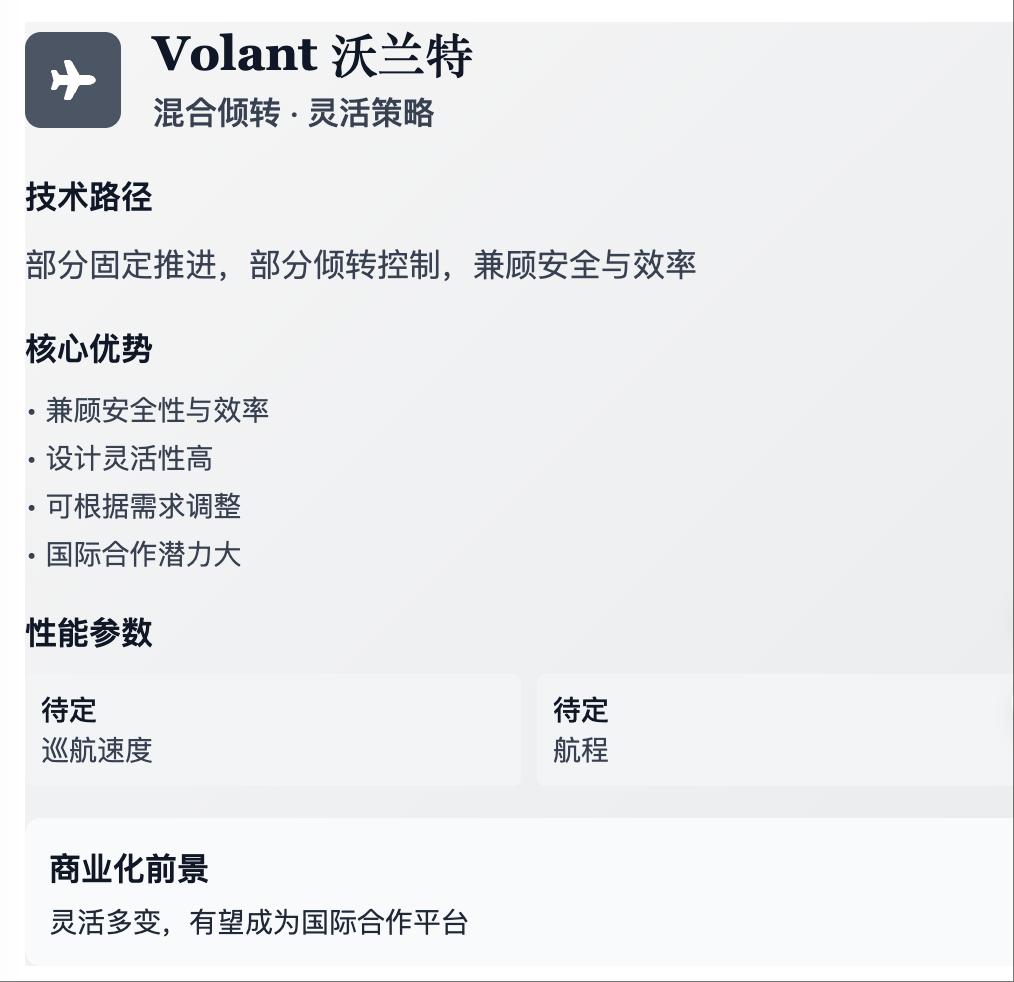
Volant is more agile. It adopts a hybrid tilt solution that enables both vertical take - off and landing and cruising for hundreds of kilometers. Its layout is more like a compromise between Joby and Archer.
On the surface, all three are "flying"; but in terms of progress, their flights are quite different.
TCab Tech's "flight" is closer to engineering verification, using a real aircraft;
INFLYNC's "flight" is more like a technology demonstration, using a model for verification;
Volant's "flight" is more like a capital roadshow, "flying for the investors to see".
The speed of Chinese eVTOLs has never been about aerodynamic speed, but rather institutional speed.
Whoever can enter the airworthiness process faster can turn "demonstration flights" into "commercial flights".
This is the truth about speed:
It's not about how fast one can fly, but who can take off legally first.
2
Airworthiness and Regulations: Slow Variables Amid the Hype
The fate of every eVTOL will ultimately pass through the gateway of the civil aviation administration.
The "Three Certificates" — the Type Certificate (TC), Production Certificate (PC), and Aircraft Airworthiness Certificate (AC) — are the only legal tickets for the industry.

By the end of 2025, EHang's EH216 - S was the only Chinese eVTOL to have obtained the CAAC Type Certificate. In the "tilt - type" market, the three companies are still at different stages:
TCab Tech: It has established contact with the CAAC airworthiness department and entered the "technical document docking stage".
Volant: It is in the "project application" stage and is collaborating with the local low - altitude center.
INFLYNC: It has not yet appeared on the official acceptance list and has not submitted a TC application.
Airworthiness is a slow variable and does not lend itself to publicity.
On average, it takes 3 - 5 years from project initiation to certificate issuance.
The submitted documents can easily exceed tens of thousands of pages, and the tests cover more than a hundred items, including failure modes, aerodynamic redundancy, and environmental adaptability. This is a war of attrition against time.
TCab Tech's strategy is to "start with freight and then move on to passengers". It first accumulates airworthiness experience through unmanned freight routes;
Volant adopts a "local co - construction" model, accumulating policy exemptions through local experimental routes;
INFLYNC has chosen to "prioritize overseas airworthiness", hoping to bypass domestic procedures, but this means higher costs and delayed returns.
This is the institutional paradox of the tilt market: the more aggressive one is, the slower they will be; the more pragmatic one is, the more likely they are to achieve real - world implementation first.
3
The Mass - Production Dilemma: Having a Prototype Does Not Mean Being Able to Mass - Produce Aircraft
"We have a prototype."
This has been the most common statement made by all eVTOL companies in the past two years.
But a "prototype" does not mean "mass - producible".
There are countless pitfalls in the supply chain, certification, and process verification between manual assembly and large - scale production.
TCab Tech's final assembly plant in Jiaxing is already taking shape, with some equipment modified by military suppliers. Its plan is to complete the first mass - production verification line in 2026.
This makes it one of the few Chinese tilt - type companies "bold enough to talk about mass production".
INFLYNC's L600 is still in the prototype stage. Although its self - developed ducted system is forward - looking, it has not yet entered the reliability verification phase. Most of its founding team members come from the aerospace and drone industries, and their thinking is biased towards "technical perfectionism".
Volant's strategy is a "light - asset outsourcing" model, with some components outsourced. Relying on the open airspace in the Lingang New Area, it attempts to flexibly promote test flights and demonstration operations.
Reality is harsh.
In the aviation manufacturing industry, no one can achieve mass - delivery based on just PowerPoint presentations.
From the verification of airframe composite materials to motor certification and flight control system redundancy, every step is costly — and it must meet the standards of either CAAC or EASA.
TCab Tech is more like a "real aircraft manufacturer".
INFLYNC is more like a "concept creator".
Volant is more like a "storyteller".
This is not a derogatory statement but a real reflection after analyzing their respective strategies.
4
The Ebb of Capital: After the Hot Money, Who Can Still Keep Burning?
eVTOLs have been the new darlings of capital, although the enthusiasm has slightly subsided.
Since 2021, almost every round of financing has been tagged with "future mobility" and "low - altitude economy". However, in 2025, the trend began to change.
The primary market's tolerance for "heavy - asset and long - cycle" projects has decreased; some funds have withdrawn, and the remaining investors are demanding "to see real delivery schedules".
According to public information: TCab Tech completed its Series B financing in 2024 and received an additional Series B+ strategic investment in 2025; Volant completed its Series B in October 2025; INFLYNC received angel investment in 2024 and completed its Pre - A round in June 2025. All three companies are still alive, but none of them are advancing at a breakneck pace anymore.
After the ebb of capital, two questions remain:
First, is there enough money to build aircraft?
Second, can the money - burning stories still be told?
TCab Tech has a relatively stable capital chain, as its founding team has a background in the military - industrial system; Volant is backed by international capital, but its consumption rate is high; INFLYNC relies on local cooperation projects, and its capital turnover is tight.
Financing has shifted from "who can get the money" to "who can survive the longest".
This is the reality of the low - altitude market — after the hot money, all that remains is the lonely sound of aircraft manufacturing.
5
The Three - Faction Landscape: The Steady - Advancement Faction, the Risk - Taking Faction, and the Hybrid Faction
If we place the tilt market on the same timeline, these three companies each represent a typical path.
TCab Tech — the Steady - Advancement Faction.
It has a clear goal: three steps of airworthiness certification, mass production, and operation. The team understands both regulations and manufacturing. Choosing to "start with freight" is a pragmatic and smart move.
Its pace is slow, but it is the type of company most likely to achieve "real - world implementation" in the industry.
INFLYNC — the Risk - Taking Faction.
It represents an idealism of "technology first". The ducted system has a strong sense of future, but the R & D cycle is long, and the verification cost is high.
In the aviation industry, this kind of approach often "gains respect but loses in terms of time".
If the ducted system is successfully verified before 2030, it may become the next generation - spanning product;
But if it takes too long, the market window may have already closed.
Volant — the Hybrid Faction.
Its strategy is more like "iterative entrepreneurship": first launch a flyable version and then seek funds while verifying.
During the downturn in the capital market, this flexibility may be a survival advantage.
But its core challenge is — how to build a reputation for safety and airworthiness; otherwise, it will forever remain in the "demonstration aircraft" stage.
The three companies are like three tracks:
One leads to stability, one leads to the future, and one leads to the unknown.
But they are all grappling with the same question — where is the boundary between speed and safety?
6
Conclusion: The Game of Life and Death Is Not Over Yet
In the first round of elimination in the low - altitude economy, victory or defeat is not determined by imagination. What determines fate is execution, patience, and cash flow.
TCab Tech has a stable path; INFLYNC has a grand technological dream; Volant has a flexible capital - playing approach.
But in the end, the technical path is not the key to victory or defeat; it is the path of implementation that matters.
Without an airworthiness certificate, everything is zero; without a mass - production line, all the publicity is meaningless; if the flight is not safe, no one will dare to take it.
The Chinese eVTOL industry is not short of talent or courage; what it lacks is time and verification.
This is a endurance race, not a speed race. After the hype has passed, the sky will still be there,
but there will be fewer companies that can actually take to the air.
This article is from the WeChat official account "Low - altitude Future", author: Yuan Su. It is published by 36Kr with permission.