After its valuation exceeded 30 billion yuan, Tuozhu challenges its competitors, and a fierce battle breaks out in the 3D printing market.
Author | Zhang Ziyi
Editor | Yuan Silai
The contradictions in the 3D printing industry have reached a white - hot stage.
Recently, the MakerWorld community under Bambu Lab released a statement, announcing that it has taken legal actions against platforms such as Creality Cloud, Nexprint, and MakerOnline.
Bambu Lab alleges that there are a large number of suspected infringing behaviors on these platforms: not only are exclusive models from MakerWorld copied in batches, but there are also cases of impersonating the original authors' accounts. Some models have even been used in commercial advertisements, directly violating the authorization terms of "no commercial use and no secondary creation" of the original works.
MakerWorld is a 3D model community under Bambu Lab. According to official data, within just two years of its launch, it has nearly ten million monthly active users and over one million 3D models, making it the world's number - one 3D model community in terms of monthly active users.
In the view of people in the 3D printing industry, Bambu Lab's legal action is quite normal. Whoever becomes the leader will start to use copyright protection to restrict other enterprises. "Even if the 3D model community ecosystem is not a direct source of profit, it is a huge moat," the source told 36Kr.
The existence of 3D model communities can help 3D printing users print models better and more conveniently, improving the printing experience.
At present, the threshold and difficulty of using consumer - grade 3D printer hardware have been significantly reduced, and the printing content has become a new competitive point in the future. The richness of community content is the cornerstone of building an ecosystem.
Moreover, the traffic spontaneously generated by such communities is of great value to enterprises. The aforementioned industry insider told 36Kr: "The existence of the community ecosystem can reduce a considerable amount of traffic costs. For a company with revenues exceeding one billion yuan, these traffic costs may be worth tens of millions or even hundreds of millions of yuan annually."
The public statement from MakerWorld is just the beginning. Behind this, 3D printing has moved from a niche circle into the spotlight. Market sources claim that Bambu Lab's revenue exceeded 5.5 billion yuan in 2024, with a shipment volume of over 1.2 million units last year, accounting for 29% of the global market share.
36Kr has learned from multiple sources that Bambu Lab's valuation in the capital market has long exceeded 30 billion yuan, and its net profit exceeds 2 billion yuan. "A market value of 30 billion yuan is quite tangible compared to companies whose performance has not been realized," an investor commented.
With the emergence of a giant, the industry has reached an inflection point. Whether to respect the open - source geek spirit or for each company to build a closed ecosystem will be an important dividing line affecting many players.
01 The Moat Built by the Community Ecosystem
For 3D printing users, the process of converting 3D model files (STL/3MF) into high - quality finished products (printed parts) is very complex. Users need to master professional 3D modeling software and also consider "manufacturability" during the design process, including factors such as wall thickness, support structure, and shrinkage tolerance.
This is also an important reason why 3D printers have long been just a geek toy: the high threshold of use has determined that the user base will not be very large.
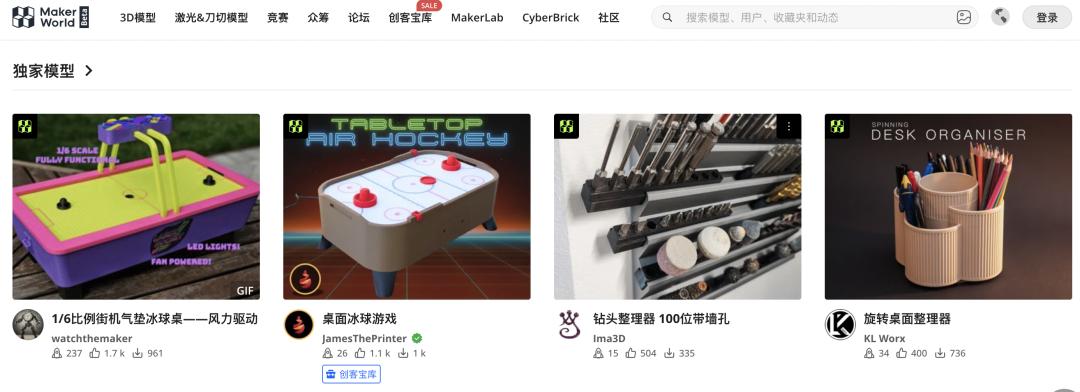
"Low threshold" is the key for MakerWorld to break into the mainstream. Users can find their favorite models on the platform. The platform automatically packages and binds the model files, print configuration files (Print Profiles), and consumable parameters, and users can directly click to print.
(Image source/Enterprise)
36Kr has learned that the models on the platform are uploaded by users independently. The platform has a MakerReward system, which uses points and monetary rewards to encourage designers to upload high - quality models and users to actively interact (such as sharing printing results and providing feedback). By clicking on the model comment section, you can also see many users uploading their successfully printed works according to the parameters.
Jinjiao Finance reported that Bambu Lab has invested huge amounts of money to incentivize creators, with an annual incentive scale of hundreds of millions of yuan. The income of top creators exceeds 500,000 yuan.
The "one - click printing" function significantly reduces the trial - and - error cost and learning time for beginners, while the platform's incentive mechanism ensures a continuous supply of high - quality model content.
In addition, MakerWorld does not restrict printer brands. In the past, 3D printer manufacturers have gone their own ways. "The configurations of 3D printers from different brands are not compatible. This is an invisible threshold. Parameter settings can affect the printing success rate. Good configurations require a large number of tests or experienced players," a 3D printing industry insider told 36Kr.
MakerWorld supports dozens of third - party printers, including Creality, Anycubic, Prusa, etc., and encourages users to share printing settings suitable for different models.
Therefore, MakerWorld is no longer just Bambu Lab's community ecosystem platform; it targets 3D printing users worldwide.
For Bambu Lab, the success of MakerWorld is a concrete manifestation of its business ambition and ability. For other 3D printing enterprises, the higher Bambu Lab climbs on the path to becoming a giant, the more dangerous it becomes for them.
02 Open - Source vs. Closed - Source
Before MakerWorld issued its statement, Josef, the founder of Prusa Research, a 3D printer company following the open - source route, once said on social media: "Imitation is the sincerest form of flattery." This statement was due to Prusa's discovery that Bambu Lab was copying 3D models from Printable, Prusa's 3D model platform.

(Image source/Social media)
The conflict between Prusa and Bambu Lab has a long history. In a blog post published in 2023, Josef expressed his concern and vigilance about some companies using open - source software and community achievements but not opening up their core hardware.
Several 3D printing industry insiders have told 36Kr that Bambu Lab's software is modified from PrusaSlicer but is used in a closed - source manner.
In response to Josef's statement, Bambu Lab published an article signed by Spaghetti Monster on its official website, stating: "We will not use patents to hinder other innovators, nor will we use overly broad patent claims to impede the development of the entire industry... Before the end of this competition, we will witness the historical transformation of 3D printing technology from an early niche market to the mainstream market, and the whole world will benefit from it."
The controversy in the industry lies in that the development and innovation of 3D printing stem from its open - source spirit, which includes the disclosure of open - source code and hardware design drawings. This altruistic idealism eliminates intellectual property barriers. Without the restrictions of high R & D costs and patent barriers, new companies can grow without obstacles, manufacture cheaper and higher - performance printers, and achieve rapid technology popularization.
This is the story of the 3D printing industry before the emergence of giants. With the influx of capital, the increase in players, and the complication of interests, this utopia that only existed in the early days of the industry will inevitably disappear gradually.
Bambu Lab's closed - source system has established a technological barrier through patents and an ecosystem, preventing it from getting involved in low - price competition at the beginning. As a result, Bambu Lab has gained time to develop products leading the industry and has brought 3D printing to a larger consumer - grade market.
The latest data from Precedence Research shows that the global 3D printing market reached $24.61 billion in 2024, equivalent to approximately 170 billion yuan. The CAGR from 2024 - 2034 is expected to reach 18.5%. The industry is in a golden period of rapid development.
Bambu Lab has initiated an arms race in the 3D printing industry. While other companies are following and imitating Bambu Lab, they are all striving to lower the threshold of 3D printing. Consumer - grade 3D printing is gradually approaching the "out - of - the - box" experience, and the success rate and yield of 3D printing are constantly increasing. 3D printers are entering many ordinary families.
Facing greater business prospects and fierce competition, companies are also wavering in their choice between open - source and closed - source.
When Prusa launched its flagship model MK4, it adopted a more cautious open - source strategy. The detailed design drawings and firmware code of some core components of the product were not fully disclosed immediately after the release. This is undoubtedly a major compromise for Prusa's completely open - source route.
In the view of Spaghetti Monster, Prusa and Bambu Lab are like Android/iOS and Linux/Windows, each with its own development strategy and capable of thriving in its own way.
Bambu Lab's closed - loop of "hardware + software + content" has achieved great success, which is a glory for Chinese manufacturing. The question is, while Android and iOS have both thrived on different paths, Apple has transformed the Chinese supply chain, and Chinese mobile phone manufacturers behind Android have laid a broader industrial foundation for today's hardware enterprises.
With Bambu Lab's development trend approaching a "monopoly," will it leave room for other 3D printing enterprises to grow?
It's hard to find an answer to this question in the short term.