Valued at over a trillion but running out of cash flow: No one dares to tell the truth behind the AI feast.
Who are the most valuable private AI startups?
Investor Deedy Das has summarized the top 15 AI startups with the highest current valuations, as well as the latest publicly available revenue and growth data.

Unsurprisingly, OpenAI, xAI, and Anthropic top the list.
OpenAI leads with a valuation of approximately $500 billion, closely followed by xAI and Anthropic. Figure AI and SSI, with zero revenue, still make it into the super-unicorn club.
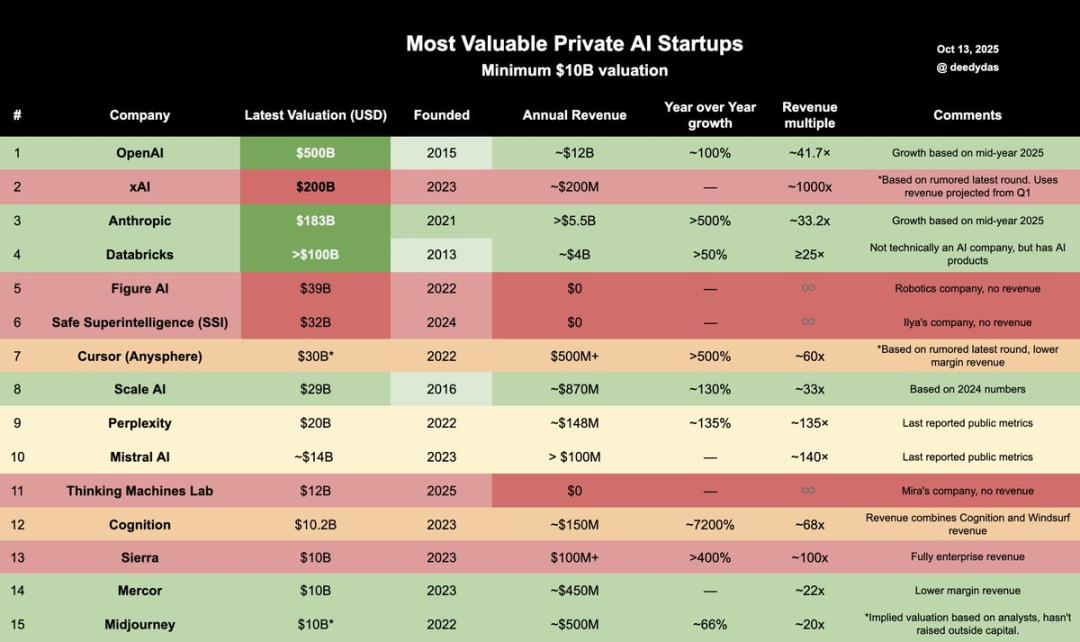
Currently, the startups on the list have a minimum valuation of $10 billion and a maximum of $500 billion.
Zero customers, zero products, zero plans,
yet still valued at over a hundred billion
Some AI startups with no customers, no products, and no plans have astonishingly high valuations - we're talking about Figure AI, Safe SuperIntelligence, and Thinking Machiens Lab.
According to Deedy Das' statistics, these three companies have zero revenue but valuations of $39 billion, $32 billion, and $12 billion respectively.
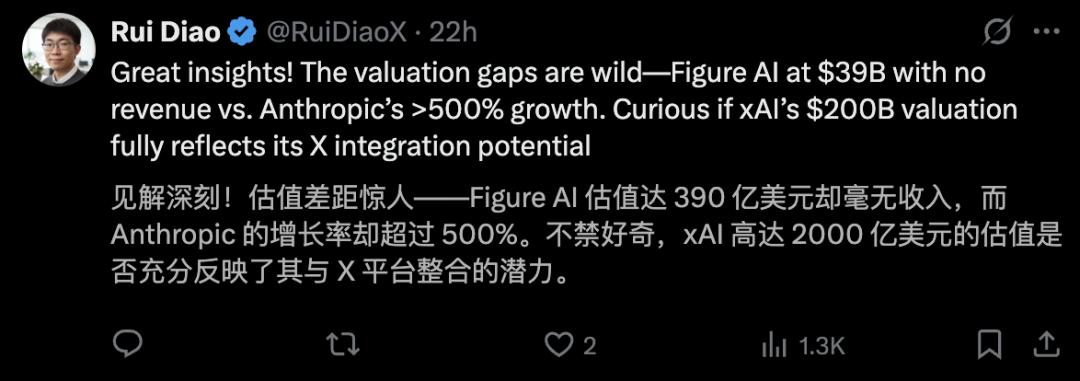
Pedro Domingos, a professor of computer science at the University of Washington and the author of "2040" and "The Master Algorithm", pointed out that Ilya's Safe Superintelligence is the most laughable.

The financing of these AI startups is really confusing -
The valuations hardly reflect any risks, but even the most advanced technologies can fail.
Currently, the market's optimism about the future is close to the expectation of "perfect execution" - and don't forget, Microsoft has full access to OpenAI, including its IP, but it hasn't met all of OpenAI's computing power procurement needs.
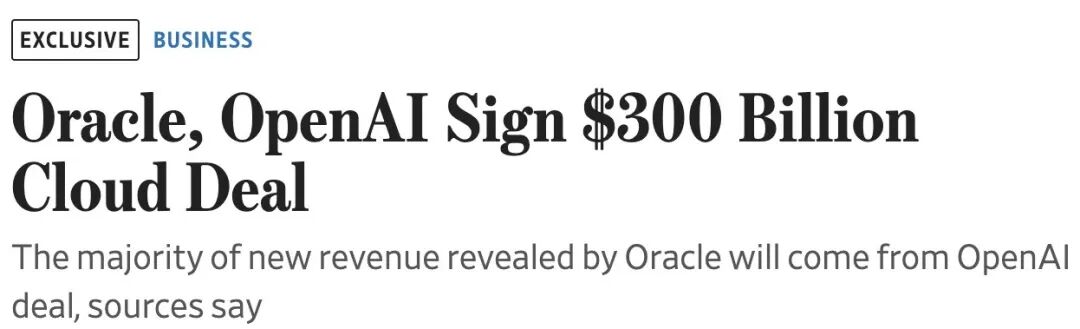
You know, Microsoft has the "right of first refusal" and could have taken Oracle's order, but it didn't.
Microsoft CEO Nadella is known for his rationality. If even he isn't fully betting on it, we should at least be cautious.
Even if AI technology doesn't stagnate, a related financial bubble is forming, and it's more dangerous than the dot-com bubble.

A often overlooked fact is that many tech companies' huge expenditures nowadays are not for opening up new businesses but for "protecting" their existing moats.
Everyone is caught up in a race that's out of control.
As Meta's Zuckerberg said, "The risk of investing hundreds of billions of dollars is less than the risk of being marginalized."
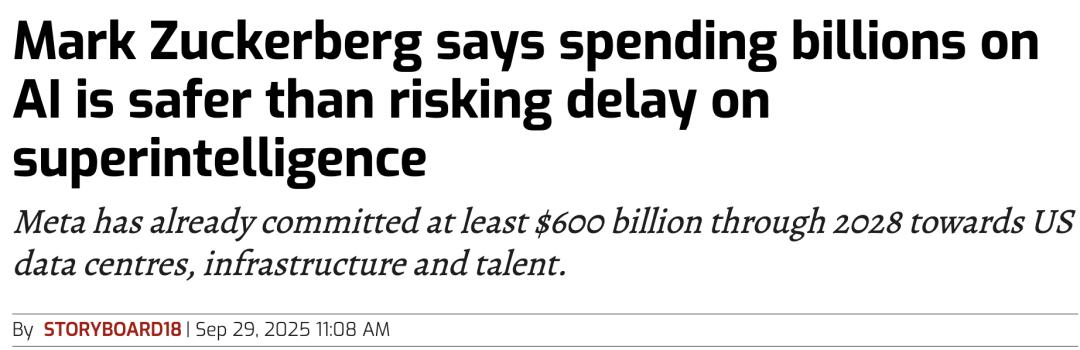
This may explain why these giants have to fight hard.
But the responsibility of the capital market is to accurately reflect risks in valuation multiples. Currently, the market clearly isn't doing this.
The money-burning cycle
The collusion between AI companies and chip companies
The current valuation level of the AI industry has far exceeded the peak of the dot-com bubble in 2000.
Different from 2000, when companies at least had "dreams" and "user growth", today's AI companies generally lack clear business models and profitability.
The AI infrastructure expenditure (such as data centers and chips) is seriously mismatched with the actual revenue, forming a "money-burning cycle":
AI companies burn money → Chip companies make money → AI companies continue to raise funds → Continue to burn money.
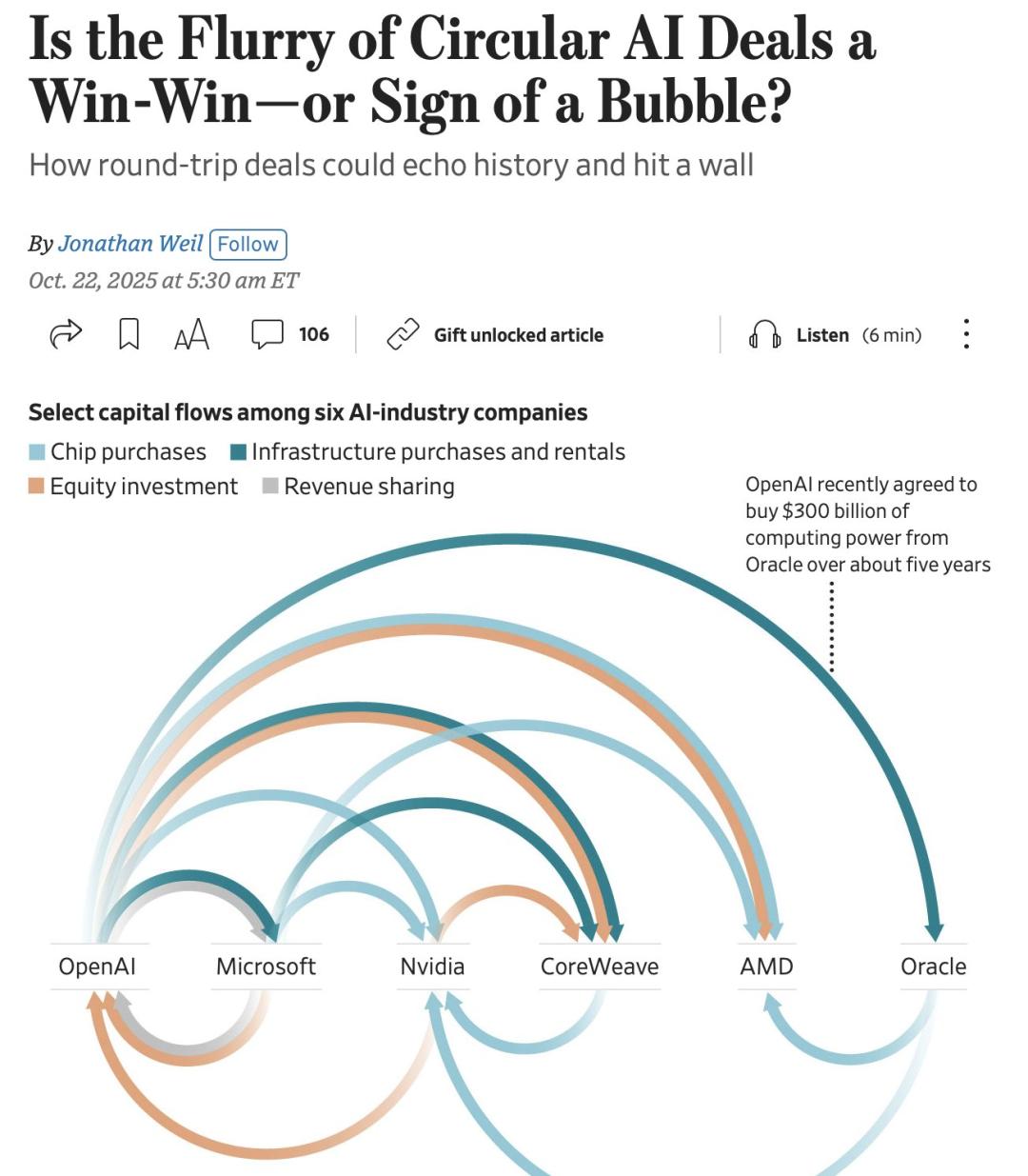
In the past, in the classic path of funding unicorn startups, large venture capital firms would invest in the early stage (with an investment scale between $1 billion and $10 billion). When the startup reached a valuation of $10 billion to $30 billion, giants like SoftBank would take over, and then it would prepare for an IPO (Initial Public Offering).
However, AI labs like OpenAI and Anthropic don't plan to go public now because once they do, their business models and profit logics will be fully dissected, and analysts will deeply question what's reasonable and what isn't.
Even if they choose to go public, they won't be able to raise enough funds.
The financing required by an AI startup now has exceeded the total free cash flow of the top five tech giants in the past five years.
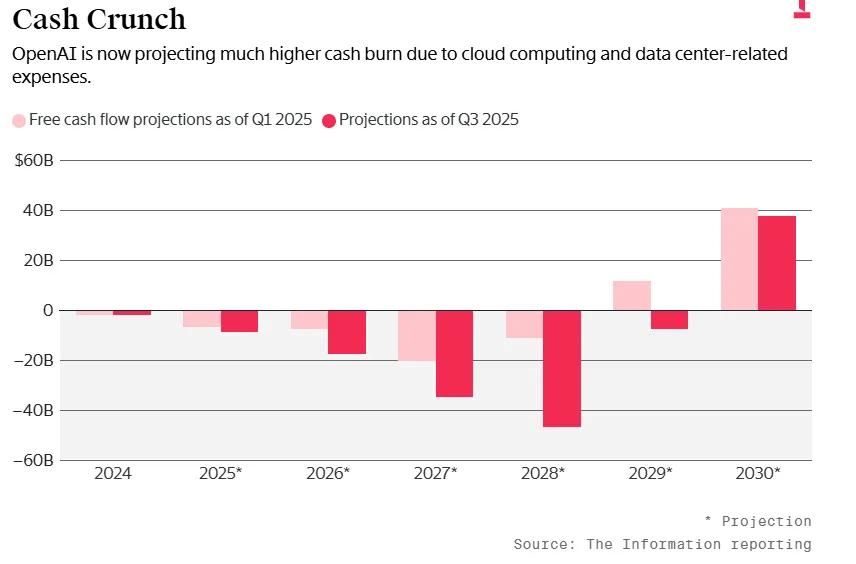
This year, OpenAI's revenue is expected to be between $15 billion and $20 billion.
Even if it doubles or triples next year, this figure is still far from enough to support the investment needed for its expansion. Therefore, OpenAI will have to continue raising funds in the future and may even take on debt.
In addition, even with this revenue, OpenAI is expected to lose approximately $9 billion this year, and the losses will continue to expand in the future, reaching $47 billion by 2028.
But the question is, who has the strength to invest over $100 billion at once?
Currently, the only one that seems capable of this is Nvidia.
Nvidia is willing to invest this money largely because OpenAI is now the "uncrowned king of AI".
Recently, in a podcast, Semianalysis' Dylan Patel said that OpenAI and Anthropic together have bought one-third of the world's Nvidia GPUs.

The problem isn't just the "circular investment" model. When the project scale exceeds $100 billion, the only possible investors are companies like Nvidia or Apple.
More importantly, even if Nvidia invests $100 billion, OpenAI still needs to raise the remaining $1.4 trillion - so who will provide this money?
Another worrying signal is that debt is being increasingly introduced in such financing deals.
Meta recently raised $29 billion for a data center, of which $26 billion is debt, and the data center itself serves as collateral for the loan. Oracle also completed a debt financing of $38 billion.
Microsoft: Prefer outsourcing over chips
As for super cloud providers like Microsoft, they are also starting to seek cooperation with emerging cloud computing service providers (neoclouds).
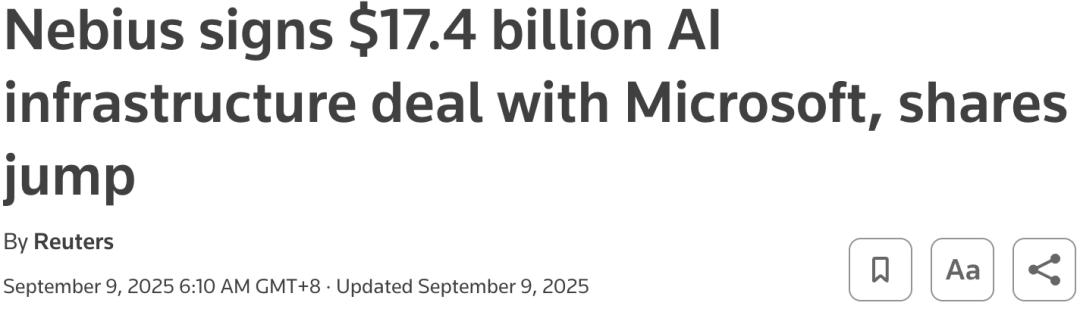
For example, Microsoft's $17.4 billion agreement (which may expand to $19.4 billion in the future) with Nebius is one such example.
Why does Microsoft cooperate with emerging cloud service providers (neoclouds)?
Because they are witnessing the strong demand for computing power from enterprise customers.
Microsoft wants to maintain customer relationships and keep customers satisfied, but it doesn't want to increase its capital expenditure (CapEx). Therefore, it prefers to transfer the risks.
For customers, it doesn't matter who provides the underlying infrastructure; they only care about the results. Once the boom passes, the losses from the old chips will be borne by the neocloud and won't appear on Microsoft's books.
For Microsoft, it's a "win-win": it retains customers and avoids losses from chip depreciation. If the demand continues to grow in the future, Microsoft also has enough time to build its own data centers and regain control of the computing power foundation.
In the current "AI frenzy" cycle, outsourcing the risk of "fast chip depreciation" is wiser than bearing it themselves.
This is also one of the key reasons for Microsoft's cooperation with neoclouds: they are uncertain about the future of capital expenditure, so they prefer to convert it into operating expenditure (OpEx).
What's even more worrying is that now even the chips themselves are being put into Special Purpose Vehicles (SPVs) as collateral for financing.
However, according to Google Trends data, the Google search volume for "AI bubble" on the Internet dropped sharply last month.
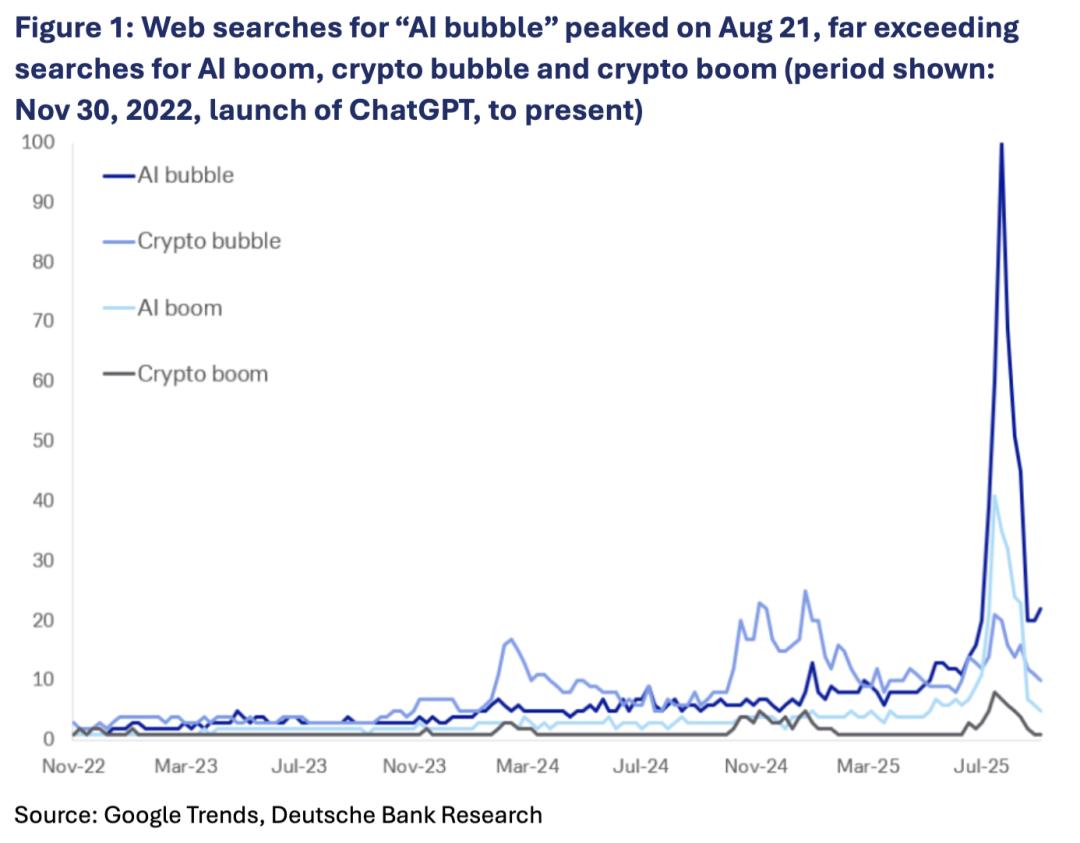
This indicates that people's concerns about valuations are decreasing.
The AI boom may stop, but it may not burst.
Although there may be a bubble, when everyone notices it, it may be the least likely time for it to burst.
References:
https://x.com/AndrewCurran_/status/1980997765397430320
https://x.com/pmddomingos/status/1978049025669841404
https://x.com/Prashant_1722/status/1977899559964582115
https://x.com/RihardJarc/status/1979895399818354883
https://www.uncoveralpha.com/p/too-much-ai-too-soon
This article is from the WeChat official account "New Intelligence Yuan". Author: New Intelligence Yuan. Editor: KingHZ. Republished by 36Kr with permission.