Sign of a peak? A central bank has turned bearish on gold.
Author | Huang Yida
Editor | Zhang Fan
Recently, the statements of central bank officials from South Korea and the Philippines regarding gold have attracted wide attention in the market.
On October 27, a Philippine central bank official put forward a bearish view on the gold price and suggested that the Philippine central bank sell a portion of its "excessive" gold reserves. On October 28, a South Korean central bank official revealed that the bank plans to "consider from a medium - to long - term perspective" to increase its gold holdings.
In recent years, gold has witnessed a historical - level market trend. As the most important current buyers of gold, central banks' attitudes towards gold largely dominate the market's expectations for the gold price.
Against this background, the bearish view of the Philippine central bank on the gold price, in addition to sending certain negative signals, easily evokes investors' memories of previous rounds when overseas central banks sold gold, leading to a sharp decline in the gold price.
The South Korean central bank is a well - known contrarian indicator in the market. The last time it increased its gold holdings was in 2013, but the gold price fell all the way that year, and the South Korean central bank happened to buy at the peak.
It can be seen that the completely opposite views of the Philippine central bank and the South Korean central bank seem to imply the same result - the gold price has peaked.
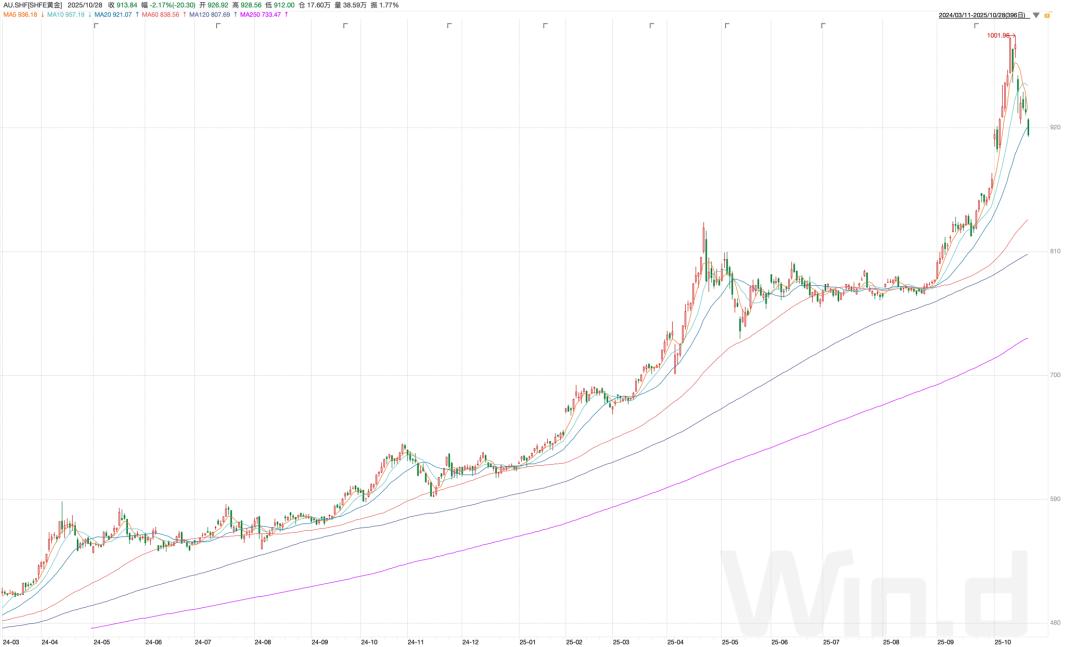
Chart: SHFE gold price trend; Source: wind, 36Kr
So, does the Philippine central bank's bearish view on the gold price draw on the historical cases of central banks selling gold? Will the South Korean central bank become a contrarian indicator again? What kind of market trend will the gold price show in the future?
01 Central Bank Reductions and Pressured Gold Prices
Looking back at the historical development of the global gold market and the trend of the gold price, as important holders and traders of gold, central banks' actions of reducing their gold holdings often have an obvious phased suppressing effect on the gold price.
This rule has been prominently manifested twice in history: once around the Asian financial crisis in 1997, when central banks of many countries sold gold intensively, directly triggering a long - term decline in the gold price; another was from 2014 to 2016, when the Central Bank of Venezuela significantly reduced its gold holdings. Coupled with other factors unfavorable to gold, it led to an obvious decline in the gold price.
The decline in the gold price around the Asian financial crisis lasted for a relatively long time, from 1996, one year before the crisis, until the millennium. The decline amplitude was also relatively large. From the phased peak in February 1996 to the lowest point in July 1999 in the past twenty years, the maximum decline of COMEX gold during this period was as high as 40%.
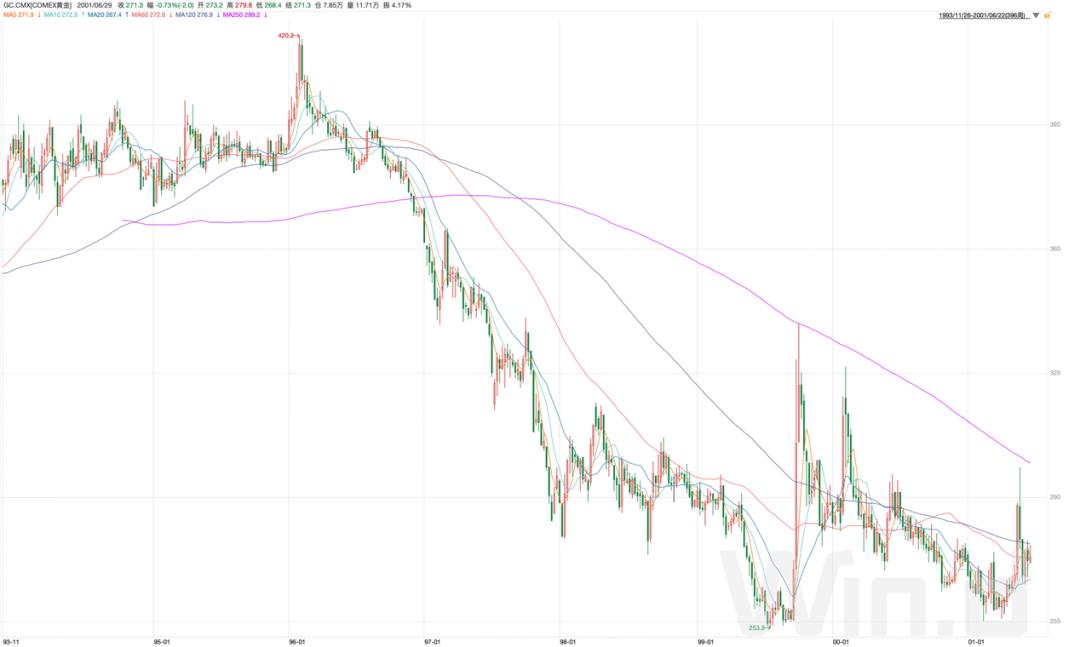
Chart: COMEX gold trend in the 1990s; Source: wind, 36Kr
At the beginning of 1996, the gold price had a short - term rapid rise, mainly benefiting from a relatively favorable supply - demand pattern and the weak performance of the stock and bond markets, which drove the gold price to reach a new five - year high. After that, the market generally expected that the strong rise of gold would come to an end. As expected, in the following more than a year, the gold price significantly declined following the above market expectations.
In 1997, with the outbreak of the Asian financial crisis, the global capital market was in turmoil. The currencies of many countries faced huge depreciation pressures, and a large amount of capital flight led to a rapid reduction in foreign exchange reserves. A typical example was South Korea at that time. Along with the significant depreciation of the Korean won, South Korea's foreign exchange reserves decreased by $12.7 billion in one year, a decline of up to 39%.
When foreign exchange reserves are insufficient, central banks sell gold as reserve assets to obtain liquidity to replenish foreign exchange reserves and support the exchange rate of the domestic currency.
During the Asian financial crisis and in the two years after the crisis, central banks of countries such as Australia, Switzerland, the Netherlands, Belgium, and Austria successively sold gold. Among them, Australia sold two - thirds of its gold assets in one day in 1997, and the Swiss central bank announced in 1999 that it would sell more than half of its gold reserves. Under the huge selling pressure, the gold price further declined and reached a phased bottom in July 1999.
It was not until September 1999 that 15 European central banks signed the Central Bank Gold Agreement (CBGA) in the United States. By restricting central banks' subsequent gold - selling actions, it effectively dispelled the market's panic about "disorderly selling". The market regained confidence, and the gold price stopped falling and rebounded.
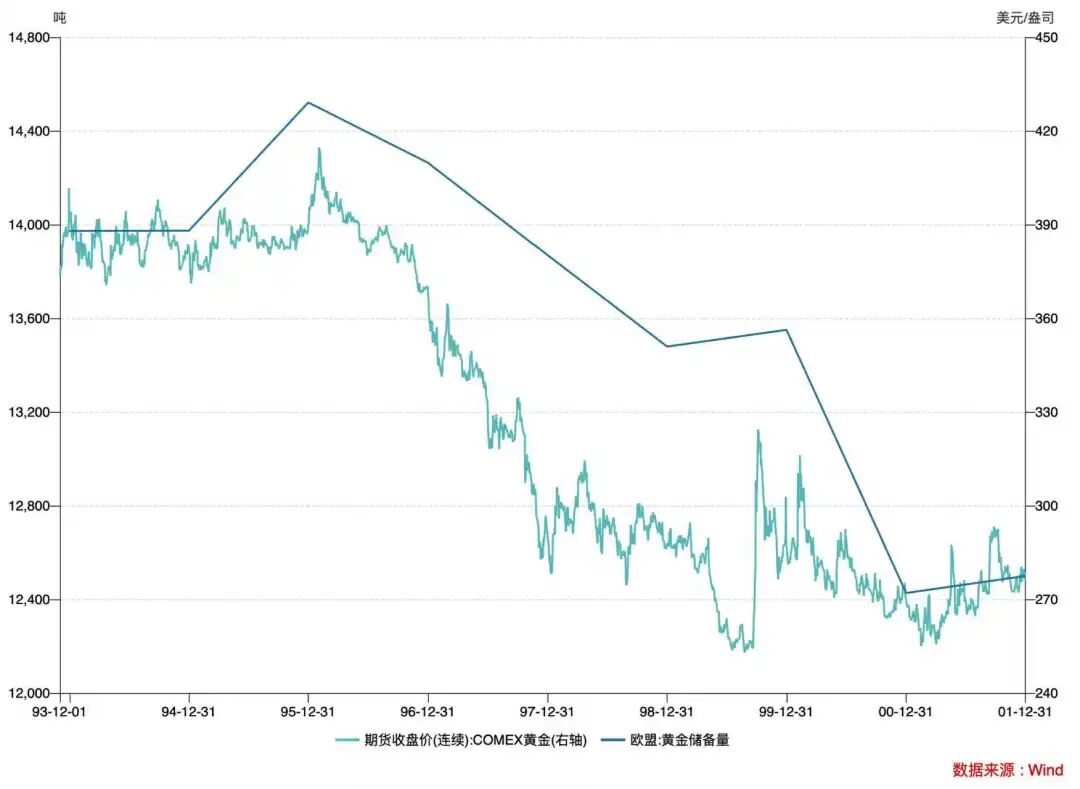
Chart: COMEX gold price and EU gold reserves; Source: wind, 36Kr
From 2014 to 2016, the overall trend of the gold price was V - shaped, with a maximum decline of about 24% during the period. One of the core reasons for the decline in the early stage was the reduction of gold holdings by the Central Bank of Venezuela.
The decisive factor driving the Central Bank of Venezuela to reduce its gold holdings was the shale oil revolution. From 2014 to 2015, the sharp increase in crude oil production led to a sharp decline in international oil prices. As an important oil - producing country, Venezuela's foreign exchange earnings from oil exports shrank rapidly during the same period. In order to balance domestic revenues and expenditures and pay off foreign debts, the Central Bank of Venezuela had to sell about 180 tons of gold reserves from 2014 to 2016.
However, the reasons for the pressured gold price during this period were far more than this. Gold has a strong anti - inflation attribute. At that time, the large increase in crude oil supply weakened inflation expectations, thus weakening the attractiveness of gold. From 2014 to 2015, the US economy grew strongly. Coupled with entering a new round of interest - rate hike cycles, the yield of US Treasury bonds increased, and the US dollar strengthened significantly. Based on the negative correlation logic between gold and the US dollar, it further suppressed the gold price.
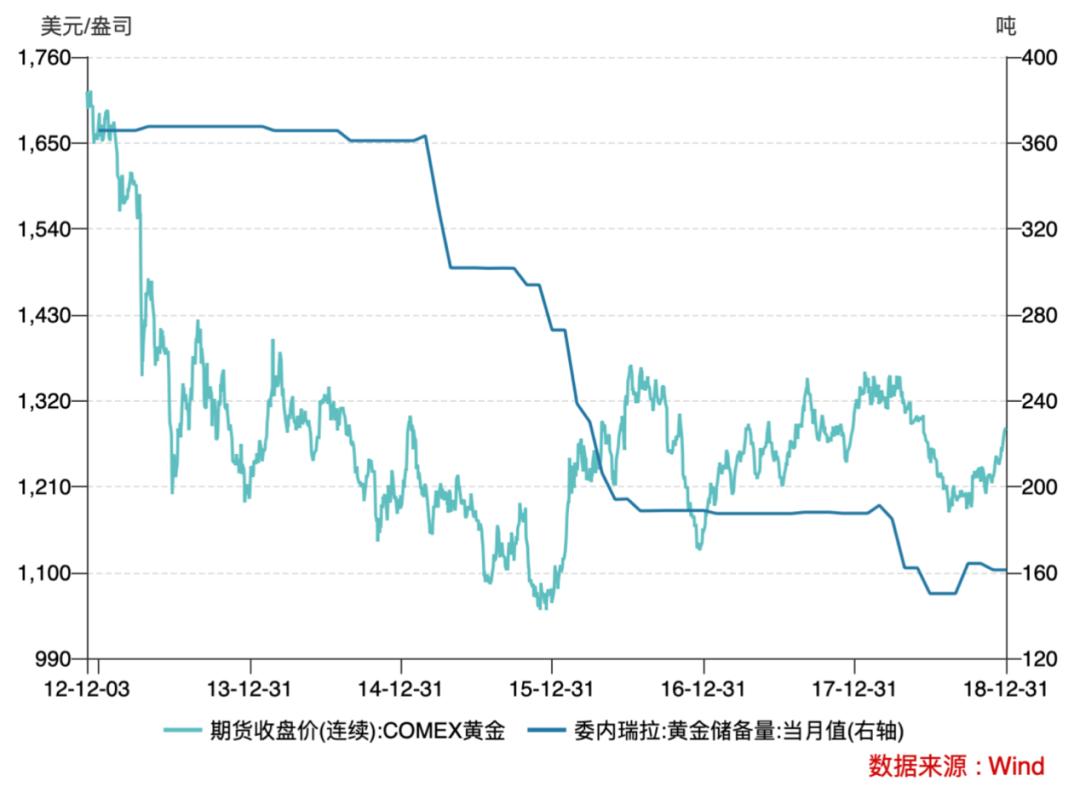
Chart: Venezuela's gold reserves and COMEX gold price; Source: wind, 36Kr
Sometimes, false signals related to central banks can also lead to a decline in the gold price.
The European debt crisis in 2013 caused heavy losses to the financial industry in Cyprus. The banks in the country suffered huge losses. There were reports that the Central Bank of Cyprus would sell gold to rescue the banking industry. Although the Central Bank of Cyprus denied this rumor, under the shroud of pessimistic sentiment, the gold price experienced a short - term sharp decline. It was later confirmed that the Central Bank of Cyprus did not sell gold, but this shows the impact of rumors or statements related to central banks on the gold price.
02 What's Different This Time?
From the above historical review, it can be seen that central banks' actions in trading gold have a significant impact on the gold price. The recent bearish view of the Philippine central bank on gold is significantly different from the logic of central banks selling gold in history.
First, the macro - background is significantly different. Whether it was the central banks of many countries selling gold around the Asian financial crisis or the Central Bank of Venezuela selling gold due to the shale oil revolution, in essence, it was a last - resort measure for central banks to stabilize exchange rates, balance international payments, and repay foreign debts during the crisis.
Currently, the global economy is not in a general crisis state. Especially recently, certain progress has been made in trade negotiations, market risk appetite has recovered, the stock market has performed strongly recently, and the attractiveness of gold as a safe - haven asset has declined. Coupled with the fact that the gold price is at a historical high, the Philippine central bank judges that the gold price may further decline.
Second, the trading purposes are also significantly different. In previous crises, central banks selling gold was an emergency measure. The Philippine central bank's recent bearish view on gold and consideration of selling are mainly for optimizing the allocation ratio of reserve assets and taking profits.
From a policy perspective, Diokno, a member of the Philippine Monetary Board, pointed out that the current gold reserves of the Philippines account for 13% of the central bank's total international reserves, exceeding the ideal range of 8% to 12%. From a trading perspective, Diokno said that the cost of the Philippine central bank's gold holdings is $2,000 per ounce, and the gold price recently approached $4,400 per ounce. The doubled increase provides sufficient motivation to take profits.
The view of the Philippine central bank is quite common. In the bull market of the gold price driven by central banks' gold purchases in recent years, central banks of many countries have accumulated a large amount of floating profits. Therefore, selling a certain proportion of gold at a high price can not only lock in some profits but also optimize the allocation of reserve assets.
In addition, central banks' perception of gold has also changed greatly. Around the Asian financial crisis in 1997, gold was far less important in central banks' reserve asset rankings than it is now. At that time, central banks of various countries relied more on foreign exchange reserves to solve problems during the crisis. Due to the relatively low emphasis on gold, selling gold did not attract much attention and controversy.
Currently, as the world's most important foreign exchange reserve, the credit of the US dollar is weakening in the long - term. The importance of gold reserves to central banks of various countries is self - evident. The core driving force of this round of gold bull market is central banks' gold purchases. Although central banks' gold purchases have slowed down since 2025, the overall net - buying level is still at a historical high, and central banks' gold purchases have played an important supporting role in the gold price.
The Philippine central bank's bearish view on gold and its plan to sell it are not only for locking in profits but also related to its economic fundamentals. Recently, the Philippine peso has been continuously depreciating. As of October 28, the exchange rate of the Philippine peso against the US dollar fell to 59, hitting a record low. The depreciation of the peso reflects to some extent the market's concern that the economic growth of the Philippines may slow down. Against this background, the Philippine central bank's plan to reduce its gold holdings also contains the intention of replenishing foreign exchange reserves and stabilizing exchange - rate fluctuations to a certain extent.
Regarding the impact of the above factors on the future gold price, although the Philippine central bank's bearish view on gold and the South Korean central bank's preparation to increase its gold holdings have both sent certain trading signals, there are still many factors supporting the gold price at present. Specifically, these include the continuation of the central banks' gold - buying trend, the expected expansion of gold - backed stablecoins, strong safe - haven demand at the macro - level, and the continuation of the weak - dollar cycle caused by interest - rate cuts.
Therefore, both the Philippine central bank's bearish view on gold and the South Korean central bank, a well - known contrarian indicator, about to enter the market have relatively limited impacts on the gold price and are expected to be digested by the market in the short term.
*Disclaimer:
The content of this article only represents the author's views.
The market is risky, and investment should be cautious. In any case, the information in this article or the opinions expressed do not constitute investment advice for anyone. Before making an investment decision, if necessary, investors must consult professionals and make careful decisions. We have no intention to provide underwriting services or any services that require specific qualifications or licenses to engage in for all parties in the transaction.