Zhu Jun, CEO of Henlius: When innovative drugs go global, avoid blindly believing in experience and relying on seniority | Exclusive interview by 36Kr
Text by | Hu Xiangyun
Edited by | Hai Ruojing
Recently, as the Hong Kong stock market for innovative drugs has corrected, large - scale BD transactions have also failed to arouse investors' enthusiasm. The market's focus is shifting to the more core values of pharmaceutical companies along with short - term fluctuations.
Henlius (HK:02696) is a beneficiary of this logic. Since the beginning of this year, Henlius' stock price has risen by more than 200%, and at one point, the increase from the lowest point to the highest point within the year was close to 500%.
Different from some innovative drug companies that initially focused on FIC and BIC products, when Henlius was founded in 2010, it mainly targeted popular original research drugs for the development of biosimilars. Its product line covers areas such as oncology and autoimmune diseases, such as rituximab, which has been approved for marketing. Although the scale of a single biosimilar product is relatively limited, it can quickly generate sales returns and build a good reputation. After achieving stable cash flow, the company then invests in higher - risk and higher - return innovative drug pipelines.
With the idea of maintaining a balance between "stable income and high risk", Henlius has become one of the early innovative pharmaceutical companies to achieve financial returns.
In the first half of this year, Henlius' total revenue was 2.8 billion yuan, and its net profit was 390 million yuan. Although the Chinese market remains the main source of income, the semi - annual report specifically mentioned that the company's overseas product profits increased by 200% year - on - year. It is expected that "the overseas product revenue and profit will achieve significant growth this year, and is expected to continue to grow at a high speed in 2026".
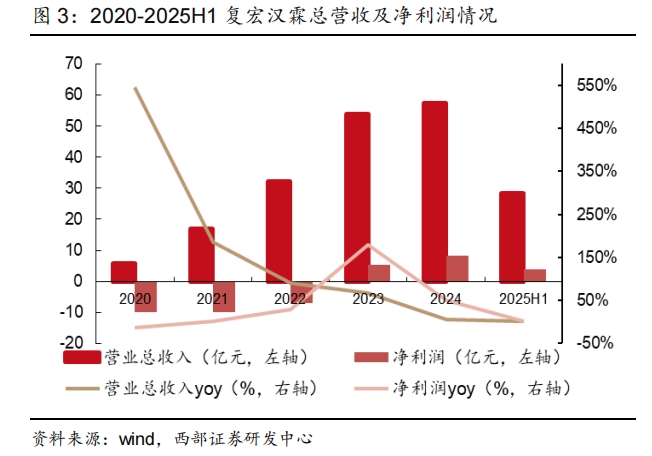
Image source: Western Securities
Now, as the biosimilar business, which is the company's basic business, matures, Henlius' focus is gradually shifting to the innovative drug segment, which is "the only way for pharmaceutical companies to break through the growth ceiling".
Judging from the existing pipeline planning, developing differentiated indications based on clinical needs may be an important way to achieve the goal.
For example, the company's core innovative drug pipeline, the PD - 1 drug serplulimab (hereinafter referred to as "Drug H"), has been deployed in the peri - operative treatment of gastric cancer, which both Keytruda and Opdivo failed in. The relevant Phase III clinical trial has reached the primary endpoint.
At the recent China Pharmaceutical Decision - Makers Summit, Zhu Jun, Executive Director and CEO of Henlius, shared with 36Kr the development ideas and progress of important pipelines. When talking about the experience of promoting new drugs to the overseas market, he sharply pointed out that in the field of innovative drugs, it is taboo to "rely on past experience". The biggest experience is "not to be restricted by experience".
From emerging markets to Europe and the United States
Currently, the most notable innovative drug among Henlius' listed products is Drug H. In 2024, the global sales revenue of Drug H reached 1.3126 billion yuan, accounting for more than 20% of the company's total revenue, with the domestic market contributing more than 90% of the income.
Drug H does not have an advantage in terms of listing time. Before it, 8 PD - 1 monoclonal antibodies had been approved in China. Its sales volume growth is related to its indication selection. Drug H is the world's first PD - 1 approved for the first - line treatment of small - cell lung cancer, with a median overall survival of 17.2 months, which once refreshed the global record of immunotherapy for small - cell lung cancer.
Zhu Jun introduced that Henlius predicts the global sales peak of this product to be $5 billion. To achieve this, in addition to continuing to expand the indication scope, "breaking into the overseas market with the United States as the core" is the next key goal for Drug H.
Drug H was initially approved in overseas markets mainly in Southeast Asian countries and was only approved in the EU in the first half of this year. In terms of time, other drugs under Henlius, such as the lymphoma drug rituximab, were also first launched in emerging markets such as Southeast Asia and Latin America.
Zhu Jun explained that in terms of commercial returns, although emerging markets are more price - sensitive, there is less competition in the same category, which helps to build a brand effect. For example, in India, Drug H is still the only PD - 1 drug approved for the treatment of small - cell lung cancer. This region has now become one of the fastest - growing markets for Drug H, and the company hopes that "the sales in this region can exceed that in China next year".
On the other hand, this is also to build and verify the closed - loop of clinical development capabilities first, which is "a very important part of building a global clinical capabilities model". Currently, Henlius has initially developed global development capabilities from clinical trials, operations, product application and registration to GMP production.
Then, focusing on entering the more difficult US market gives the company an extra "chance of winning". It is understood that the first indication that Drug H plans to apply for in the United States is also small - cell lung cancer. The bridging trial has completed the enrollment of all subjects, and it is expected to formally apply for marketing next year.
Among other indications under research, the peri - operative treatment of gastric cancer and the treatment of colorectal cancer have higher priorities because these are "markets that Keytruda has not yet occupied".
Taking the peri - operative treatment of gastric cancer as an example, surgery is the main treatment method for gastric cancer, but postoperative recurrence is very common. Therefore, carrying out interventions during the "peri - operative period" before and after surgery to help patients meet the surgical indicators and ensure better prognosis has become the research and development direction of the industry. At the same time, since the peri - operative treatment is mainly for early - stage stage II/III patients and there was no effective treatment plan before, the market is relatively blank.
However, at present, the peri - operative treatment of gastric cancer is mainly based on chemotherapy, which is prone to problems such as adverse reactions and complications. In terms of immunotherapy, although Keytruda and Opdivo also tried to capture this market before, they both failed due to poor clinical results, which once led the industry to question the feasibility of treating this indication.
"But Henlius did not give up on this field," Zhu Jun introduced. "We found that many patients could not complete adjuvant chemotherapy not because of insufficient conditions, but because they could not bear the side effects of chemotherapy after surgery and chose to give up. So we thought, could we try a single - drug regimen of Drug H after surgery?"
At that time, it was not easy to adhere to this decision. Even classic drugs like Keytruda and Opdivo need to be used in combination with chemotherapy in pre - and post - operative treatment. After six years of research, in early October this year, Henlius officially announced the results of the relevant Phase III registration clinical trial. The interim analysis results reached the primary study endpoint of event - free survival, which preliminarily proved the effectiveness of replacing adjuvant chemotherapy with immunotherapy alone after gastric cancer surgery, and the independent data monitoring committee recommended early application for marketing.
"We hope to convey an idea to the industry that not all PD - 1 assets are homogeneous. When you can really solve problems from the patients' perspective, the market will definitely reward you," Zhu Jun said.
The biggest experience in going global is "not to be restricted by experience"
Currently, including Drug H, Henlius has launched 9 products globally, 6 of which are approved in overseas markets, covering 900,000 patients in 60 countries and regions such as the United States, the EU, Australia, and Indonesia.
When talking about the experience of promoting new drugs to the overseas market, Zhu Jun believes that in the field of innovative drugs, it is taboo to "rely on past experience", especially when communicating with different global regulatory authorities. Experience can sometimes become a "burden". "Many times we think that we don't need to ask the regulatory authorities about this matter because they will definitely not agree. But in fact, as long as we calm down and analyze from the perspectives of patients, drug mechanisms, and market pros and cons, and dare to ask questions and argue with the regulatory authorities, we will often get good results in the end, and the regulatory authorities will be convinced by us."
Especially in the process of clinical development, whether a Chinese pharmaceutical company can discover more targeted markets and meet unmet clinical needs has become a decisive factor for it to gain a foothold in the local market.
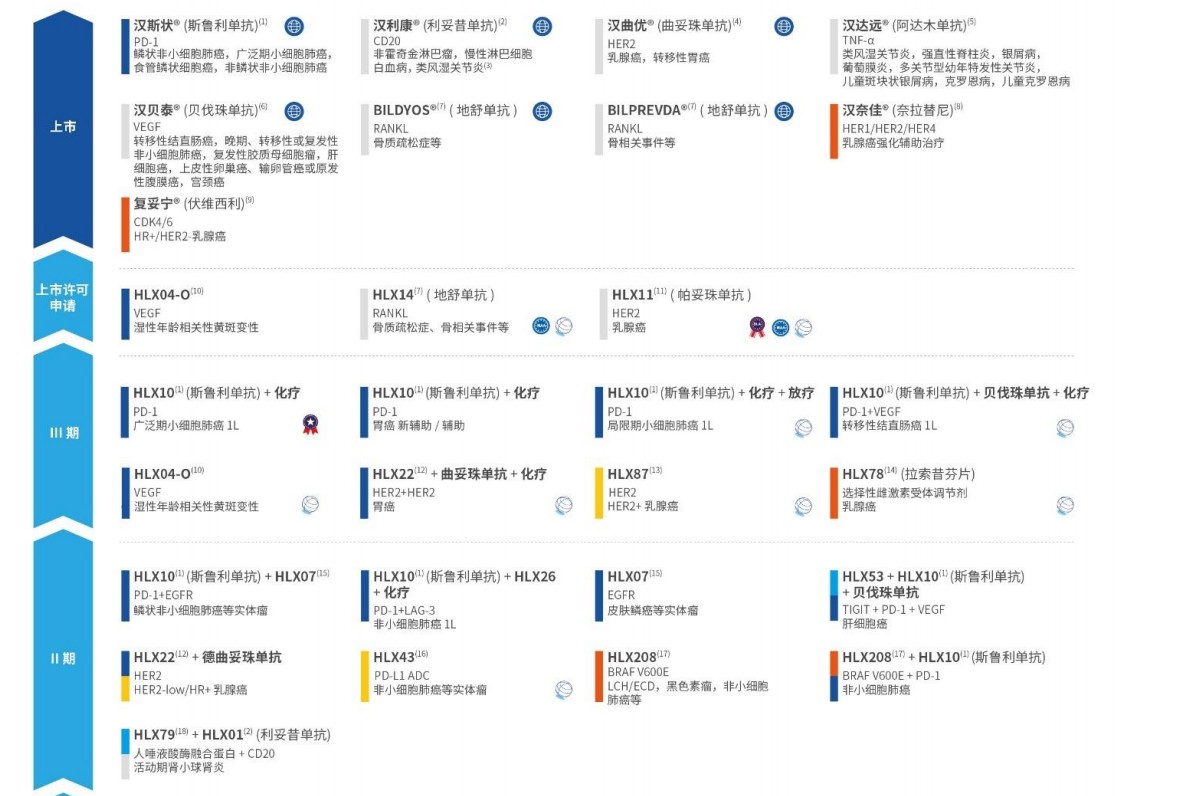
Henlius' listed and some late - stage R & D pipelines (statistics as of early September 2025)
This feature is mostly reflected in Henlius' subsequent innovative pipelines. Taking HLX43, a core PD - L1 ADC drug under research by the company, as an example, the defects of traditional PD - L1 inhibitors and ADC - type drugs are relatively obvious. The former has insignificant efficacy for a large number of patients with negative PD - L1 expression, while the latter has a narrow indication range and strong toxicity.
"Most similar products on the market use PD - L1 as a target to expand the functions of ADC. But we hope to make HLX43 an ADC with tumor immunotherapy functions, and at the same time solve the three major problems of PD - L1 relying on biomarker screening, the narrow indication range of ADC, and the accumulation of blood toxicity after long - term use."
Thanks to the mechanism innovation, Henlius found that HLX43 has obvious effects on patients with EGFR wild - type non - squamous non - small - cell lung cancer (NSCLC). The objective response rate (ORR) in the Phase I clinical trial is 46.7%, higher than the existing therapies. In the United States, there are more than 100,000 patients with this subtype, which is 6 or 7 times the number of patients with the more well - known EGFR - mutated type. "It is the most common indication among US lung cancer patients, but most other bispecific antibody varieties have difficulty in solving it."
Zhu Jun said that after the data of HLX43 was released this year, many US clinical PIs were very positive and hoped to participate in the international multi - center clinical trial of HLX43.
In addition to HLX43, Henlius is also focusing on the development of HLX22, which is a combination of trastuzumab and chemotherapy for the first - line treatment of HER2 - positive advanced gastric cancer. It is currently conducting an international multi - center Phase III clinical trial, "head - to - head" challenging Keytruda.
It is understood that Henlius has invested nearly $200 million in this research. The reason for such a large investment is that patients with HER2 - positive advanced gastric cancer are often unable to undergo surgery at the time of diagnosis, and the progression - free survival (PFS) of existing drug treatments is only 8 - 10 months, and their survival situation is very painful. Under the treatment plan of HLX22, the PFS of patients has been significantly prolonged. "Some patients have not had disease progression for two years, and their tumors have continued to shrink."
"If we can enable patients to live with tumors for a longer time, in terms of commercial returns, it means that the market scale for this patient group can be expanded by about 3 times, which is equivalent to turning a'shallow blue ocean' into a 'deep blue ocean'," Zhu Jun said.