Bama Tea cannot become Moutai.
Author | Xie Yunzi
Editor | Zhang Fan
Cover Source | Visual China
Has the capital market's prejudice against "tea" been broken?
On October 28, Bama Tea is about to be officially listed on the Hong Kong stock market. It is expected to raise a total of HK$428 million. The funds will be used for the expansion of the company's production base and construction. Huatai International, ABC International, and Tianfeng International are its joint sponsors.
According to preliminary statistics, the subscription amount of the company in margin trading reached as high as HK$85.3 billion, exceeding the HK$45 million raised in the public offering by 1,896 times, once setting the highest subscription record for recent new stocks in the Hong Kong stock market.
Bama Tea was established in 1997 and is a typical family-owned enterprise.
The IPO prospectus shows that Wang Wenbin, Wang Wenli, Chen Yajing, Wu Xiaoning, Wang Wenchao, and Wang Xiaoping form a concerted action group of Bama Tea and are the largest controlling shareholders of the company, holding 55.9% of the voting rights.
Beyond the founding family, the public is quite concerned about the "marriage alliance of Fujian's wealthy families" behind Bama Tea.
According to public information, one son and two daughters of Wang Wenbin, the actual controller of Bama Tea, are respectively married to the corresponding heirs of Anta Sports, Septwolves, and Jiangsu Gaoli Holdings. Through the marriages of their children, four companies, Bama Tea, Anta, Septwolves, and Gaoli Holdings, have formed a huge business network.
Before this IPO, Bama Tea also received two investments from the "Zhou family" of Septwolves.
The prospectus published after the hearing shows that from September to November 2024, Chen Yajing, the wife of Wang Wenbin, transferred 2.28 million shares at a price of 30.3 yuan per share to Shengwang Fund, a general partnership manager in Chengdu Xinjin, and about 1.98 million shares to Quanzhou Huixinfu Company. In addition to Chen Yajing, in December last year, Wang Wenli, the younger brother of Wang Wenbin, also transferred about 1.48 million shares at a price of 30.3 yuan per share to Jinjiang Baiyingcheng Trading.
Among them, the actual controller of Shengwang Fund is Liu Yonghao, the chairman of New Hope; the actual controller of Huixinfu Company is Zhou Yongwei of Septwolves Group. After completing these three share transfers, the concerted action group where Wang Wenbin is located cashed out a total of 174 million yuan. And these three capital injections before passing the hearing did improve the capital market's recognition of the company's overall value.
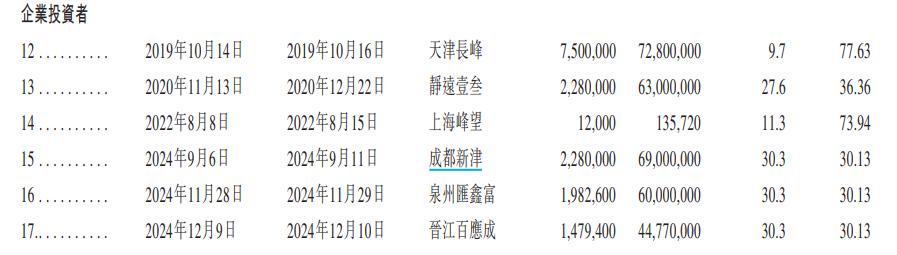
The picture is taken from Bama Tea's prospectus
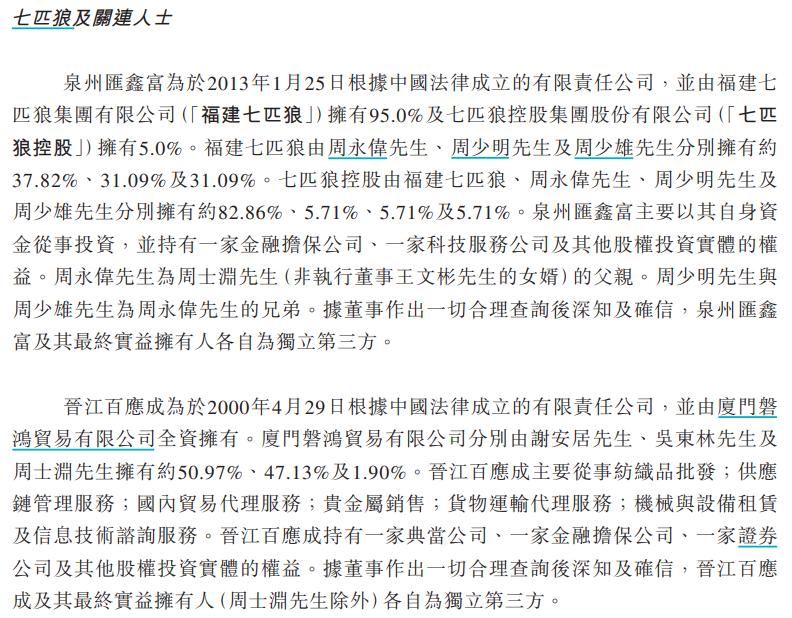
The picture is taken from Bama Tea's prospectus
However, behind the enthusiastic subscription, the slowdown in Bama Tea's performance cannot be ignored.
The prospectus shows that from 2022 to 2024, Bama Tea's revenues were 1.818 billion yuan and 2.122 billion yuan respectively, with revenue growth rates of 16.8% and 1.0% respectively. In the first half of 2025, Bama Tea's revenue reached 1.06 billion yuan, a year-on-year decrease of 4.2%.
In terms of net profit, from 2022 to 2024 and the first half of 2025, Bama Tea achieved 166 million yuan, 206 million yuan, and 120 million yuan respectively, with a year-on-year decrease of 17.8% in the first half of 2025.
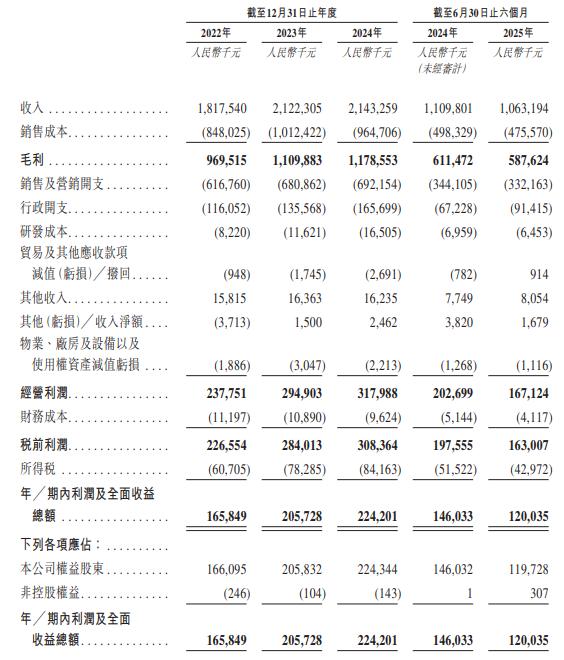
The picture is taken from Bama Tea's prospectus
Regarding the pressure on operating performance, Bama Tea said that the main reason is the decline in sales in offline channels.
All along, Bama Tea has relied on franchisees for expansion, and the sales revenue brought by its franchisees has always accounted for a large part of the total revenue. As of June 30, Bama Tea had a total of 3,585 offline stores; among them, there were 3,341 franchise stores.
However, in recent years, Bama Tea has also been losing franchisees.
Data shows that since 2022, Bama Tea has lost more than 300 franchisees in total. The confidence of franchisees is more positively correlated with the profitability of single stores, and the sales volume per store of Bama Tea's franchisees has dropped from 350,000 yuan in 2023 to 250,000 yuan in 2024.
The reason, in addition to the shrinkage of single-store revenue caused by store expansion, is that Bama Tea's profitability also needs to be improved.
In terms of gross profit margin, which best reflects the profitability of the main business, Bama Tea, which always claims to be a high-end brand, has an overall gross profit margin level of around 52%, which is comparable to that of Tianfu and Canglan Ancient Tea. And in recent years, Bama Tea has also faced the problem of cost pressure.
From 2021 to 2024, Bama Tea's sales and marketing expenses were 617 million yuan, 681 million yuan, and 692 million yuan respectively, accounting for more than 32% of the revenue. In the first half of 2025, Bama Tea's sales and marketing expenses decreased to a certain extent but still remained at a high level of 332 million yuan. And due to the increase in labor costs, its management expenses increased to a certain extent during the same period.
Although Bama Tea has made considerable investments in advertising and marketing, it has never established an absolutely advantageous market leading position.
In 2024, the market size of high-end tea in China was about 103.1 billion yuan, and Bama Tea only accounted for 1.7%. Of course, this may also be related to the long-standing shortcomings in the Chinese tea market.
All along, investors often like to compare baijiu and tea. Baijiu and tea do have similarities.
For example, both are representatives of Chinese traditional culture and the society of human relationships; both have relatively mature and long-established production processes; both are affected by regional raw materials and the environment; and in terms of price, both can be regarded as "liquid gold."
Actually, before the subscription of Bama Tea, the capital market has always "loved baijiu but not tea."
Earlier, Lancang Ancient Tea, which mainly produces Pu'er tea, withdrew its listing application due to a relatively high inventory balance. Since Bama Tea voluntarily delisted from the New Third Board in 2018, it has also failed in two A-share IPO attempts.
Some analysts believe that the A-share market is becoming more and more strict in reviewing the governance structure, related-party transactions, and business compliance of family-owned enterprises. This may also be the key factor for traditional tea companies to "withdraw at the last moment" many times. However, the performance of the Hong Kong stock market for tea may not be optimistic either.
As of 23 December before the release of this article, the market value of Tianfu Group, the parent company of Tianfu Tea, was HK$3.25 billion, almost halved from its peak. Regarding the "new stock subscription boom" of Bama Tea, Shen Meng of Xiangsong Capital also said that subscription is only a short-term behavior. The key lies in the performance of the stock price and trading volume after the end of the lock-up period.
From the perspective of enterprise growth, the addictiveness of tea is always lower than that of baijiu, and compared with baijiu, tea is also less dependent on the catering scenario. Before the emergence of the new tea-drinking track featuring "low sugar, fresh milk, and good tea," the teahouse model mainly for socializing also developed slowly. These may also lead to the fact that the per capita tea consumption amount in the Chinese market has always been lower than that of baijiu.
In 2024, the total domestic sales of Chinese baijiu was 796.384 billion yuan, and the total domestic sales of tea was 325.76 billion yuan. Based on the total population of 1.408 billion that year, the per capita baijiu consumption amount in China last year was 565.61 yuan, and the per capita tea consumption was 231.36 yuan.
Looking at the upstream and downstream of the industrial chain, although there are also a large number of OEM behaviors in the baijiu market, tea has more attributes of bulk agricultural products and always has problems such as "insufficient standardization of products and production," "low technological barriers," and "insufficient transparency of the upstream and downstream."
In the total domestic sales of tea, more is consumed as raw materials by milk tea brands and retail bottled tea beverages. This also makes the brand premium of tea categories not high, affecting the gross profit margin level of the entire industry.
The financial report data can more intuitively reflect this judgment. The median gross profit margin of 19 listed baijiu companies in 2024 was 73.16%, while the gross profit margin level of listed tea companies was basically around 50%.
All these point to a clear fact that for the capital market to produce a listed tea company that can represent Chinese tea culture and be comparable to Maotai, Wuliangye, etc., "Bama Tea and others" still have a long way to go.
*Disclaimer:
The content of this article only represents the author's views.
The market is risky, and investment should be cautious. Under any circumstances, the information in this article or the opinions expressed do not constitute investment advice to anyone. Before making an investment decision, if necessary, investors must consult professionals and make careful decisions. We have no intention to provide underwriting services or any services that require specific qualifications or licenses to engage in for the trading parties.

Follow for more information
This article is from the WeChat public account "36Kr Finance". Author: Xie Yunzi Zhang Fan. It is published by 36Kr with authorization.