Turning a profit: The 39-billion-yuan photovoltaic giant emerges from its "darkest hour"
The bottom cycle of the photovoltaic industry has been identified, and the haze of performance losses is about to dissipate.
As of now, a small number of photovoltaic enterprises have taken the lead in emerging from the quagmire of losses, including GCL Technology, a silicon material giant.
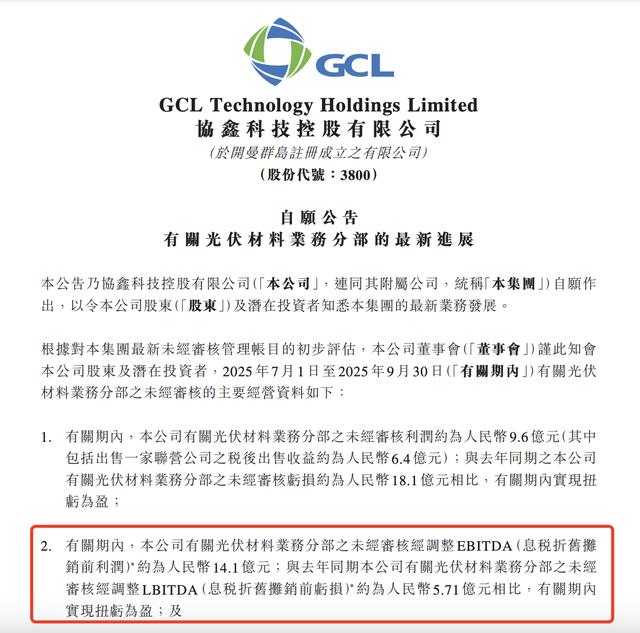
On October 16th, GCL Technology released a voluntary announcement stating that its photovoltaic materials business turned a profit in the third quarter of this year, with an unaudited profit of 960 million yuan, a significant improvement compared to the loss of 1.81 billion yuan in the same period last year.
For GCL Technology, the significant turnaround in performance in the third quarter is undoubtedly an important signal, indicating that it has emerged from the "darkest hour."
However, the market had already anticipated the improvement in GCL Technology's performance.
On the day after the release of the voluntary announcement, GCL Technology's stock price opened high and closed low, with a 6.52% decline at the end of the day. As of the latest closing, its total market value is HK$39.3 billion. According to statistics, GCL Technology's increase this year is about 20%, which is not outstanding in the photovoltaic industry.
The Logic Behind the Profit
Actually, the reason why the market is "unimpressed" by GCL Technology's significant turnaround in the third quarter is mainly that the improvement in its performance does not come from changes in the industrial logic.
In the voluntary announcement, GCL Technology summarized the reasons for its significant turnaround in the third quarter. Apart from the increase in the profitability of the business driven by the rise in silicon material prices, the key was the gain of 640 million yuan from the sale of an associated company. This so - called "associated company" is Xinhua Semiconductor, which was nurtured and incubated by the GCL Group, and the group's founder, Zhu Gongshan, has repeatedly expressed his "pride" in it.
Different from ordinary silicon material enterprises, GCL Technology is recognized in the industry as a "technology fanatic." Its long - term goal has been the research, development, and commercialization of disruptive photovoltaic technologies, such as the previously niche granular silicon technology. Compared with polycrystalline silicon produced by the traditional modified Siemens method, granular silicon has significant advantages in energy consumption, cost, and carbon footprint. Therefore, it is regarded as the next - generation silicon - based material. However, the dedication to technology also means huge capital investment and a long return cycle. For example, in 2024, GCL Technology's R & D expenditure was 1.102 billion yuan, while Daqo New Energy's R & D expense was only 32.78 million yuan.
Against the backdrop of increasing "involution" in the photovoltaic industry, the continuous high - level R & D investment has put GCL Technology under unprecedented operational pressure. The financial report data shows that in the first half of this year, GCL Technology suffered a huge loss of 1.776 billion yuan, a 20.04% decline year - on - year. In 2024, GCL Technology even lost 4.75 billion yuan. The huge losses have continuously consumed GCL Technology's cash flow. Coupled with the serious losses of its sister company, GCL System Integration Technology Co., Ltd., within the group, and the fact that the approximately 4 billion yuan private placement plan has not been finally completed, GCL Technology had to sell Xinhua Semiconductor.
So, how regrettable is it for GCL Technology to sell Xinhua Semiconductor?
Public information shows that Xinhua Semiconductor was jointly established by the GCL Group and the National Integrated Circuit Industry Investment Fund in 2015, focusing on the research, development, and production of electronic - grade high - purity polycrystalline silicon. In the semiconductor industry, there are two major "bottleneck" areas: lithography machines on the equipment side and electronic - grade polycrystalline silicon on the material side. The electronic - grade polycrystalline silicon required for semiconductor manufacturing has extremely high purity requirements, reaching over 11 nines. Previously, the electronic - grade polycrystalline silicon field was long - term monopolized by international giants such as Germany's Wacker Chemie and the United States' Hemlock. The price of electronic - grade polycrystalline silicon per kilogram was as high as 3,000 - 5,000 yuan, nearly a hundred times the price of solar - grade polycrystalline silicon. Xinhua Semiconductor successfully broke this monopoly.
Data shows that currently, the electronic - grade polycrystalline silicon produced by Xinhua Semiconductor has achieved an ultra - high purity of 13 nines. At the end of 2024, Xinhua Semiconductor's 10,000 - ton electronic - grade polycrystalline silicon project in Inner Mongolia was successfully completed and put into trial production, making Xinhua Semiconductor the only domestic enterprise capable of providing raw materials for 12 - inch large silicon wafers, directly serving the supply chain of a domestic technology giant's 14nm, 10nm, and 7nm silicon wafers. By December 2024, Xinhua Semiconductor had completed the acceptance of the listing counseling on the Science and Technology Innovation Board and originally planned to apply for an IPO in 2025. No wonder the capital market remained indifferent to GCL Technology's turnaround after selling such a promising enterprise.
The First Glimmer of Hope
Although it is a pity to sell Xinhua Semiconductor, GCL Technology still has a good prospect.
The reason for this judgment is that GCL Technology's core technology, granular silicon, has become increasingly mature and is getting closer to large - scale commercialization. Of course, to understand the value of granular silicon, one first needs to understand the mainstream production technology routes of polycrystalline silicon.
Currently, the mainstream production technology routes of polycrystalline silicon are mainly divided into two types: the traditional "modified Siemens method" and the "silane fluidized - bed method."
The traditional "modified Siemens method" is the most mainstream process in the industry at present. The product produced is rod - shaped silicon. This method has mature technology and relatively low cost. However, since the silicon material needs to be repeatedly heated and cooled during the production process, the power consumption per ton of products can be as high as about 60,000 kWh. Therefore, the "modified Siemens method" also has the defect of extremely high energy consumption.
In addition, the production process of the "modified Siemens method" is intermittent and cannot run continuously. Moreover, there is a risk of introducing impurities when the rod - shaped silicon is crushed into blocks.
The "silane fluidized - bed method," as a less - common production process, produces granular silicon. In the fluidized - bed reactor of the "silane fluidized - bed method," through the continuous deposition of silane gas on silicon seed crystals, granular polycrystalline silicon with a particle size of about 1 - 2 millimeters is directly generated without introducing impurities. In addition, this is a continuous production process, and the reaction temperature is only 500 - 800°C, much lower than that of the "modified Siemens method."
However, the "silane fluidized - bed method" also has its disadvantages. As early as June 2021, LONGi Green Energy stated in response to an investor's question that the granular silicon produced by the "silane fluidized - bed method" has four disadvantages: high metal content, high carbon content, presence of powder, and hydrogen content. In addition, the turbidity problem of granular silicon was particularly prominent before. An increase in the usage ratio would lead to a significant increase in the wire - breaking rate, resulting in product quality problems. It is precisely because the granular silicon produced by the "silane fluidized - bed method" has many problems such as high metal impurities and unsatisfactory crystal pulling that photovoltaic giants like LONGi were previously reluctant to use granular silicon.
However, with continuous technological improvement and optimization, granular silicon has gradually shown strong competitiveness due to its significant advantages in cost and low - carbon aspects. According to the data released by GCL Technology, the cash cost of its granular silicon is on a continuous downward trend. As of the second quarter of 2025, the cash cost has dropped to 25.31 yuan/kg. As the cost continues to decline, the price advantage of granular silicon is obvious. According to infolink data, as of October 2024, the average price of polycrystalline silicon dense lumps was 40 yuan/kg, and the average price of polycrystalline silicon granular material was 36.5 yuan/kg. It can be seen that the selling price of granular silicon is nearly 10% lower than that of rod - shaped silicon.
Overall, although GCL Technology sold its core asset, Xinhua Semiconductor, the "self - amputation for survival" is a crucial step in its grand bet on granular silicon. The sale of Xinhua Semiconductor has bought GCL Technology valuable "ammunition" and time for the continued progress of its main technical route. Currently, against the backdrop of the increasingly mature "silane fluidized - bed method" technology, GCL Technology has obviously emerged from the darkest hour.
This article is from the WeChat official account "Kanjian Finance," author: Kanjian Finance, published by 36Kr with authorization.