The controlling shareholder "dipped into their own pockets" to compensate VCs after selling the company for less than 30% of its value.
At the beginning of 2023, when we were researching semiconductor investments, an investor analyzed for us that the high valuations driven by the chip investment boom after 2018 would inevitably be corrected in the next two years. This statement has come true in this year's semiconductor M&A wave.
Since the beginning of this year, it has become a common practice for listed companies to acquire semiconductor startup projects. According to statistics from Touzhong Jiachuan, as of today since January 1, 2025, 90 related transactions have been disclosed in the A-share market. Although many acquisition prices have not been disclosed, a trend of discounted sales can still be seen in the limited cases.
For example, the latest deal, VeriSilicon's acquisition of Point Semiconductor, is a case in point.
At the last round of financing, Point Semiconductor was valued at $500 million (about 3.56 billion RMB), but the acquisition price this time is 950 million RMB, only 26.7% of the aforementioned valuation. Judging from the price alone, every round of investors has suffered losses.
However, in VeriSilicon's acquisition, Pixelworks, the parent company of the seller, gave up some interests to external investors, and the SPV company reserved opportunities for early investors to participate, thus balancing the interests of all parties. In the words of Pixelworks' CEO, "it has maximized the realizable value for external shareholders."
This is not an isolated case. The acquisition of Ruicheng Xinwei by Galen Electronics last month was also similar. Ruicheng Xinwei had a maximum valuation of 4.878 billion, but the transaction price was only 1.9 billion, a discount of less than 40%. Of course, the transaction structure with differential pricing also protected the interests of external investors. Even VCs after the C+ round exited at cost price.
This is what we have witnessed this year: on the one hand, projects that have difficulty entering the capital market are "offering discounts" to pay for the high valuations of the past; on the other hand, for everyone to reach an agreement and exit gracefully, everyone has to "make concessions". Perhaps last year, people still held back during negotiations, but this trend has accelerated significantly this year.
01. Buying a $3.5 billion chip company for $950 million
The acquisition of Point Semiconductor is the second M&A deal disclosed by VeriSilicon this year.
The first one was last month, when VeriSilicon planned to acquire CoreStar Technology, but details such as the price of that transaction have not been disclosed. Immediately afterwards came the news about Point Semiconductor.
Point Semiconductor was originally an American company. Its parent company, Pixelworks, was founded in 1997 and is a chip design company focusing on the video and display fields. Pixelworks went public on the NASDAQ in 2000, established a chip design center in Zhangjiang, Shanghai in 2003, and set up Point Semiconductor in Shanghai in 2004 to accelerate the exploration of the Chinese market.
So far, Point Semiconductor has become a leader in the AI independent display chips for smartphones, holding more than 160 domestic and international invention patents. It has successfully entered the supply chains of mainstream mobile phone manufacturers. It is also a globally leading manufacturer of 3LCD projector main control chips (SOC), with a market share of over 80%.
VeriSilicon plans to acquire it for 950 million RMB. The announced transaction structure is as follows:
1. VeriSilicon will establish a special purpose vehicle (SPV) - Tian Sui Xin Yuan - as the acquisition entity to complete the acquisition of the target company, "Point Semiconductor".
2. VeriSilicon will hold 40% of the shares of Tian Sui Xin Yuan, enjoying control rights and a majority of director seats; the remaining 60% will be held by co-investors.
3. The acquisition price is 950 million RMB, including a cash consideration of 930 million RMB and transaction fees, corresponding to 100% of the equity of Point Semiconductor. The transaction will be paid in a one-time cash payment.
Strategically, VeriSilicon's acquisition of Point Semiconductor is a key move in the era of AI and the wave of visual computing. By strengthening its technological advantages in the field of visual processing, it will further enhance the company's competitiveness in the edge AI ASIC market.
However, it is worth noting that the transaction price this time is only 950 million, far less than Point's previous valuation.
Let's first take a look at the three rounds of financing completed by Point Semiconductor since 2021.
In August 2021, Point began to introduce Chinese funds to promote local financing. Public information shows that in August 2021, VeriSilicon, Beyond Moore Investment, Yitang Changhou, Xinshuo Investment, Canaan Technology and other companies jointly made a strategic investment in Point. At this time, the company's valuation was about 1.5 billion.
One year later, Pixelworks, the parent company of Point Semiconductor, sold a 2.73% minority stake to Chinese investment institutions such as Longding Investment. The transaction amount at that time was $12.9 million, corresponding to a pre - investment valuation of the enterprise of 3.2 billion RMB.
At the end of 2022, the management team and market - oriented investors launched another round of investment. Among them, market - oriented investors bought a 2.76% stake for $14.3 million, corresponding to a pre - investment valuation of about $501.4 million, approximately 3.56 billion RMB.
This means that since the first round, Point Semiconductor's valuation has been higher than the current acquisition price. 950 million is only 26.7% of the company's pre - investment valuation of 3.56 billion RMB at the end of 2022. The valuation has indeed been discounted to less than 30%.
If all investors exit at the same price based on the 950 - million valuation, they will all suffer losses. So the key question is, how to solve the problem of interest distribution for external investors when the valuation is depressed?
02. The controlling party compensates external investors, and VCs don't lose money
The two parties to the transaction did not adopt a differential pricing method. Instead, Pixelworks, the parent company of Point, transferred some of its shares, giving external shareholders a higher exit ratio.
Specifically, Pixelworks' shareholding ratio was adjusted from 78.14% to 49.49%. The overall shareholding ratio of external shareholders increased from 21.86% to 50.51% (see the table below).
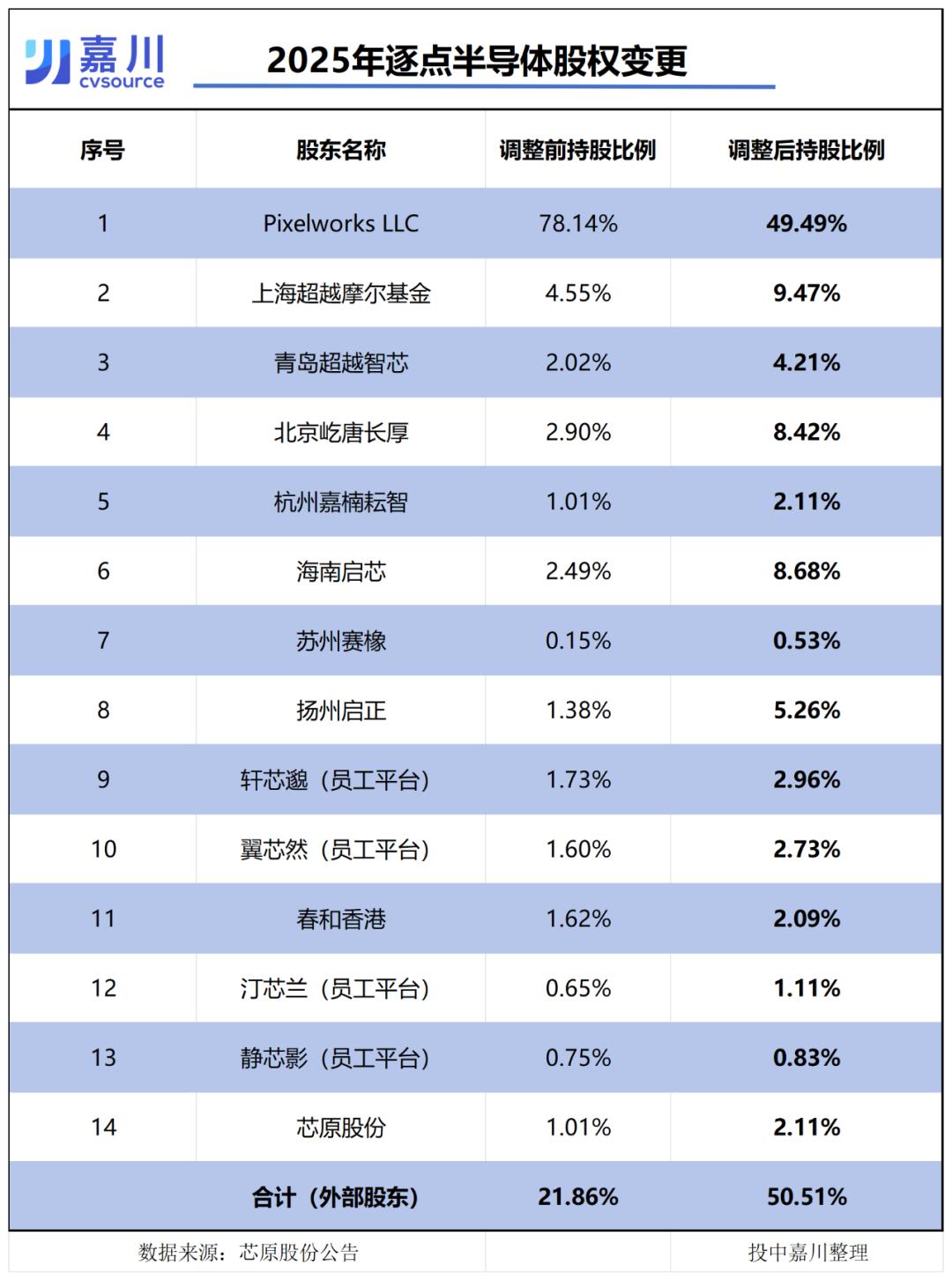
For example, the shareholding ratio of Shanghai Beyond Moore Fund increased from the original 4.55% to 9.47%; Beijing Yitang Changhou's increased from 2.90% to 8.42%; the shareholding ratio of Hainan Qixin (Longding Capital), which participated in the investment in 2022, increased from 2.49% to 8.68%. Even the employee stock ownership platform's shareholding ratio was increased.
Take Hainan Qixin as an example. At the time of investment, the pre - investment valuation of the enterprise was 3.2 billion. Calculated based on the adjusted shareholding ratio of 8.68% and the valuation of 930 million, the exit cost is roughly the same as the investment cost. In other words, the shares reduced by Pixelworks were all distributed to VCs and the management team, and it voluntarily made concessions to compensate investors. At least it ensured that external shareholders would not suffer obvious losses.
Another point is that the establishment of the special purpose vehicle also leaves an opportunity for some investors to seek higher returns.
In VeriSilicon's announcement, it is written as follows: "It is proposed to introduce one or more co - investors (including, but not limited to, some original shareholders of the target company) to invest in Tian Sui Xin Yuan, and jointly invest and acquire the target company externally."
This may imply that not all old shareholders will exit at once. Some VCs or industrial parties can transfer their investments to the newly established SPV and become shareholders of the acquirer's SPV. This arrangement reserves an opportunity for external investment institutions to obtain the added value after the integration of VeriSilicon and Point Semiconductor.
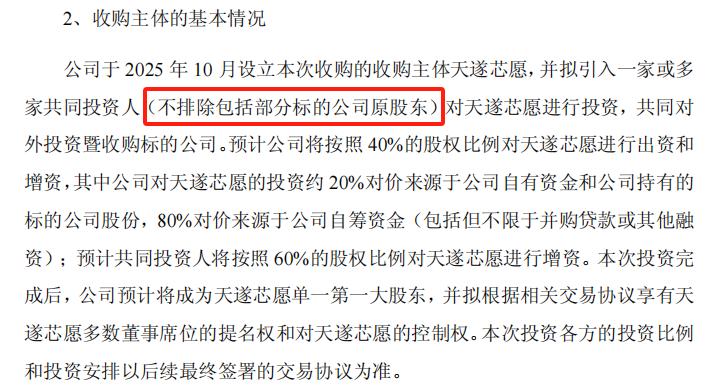
Image source: VeriSilicon's announcement
Of course, this design also brings great benefits to the acquirer, VeriSilicon. Since VeriSilicon only holds a 40% equity stake in the SPV, it only needs 380 million (40% of 950 million) in funds to complete the acquisition of Point.
Moreover, according to the announcement, 80% (about 300 million) of the 380 million was raised through M&A loans, and 20% (about 76 million) was the company's own funds. After subtracting VeriSilicon's 2.11% (about 20 million) stake in Point, it means that VeriSilicon only needs to pay 56 million out of its own pocket to acquire Point. This indeed seems like a cost - effective deal.
03. Caught between internal and external troubles, Pixelworks is eager to cash out and exit
However, there is still a question: why is the controlling party willing to sell a company originally valued at up to 3.5 billion at a 70% discount? Even exit in a way that compensates external investors?
This may be related to Pixelworks' current embarrassing situation.
First of all, Point Semiconductor's financial data is not satisfactory. The announcement shows that in 2024, Point's revenue was 385 million, but the net profit was a loss of 120 million; in the first half of this year, the revenue was only 110 million, and the net profit was a loss of 64 million. Not only is profitability far out of reach, but it is also difficult for the revenue to exceed last year's level. In 2023, Pixelworks still hoped that Point could be listed on the STAR Market and grow stronger with the help of the Chinese capital market, but this plan soon came to nothing.
Moreover, Pixelworks' own business situation is also very poor. Public data shows that in 2024, Pixelworks' revenue was $43.21 million, a 27.60% decrease compared with $59.68 million in the previous year. The net profit was a loss of $28.72 million, a 9.72% increase in losses compared with 2023. That is to say, the parent company's revenue has dropped significantly, the profit has been negative for a long time, and it is under great operating pressure. It not only fails to provide support for the growth of its subsidiary, but also has the motivation to seek capital replenishment and risk hedging.
So from Pixelworks' perspective, which is more important? The answer is obvious. Instead of bleeding slowly, it is better to directly sell the subsidiary to obtain net cash. According to a report from PRNewswire, if this transaction goes smoothly, after deducting transaction costs, taxes, etc., Pixelworks is expected to receive about $50 - 60 million in cash, which can quickly fill its financial gap.
Coupled with the current background of Sino - US technological competition and supply - chain re - layout, the political risks, compliance costs, and uncertainties such as export controls of China - related businesses have increased. Therefore, it is even more urgent for Pixelworks to sell its Chinese business.
On the day the news was released, Pixelworks' stock price dropped from a high of $14.03 to a low of $7.165, a decline of more than 47%. However, this did not change the optimistic view of Pixelworks' CEO, Todd DeBonis. He said that this is the optimal path for the future development of Pixelworks and its Shanghai subsidiary, and it has also maximized the realizable value for external shareholders. He also said that the transaction will be completed as soon as possible this year. It can be seen that Pixelworks really wants to get out as soon as possible.
References:
1. Pixelworks Announces Definitive Purchase Agreement to Sell its Shanghai Semiconductor Subsidiary to VeriSilicon
2. Pixelworks' Shanghai subsidiary, Point Semiconductor, obtains a new round of strategic investment
Pixelworks' Point Semiconductor announces a strategic equity investment in its Shanghai subsidiary
This article is from the WeChat official account "Beyond the J Curve", author: Yang Boyu, published by 36Kr with authorization.