The threshold for automobile tax cuts has been reset. Is BYD hit hard again?
At the end of each year, China's new energy vehicle policies are a key factor that affects the market. The key policies mainly include subsidies for scrapping old vehicles and replacing them with new ones, as well as purchase tax exemptions.
Among them, the purchase tax exemption for new energy vehicles has no regional differences, which is easy to understand and has the most obvious impact on users. According to the original exemption plan, the exemption will continue from 2024 to 2025, but the exemption amount per vehicle will not exceed 30,000 yuan. Starting from 2026, new energy vehicles will be subject to full taxation, but at a half - rate, which means a 5% vehicle purchase tax (the original rate is 10%).
The half - rate purchase tax was expected, but the recently introduced policy has also raised the technical standards for models eligible for tax incentives through core indicator adjustments. In addition to the reduction in the purchase tax amount, the subsidy threshold has also been raised. The questions are:
Will BYD face more pressure after being closely watched for "price cuts"? Will the minimum pure - electric range requirement benefit CATL or second - tier battery manufacturers? Will there be a big - scale price cut in the fourth quarter?
Let's analyze these questions in depth:
1. Will the purchase tax policy shift from exemption to half - rate collection be implemented as planned?
The purchase tax exemption policy is directly related to consumers' car - buying costs. According to the policy at the end of 2023, for eligible new energy vehicles, starting from 2026, the purchase tax will be halved.
Announcement No. 10 [2023] of the Ministry of Finance, the State Taxation Administration, and the Ministry of Industry and Information Technology states: "New energy vehicles purchased between January 1, 2024, and December 31, 2025, are exempt from vehicle purchase tax. For each new energy passenger vehicle, the exemption amount does not exceed 30,000 yuan. New energy vehicles purchased between January 1, 2026, and December 31, 2027, are subject to a half - rate vehicle purchase tax. For each new energy passenger vehicle, the reduction amount does not exceed 15,000 yuan."
The calculation method is: Subsidy amount (with a cap of 15,000 yuan) = Total vehicle price including tax / 113% (13% is the VAT) × (10% - 5%).
If this policy remains unchanged, new energy vehicles will be subject to purchase tax starting from 2026, which is completely in line with expectations. Therefore, before the policy change, there should be a lot of new car - buying demand in the fourth quarter of this year.
As mentioned before, "eligible" means that the models must be included in the "Catalogue of New Energy Vehicles Exempt from Vehicle Purchase Tax". Two days ago, relatively unexpected higher technical standards were set for models eligible for exemption, and the 2026 exemption catalogue will be updated based on the new requirements.
2. How does the tax exemption policy affect consumers?
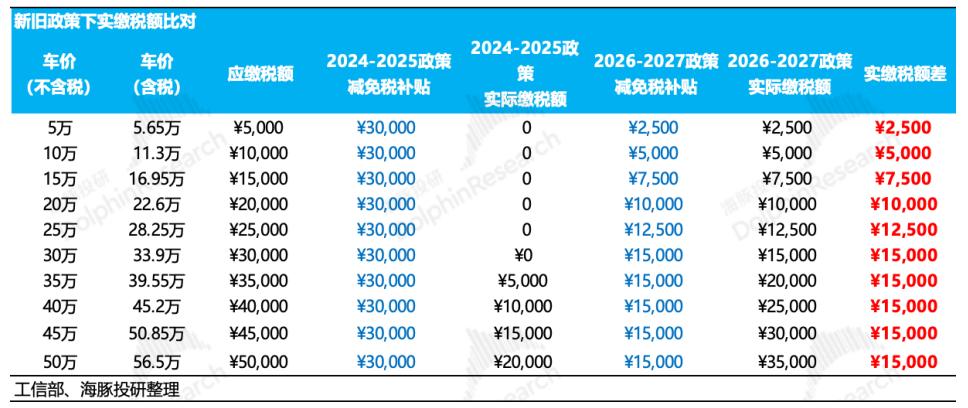
Overall, under the new policy, all new energy vehicles will need to pay purchase tax from 2026 to 2027 (at a half - rate, with an actual tax rate of 5%), while models priced below 300,000 yuan are completely tax - exempt before the end of 2025.
Specifically: For a 100,000 - yuan vehicle, consumers will need to pay an additional 5,000 yuan; for a 200,000 - yuan vehicle, an additional 10,000 yuan; and for vehicles priced above 300,000 yuan, an additional 15,000 yuan. Overall, this is equivalent to a 3 - 5% increase in car - buying costs.
For consumers planning to buy a car in early 2026, it is very likely that there will be a wave of concentrated purchases at the end of the "full - exemption" period, that is, in the fourth quarter of 2025 (combined with year - end promotions, the actual discount may be even greater), resulting in a short - term demand surge. The pre - emptive demand may put pressure on the year - on - year sales performance of car companies in Q1 2026 (which is already a slow sales season).
Looking at different price ranges, the 50,000 - 150,000 - yuan market will be most affected: Consumers in the lower - end market are very price - sensitive, and some popular models may not be eligible for the 5% tax reduction (details will be discussed later). As a result, demand may shift to the second - hand market or be postponed.
For consumers in the 150,000 - 300,000 - yuan price range (including mainstream new - energy vehicle brands such as NIO, XPeng, and Li Auto) and higher - end markets, the impact of the policy adjustment is relatively controllable. The real test lies with car companies on the supply side.
Consumers in this price range can bear the potential cost increase of 5,000 - 15,000 yuan to a certain extent. Their car - buying decisions focus more on core factors such as product quality, brand image, and technological strength. The impact of price is relatively smaller than that on consumers of vehicles priced below 150,000 yuan.
After carefully reviewing the policy details (see later), Dolphin Research found that the standard adjustment applies equally to all car companies in this price range - eligible manufacturers can enjoy a 5% preferential tax rate.
In this situation, car companies face a similar dilemma: Should they absorb the increased tax costs to maintain stable terminal prices, protect market share and brand image, or pass part of the costs on to consumers?
Of course, in the short term, for cars ordered before the new year and delivered after the new year, car companies will bear the impact of the purchase tax change. In the long run, car companies with strong cost - control capabilities and high vertical integration levels (such as Tesla) are better able to absorb cost pressures; companies with strong brand premium capabilities, such as Huawei and Xiaomi, can indirectly transfer costs through higher vehicle pricing. In addition, companies with high organizational efficiency and good cost - control also have stronger resilience.
Against the backdrop of an equal - footing policy, the company that can offer products with better cost - performance ratios will gain an advantage in this policy adjustment.
3. Adjustments to the technical conditions of the tax - exemption catalogue: What has been adjusted? What is the policy intention? Who will benefit and who will be affected negatively?
A. Policy objective: Shifting from price competition to technology competition
Let's focus on the adjustments to product technical requirements made by the three departments, including the Ministry of Industry and Information Technology. Compared with changes in subsidy amounts, technical standards better reveal the policy intention, and this time the intention is clear - to guide the industry from price competition to technology competition through threshold setting.
Next, Dolphin Research will conduct an in - depth analysis of the changes in technical requirements for pure - electric vehicles and plug - in (including extended - range) hybrid vehicles from a micro - perspective.
1. Pure - electric vehicles:
Pure - electric models eligible for the 2026 tax - exemption list must comply with the new national standard GB 36980.1—2025, which is a basic requirement for efficiency improvement.
As shown in the figure, the new national standard (blue line) has systematically adjusted the calculation method for the energy consumption limit (ECL). The limit curve is generally lower than the requirements of the "Technical Requirements for New Energy Vehicle Products" (Announcement No. 32 [2023] of the Ministry of Finance, the State Taxation Administration, and the Ministry of Industry and Information Technology / Attachment) (yellow line).
This means that for almost all vehicle weight categories, the "energy consumption limit" set by the new standard is much stricter than the "target value" (i.e., the limit) of the old standard. For vehicles of the same curb weight, the new standard allows significantly lower power consumption per 100 kilometers. This shows that the policy has set a more stringent threshold for vehicle energy - efficiency performance, aiming to systematically improve the overall energy - consumption management level of vehicles.
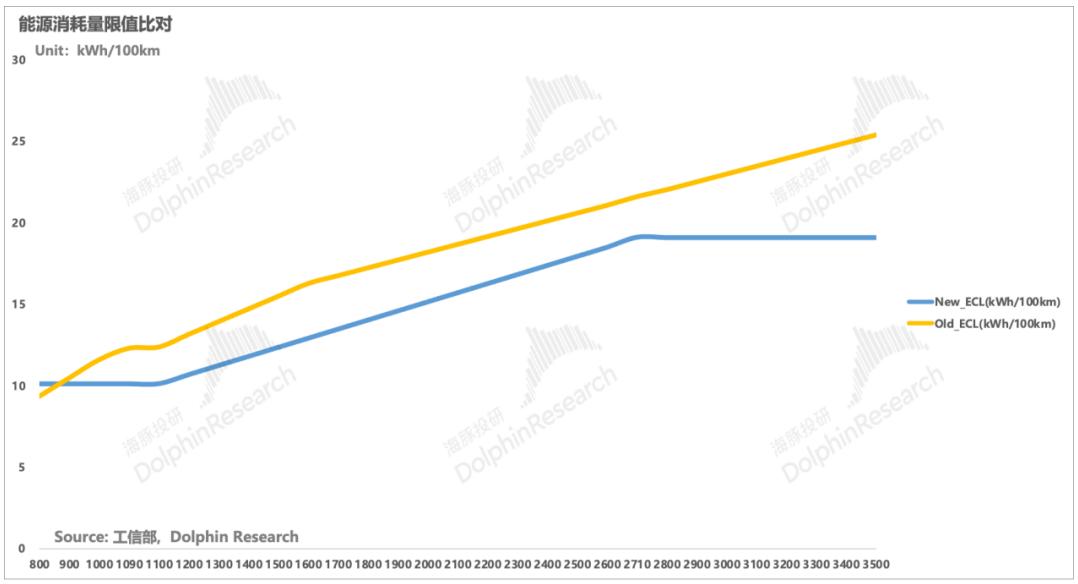
1) Light - weight small - car market (curb weight less than 1100 kg)
The most significant change in the new standard is that the slope becomes zero - the slope of the old standard in this range was the highest among the three segments, giving small cars more flexibility in energy consumption when increasing weight. The new policy completely eliminates this "leniency" and no longer allows small cars to exceed the energy - consumption limit due to increased weight. This means that the path for some small cars in the past, which could meet the standards even with heavy bodies, high wind resistance, and backward electronic control technology, relying on the high - slope "exemption," has been completely blocked.
2) Mainstream passenger - car market (curb weight between 1100 kg and 2510 kg)
The new standard covers a wider weight range, and its slope is between the "steep" and "gentle" slopes of the old standard. It encourages light - weighting without overly penalizing reasonable configuration upgrades. The most critical change is that the starting point (intercept) of the entire energy - consumption curve has been significantly lowered. This is equivalent to setting a significantly higher technical threshold for all mainstream models.
The impact on the market is structural, with the pressure mainly on hybrid vehicles: High - energy - consumption gasoline - to - electric converted models and old platforms will be forced out of the market - models that simply retrofit the chassis of fuel - powered vehicles with battery packs and lack optimization of dedicated electric platforms cannot meet the energy - consumption requirements at all. On the other hand, for car companies still selling such models, their production lines, inventories, and even brand values will face significant impairment risks.
3) High - end luxury - car market (curb weight greater than 2510 kg)
The slope of the old standard increased in the heavy - vehicle range. Even for vehicles weighing more than 3 tons, their energy consumption was still allowed to increase with weight. The new standard sets a clear energy - consumption ceiling - 19.1 kWh/100 km.
In terms of policy intention, Dolphin Research believes that the government does not encourage car companies to create a "luxury feel" by unrestrictedly piling on configurations (such as large screens, refrigerators, and massage seats).
High - end electric - vehicle brands must rely on top - notch technologies - more efficient three - electric systems, better aerodynamic designs, and more lightweight materials - to offset the energy - consumption pressure caused by increased weight and additional configurations.
B. Pass for pure - electric vehicles, changes needed for hybrid vehicles
To more intuitively evaluate the actual impact of the new policy, Dolphin Research calculated the eligibility of pure - electric models currently in production and sales of multiple covered new - energy vehicle companies (if both old and new models are sold, the new models were selected) and compiled a list of models that can enter the "Tax - Exemption Catalogue" effective in 2026 and later.
1) Pure - electric vehicles: Most pass, except for Geely's Geometry series
The calculation results show that for pure - electric vehicles, the tightening of the new tax - exemption policy has a relatively controllable impact on most car companies. Among a total of more than 80 pure - electric models of ten car - company brands in the statistics, the vast majority of models can meet the new standard requirements and smoothly enter the tax - exemption list. Only 4 models under Geely and 1 model under Leapmotor may not be eligible for the 2026 tax - exemption list, with a total of 5 models at risk of not meeting the standards.
This result indirectly confirms two points: First, after years of development, mainstream car companies have basically matured in the energy - efficiency management technology of pure - electric vehicles. Although the new standard is stricter, it is easy to meet with some effort. Second, the models that cannot meet the standards are mainly concentrated in specific product lines of individual car companies, probably based on old platforms or with insufficient energy - consumption optimization.
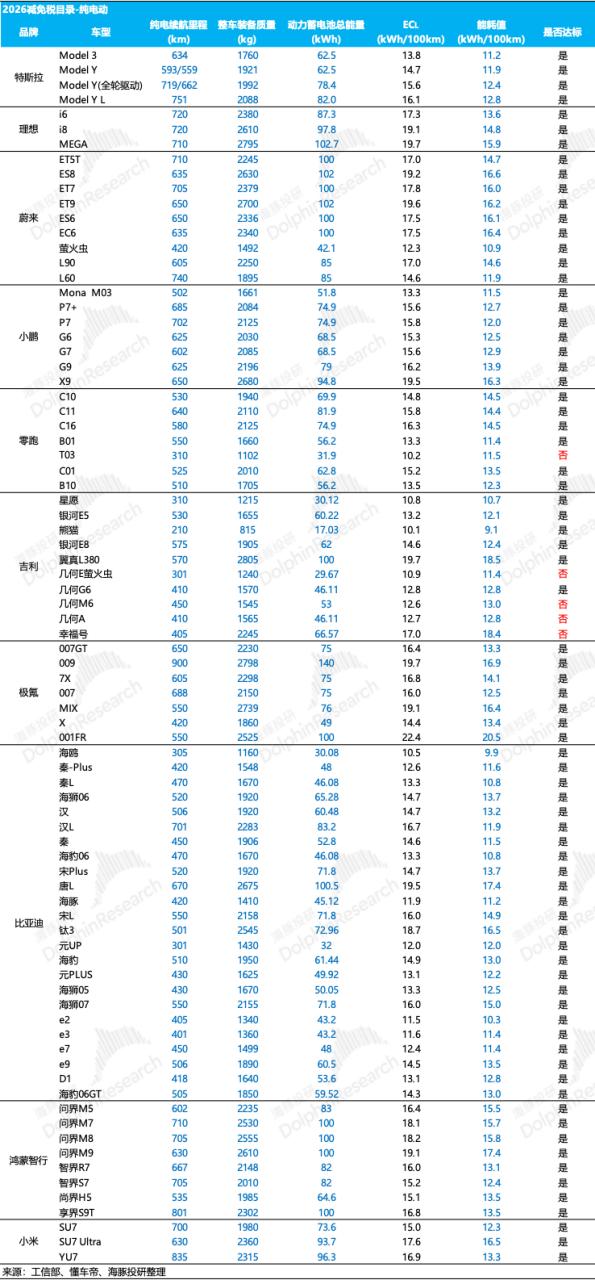
From the above information, it can be seen that the tightening of the new standard has little overall impact on pure - electric vehicles. The problematic models are mainly in the economy - class small - car market (priced between 50,000 and 100,000 yuan). Models such as Leapmotor T03 (exceeding the standard by nearly 13%) and Geometry E (exceeding the standard by nearly 5%) face the risk of being excluded due to excessive energy consumption.
These models are mainly targeted at the cost - effective and mass - market segments. To control costs, they often do not use lightweight materials, low - wind - resistance designs, or efficient three - electric systems. Their energy - consumption values exceed the upper limits corresponding to their body weights. For these price - sensitive volume - selling models, losing the tax - rate preference is equivalent to a forced price increase of about 10% (5,000 - 10,000 yuan), which is almost a fatal blow in the highly competitive low - end market. The price disadvantage caused by energy - efficiency differences under the new policy will directly lead to a loss of market share.
Further, the new national standard not only eliminates non - compliant models but also accelerates the elimination of old brands and platforms. Geely's Geometry series is a typical example: The brand was established in 2019, and its core models, Geometry A and Geometry C, are both based on the FE platform. There is a generational gap in the efficiency of their three - electric systems, overall vehicle integration, and lightweight levels compared to dedicated electric platforms after 2023 (such as Geely's SEA architecture). More importantly, the Geometry brand rarely launches new models, and its product line is seriously aging. Against the background that 4 Geely models are not eligible for the 2026 tax - exemption list, most models of the Geometry brand may have difficulty meeting the standards. In fact, this policy presses the "asset - clearance button" for Geely's Geometry brand.
2) Hybrid vehicles: BYD may face difficulties
Let's first look at the key adjustments in the new policy, which mainly focus on 1) energy consumption and 2) different energy consumption (including electricity and fuel consumption) for different vehicle weights.
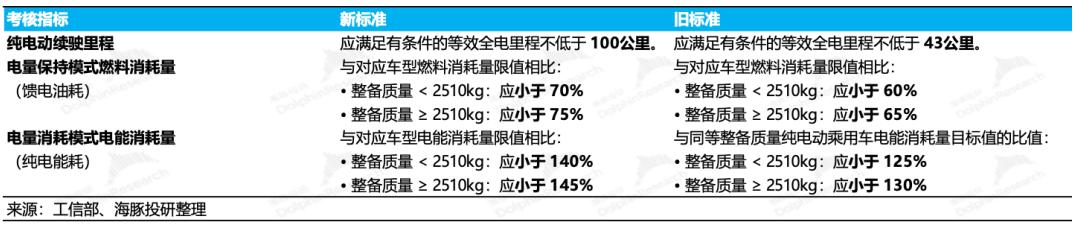
a. The new standard raises the pure - electric range of new energy vehicles from 43 kilometers to 100 kilometers, an increase of 132%. This is the most core variable in this policy adjustment. In terms of usage scenarios, a 100 - kilometer pure - electric range can basically cover the daily commuting needs of urban users. This adjustment redefines PHEVs from "transitional products with frequent gasoline - electric switching" to "products that use electricity for daily use and gasoline for long - distance travel," forming a clearer differentiated competition with pure - electric vehicles