In the era of "fierce competition for the existing market share", office buildings in Beijing are offering various incentives to ensure "renewal and retention" of tenants.
In the third quarter of 2025, the incremental demand in the Beijing office building market remained weak, and the overall market will maintain an environment favorable to tenants.
According to statistics from JLL, as of the end of the third quarter, the vacancy rate in the Beijing Grade A office building market decreased by 0.3 percentage points quarter-on-quarter to 15.5%, showing a continuous downward trend, which alleviated the market pressure to some extent.
The main reasons for the overall decline in the office building vacancy rate are as follows. Firstly, there was less new supply in the market, and there was even zero new supply in the third quarter. Secondly, office building owners are paying more and more attention to the renewal and retention of existing tenants. Moreover, after the rent drops to a certain level, the proportion of enterprise relocation costs (such as decoration) increases accordingly, and the average cost needs to be spread over a longer period, which reduces the enthusiasm of enterprises to change offices.
"The development of the Beijing office building market has entered a new normal, and the breaking of rent barriers between regions has enhanced cross - regional mobility." Zhang Jisu, the Managing Director of JLL North China, said: "Although the overall Beijing commercial real estate market is under full pressure due to insufficient effective demand, all parties' owners are returning to rationality, actively constructing diversified operation strategies, and seeking the 'second growth curve' to enhance core competitiveness and survive the market cycle."
In recent years, the Beijing office building market has shifted from the era of "user growth" to the era of "competition for the existing stock". Office building owners are paying more and more attention to the renewal and retention of existing tenants. Especially, the owners of projects with a long - term high vacancy rate or great pressure to reduce inventory in the near future are stabilizing the tenants in the building by offering more favorable renewal terms. As the cornerstone of stabilizing the leasing structure in the building, some owners are willing to provide additional services such as public area redecoration for high - quality large - area tenants when renewing the lease.
In a market environment with limited incremental demand, the average rent difference between sub - markets has gradually narrowed, resulting in fierce price competition not only within the regional market but also radiating to surrounding cross - regional projects. In the third quarter of this year, some tenants showed a trend of cross - sub - market flow across the city.
For example, there has been a large - scale influx of tenants in the Wangjing and Jiuxianqiao areas because projects with high vacancy pressure in the region have attracted cost - conscious tenants to move in by offering more radical strategies such as a longer rent - free period.
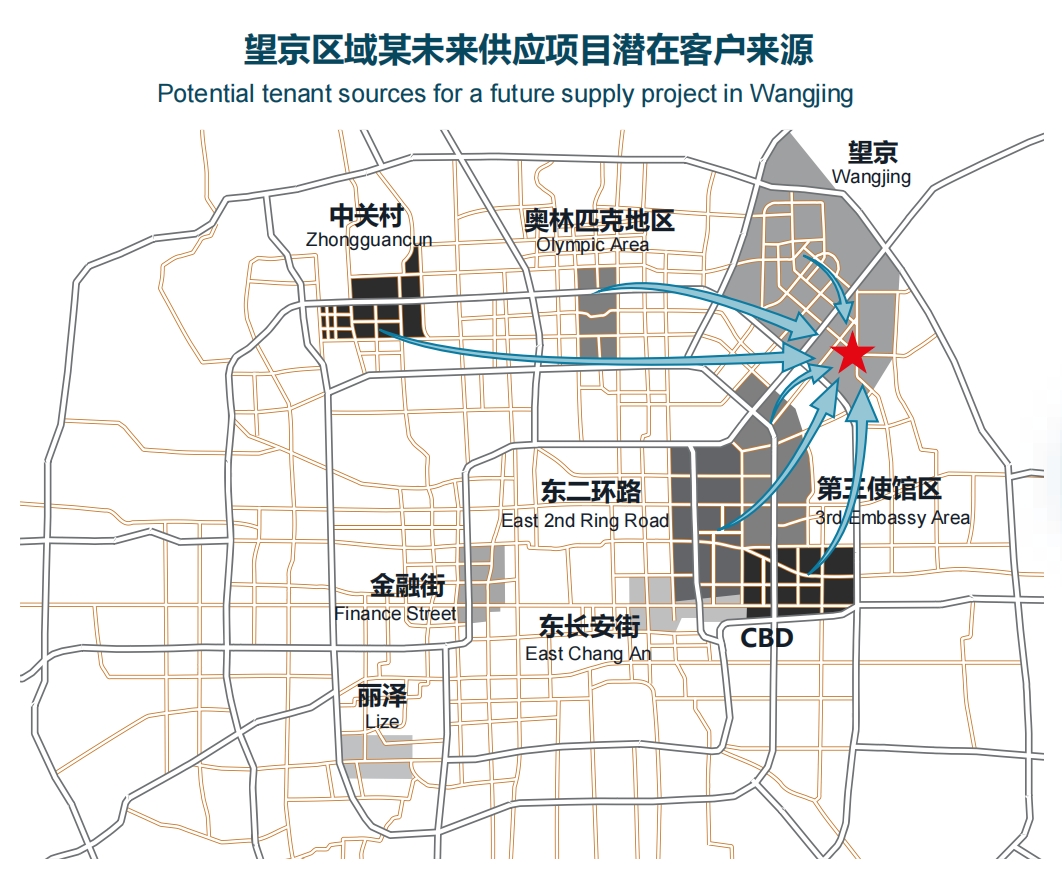
Image source: JLL
Meanwhile, the regional differentiation of the vacancy rate is extremely obvious. The vacancy rates in sub - markets such as Zhongguancun and Financial Street are significantly lower than the city average, while the vacancy rates in the Tongzhou Canal Business District and the Lize Business District are hovering at a high level.
In terms of rent, the continuous decline in tenants' affordability remains the main trend. In the third quarter, tenants' expectations for the market rent continued to decline, and the average rent of Grade A office buildings in the whole city dropped to 223 yuan per square meter per month, a 3.2% decrease quarter - on - quarter. Zhang Siliang, a senior director of JLL Beijing Commercial Real Estate Department, said: "It is expected that the overall downward trend of rent will continue until at least 2027."