A fire accident occurred to the Xiaomi SU7, and the battery and door handle have become the focus of attention.
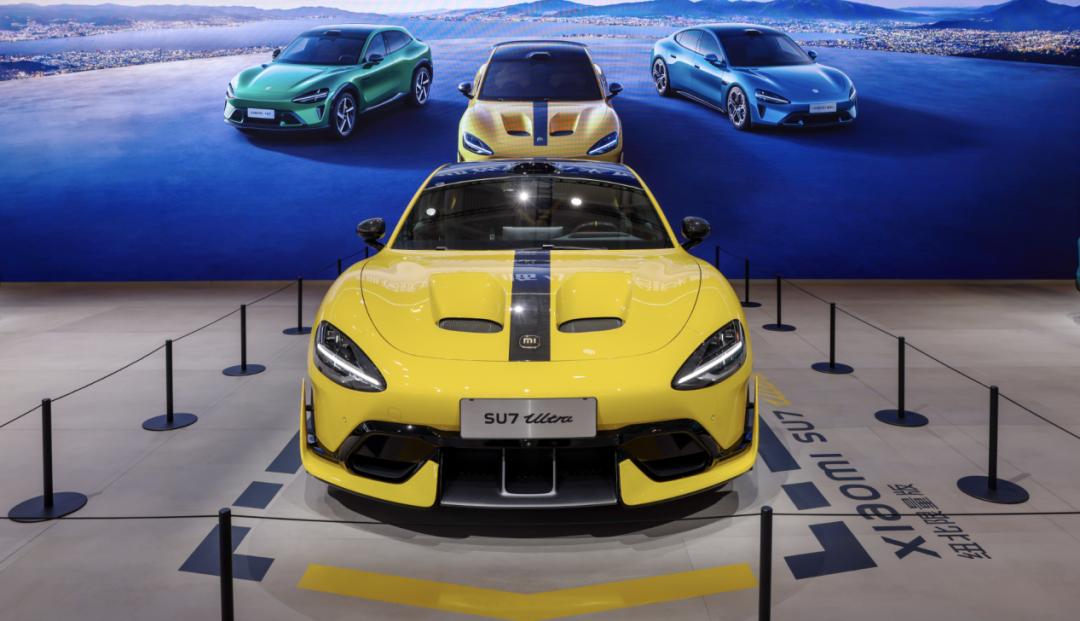
On the morning of October 13th, a traffic accident video spread widely on social media. The video shows that a car caught fire after the accident. Four people successively attempted to rescue the unconscious driver by breaking the window or opening the door, but all efforts were in vain. The on - site pictures show that the rear design, the dug - out hood of the burning vehicle are consistent with those of the Xiaomi SU7 Ultra.
In the afternoon of the 13th, a police report from the Traffic Management Bureau of the Chengdu Public Security Bureau showed that at around 3:18 am on October 13, 2025, a road traffic accident occurred on the southern section of Tianfu Avenue in our city... After preliminary investigation, the party involved, Deng Moumou (male, 31 years old), was driving a small car with the license plate Sichuan AC****9... It collided with a small car with the license plate Sichuan AA****3 driven by Li Mou in the same direction ahead. Then it crossed the central green belt of the road and caught fire. The accident caused the death of driver Deng Moumou... After testing, Deng Moumou was suspected of driving a motor vehicle under the influence of alcohol.
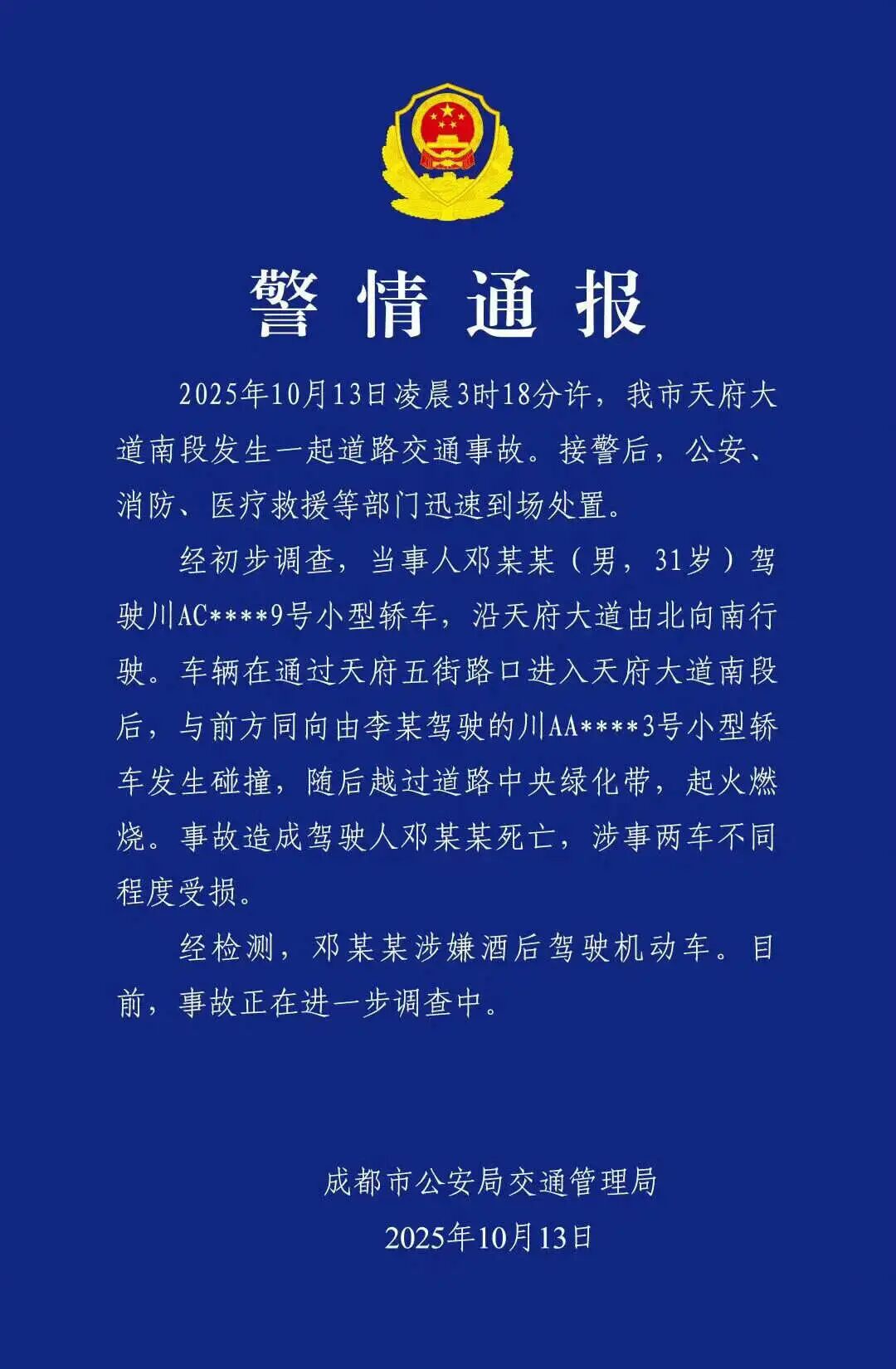
Combining the video and picture materials on social media with the police report, four facts can be confirmed: First, both of the involved cars are pure electric vehicles, and one of them caught fire; Second, the driver of the burning vehicle was suspected of drunk driving; Third, the accident was quite tragic, as the burning vehicle crossed the central green belt of the road; Fourth, passers - by tried to rescue the driver, but they still couldn't open the door in the end, resulting in the driver being trapped in the burning vehicle.
What cannot be confirmed from the police report is whether the driver of the small car with the license plate Sichuan AC****9 died immediately after the accident or because of the fire of the involved vehicle.
It can be seen from the video clips on social media that four people passing by the accident scene successively tried rescue measures such as pulling the door handle to open the door and breaking the window to open the door. However, the window glass couldn't be broken, and the door couldn't be opened. Subsequently, the entire car body was engulfed by flames. Judging from the on - site pictures, the whole car was burned down to only an iron frame.
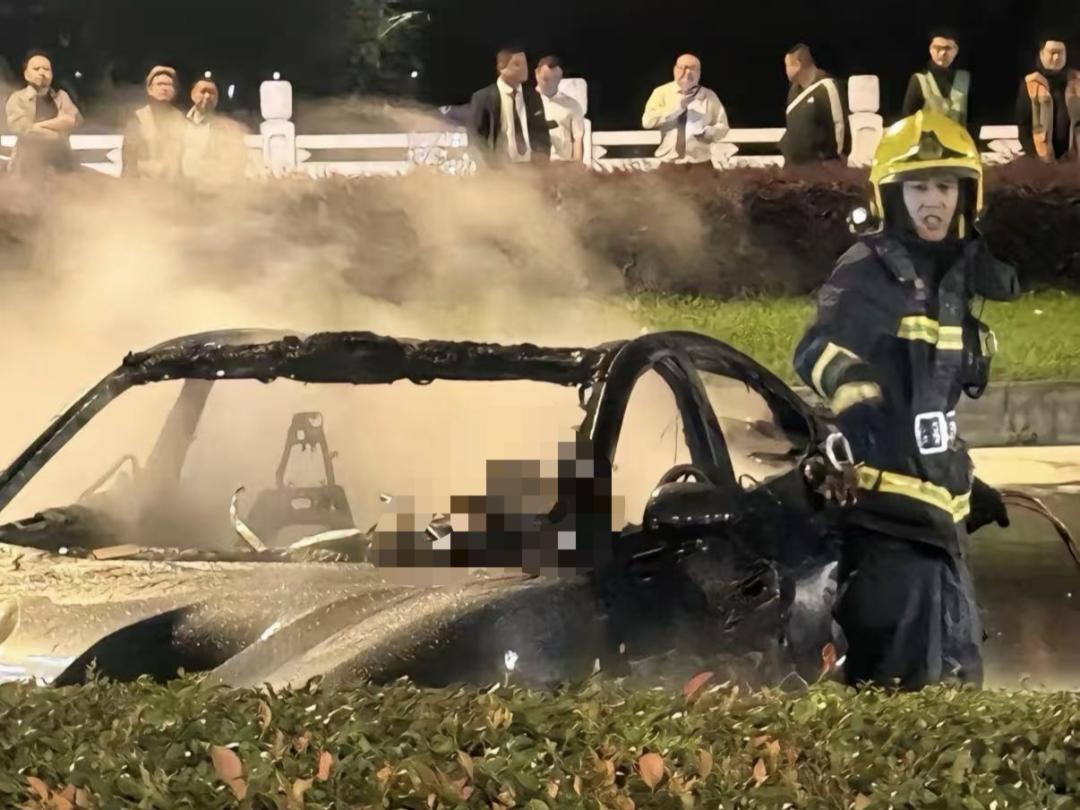
Pictures of the accident scene circulated online
As of now, Xiaomi Auto and Lei Jun have not made any comments on the incident of "the car caught fire after the accident and the door couldn't be opened". Lei Jun's Weibo shows that he is in Xinjiang, testing Xiaomi's third - generation model with the Xiaomi Auto test team. According to comprehensive media reports, this car is the Xiaomi YU9. Xiaomi's customer service explained that the vehicle would automatically unlock when it detected a collision signal. In fact, both the collision and the fire have become facts, but the driver's door of the vehicle didn't unlock.
Due to this accident, the battery safety and door handle design that Xiaomi Auto had previously emphasized have once again been questioned. Lei Jun once explained in detail the inverted cell design at the Xiaomi SU7 technology press conference - when a collision or thermal runaway occurs, the flames or impact force will be released downward instead of towards the vehicle occupants, buying time for rescue. To solve the impact of gravity on the electrolyte after the cell is inverted, Xiaomi also specially developed a special electrolyte with CATL.
Xiaomi Auto also emphasized that the Xiaomi CTB battery has the industry's top - level 17 - layer high - voltage insulation protection in terms of protection. In particular, 165 pieces of aerogel insulation materials are laid on both sides of the cell, which can resist a maximum temperature of 1000℃. In addition, there is a comprehensive 14 - layer hardcore physical protection, including 3 - layer top support, 3 - layer side - impact protection, and 8 - layer bottom protection structure.
In the 131st episode of Xiaomi Auto's Q&A with netizens, Xiaomi Auto claimed that the bulletproof coating used at the bottom of the Xiaomi SU7 Ultra battery pack is widely used in military equipment and aerospace devices, such as the mine - resistant plates of armored vehicles, the armor of military vehicles, and bulletproof helmets, and has anti - explosion and anti - bullet effects.
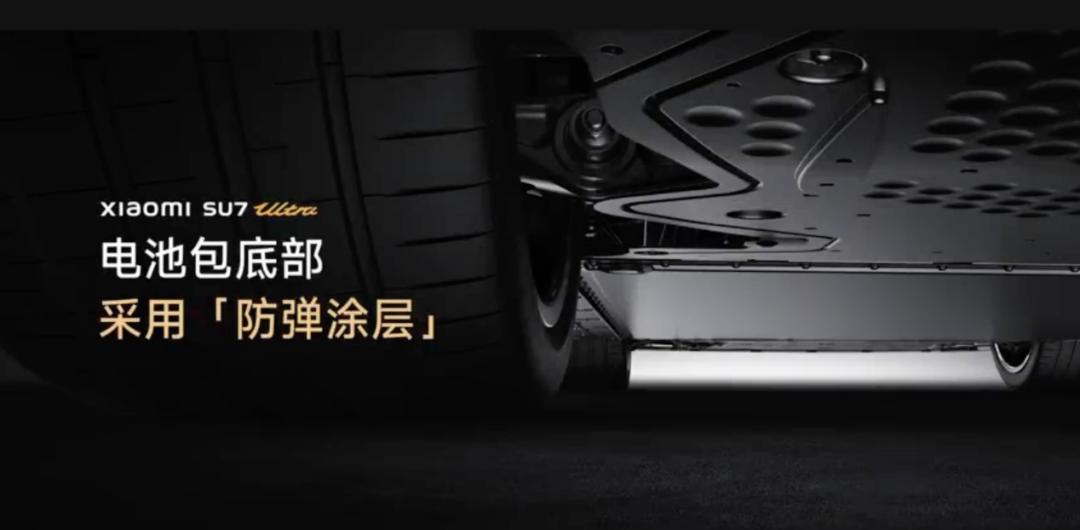
After applying this material, the tear - resistance performance of the bottom of the Xiaomi SU7 Ultra battery pack is improved by 10 times, the puncture - resistance performance is improved by 13 times, the scratch - resistance performance is improved by 10 times, and the adhesion is improved by 10 times compared with the traditional battery - pack bottom protection material, which can fully improve the scratch - resistance and puncture - resistance performance of the Xiaomi SU7 Ultra battery pack.
To intuitively demonstrate the effect of this material, Lei Jun also specially posted a video. He conducted an interesting test by coating the bulletproof coating on a watermelon and dropping it from the sixth - floor height, and the watermelon didn't break.
In addition, Xiaomi Auto also explained in the Q&A the extreme - scenario battery test conducted by CATARC on the Xiaomi SU7 Ultra: The simulated collision simulated the huge energy impact that the battery needs to withstand when the vehicle hits a wall at high speed and the acceleration exceeds 60g. The pit - scraping scenario is also very close to the user's daily life, simulating the potential situation of the vehicle being scraped by a damaged road when driving at a speed of 30 km/h. After the scraping, a wading test was directly carried out when the damage degree of the battery was unknown, which not only tested the anti - scratch and puncture ability of the battery pack but also tested its waterproof and sealing performance.
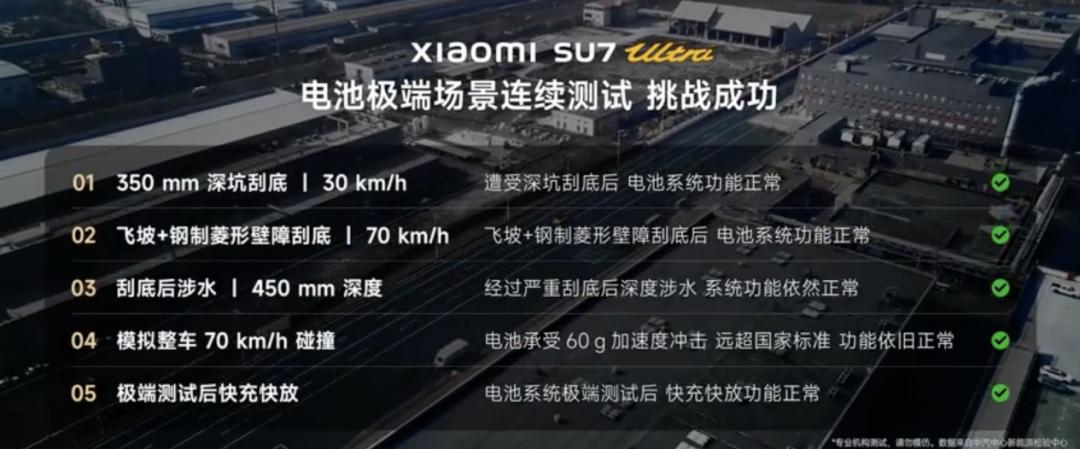
In this accident that occurred in Chengdu, the Traffic Management Bureau of the Chengdu Public Security Bureau has not provided the speed of the involved vehicle at the time of the accident. However, the description of "crossing the central green belt of the road" in the report and the description of "simulating the vehicle hitting a wall at high speed and the acceleration exceeding 60g" in Xiaomi Auto's Q&A both belong to extreme collision conditions, which may be the cause of the vehicle fire. Regarding the condition of the battery pack, we can only wait for the subsequent investigation results.
The door handle is another controversial point. Like the Xiaomi SU7, the SU7 Ultra also uses a fixed semi - hidden door handle design with a micro - switch inside, which can easily achieve electric unlocking. Xiaomi Auto claims that this design is easier to open than the "flip - up semi - hidden door handle" with a pure mechanical structure in the early years, and there is no need to physically lift the handle hinge.
A review blogger disassembled the door handle of the Xiaomi SU7 and found that the door handle of the Xiaomi SU7 indeed has no mechanical structure and is an electronically controlled switch. Under normal circumstances, such a design is indeed conducive to easily opening the door. However, in an emergency situation where the vehicle loses power due to a collision, this design may become a fatal flaw.
Data from C - IASI shows that the success rate of the door popping out in a side - impact test for models equipped with electronic door handles is only 67%, far lower than the 98% of mechanical door handles.
Meanwhile, the mechanical handle inside the Xiaomi SU7 is located relatively low, and there is no mechanical handle on the outside door handle. Therefore, when the driver inside the car is unconscious or unable to rescue himself, rescuers outside the car can only break the window and then reach in to pull the mechanical handle at the bottom inside the door; or they can only cut and break the door - frame structure for rescue. However, both methods take a relatively long time.
A person involved in the rescue recalled that after someone broke the ordinary window glass with the door handle, they still couldn't open the driver's door. Soon after, there was an obvious explosion sound. They suspected it was a battery explosion, so the rescuers stayed away from the vehicle.
This accident of the Xiaomi SU7 Ultra has once again triggered discussions on the new national standards for batteries and hidden door handles.
Starting from July 1, 2026, China will implement the new version of "Safety Requirements for Traction Batteries of Electric Vehicles" (GB38031 - 2025, also known as the 2025 new battery national standard), which focuses on strengthening battery safety standards and adds multiple test requirements, including the thermal diffusion test - after the battery thermal runaway, it should "not catch fire and not explode", and the smoke should not harm the people inside the vehicle. The old standard was to give an alarm 5 minutes before the fire. The newly added test items include the bottom - impact test and the fast - charging cycle test.
Xiaomi Auto claims that all Xiaomi Auto models' battery packs adhere to ultra - high - standard development, and the batteries of the Xiaomi SU7, Xiaomi SU7 Ultra, and Xiaomi YU7 all meet the 2025 new battery national standard.
On September 24 this year, the First Department of Equipment Industry of the Ministry of Industry and Information Technology publicly solicited opinions on the mandatory national standard of "Safety Technical Requirements for Automobile Door Handles" (hereinafter referred to as the "Requirements") and three mandatory national standard modification sheets.
The "Requirements" prohibit the design of fully hidden exterior door handles and require each door (excluding the tailgate) to be equipped with a mechanical release function, ensuring that the operating space is no less than 60mm * 20mm * 25mm to improve the safety and reliability of accident rescue. It is recommended that this standard be implemented on January 1, 2027. However, there is still no conclusion on how to handle the existing vehicles with hidden exterior door handle designs and without mechanical release functions.
This article is from the WeChat public account "Power Plant", author: Hua Zijian. It is published by 36Kr with authorization.