In the maritime race, how can Shenzhen catch up with Shanghai?
On October 11th, the
The report puts forward that "Shanghai, Shenzhen, and Qingdao are the leaders of the three major marine economic circles in China". As the leader of China's marine economy, Shanghai ranks second in the world in terms of economic and trade vitality, and its port cargo throughput continues to rank first in the world. It is accelerating the transformation from "a participant in the global supply chain" to "a shaper of the global value chain".
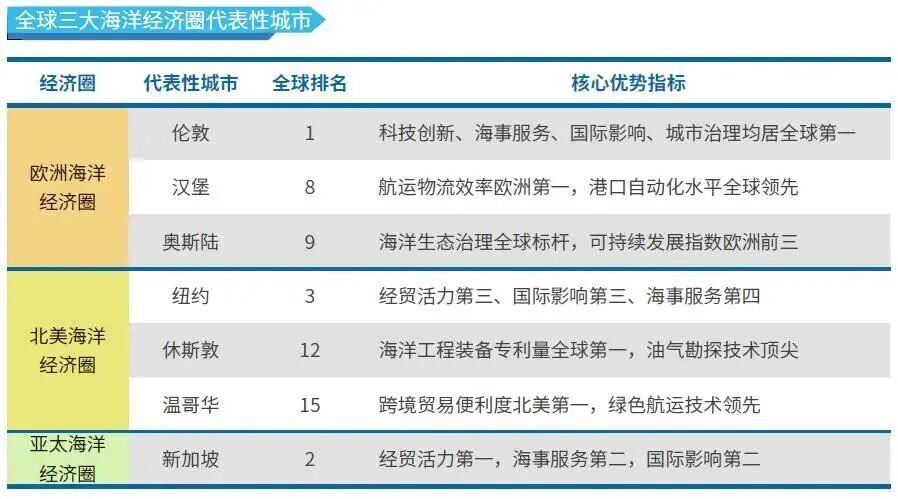
Shenzhen ranks fourth in the world in terms of scientific and technological innovation. Its innovation capabilities in emerging fields such as marine electronic information, high-end equipment manufacturing, and underwater robots provide strong support for building it into a "global ocean center city". Qingdao gives full play to its rich marine science and education resources and ranks eighth in the world in scientific and technological innovation. It has about one-fifth of the national marine-related scientific research institutions and nearly one-third of the national marine-related academicians of the two academies, and has become the national source of marine scientific and technological innovation.
To date, the annual total scale of China's marine economy has exceeded 10 trillion yuan. According to the data previously released by the Ministry of Natural Resources, a preliminary accounting shows that the marine GDP in the first half of this year was 5.1 trillion yuan, more than half of the target has been completed; it increased by 5.8% year-on-year, 0.5 percentage points higher than the growth rate of the GDP. From the perspective of development prospects, the explosive period of the marine economy has just begun.
Looking at different regions, the three major marine economic circles in the north, east, and south of China have formed a differentiated development pattern based on different resource endowments and industrial bases. Among them, the northern marine economic circle has prominent advantages in marine scientific research and education, the eastern marine economic circle has a complete port shipping system and a high degree of export orientation, and the southern marine economic circle has the advantages of a vast sea area, rich resources, and a prominent strategic position.
The report points out that "Shanghai, Shenzhen, and Qingdao are the leaders of the three major marine economic circles in China". From the perspective of the coordinate positioning of the global ocean city competitiveness, Shanghai is in the "top echelon" and ranks fourth overall. Among them, it ranks second in both economic and trade vitality and international influence, sixth in scientific and technological innovation, and fifth in maritime services. In contrast, Shenzhen and Qingdao are both in the second echelon, ranking 11th and 16th respectively.
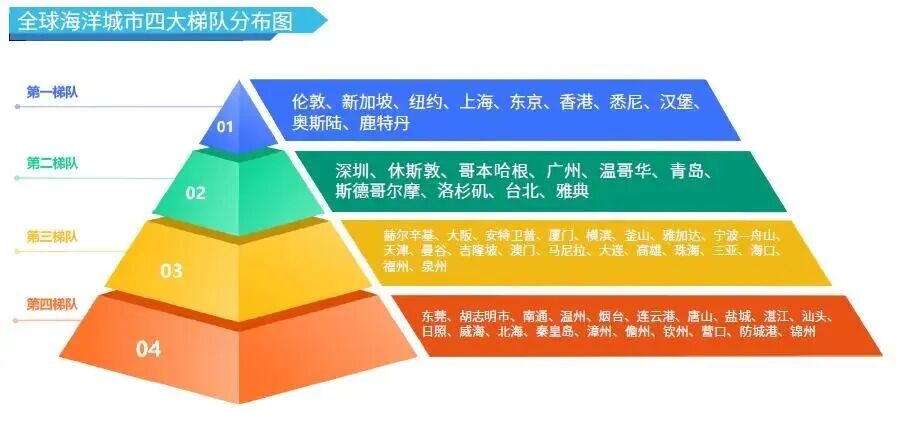
Image source: China Development Institute
Among them, Shenzhen may feel a stronger sense of urgency. As early as 2017, the <13th Five-Year Plan for the Development of the National Marine Economy> proposed to "promote the construction of cities such as Shenzhen and Shanghai into global ocean center cities". This was the first time that Shenzhen was entrusted with the task of building a global ocean center city. In 2019, the
In the view of local scholars, Shenzhen is one of the two global ocean center cities clearly proposed by the state, ranking alongside Shanghai and ahead of it in the order. Among China's 18,000-kilometer continental coastline, Shenzhen is the most representative typical coastal city. However, in terms of data, in 2024, the city's marine GDP reached 540.9 billion yuan, accounting for 14.7% of the GDP. In the same period, Shanghai's marine GDP exceeded one trillion yuan, reaching 1,138.7 billion yuan, accounting for 21.1% of the GDP.
Facing Shanghai's "leading", how can Shenzhen take a further step? "Technology-driven" may become a new opportunity. The report mentioned that Shenzhen can promote the in-depth integration of "deep-sea equipment - new energy - smart port and shipping" technologies, promote the integration of deep-sea mining robots and renewable energy power supply systems, and the linkage between LNG bunkering and intelligent scheduling algorithms; and establish a marine resource trading center to explore the market-oriented allocation of elements such as deep-sea mineral development rights and marine carbon sinks...
According to the next-stage development goals of Shenzhen's marine economy previously put forward, it is clear that it aims to achieve a marine industrial added value of 215 billion yuan by the end of the 15th Five-Year Plan period, with an average annual growth of more than 12%, and a marine service industry added value of 736 billion yuan by the end of the 15th Five-Year Plan period, with an average annual growth of more than 10%.
This article is from the WeChat public account "Urban Evolution Theory", author: Yang Huan. Republished by 36Kr with permission.