KANG Xiaoqiang of LZBio: Break through in the favorable cycle and develop differentiated new drugs | Exclusive interview by 36Kr
In this year's wave of IPOs of innovative pharmaceutical companies in the Hong Kong stock market, VelociBio, a company from Nanjing, Jiangsu, emerged as a "dark horse." Its share price doubling on the first day of listing and the title of "the first TCE stock" brought this pharmaceutical company, which had been operating low - key for 11 years, into the spotlight. The management seized the opportunity to double the fundraising amount and successfully raised nearly HK$1.4 billion.
VelociBio is a company focusing on tumor immunotherapy. Currently, it has 14 candidate drugs, among which 6 have entered the clinical trial stage. Kang Xiaoqiang, the founder, chairman, and CEO of VelociBio, told 36Kr that the company plans to file 5 new drug INDs in 2026. For the company's key pipeline, LBL - 024, in addition to the pivotal clinical trial for extrapulmonary neuroendocrine carcinoma, it will expand to 8 - 10 tumor indications in the next two years, including non - small cell lung cancer and melanoma, which have large patient populations.
"Differentiation" is a term frequently mentioned by Kang Xiaoqiang. He believes that in the highly competitive field of tumor treatment, developing unique drugs is the key to a company's competitiveness. "I even wanted to name the company 'Unique'."
Although it was a joke, it somewhat summarizes the pursuit of this innovative pharmaceutical company. At the beginning of its venture in the tumor treatment field, VelociBio did not choose the crowded PD - (L)1 target but decided to address the problems of patients that drugs like Keytruda and Opdivo cannot solve.
From initially choosing the LAG - 3 target to making efforts to overcome the 4 - 1BB target, which has caused many multinational pharmaceutical companies to fail due to hepatotoxicity, Kang Xiaoqiang believes that developing competitive and differentiated new drugs is the key to supporting the market value of a pharmaceutical company. "We must go a step further on the existing therapies and solve the problems that current drugs cannot solve."
Recently, VelociBio disclosed the clinical research results of its two innovative drugs, which will be announced at ASH (American Society of Hematology). At that time, the data results of highly - anticipated new drugs such as TCE (T - cell engager) will directly influence the stock market's judgment of the company's value.
Tumor Immunotherapy 2.0: From Small to Large, "Screening" Indications
In the field of tumor treatment, PD - (L)1 inhibitors, as epoch - making products, have achieved great success and created the world's best - selling drug with an annual sales peak of $29.5 billion. However, in clinical practice, there is a large group of patients who are ineffective or resistant to PD - 1 inhibitors.
The immune systems of these patients are not active enough, and the tumor microenvironment often presents a "cold tumor" state lacking T - cell infiltration. How to transform their tumor microenvironment into a "hot tumor" that the immune system can recognize and attack has become a difficult problem that many new drug developers are trying to solve.
VelociBio's bispecific antibody drug LBL - 024 (Opatisulumab), which targets PD - L1 and 4 - 1BB, attempts to "conditionally activate" 4 - 1BB. While solving the toxicity problem that has long troubled the 4 - 1BB target, it increases the number of T cells to transform cold tumors lacking immune response into hot tumors. Since 4 - 1BB is widely expressed, once successful, it means that the drug has broad - spectrum anti - cancer potential comparable to that of PD - (L)1 inhibitors.
4 - 1BB is a powerful T - cell co - stimulatory molecule. Once activated, it can greatly enhance the killing ability of T cells. However, the problem is that T cells are distributed throughout the body, especially concentrated in immune organs such as the liver. After traditional 4 - 1BB agonist antibodies enter the human body, they will activate T cells indiscriminately, leading to a strong immune response in the human body and then causing severe hepatotoxicity. This is also the key reason why multinational pharmaceutical companies such as Pfizer and BMS have failed at this target.
VelociBio's LBL - 024 adopts a symmetric molecular design and makes the antibody have a much higher affinity for the tumor microenvironment marker PD - L1 than for 4 - 1BB. This means that the antibody drug will change its conformation and "awaken" the agonistic activity against 4 - 1BB only after binding to PD - L1 on the surface of tumor cells, achieving precise activation of T cells in tumor tissues. This design mechanism makes it possible to reduce the risk of hepatotoxicity.
The clinical trial data of the drug also shows good safety. As of June this year, 175 patients were enrolled in the single - drug treatment clinical trial of LBL - 024, and the incidence of hepatotoxicity was much lower than that of traditional 4 - 1BB agonists.
In clinical development, VelociBio chose a strategy of "from small to large." It first promoted the single - arm clinical trial of LBL - 024 for extrapulmonary neuroendocrine carcinoma (EP - NEC) for proof - of - concept. The patient base of this cancer is small and lacks effective drugs. The enrollment for the pivotal clinical trial has been completed, and it is expected to become the first approved drug for this indication in 2027.
"First, to enter the market as soon as possible, we still need to start from the later - line (tumor treatment). If we choose first - line small - cell lung cancer at the beginning, the time will be significantly prolonged, and the competition will be very fierce," Kang Xiaoqiang introduced his clinical development idea.
"Second, we found that neuroendocrine carcinoma is a cold tumor, and LBL - 024 can transform cold tumors into hot tumors. This indicates that our antibody may also have such effects on other indications. Therefore, we can try many indications for which PD - 1 has not been approved."
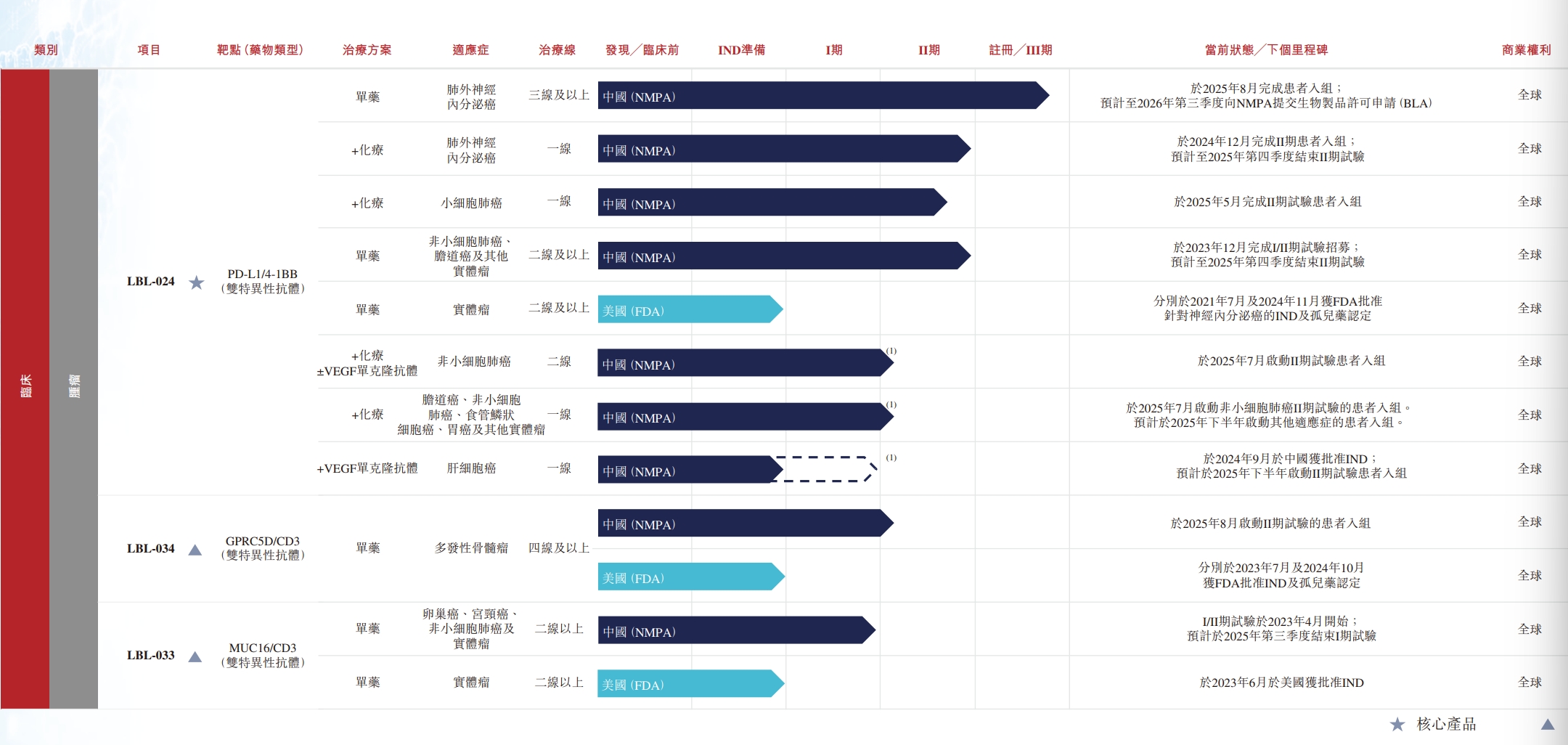
Clinical progress of some pipelines of VelociBio
In the mid - year report released recently in 2025, VelociBio also disclosed the Ib/II - phase clinical data of LBL - 024 in combination with the standard first - line chemotherapy regimen for the treatment of small - cell lung cancer: among the 52 efficacy - evaluable patients enrolled, the objective response rate was 86.5%, and the disease control rate was 96.2%. Currently, the small - scale trial shows the excellent potential of the drug's efficacy. In the future, if it can provide excellent long - term survival benefit data in a larger - scale Phase III registration clinical trial, then LBL - 024 is expected to become a cornerstone drug in the era of Tumor Immunotherapy 2.0.
In addition, in the second half of 2025, VelociBio has started or plans to start Phase II clinical studies of this drug for the treatment of non - small cell lung cancer, biliary tract cancer, hepatocellular carcinoma, etc. So, will simultaneously starting clinical trials for multiple indications bring huge R & D cost pressure?
"For LBL - 024, we plan to expand to 8 - 10 indications, but we need to pay attention to efficiency during the expansion process." Kang Xiaoqiang explained his adaptive clinical trial strategy. For example, if a cohort for an indication plans to recruit 40 patients, we don't need to wait until all the patients are recruited to evaluate the results. We may first look at the data of the first 10 patients. If none of them responds, the trial can be terminated due to ineffectiveness; if 8 out of 10 patients respond, there is no need to recruit 40 patients.
In the field of new drug development, "Fast try, Fast die" is a rational strategy. Through low - cost clinical trials for "screening," the cancer types with the greatest treatment potential of LBL - 024 can be determined, and then large - scale Phase III clinical trials with higher investment can be carried out to avoid blind investment and increase the probability of successful development.
In the landscape of tumor immunotherapy, LBL - 007, an LAG - 3 monoclonal antibody of VelociBio that was previously BD - licensed to BeiGene, is also a highly - anticipated pipeline. After terminating the cooperation with BeiGene and regaining the global development rights of the drug in May 2025, VelociBio also launched a clinical study of the combination of this monoclonal antibody and LBL - 024 in September to evaluate the effect of treating advanced melanoma. At the same time, it is still seeking cooperation opportunities with global pharmaceutical companies to accelerate the advancement of LBL - 007 in the overseas market.
Open Sources and Reduce Expenditures, Promote Multi - platform Pipelines
Currently, VelociBio is simultaneously developing 14 new drug pipelines on three technology platforms: Tumor Immunotherapy 2.0, TCE, and ADC (antibody - drug conjugate), which undoubtedly requires sufficient R & D funds.
After years of new drug R & D in the United States and experiencing the cycle changes of biotech companies, Kang Xiaoqiang believes that "a company's financing must follow the cycle. It should raise more funds at the market peak and hoard sufficient ammunition, rather than overly caring about valuation and equity dilution."
When preparing for the Hong Kong stock listing last year, he and his team also mentally prepared for "submitting the listing application multiple times if the market is bad." This year, when the market quickly recovered, he nearly doubled the fundraising amount and raised $189 million. Previously, in July and August 2021, Kang Xiaoqiang realized that the capital market was turning and increased the planned amount of Series C financing from the original 300 million yuan to 620 million yuan. This financing supported the company through four years of capital winter.
In addition to direct blood - transfusion from the capital market, BD licensing cooperation has become another key for Chinese Biotech companies to obtain cash flow. VelociBio once cooperated with BeiGene to develop LBL - 007 and received a down payment of 200 million yuan; another autoimmune TCE drug, LBL - 051, has the right to receive a down payment of $35 million and recent payments through the model of establishing a NewCo company with Aditum Bio in the United States.
"Currently, the market tends to use pre - clinical assets to establish NewCo. After cooperative development to Phase I/II of clinical trials and completing proof - of - concept, the pipeline rights are sold." Kang Xiaoqiang believes that "licensing out clinical - stage assets is not selling products but a form of cooperation. Since it is difficult for Chinese Biotech companies to conduct clinical trials and sales in the United States, global cooperation is a more efficient way."
Regarding the selection of cooperation partners, he pointed out two core dimensions: "First, they should have money; second, they should pay attention. Whether the partner truly recognizes the value of your pipeline and is willing to focus on developing your products, rather than delaying the R & D process due to accidental factors such as personnel changes."
In addition, for pipelines with the potential to become "blockbusters," whether Biotech companies should choose co - development, like the "high - stakes" model of Legend Biotech and Johnson & Johnson's joint development and sharing of commercialization results, is also worthy of discussion.
In addition to LBL - 024 mentioned above, VelociBio's TCE pipeline, LBL - 034, is also highly anticipated. This drug is the second - ranked GPRC5D - targeted TCE in terms of global clinical progress, used for the treatment of relapsed/refractory multiple myeloma. In the latest disclosed clinical data, the ORR (objective response rate) of the high - dose group of LBL - 034 reached 90%, which is comparable to that of CAR - T therapy costing one million yuan per injection, and the price is expected to be reduced by 80%.
It is understood that currently, VelociBio is trying to establish BD cooperation with leading pharmaceutical companies to increase the clinical and commercial value of LBL - 034.
In addition to opening up sources of funds, Kang Xiaoqiang believes that improving R & D efficiency is particularly important. "Maybe because we are in Nanjing, where it is relatively quiet, our R & D team is very stable. More than fifty people (the drug discovery and pre - clinical research team) have achieved many results. Sometimes, the key lies in an efficient R & D mechanism and atmosphere, rather than piling up a large amount of funds."
When talking about the current popularity of the innovative drug industry, Kang Xiaoqiang admitted that "there is a bit of a bubble," but he believes that any industry needs a bubble to grow. The key is whether the companies in it can use resources to create unique value; otherwise, the bubble will eventually burst.