Tesla has done its best in selling cars at discounted prices.
Author | Ding Mao
Editor | Zhang Fan
During the National Day holiday, Tesla launched two affordable models in the North American market, namely the Model Y Standard priced at $39,990 and the Model 3 Standard priced at $36,990.
Compared with the previous long - range versions, these two affordable models are $5,000 and $5,500 cheaper respectively, directly bringing Tesla's starting price into the range of $35,000 - $40,000.
While the prices are lowered, the configurations of the affordable Teslas have also been reduced. For example, the standard versions have cancelled the light bars at the front and rear of the car, use fabric materials for the interior, require manual adjustment of the steering wheel and exterior rear - view mirrors, and only the front seats support heating. In terms of assisted - driving configurations, both models are only equipped with the Traffic - Aware Cruise Control system and are not equipped with Tesla's Autopilot assisted - driving system.
The market doesn't seem to buy into Tesla's "price cut + configuration reduction" measures this time. After the news was released, Tesla's stock price fell by nearly 5%, and its market value evaporated by about $67 billion at one point.
So, can Tesla continue its high - sales myth with the affordable models? What is the fundamental reason for Tesla's continuous strategy of sacrificing price for volume? How much more room is there for price cuts in the future?
Affordable models struggle to continue the sales myth
Overall, the standard models launched by Tesla in the North American market this time are actually a disguised price - cut measure. By reducing some functions, Tesla lowers the prices of the existing Model 3 and Model Y to attract price - sensitive consumers with a lower purchase threshold.
Undoubtedly, the core purpose of Tesla's move is to break through the current increasingly severe pressure on sales growth. Specifically, it may be based on three considerations:
First, to hedge against the potential risk of sales decline due to price increases after the expiration of the US government subsidy ($7,500 tax credit).
Second, to regain growth in pressured markets with a more friendly price. Tesla is currently facing the pressure of slowing sales growth, especially in the Chinese and European markets. The affordable models may be the key to solving this contradiction. If calculated according to the price - cut ratio in the North American market, the domestic standard - version Model 3 would be priced at about 205,000 yuan, and the standard - version Model Y at about 235,000 yuan. This means that once the affordable models are launched in China, Tesla will directly enter the mainstream competitive price range of 200,000 - 250,000 yuan. It is expected to regain high growth in the domestic market with its brand appeal and more friendly price.
Third, to test the waters for the future low - cost models (Model 2) based on the new platform.
However, can the affordable Teslas really stand up to the competition?
Theoretically, by reducing the purchase threshold through a disguised price cut, Tesla can indeed attract the favor of some price - sensitive users, thereby expanding the scope of potential car buyers and obtaining a larger incremental market share.
But in fact, the market generally believes that due to the configuration reduction and limited price cuts this time, the standard - version Model 3 and Model Y still fall within the price range of about $35,000 - $40,000, not showing a significant gap from the long - range versions. Moreover, they are far from the "affordable revolutionary cars" in the $20,000 - $30,000 range that the market originally expected. Therefore, the attractiveness of the standard models to new users may be limited.
For the Chinese market, the customer - attracting effect of the affordable models may be further diminished.
The price range of 200,000 - 250,000 yuan is currently the most competitive segment in the domestic new - energy vehicle market. Tesla is facing formidable competitors such as BYD Han, Xiaomi SU7, XPeng P7i/G6, and LeDao L60.
In the past two years, with the intensification of product homogenization, domestic players have built a high - value - for - money barrier by "cutting prices + increasing configurations" and piling on features in terms of comfort, space, luxury, and intelligence. This has also given consumers a wider range of choices, and their expectations for products have become all - around requirements of "wanting it all".
In this context, it remains a question whether domestic consumers are willing to sacrifice the user experience to pay for Tesla's brand halo with the "stripped - down" models.
However, it is foreseeable that once Tesla enters the domestic market with the reduced - configuration affordable models, it will surely trigger fierce responses from competitors. At that time, the entire market will probably enter a new round of in - depth competition of "competing on price, configuration, and user experience".
Limited ammunition for price cuts
For a long time, benefiting from production efficiency and the direct - sales model, Tesla's profitability has far exceeded the industry average. This is not only the key factor for Tesla to maintain its leading position in the industry for a long time but also the confidence for it to initiate price competition to seize market share in the increasingly intense competitive environment.
Theoretically, Tesla's gross - profit margin higher than the industry average can be regarded as its short - term bottom line for price cuts, while its leading operating - profit margin reflects the sustainability of Tesla's price - cut strategy.
Before 2023, Tesla's gross - profit margin remained at a very high level of 20% - 25% for a long time, with an advantage of 15 - 20 percentage points compared with the average of domestic mainstream new - energy vehicle manufacturers. Even compared with domestic leading companies such as BYD, Tesla once had a gross - profit - margin advantage of about 10 percentage points.
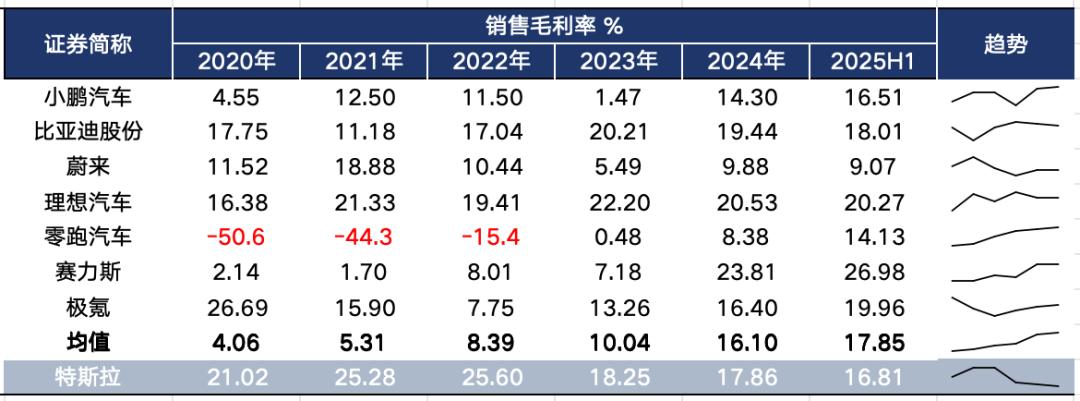
Chart: Comparison of gross - profit margins of mainstream new - energy vehicle manufacturers. Data source: Wind, compiled by 36Kr
However, since 2023, with the intensification of industry competition, in order to seize market share and maintain its leading position, Tesla has continuously launched global price wars, causing its gross - profit margin to decline all the way.
From 2023 to H1 2025, its gross - profit margins were 18.25%, 17.86%, and 16.81% respectively, a decrease of nearly 10 percentage points compared with the peak level of 25.6% in 2022. Among them, the gross - profit margin of vehicle sales has dropped from 26.2% in 2022 to 12.8%, not only hitting a new low in recent years but also showing a decline of nearly 14 percentage points.
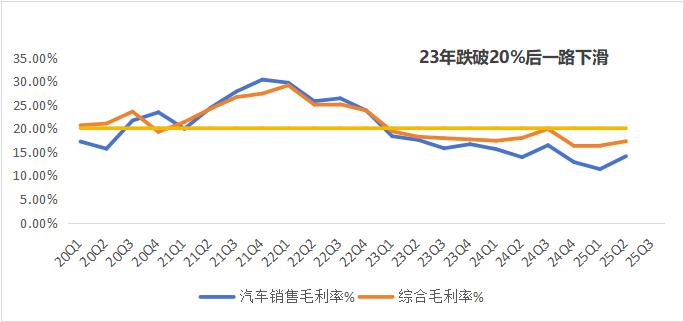
Chart: Tesla's continuous decline in gross - profit margin. Data source: Wind, compiled by 36Kr
While Tesla's gross - profit margin has been continuously declining, domestic competitors have improved their profitability in the past two years by virtue of scale, supply - chain integration, and cost - control capabilities.
From the comparison data, since 2023, Tesla's average gross - profit - margin advantage over domestic mainstream competitors has been continuously narrowing from nearly 20 percentage points to less than 2 percentage points. In the first half of 2025, it even fell behind the industry average by 1 percentage point. During the same period, compared with domestic leading car companies such as BYD and Li Auto, Tesla's gross - profit margin has been surpassed for three consecutive years.
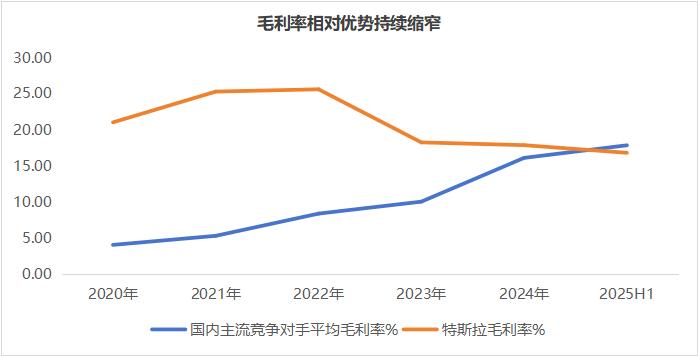
Chart: Reduction of Tesla's gross - profit - margin advantage. Data source: Wind, compiled by 36Kr
This trend indicates that Tesla's "short - term ammunition" for price cuts is rapidly running out, and its profit advantage over competitors is sharply weakening.
What's more worthy of attention is that with the continuous decline in gross - profit margin and the huge R & D expenses for new - model development, autonomous driving, Robotaxi and other services, Tesla's operating - profit margin, which better reflects its real profitability, has also dropped sharply. In the first half of 2025, Tesla's operating - profit margin narrowed to 3.4%, a decline of more than 13 percentage points compared with the peak of 17% in 2022, posing a severe challenge to the sustainability of its future price cuts.
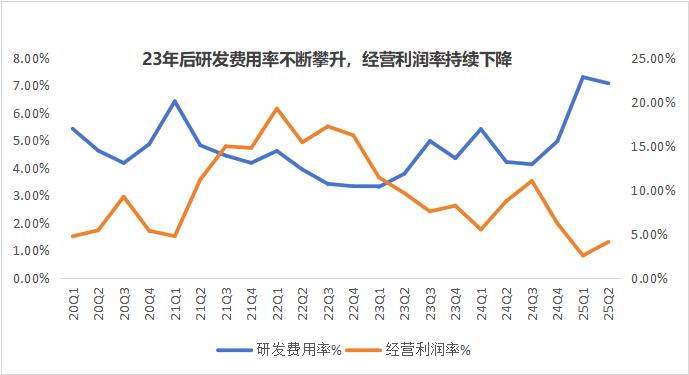
Chart: Tesla's continuous increase in R & D expense ratio and decline in operating profit. Data source: Wind, compiled by 36Kr
After all, once Tesla's operating profit is in trouble, it means that it cannot support its daily operations through self - financing. At the same time, it will directly weaken its investment ability in FSD, AI, and the next - generation platform, thus impacting the foundation of its long - term strategy.
Why is it so important to cut prices to maintain sales?
Since the price - cut strategy has continuously worsened Tesla's financial performance, why does Tesla still try to sacrifice price for volume?
The most fundamental reason is that vehicle sales are the direct means for Tesla to defend its scale and cost - leading advantages.
As the global electric - vehicle market has shifted from "supply falling short of demand" to a stock - competition stage, the market environment has deteriorated sharply. Chinese automakers represented by BYD, Xiaomi, NIO, XPeng, and Li Auto have continuously seized market share with their supply - chain advantages, scale effects, more competitive prices, more attractive configurations, and faster iteration cycles. In particular, the acceleration of their overseas expansion has directly impacted Tesla's sales in the Chinese and European markets.
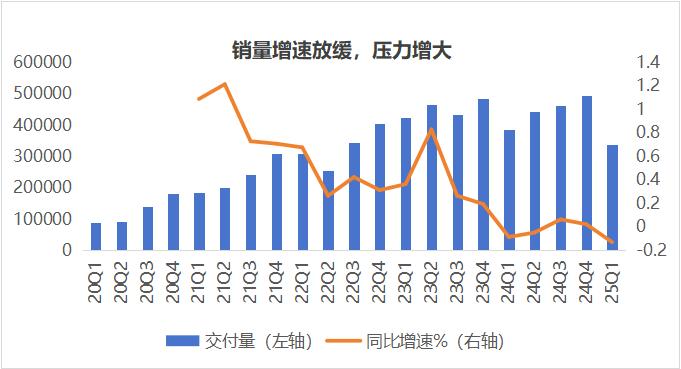
Chart: Slowdown in Tesla's sales growth. Data source: Wind, compiled by 36Kr
In this context, price cuts have become a necessary means for Tesla to defend its market position and respond to challenges.
The automobile - manufacturing industry is a typical capital - intensive industry. Whether it is the construction of super - factories or the continuous iteration of vehicle platforms, it faces huge cost inputs. This typical characteristic makes automobile manufacturers highly dependent on scale effects to make a profit. Only through continuous sales growth can the cost be effectively spread, resulting in a marginal decrease in unit cost and thus maintaining a relatively high gross - profit level.
Meanwhile, high sales volume is also the key for automakers to maintain a strong voice in the supply chain. Bargaining power is directly related to the material - procurement cost of automakers and is a decisive factor in obtaining long - term cost advantages.
In other words, for automakers, the higher the sales volume, the more obvious the cost advantage, the greater the probability of obtaining long - term and stable profitability, and the more stable the survival space. This is also the main reason why Tesla is willing to use its relatively high gross - profit margin as "ammunition" to accelerate the reshuffle of the industry through price cuts, sacrificing short - term profits to lock in future market share.
In addition, more importantly, the sales volume of automobile hardware also directly determines whether Tesla's long - term technology narrative can hold true.
The reason why Tesla can obtain a valuation far exceeding that of traditional automakers is actually the market's over - pricing of its identity as an "energy - technology giant". Innovative services such as Robotaxi are the key to maintaining its technology label.
In the long run, the continuous expansion of vehicle sales is the foundation for supporting the grand narrative of Robotaxi.
On the one hand, the larger Tesla's vehicle sales volume, the larger its user base, which will directly drive the expansion of software - service businesses such as FSD subscription revenue, laying the foundation for the future commercialization of Robotaxi. In fact, in the past two years, with the growth of vehicle ownership, the growth rate of Tesla's FSD revenue has accelerated, far exceeding that of vehicle sales during the same period. (Note: Tesla does not directly disclose FSD - related revenue, but its deferred - revenue balance is mainly the unrecognized part related to FSD, Internet connection, free Supercharger use, and software updates.)
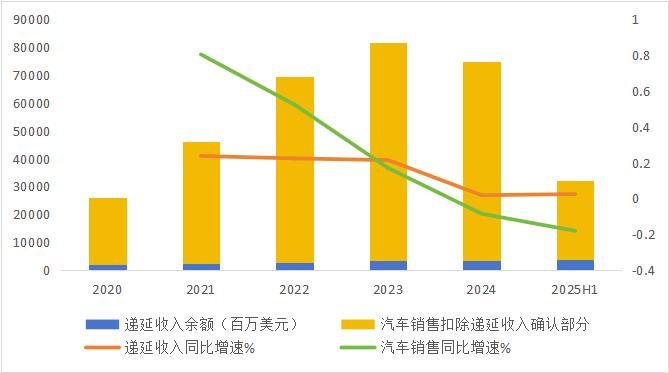
Chart: Changes in Tesla's FSD - related revenue. Data source: Wind, compiled by 36Kr
On the other hand, the progress of the Robotaxi service depends on users' trust and acceptance, which highly depends on the reliability of Tesla's autonomous - driving technology. The FSD system requires a large amount of real - world driving data for training and improvement. As the channel for data growth, only by selling more vehicles can a large amount of diverse driving data be accumulated to ensure the evolution of FSD technology.
Therefore, for Tesla, sales volume is not only directly related to its leading position in the new - energy vehicle industry but also an important link for it to break away from the label of "automobile manufacturer" and move towards becoming an "energy - technology giant", as well as the key to maintaining a high valuation in the capital market.
In view of this, as long as the long - term technology narrative holds true, Tesla will have the motivation to sacrifice price for volume. The short - term pressure on gross - profit margin and operating - profit margin is the necessary "strategic cost" it pays to lock in future market share and the energy - technology valuation logic.
*Disclaimer:
The content of this article only represents the author's views.
The market is risky, and investment should be made with caution. In any case, the information in this article or the opinions expressed do not constitute investment advice for anyone. Before making an investment decision, if necessary, investors must consult professionals and make decisions carefully. We have no intention of providing underwriting services or any services that require specific qualifications or licenses for the trading parties.