Is the debate between gasoline and electric vehicles nearing its end?
"I just checked the new energy vehicle penetration rate data from last week. It exceeded 60% for the first time, reaching a new high. When will it exceed 80%?"
On September 9th, Beijing time, He Zhiqi, the executive vice president of BYD, wrote such a passage on his personal Weibo. The accompanying picture shows the corresponding new energy vehicle penetration rates over the past eight weeks.
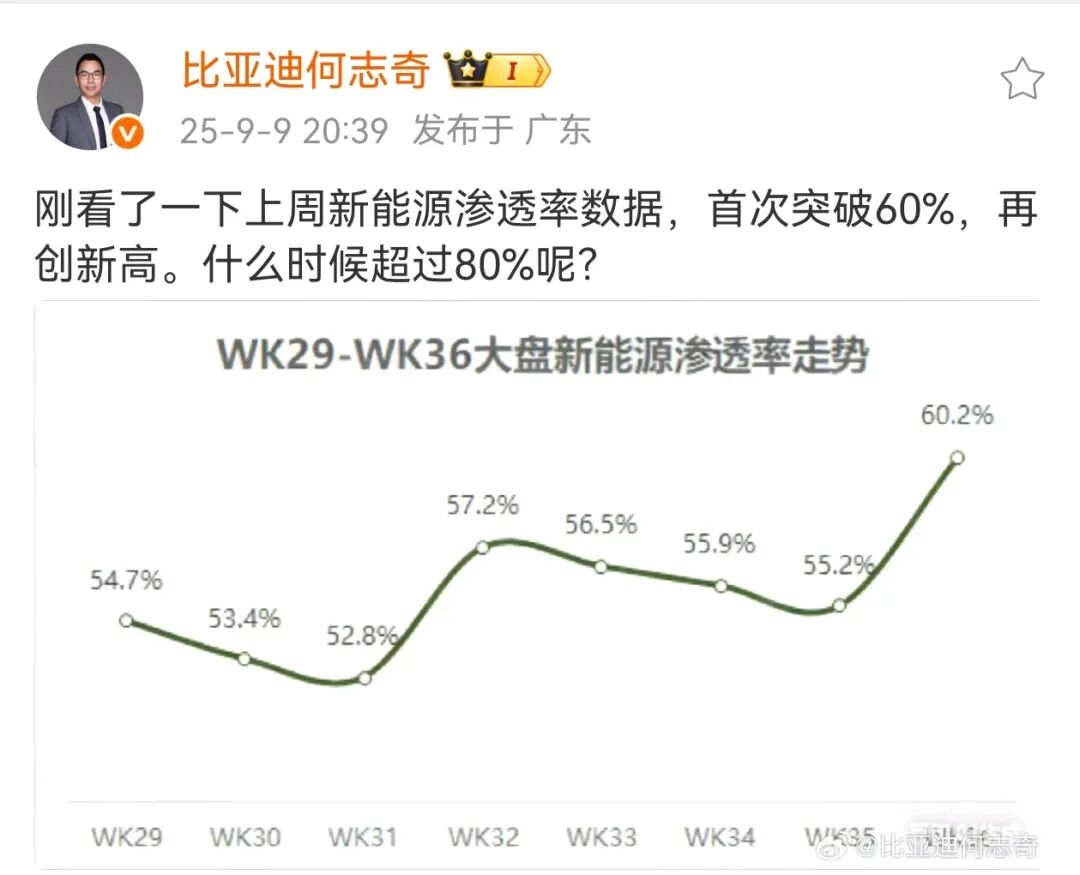
Looking at the entire curve, although there have been some fluctuations, the overall trend is undoubtedly upward. Now that this key data has officially crossed the 60% mark, what does it prove?
The title of today's article is the answer I'm giving.
Actually, just looking at the situation in the entire Chinese auto market in the first half of the year, traditional fuel-powered vehicles were still putting up a tough fight and showed strong resilience. The new energy vehicle penetration rate hovered around 50%.
However, in the second half of the year, the situation changed dramatically. Just as mentioned at the beginning, after a fierce "tug-of-war," the decline of traditional fuel-powered vehicles became obvious.
As for the fundamental reason behind this, the all-round improvement in the product strength of new energy vehicles, which has firmly captured the minds of more end consumers, undoubtedly accounts for a large proportion. In the face of direct competition, the shortcomings of traditional fuel-powered vehicles have been more thoroughly exposed.
The other part is because they can no longer afford the losses. You know, in the first half of the year, the key reason they were able to put up a fight and even hold their own against new energy vehicles was the "heavily discounted" average transaction price.
Take last month, August, as an example. According to relevant statistics from the Passenger Car Association, the promotion intensity of traditional fuel-powered vehicles reached 22.9%, while that of new energy vehicles was only 10.7%. It's obvious who is over - exploiting their resources.
From the perspective of traditional fuel-powered vehicle manufacturers, this way of "harming oneself by a thousand to injure the enemy by eight hundred" is really becoming unaffordable. But at this critical moment, if they withdraw the preferential policies, their existing market share will be quickly snatched by new energy vehicles.
Once sales slump, it will lead to cost amortization problems in the R & D and manufacturing sectors, further damaging the company's overall operation. Many of their dealers will also be severely impacted.
Anyway, traditional fuel-powered vehicles this year seem to be caught in a helpless "vicious cycle." To slow down the pace of their decline, they have to trade profits for time.
Looking at the sales rankings at all levels, even though there are still some so - called "established players" that are still popular among consumers, only they know how much they have sacrificed to achieve high sales.
An even more intuitive sign is that many 4S stores have "defected" and are wisely joining the wave of embracing new energy vehicles. At the same time, some clear - headed joint - venture brands have also significantly accelerated their electrification transformation relying on the Chinese local system, and have begun to show initial results.
Considering all these signals, whether we admit it or not, I believe all industry participants can feel that "the end of the battle between fuel - powered and electric vehicles is not far away."
Especially now with the arrival of the "Golden September and Silver October," as car manufacturers continue to increase their efforts in launching new models and promotions, it's almost no challenge for the monthly new energy vehicle penetration rate to approach or exceed 60%. A long time ago, Wang Chuanfu, the chairman of BYD, made a similar prediction, which has now been verified.
In contrast, Li Bin, the CEO of NIO, once thought this data had a chance to reach 70%. All I can say is: "It's a bit difficult, but not impossible."
Because there is a "tipping point" that cannot be ignored. The exemption from purchase tax for new energy vehicles will continue to be "phased out" after this year.
According to the policy, for new energy vehicles purchased between January 1, 2026, and December 31, 2027, the tax - exemption limit will be halved from 30,000 yuan to no more than 15,000 yuan.
From the perspective of consumers, this will undoubtedly directly lead to a significant increase in their purchase costs.
Based on this background, it's completely predictable that in order to continue to enjoy this year's purchase - tax exemption, the demand for new energy vehicles from first - time buyers, those looking to add a vehicle, and those wanting to replace their cars will surely skyrocket.
After the "Golden September and Silver October," the remaining two months will be the real climax. The crushing of traditional fuel - powered vehicles will reach an unprecedented level.
Seeing this, some may question: "With the phasing out of policies, won't new energy vehicles, which have briefly reached the peak, return to their original state?"
In my opinion, "a short - term decline in sales is inevitable, but if we look at the long - term, the herd effect in the Chinese auto market is becoming more and more significant."
The acceptance of new energy vehicles among the main consumer group is rising much faster than expected. As they spread the word, it's only a matter of time before the remaining holdouts are convinced.

From the perspective of car manufacturers, it's obvious where the future lies. Next year, they will definitely step up their efforts and continue to iterate.
In terms of supply, compared with traditional fuel - powered vehicles, which are like "the setting sun," there are far more new energy vehicle products for consumers to choose from. The decline in the cost of power - battery raw materials also gives new energy vehicles more confidence and room to engage in "price wars" and reshape the pattern of various market segments.
In short, new energy vehicles have all the advantages of timing, location, and human harmony.
In an article this month, I once wrote: "When the new energy vehicle penetration rate steadily crosses the 50% mark, new energy vehicles have won the decisive battle like the crossing of the Yangtze River."
So, what about breaking through 60%, crossing 70%, or even reaching higher levels?
The answer is very simple. The complete victory is just around the corner. After winning the decisive battle that determines the outcome, the remaining battles are just about taking over the remaining territories.
Of course, if you continue to ask when traditional fuel - powered vehicles will bid farewell to the Chinese auto market?
I still hold the view that: "Due to the large user base and diverse usage scenarios, they definitely won't disappear completely. But as time goes by, they will probably shrink to a very small share, say around 10%. New energy vehicles relying on the three technical paths of pure - electric, plug - in hybrid, and extended - range will divide up the delicious 90%."
By then, the battle between fuel - powered and electric vehicles will finally come to an end.
This article is from the WeChat official account "Automobile Commune" (ID: iAUTO2010). The author is Cui Liwen. It is published by 36Kr with permission.